Topic Summary
E-Commerce License Suits Pure Digital Sellers
An e-commerce license in Dubai authorises sales exclusively through websites, apps, and online marketplaces — no physical retail counter is permitted. Founders running Instagram shops or Shopify storefronts with no walk-in customers are a textbook fit for this license type.
Commercial License Unlocks Physical and Online Trading
A commercial license covers both offline and online sales, including import, export, B2B wholesale, and physical retail distribution. Businesses supplying a Dubai Mall kiosk alongside a website need this broader license to stay compliant.
Dubai South Offers Fast, Low-Cost E-Commerce Setup
Dubai South Business Hub Free Zone licenses start from AED 12,500. This removes a real cash-flow barrier for early-stage founders launching digitally.
Activity Codes Determine License Scope, Not Channel
Under ISIC Rev.4 classification, e-commerce is not a standalone sector — the license activity is defined by the type of goods or services sold, not the digital channel used. A founder selling cosmetics online holds a cosmetics retail license, not a generic 'e-commerce' license.
Extra Activities Add Cost Beyond the First Five
At Dubai South Business Hub Free Zone, each business activity beyond the first five costs an additional AED 2,000. Founders should map their full list of intended activities before choosing a license type to avoid unexpected fees.
Free Zone Licenses Restrict Direct UAE Physical Retail
Free zone commercial license holders who want to sell directly to UAE consumers through physical retail must work through a mainland entity or a licensed local distributor. This restriction applies across all UAE free zones, not just Dubai South.
Tax Registration Penalties Can Catch New Founders Off Guard
Late VAT or corporate tax registration each triggers a one-time AED 10,000 penalty from the Federal Tax Authority. Founders should factor compliance timelines into their setup plan from day one, regardless of which license type they choose.
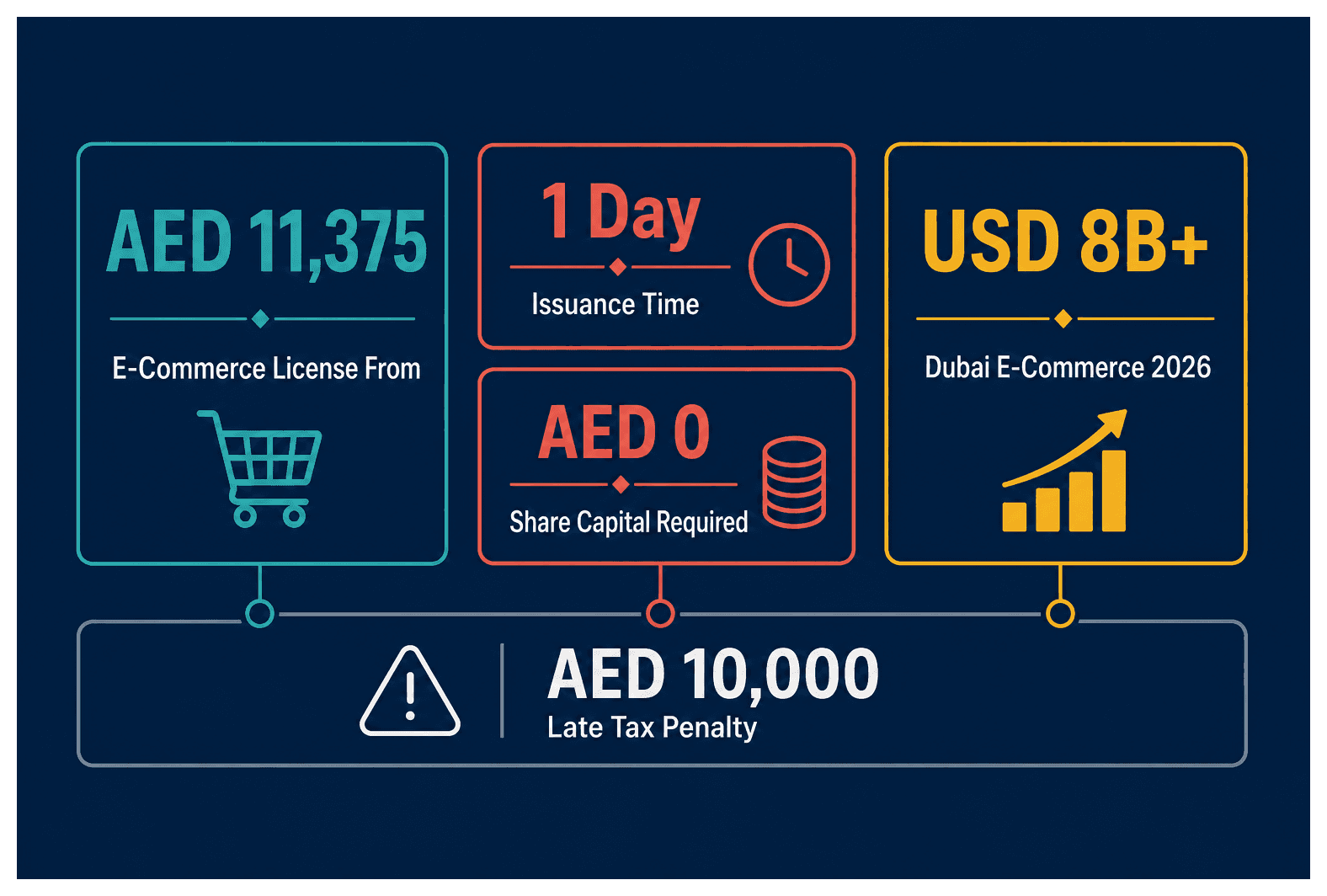
In 2026, Dubai's e-commerce sector is projected to surpass USD 8 billion in annual transaction value (Statista, 2026). The UAE ranks among the top 20 global e-commerce markets by per-capita spend. Dubai South Business Hub Free Zone (DSBH) issues e-commerce licenses from AED 12,500, with a one-day issuance timeline. Zero paid-up share capital is required. Late VAT or corporate tax registration each triggers a one-time AED 10,000 penalty (Federal Tax Authority, 2026). Yet the single most common mistake first-time founders make is choosing the wrong license before their first sale.
This article breaks down the e-commerce license vs commercial license in Dubai comparison across cost, permitted scope, visa impact, and real-world fit. You'll get a clear recommendation for each founding scenario, not a fence-sitting summary.
What Is an E-Commerce License vs Commercial License in Dubai
An e-commerce license in Dubai authorises online-only sales of goods or services through digital channels. A commercial license permits both physical and online trading. The key difference is scope: a commercial license covers walk-in retail and B2B supply chains, while an e-commerce license restricts trading to digital storefronts and platforms.
Defining the E-Commerce License
An e-commerce license is issued for businesses that sell products or services exclusively through websites, apps, or online marketplaces. No physical retail counter is permitted under this activity code alone. Worth flagging: under ISIC Rev.4, e-commerce is not a standalone category. The license activity is classified by the type of goods or services sold, not the digital channel used (UN Statistics Division, 2008). So a license to sell cosmetics online is classified under cosmetics retail, not "e-commerce" as a sector.
Dubai South Business Hub Free Zone licenses start from AED 12,500. The license is issued in one day. Zero paid-up share capital is required, which removes a genuine cash-flow barrier that trips up many early-stage founders. DSBH launched in September 2025, so these figures reflect its current published pricing.
A founder selling handmade skincare products through an Instagram shop and a Shopify storefront, no warehouse counter, no walk-in customers, is a textbook e-commerce license holder. The digital channel is the entire business model, and the license reflects that cleanly.
Defining the Commercial License
A commercial license covers buying and selling of goods, both online and offline, and typically includes import, export, and physical distribution activities. On the mainland, DET (Dubai's Department of Economy and Tourism) issues commercial licenses. In free zones, the relevant free zone authority issues them, with activities scoped to that zone's permitted list.
A commercial license generally allows more activity codes, including physical retail, B2B wholesale, and direct supply to UAE distributors. An e-commerce license alone does not cover these channels. Additional activities beyond the first five cost AED 2,000 each at DSBH, so founders should map their full list of business activities in Dubai before choosing a license type.
An electronics importer supplying both a Dubai Mall kiosk and a website needs a commercial license to cover the physical retail element. The e-commerce activity alone would not be sufficient for that model. Free zone commercial licenses also require a mainland entity or licensed local distributor for any direct physical retail to UAE consumers, that's not a DSBH-specific restriction; it applies across UAE free zones.
E-Commerce License vs Commercial License in Dubai: Head-to-Head Comparison
Feature | E-Commerce License | Commercial License |
|---|---|---|
License fee at DSBH (starting price) | From AED 12,500 | Varies by activity list; AED 2,000 per activity beyond first five |
Physical retail permitted | No, digital channels only | Yes, showroom, kiosk, and walk-in retail permitted |
Online sales permitted | Yes, website, app, and marketplace sales | Yes, online and offline sales both permitted |
Import/export activity codes | Not typically included; may require additional activity codes | Included as standard for trading businesses |
UAE mainland direct retail | Requires mainland entity or licensed distributor | Requires mainland entity or licensed distributor (free zone rule) |
Visa sponsorship | Yes, visa fees always charged separately | Yes, visa fees always charged separately |
Paid-up share capital (DSBH) | Zero required | Zero required at DSBH |
Side-by-Side Comparison: Cost, Scope, Visas, and Best Fit
Comparing an e-commerce license vs a commercial license in Dubai shows that e-commerce licenses are lower cost and faster to obtain, while commercial licenses offer broader scope including physical retail. Both can sponsor visas, but visa fees are always an additional cost on top of the license fee regardless of license type.
Cost Breakdown at a Glance
At DSBH, the cost picture breaks down like this:
B2C e-commerce license: from AED 12,500
Broader e-commerce license: from AED 12,500
First-year package for a sole founder with one visa: from AED 18,350
Each activity beyond the first five: AED 2,000 per activity
Visa fees (medical fitness, Emirates ID, ICP stamping): always additional, never bundled
A solo founder launching a dropshipping business with two visa quotas would calculate: license fee (AED 12,500) plus two investor visas at prevailing ICP rates. That's never a flat bundled figure. Mainland commercial licenses carry DET registration fees, notarisation costs, and Ejari if a physical office is required, these can push first-year costs materially higher than the free zone equivalent.
Scope and Activity Permissions Compared
The e-commerce license covers digital sales only, products, services, or both, but no physical retail counter. It suits D2C brands, online marketplaces, and digital service providers. The commercial license covers physical and digital trading, import/export, B2B wholesale, and distribution. It suits businesses that need to supply UAE-based retailers or operate a showroom.
A furniture brand selling exclusively on its own website and via noon.com needs only an e-commerce license. The same brand opening a showroom in Business Bay needs a commercial license covering physical retail. Neither license type at a free zone automatically grants access to the UAE mainland retail market, that requires a mainland entity or a licensed local distributor. DSBH is not a designated zone, so no special customs or VAT concessions apply. Free zone goods are duty-suspended, not duty-exempt.
Visa Quota and Residency Impact
Both license types at DSBH can be linked to UAE residency visa packages. The visa quota depends on the license package chosen, not the license type itself. Visa fees are charged separately, founders must budget for medical fitness, Emirates ID, and ICP stamping fees on top of the license cost.
100% foreign ownership is available for both e-commerce and commercial licenses on the free zone route and is also available on the mainland (u.ae, 2024, still accurate as of 2026). It is not a free zone exclusive. A founder from Germany setting up a B2C fashion brand can hold 100% ownership of an e-commerce entity at DSBH and sponsor a spouse visa, but the spouse visa fee is a separate line item, not covered by the license fee.
Tax and VAT Obligations for Each License Type
Both e-commerce and commercial license holders in Dubai are subject to UAE VAT at 5% if annual taxable turnover exceeds AED 375,000, and to corporate tax at 9% on taxable income above AED 375,000. Late VAT or corporate tax registration each carries a one-time AED 10,000 penalty.
Corporate Tax: What Both License Types Face
The UAE corporate tax rate is 9% on taxable income above AED 375,000. This applies to both e-commerce and commercial license holders regardless of free zone or mainland location, unless Qualifying Free Zone Person (QFZP) conditions are met. Never assume 0% applies automatically.
A 0% corporate tax rate is available only to entities that satisfy all four QFZP conditions: adequate substance in the UAE, qualifying income, no mainland business, and compliant transfer pricing (Federal Tax Authority, 2026). If any condition is unmet, the 9% rate applies. Late corporate tax registration carries a one-time flat penalty of AED 10,000, it is not a monthly recurring charge.
Here's a concrete example: a free zone e-commerce company earning AED 600,000 in net profit that has not confirmed QFZP status will owe corporate tax at 9% on AED 225,000, the slice above the AED 375,000 threshold. That's AED 20,250 in tax that many founders don't budget for. Always evaluate QFZP eligibility with a qualified tax adviser before your first taxable year closes.
VAT Registration and Compliance
Mandatory VAT registration threshold: AED 375,000 in annual taxable turnover
Voluntary registration available from: AED 187,500
VAT rate on taxable supplies: 5%
Late VAT registration penalty: AED 10,000 (one-time)
E-commerce sales to UAE customers are taxable supplies. Selling online does not create a VAT exemption. An online clothing store hitting AED 400,000 in UAE sales within its first year must register for VAT immediately, the digital channel offers no exemption from the obligation. Founders should register early if growth is fast; retroactive VAT liability can be significant for a scaling D2C brand.
Is a free zone license automatically tax-exempt?
No. Free zone entities are not exempt from UAE VAT or corporate tax by virtue of free zone location alone. DSBH is not a designated zone, so no designated-zone VAT or customs benefit applies. QFZP status must be assessed independently against the four published conditions set by the Federal Tax Authority.
Five Steps to Choose the Right License for Your Dubai Business
To choose between an e-commerce license and a commercial license in Dubai, map your sales channels, check mainland access needs, list all required activity codes, calculate total first-year cost including visas, and confirm regulated-activity approvals. Five structured steps prevent the most common and costly setup errors.
Step 1: Map Your Sales Channels and Customer Location
If 100% of your revenue will come through a website, app, or marketplace with no physical retail touchpoint, an e-commerce license is the correct starting point. If any revenue stream involves a physical counter, showroom, or direct supply to UAE mainland retailers, a commercial license is required, or an e-commerce license plus a separate mainland entity.
Customer geography matters too. Selling exclusively to overseas buyers from a free zone is structurally different from selling primarily to UAE-resident consumers through a local platform. A SaaS founder selling software subscriptions globally through a payment gateway, no physical office, no local retail, maps cleanly to an e-commerce license.
Step 2: List Every Activity You Need and Check the Cost
Use the DSBH business activities list to identify your exact activity codes before applying. The first five activities are included in the license fee. Each additional activity costs AED 2,000. A commercial license with eight activities will cost AED 6,000 more in activity fees than a license with five, map this before committing to a license type.
Regulated activities (selling food supplements or financial products online, for example) require both the DSBH license and separate approval from the named regulator. DSBH licenses the activity; the regulator approves it. A health-supplement e-commerce brand needs both the DSBH e-commerce license and approval from the relevant health authority, the license alone is not sufficient to sell regulated products.
Step 3: Calculate Total First-Year Cost Including Visas
The license fee is only one component. Add visa fees (medical fitness, Emirates ID, ICP stamping), any activity add-on fees, and professional services costs to get a true first-year figure. Use the Dubai free zone company setup cost calculator to model your specific configuration. A sole founder with one visa at DSBH starts from AED 18,350 all-in for the first year.
A founder budgeting AED 12,500 for an e-commerce license and expecting that to cover everything will be surprised when ICP visa fees, Emirates ID, and medical costs add several thousand dirhams to the bill. Founders who budget on license fee alone routinely underestimate first-year setup costs.
Step 4: Confirm Mainland Access Strategy
A free zone e-commerce or commercial license does not automatically allow direct retail to UAE mainland end consumers through a physical store. A mainland entity or licensed distributor arrangement is required (u.ae, 2024, still accurate as of 2026). This is not a DSBH-specific restriction; it applies across UAE free zones.
If mainland retail is a near-term plan, factor in the additional cost and timeline of a dual-entity structure from the outset. A fashion brand planning to open a pop-up in a Dubai mall within 18 months should structure a mainland commercial entity from day one rather than scrambling to restructure later. For purely digital, cross-border, or export-focused businesses, free zone licensing is typically the simpler and more cost-effective route.
Clear Recommendations by Founder Scenario
Choose an e-commerce license if you sell exclusively online, ship direct to customers, and have no immediate need for a physical UAE retail presence. Choose a commercial license if you need physical distribution, mainland wholesale supply, or a showroom. Most digital-first founders launching in 2026 will find the e-commerce license both sufficient and more cost-effective.
Choose an E-Commerce License If You Fit These Profiles
D2C brand selling through your own website or a third-party marketplace (Amazon.ae, noon.com) with no physical retail counter.
Digital service provider, software, consulting, design, billing clients globally through online invoicing.
Dropshipper or print-on-demand operator with no UAE warehouse requirement (DSBH does not provide bonded warehousing or customs integration).
Dubai South Business Hub Free Zone licenses start from AED 12,500.
A graphic designer based in Dubai selling brand identity packages to clients in Europe and Australia entirely via online proposals and digital delivery, this is a clean e-commerce license use case. No physical touchpoint, no local retail, no import/export codes needed.
Choose a Commercial License If You Fit These Profiles
Importer supplying goods to UAE supermarkets, retailers, or distributors, physical transfer of goods to local third parties requires commercial trading activity codes.
Brand with a physical showroom or retail outlet as part of the business model from launch.
Business with a long activity list spanning both physical and digital channels, the commercial license provides broader scope without needing a dual-entity structure.
Operator needing import/export activity codes alongside online sales, a trading license in Dubai covering both channels is more appropriate than a pure e-commerce license.
A food and beverage importer distributing to UAE hotels and restaurants while also running an online B2B ordering portal needs a commercial license. The e-commerce license alone does not cover direct supply to local trade buyers. Each additional activity beyond the first five costs AED 2,000, so map your full list before applying.
Regulated Activities: What Both License Types Must Do Differently
Any e-commerce or commercial license covering a regulated activity in Dubai requires two approvals: the free zone authority issues the trade license, and the named sector regulator, such as the health authority for supplements or the Central Bank for financial products, must grant its own separate approval before trading can begin.
Which Activities Trigger a Second Approval
Health supplements and medical devices: DSBH licenses the activity; the relevant health authority approves the product and operator separately.
Financial services or investment products sold online: DSBH licenses the activity; the Central Bank of the UAE or the relevant authority must approve the operator and product.
Education or training delivered online: DSBH licenses the activity; KHDA or the relevant emirate-level authority must approve the curriculum and provider.
Food products sold via e-commerce: Dubai Municipality or the relevant food safety body approves the product and premises separately.
An online pharmacy wanting to sell prescription medications via an app needs both the DSBH e-commerce license and full licensing from the relevant health authority. The trade license is the starting point, not the finish line. DSBH's one-day issuance applies to the trade license only, regulator approvals operate on their own timelines, sometimes running to weeks or months.
How to Identify Your Regulatory Requirements Before Applying
Review the DSBH business activities list and cross-reference each activity code with the relevant UAE regulator's published licensing requirements. Build the regulator approval timeline into your launch plan, some approvals cannot be fast-tracked by the free zone, regardless of how quickly the trade license is issued. Budget separately for regulatory fees, which are charged by the regulator and are not part of the DSBH license fee.
A founder of an online financial advisory platform should contact both DSBH for the trade license and the relevant financial regulator before signing any client contracts. Operating without both approvals is a compliance risk. If you're in tech or software, an Statista
Frequently Asked Questions