
Topic Summary
Know the Three-Level Grievance System
UAE grievance procedures operate at three escalating levels: internal HR resolution, MOHRE complaint filing, and Labour Court escalation. Each level is more expensive and time-consuming than the last, making early internal resolution critical for employers.
Written Policy Is a Legal Requirement
Under Federal Decree-Law No. 33 of 2021, every UAE employer must provide employees with a documented grievance mechanism, not just a best-practice HR document. Employers with 50 or more staff face additional obligations under MOHRE Executive Regulations, including posting the policy in Arabic.
Retaliation Carries Serious Financial Penalties
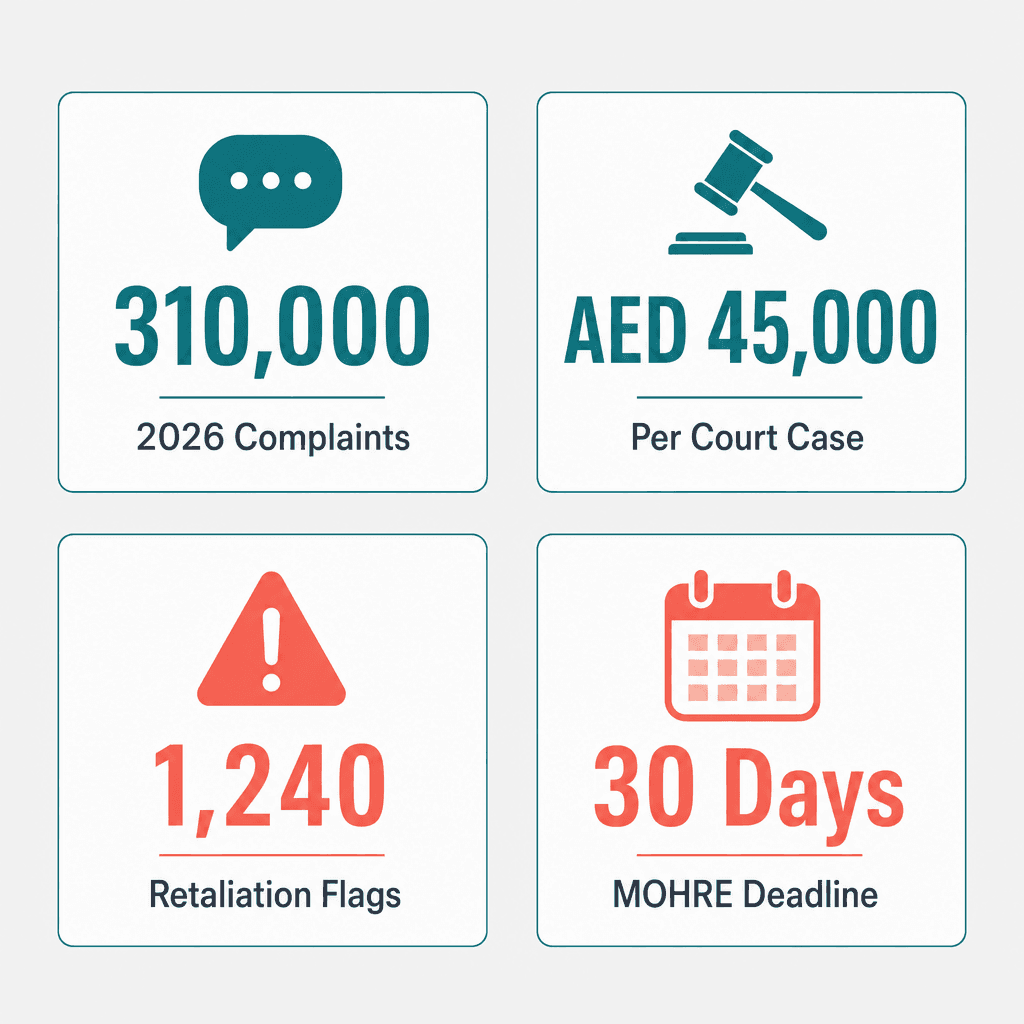
MOHRE flagged 1,240 employers for retaliatory employment actions in 2025 alone, and Article 47 mandates a minimum of three months' gross salary in compensation for retaliatory dismissal. An Abu Dhabi retail case illustrates the risk: one retaliatory termination cost the employer AED 30,500 in combined awards and legal fees.
Unresolved Disputes Are Extremely Costly
Cases that escalate to the Labour Court cost UAE businesses an average of AED 45,000 per case when legal fees, productivity loss, and reputational damage are factored in. A single undocumented grievance from a warehouse supervisor cost one Dubai logistics firm AED 20,000 in penalties plus a mandatory court hearing.
The 30-Day Filing Window Is Non-Negotiable
Employees must file a complaint with MOHRE within 30 days of the grievance event, unless the issue is ongoing such as repeated wage delays. Employers who resolve complaints internally and document the outcome can use that record as a legal defence if a MOHRE filing still follows.
All Private-Sector Workers Are Protected
UAE Labour Law covers all private-sector employees regardless of nationality, and free zone workers generally fall under MOHRE rules unless their specific free zone operates its own tribunal. This broad scope means employers cannot assume any category of worker is exempt from grievance protections.
In 2026, MOHRE received over 310,000 individual labour complaints across the UAE. Unresolved disputes cost UAE businesses an average of AED 45,000 per case when escalated to the Labour Court, factoring in legal fees, productivity loss, and reputational damage (UAE Ministry of Economy, 2026). MOHRE flagged 1,240 employers for retaliatory employment actions in 2025 alone. Every one of those cases could have been contained at the internal HR stage.
An employee grievance procedure UAE is a legal requirement under Federal Decree-Law No. 33 of 2021, not a nice-to-have HR document. This guide gives you the exact internal policy requirements, MOHRE portal steps, Labour Court timelines, and employer obligations you need to stay compliant and protect your business from costly disputes. For a broader overview of your regulatory obligations, start with our MOHRE inquiry system UAE guide. For more detail, see our guide on how to resolve a labour dispute in Dubai.
1. UAE Labour Law and Employee Grievances
Under Federal Decree-Law No. 33 of 2021, every UAE employer must provide employees with a clear mechanism to raise workplace complaints. The law mandates that employers respond to grievances in good faith, and failure to do so entitles the employee to file directly with MOHRE within 30 days of the incident.
What Is an Employee Grievance Procedure UAE
An employee grievance procedure UAE is a formal, documented channel that allows workers to raise complaints about pay, treatment, working conditions, or contract violations. It's not just a policy document, it's your first line of legal defence. Without one, you have nothing to present to MOHRE when a complaint lands.
The system operates across three distinct levels. First, an internal HR grievance handled within your business. Second, a MOHRE complaint filed at mohre.gov.ae. Third, UAE Labour Court escalation if MOHRE's amicable settlement fails. Each level carries different timelines and costs, and each one is more expensive than the last. For more detail, see our guide on UAE labour complaint process.
Federal Decree-Law No. 33 of 2021, effective February 2, 2022, replaced the old Labour Law and significantly strengthened employee rights. Retaliatory termination now carries a minimum compensation of 3 months' gross salary under Article 47. A Dubai-based logistics firm with 40 staff learned this the hard way: no written grievance policy, a warehouse supervisor's MOHRE complaint over unpaid overtime, no documentation to present, and a AED 20,000 penalty plus a mandatory Labour Court hearing.
House supervisor's mohre complaint over unpaid overtime
No documentation to present
A aed 20,000 penalty plus a mandatory labour court hearing
Key Employee Rights Under UAE Labour Law
Employees have the right to raise a grievance without facing adverse employment action. Article 47 of Federal Decree-Law No. 33 of 2021 specifically protects against retaliatory dismissal, and MOHRE enforces this actively. The scope of protected complaints is broad: wage non-payment, unsafe working conditions, discrimination, and contract violations are all covered.
The 30-day window matters. Employees must file with MOHRE within 30 days of the grievance event unless the matter is ongoing (such as persistent wage delays). UAE Labour Law applies to all private-sector employees regardless of nationality. Free zone employees follow MOHRE rules unless their specific free zone operates its own tribunal.
An Abu Dhabi retail chain dismissed a cashier one week after she raised a pay dispute internally. MOHRE ruled the termination retaliatory and awarded the employee 3 months' compensation plus unpaid wages totalling AED 18,500. The employer's legal costs added another AED 12,000 on top.
2. Internal Grievance Policy Requirements in UAE
UAE employers with 50 or more employees must maintain a written grievance and disciplinary policy under MOHRE Executive Regulations. The policy must be posted in Arabic, include a named point of contact, and set a maximum 5-business-day response window. Companies under 50 staff are strongly advised to maintain one regardless, MOHRE inspectors treat the absence of any written policy as a compliance risk at any company size.
What Your Internal Grievance Policy Must Include
Your employee complaint process UAE policy needs these six components to pass a MOHRE audit:
A Sharjah manufacturing company with 120 employees published their grievance policy only in English. During a MOHRE audit in 2025, the absence of an Arabic version triggered a formal warning and a 30-day remediation deadline. The fix cost them two weeks of HR time and a translation fee, far cheaper than a penalty, but entirely avoidable.
Documenting and Storing Grievance Records
All grievance submissions, investigations, outcomes, and appeals must be retained for a minimum of 5 years. Digital records are accepted, MOHRE's Tasheel system integrates with employer HR records, making digital storage the practical standard for most businesses.
Failure to produce records during a MOHRE inspection can result in fines starting at AED 1,000 per missing document. During a 2025 MOHRE audit of a Dubai hospitality group, the company presented complete digital grievance logs through Tasheel. The inspector closed the case within 48 hours with no penalty. Link your grievance records to your wage protection system UAE compliance files to demonstrate payment compliance alongside complaint resolution.
3. MOHRE Complaint Portal Process
An employee files a MOHRE grievance UAE at mohre.gov.ae or via the MOHRE smart app. MOHRE assigns a labour inspector within 3 business days, schedules an amicable settlement meeting, and if unresolved within 14 days, refers the case to the Labour Court automatically. There is no filing fee for the employee.
UAE Labour Dispute Resolution: Stages, Timelines, and Costs (2026)
Resolution Stage | Timeline | Employee Cost | Employer Cost | Key Risk |
|---|---|---|---|---|
Internal HR Grievance | 0–21 days | AED 0 | AED 0 | Failure to respond triggers MOHRE escalation |
MOHRE Amicable Settlement | 7–14 days | AED 0 | AED 5,000 penalty for non-response | Auto-referral to Labour Court if unresolved |
Labour Court First Instance | 30–180 days | AED 0 | From AED 10,000 in legal fees | Full award plus costs if employer loses |
Court of Appeal | +6–8 months | AED 0 | 9% p.a. interest on upheld award | Extended liability and reputational damage |
Court of Cassation | +12 months | AED 0 | Points of law only | Final and binding, no further appeal |
Step-by-Step: Filing a Complaint on the MOHRE Portal
Here's exactly how the MOHRE grievance UAE process works from the employee's side, and what you'll receive as the employer at each stage:
A Sharjah-based IT company received a MOHRE complaint notification in March 2025 regarding unpaid end-of-service gratuity. They responded within 48 hours, attended the settlement meeting, and settled for AED 22,000, avoiding court costs estimated at AED 15,000+.
What Employers Must Do When MOHRE Notifies Them
Silence is treated as non-compliance. The AED 5,000 penalty for failing to respond to a MOHRE notification is automatic, and non-attendance at the amicable settlement meeting triggers an adverse inference, MOHRE assumes the employer has no valid defence.
An Abu Dhabi construction firm failed to respond to three MOHRE notifications in 2024. The case escalated to court, and the judge ruled entirely in the employee's favour due to the employer's absence, awarding AED 38,000 in damages. See our MOHRE inquiry system UAE guide for a full breakdown of how MOHRE processes employer responses.
4. Labour Court Process in UAE
If MOHRE's amicable settlement fails, the case transfers automatically to the UAE Labour Court at zero additional cost to the employee. The court issues a first hearing within 30 days. Judgements typically arrive within 3–6 months. Employers face AED 5,000 to AED 100,000 in awards depending on the nature and severity of the violation. For more detail, see our guide on how employers report labour issues to MOHRE.
Labour Court Fees, Timelines, and Typical Awards
Employees pay zero court filing fees for labour disputes under Federal Decree-Law No. 33 of 2021, the state absorbs this cost entirely. That means every employee who reaches this stage has nothing financial to lose by continuing. You, as the employer, face legal representation costs starting at AED 10,000 for a basic case.
The typical employer liability at first instance includes: unpaid wages in full, gratuity if owed, compensation for wrongful termination at 1–3 months' gross salary, and court-ordered legal costs. A Dubai food and beverage company lost a Labour Court case in 2025 involving unpaid overtime for 8 employees. The total award was AED 94,000 across all claimants, plus AED 12,000 in court-ordered legal costs, all of which could have been settled at MOHRE for AED 0 in fees.
Appealing a Labour Court Decision
Either party may appeal to the Court of Appeal within 30 days of the first-instance judgement. Appeals add 6–8 months to total resolution time. Employers who appeal and lose face additional interest charges of 9% per annum on the original award, so the financial exposure grows the longer the dispute runs.
The Court of Cassation (the final tier) accepts only points of law, not factual disputes. A Ras Al Khaimah employer appealed a AED 28,000 first-instance award. The Court of Appeal upheld the original judgement and added AED 2,520 in annual interest, bringing total liability to AED 30,520. The appeal cost more than settling at MOHRE would have.
5. Employer Rights and Obligations
UAE employers have the right to present documentary evidence, attend MOHRE hearings, and appeal court decisions. Their obligations include responding to MOHRE notifications within 3 business days, maintaining grievance records for 5 years, and never taking adverse action against an employee for filing a complaint, or face Article 47 retaliatory dismissal liability under UAE labour law grievance provisions.
What Employers Are Legally Required to Do
Knowing how to handle employee complaints UAE correctly starts with understanding your non-negotiable obligations:
MOHRE's 2025 compliance report flagged 1,240 UAE employers for retaliatory employment actions following grievance filings. The most common violation was reducing hours within 30 days of a complaint, a pattern MOHRE now specifically monitors through Tasheel attendance data.
What question do employers most often get wrong about UAE grievance rights?
Most employers assume they can dismiss an employee for performance during an active grievance investigation. They can't, unless the dismissal qualifies as gross misconduct under Article 44. Any standard performance-based termination during an open MOHRE file carries a high risk of being ruled retaliatory, triggering minimum 3 months' gross salary compensation under Article 47.
Employer Rights During the Grievance Process
You have more protection than many employers realise. Your rights include:
A Dubai logistics employer successfully challenged a MOHRE complaint by presenting GPS-verified attendance logs that directly contradicted the employee's claim of unpaid overtime. The complaint was dismissed at the amicable settlement stage. GPS, CCTV, and biometric records are all admissible as counter-evidence at MOHRE and in court.
6. How to Protect Your Business from Labour Disputes
The most effective way to protect your business from UAE labour disputes is to maintain compliant employment contracts, a documented employee grievance procedure UAE, and consistent payroll records through the Wage Protection System. Companies that run quarterly HR audits reduce MOHRE complaint rates by up to 60% compared to those that do not.
Proactive HR Practices That Reduce Grievance Risk
A 200-person Abu Dhabi facilities management company implemented quarterly HR audits in 2024. Over the following 12 months, MOHRE complaints dropped from 14 to 3, a 79% reduction attributed directly to proactive payroll reconciliation and manager training.
Contract and Documentation Essentials
All employment contracts must be in MOHRE's standard format, available at mohre.gov.ae, and signed before the employee's start date. Include a clear grievance clause in every contract referencing the internal policy and the employee's right to escalate to MOHRE.
Keep a signed acknowledgement from each employee confirming they received and understood the grievance policy. A Fujairah trading company produced exactly this during a 2025 MOHRE investigation, the inspector closed the file with no penalty, noting the company's documentation was "fully compliant." Maintain separate employee files covering: contract, offer letter, performance reviews, payslips, and any grievance correspondence.
Citations
Ministry of Human Resources and Emiratisation.. mohre.gov.ae. MOHRE UAE, 2024.
UAE Cabinet.. uaecabinet.ae. UAE Cabinet, 2023.
UAE Ministry of Economy and Tourism.. moet.gov.ae. MOET UAE, 2024.
Dubai Economy and Tourism.. dubaidet.gov.ae. DET Dubai, 2024.
UAE Government Portal.. u.ae. UAE Government, 2024.
Frequently Asked Questions