
Topic Summary
What Is Expand Free Zone Company to UAE Mainland and Why It Matters
To expand a free zone company to the UAE mainland means gaining the legal right to trade with mainland customers or operate onshore. You do it through a commercial agent, a mainland branch, or a separate mainland license from Dubai's licensing authority.
Why Growing Free Zone Companies Hit the Mainland Ceiling
Why Growing Free Zone Companies Hit the Mainland Ceiling
Step-by-Step Guide to Expand Free Zone Company to UAE Mainland
Three routes exist: a licensed commercial agent, a mainland branch, or a separate license from Dubai's Department of Economy and Tourism (DET, formerly DED). Each differs in control, cost and speed.
Cost Comparison of Mainland Access Options
The agent route costs least, mostly legal fees and commission. A branch adds license, premises and approval fees. A full DET license usually costs most. Fees vary by activity, so request itemised written quotations for any free zone to mainland expansion Dubai plan.
Free Zone to Mainland Expansion Dubai: Choosing the Right Route
Choose by expected mainland revenue and the control you need. Testing suits an agent, steady client work suits a branch, and heavy retail or tenders suit a separate license. Wondering how to get mainland access Dubai South style? Anchor your trade with a Dubai South Business Hub entity.
Compliance Checks Before You Expand Free Zone Company to UAE Mainland
Before you expand, confirm licensed activities, VAT, corporate tax position and contract terms. Mainland sales can affect free zone tax treatment, so review revenue classification with the Federal Tax Authority rules.
Your Next Step
To expand a free zone company to the UAE mainland, pick the lightest compliant route and keep your free zone entity for exports. Speak with Dubai South Business Hub to review your activity and get a written cost estimate.
The UAE has more than 40 free zones (u.ae, 2026), and over 40% of free zone companies report needing a mainland presence within two years (Dubai Chamber, 2025). This guide helps you expand a free zone company to the UAE mainland by choosing between three routes, with costs and compliance traps flagged.
What Is Expand Free Zone Company to UAE Mainland and Why It Matters
To expand a free zone company to the UAE mainland means gaining the legal right to trade with mainland customers or operate onshore. You do it through a commercial agent, a mainland branch, or a separate mainland license from Dubai's licensing authority.
What a Free Zone License Allows Today
A free zone license covers activity inside the zone and international trade. Picture a Dubai South electronics trader landing a large mainland retail order. The invoice isn't the issue; the licensed activity and delivery method decide whether it's compliant. Our guide on a free zone company trading across UAE covers the legal scope.
Why Mainland Access Drives Growth
Access to government and retail buyers.
Direct contracts, no middleman margin.
Physical presence builds buyer trust.
Why Growing Free Zone Companies Hit the Mainland Ceiling
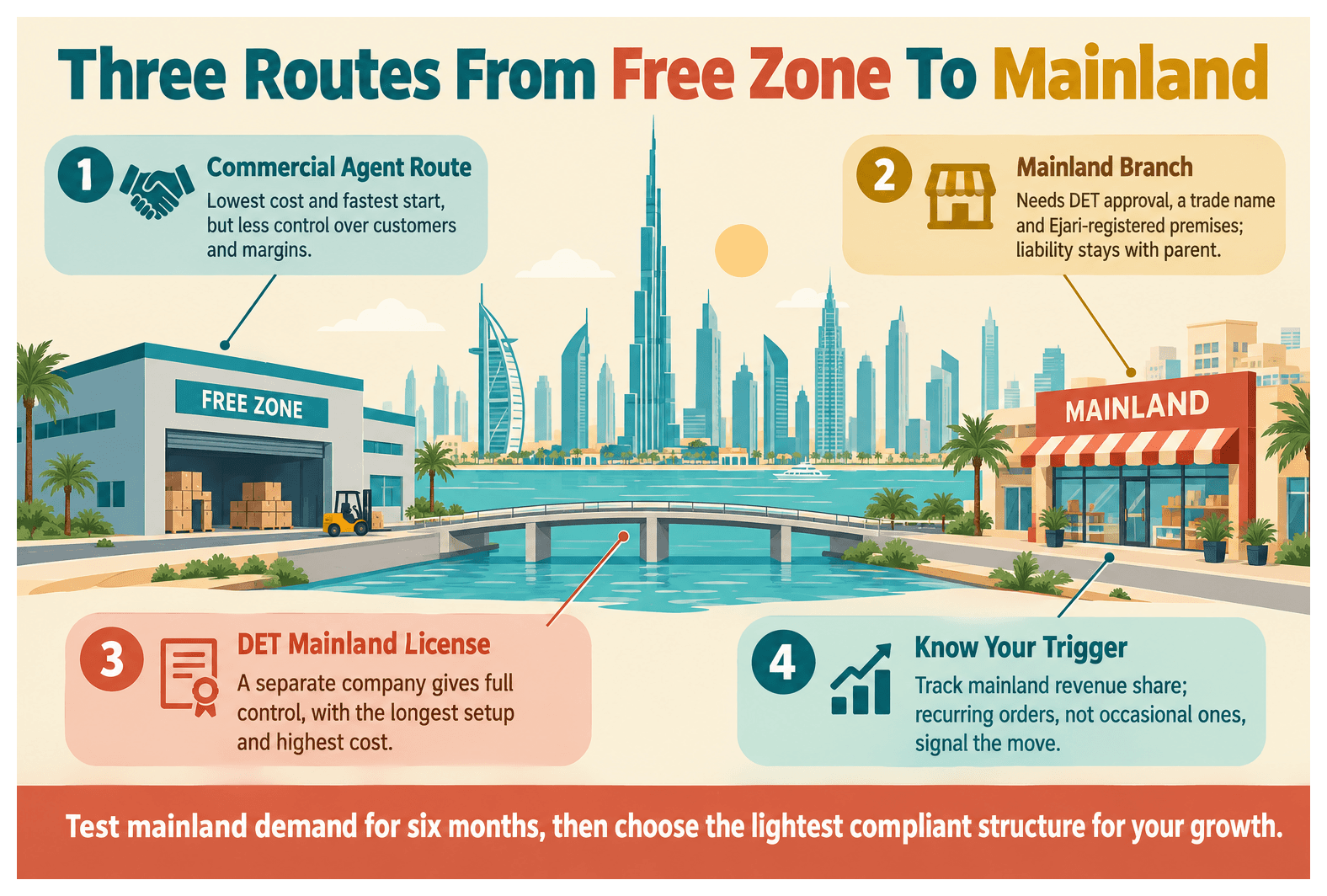
Free zone companies hit a ceiling when mainland demand outgrows their license. Recognising the triggers early lets you pick the lightest compliant structure for free zone to mainland expansion Dubai, instead of overbuilding.
Common Triggers for Going Onshore
Recurring mainland orders, not occasional ones.
Tenders requiring a mainland license.
Need for showrooms or warehouses.
A furniture importer whose mainland B2B orders now outweigh export sales is a classic case. Track mainland revenue share as your trigger metric.
Signs You Don't Need a Full Mainland License Yet
Occasional sales can run through a distributor. Test demand for six months before committing to onshore costs. Read about selling to mainland customers on a free zone trading license first.
Step-by-Step Guide to Expand Free Zone Company to UAE Mainland
Three routes exist: a licensed commercial agent, a mainland branch, or a separate license from Dubai's Department of Economy and Tourism (DET, formerly DED). Each differs in control, cost and speed.
Step 1: Appoint a Commercial Agent or Distributor
Lowest cost, fastest start.
The agent holds the license and sells locally.
You need a written agreement with clear terms.
Trade-off: less control over customers and margins.
A Dubai South FMCG exporter might reach supermarkets this way. See local distributor agreements for free zone companies.
Step 2: Register a Mainland Branch
Extends your legal identity onshore.
Needs DET approval, trade name and Ejari-registered premises.
Liability stays with the parent.
Indicative Comparison of Mainland Access Options
Feature | Commercial Agent or Distributor / Mainland Branch | DET Mainland Trade License |
|---|---|---|
Upfront cost (indicative) | Agent: legal drafting only. Branch: license, approval and lease fees. | Highest: license, premises and visas. |
Annual running cost | Agent: commission. Branch: renewal and lease. | Renewal, lease, audit and staff costs. |
Control over customers and pricing | Agent: limited. Branch: strong. | Full control. |
Setup time | Agent: days to weeks. Branch: weeks. | Longest, with initial and final approvals. |
Premises and visa requirements | Agent: none. Branch: Ejari premises, visa quota. | Ejari premises and own visa quota. |
Step 3: Obtain a DET Mainland Trade License
A separate mainland company gives full onshore rights.
Choose activity, legal form and premises, then get approvals.
Many activities allow full foreign ownership; some need approvals.
A trader can keep its Dubai South entity for exports and open a mainland company for retail. More than 40% of UAE businesses run more than one entity, as covered in setting up a Dubai free zone company alongside a mainland entity.
Cost Comparison of Mainland Access Options
The agent route costs least, mostly legal fees and commission. A branch adds license, premises and approval fees. A full DET license usually costs most. Fees vary by activity, so request itemised written quotations for any free zone to mainland expansion Dubai plan.
Where Budgets Usually Overrun
Premises size and location: one branch saw its lease double the estimate.
Visa quotas and labour compliance.
VAT, audit and renewals.
Check renting an office outside your Dubai free zone before signing.
Free Zone to Mainland Expansion Dubai: Choosing the Right Route
Choose by expected mainland revenue and the control you need. Testing suits an agent, steady client work suits a branch, and heavy retail or tenders suit a separate license. Wondering how to get mainland access Dubai South style? Anchor your trade with a Dubai South Business Hub entity.
Matching the Route to Your Business Model
Phase it. A Dubai South trader might start with a distributor, then add a mainland license once mainland revenue crosses a threshold you set in advance.
Keeping Your Free Zone Entity Working for You
Keep the free zone company for international trade and residency visa packages. Separate entities protect liability and simplify reporting.
Compliance Checks Before You Expand Free Zone Company to UAE Mainland
Before you expand, confirm licensed activities, VAT, corporate tax position and contract terms. Mainland sales can affect free zone tax treatment, so review revenue classification with the Federal Tax Authority rules.
Tax and VAT Considerations
Corporate tax: 9% above the threshold.
Free zone treatment depends on qualifying income.
VAT: 5%, with registration thresholds.
Contracts, Premises and Staffing
Written agency agreements.
Ejari lease for branches.
Check visa quotas before hiring onshore staff.
Your Next Step
To expand a free zone company to the UAE mainland, pick the lightest compliant route and keep your free zone entity for exports. Speak with Dubai South Business Hub to review your activity and get a written cost estimate.
References
Frequently Asked Questions