Topic Summary
What Running a Free Zone Company Alongside a Mainland Entity Means
Running a free zone company alongside a mainland entity in Dubai means operating two separately licensed legal structures under the same or different owners: one free zone entity for international trade and one mainland entity for direct access to the UAE domestic market. Each co
Requirements for Running a Free Zone Company Alongside a Mainland Entity
Requirements for Running a Free Zone Company Alongside a Mainland Entity
Alongside Mainland Dubai Cost: What to Budget for Both Entities
The alongside mainland Dubai cost for a dual-structure setup combines the free zone license fee and the mainland license fee. A Dubai South Business Hub Free Zone license starts at AED 12,500 for the 0 Visa Package. Mainland DET license costs vary by activity and office size but
Step-by-Step Guide to Setting Up Both Entities
Setting up a Dubai free zone company alongside a mainland entity involves ten ordered steps: choose your activities, reserve trade names, incorporate the free zone entity, open its bank account, then incorporate the mainland entity, lease a mainland office, register both entities
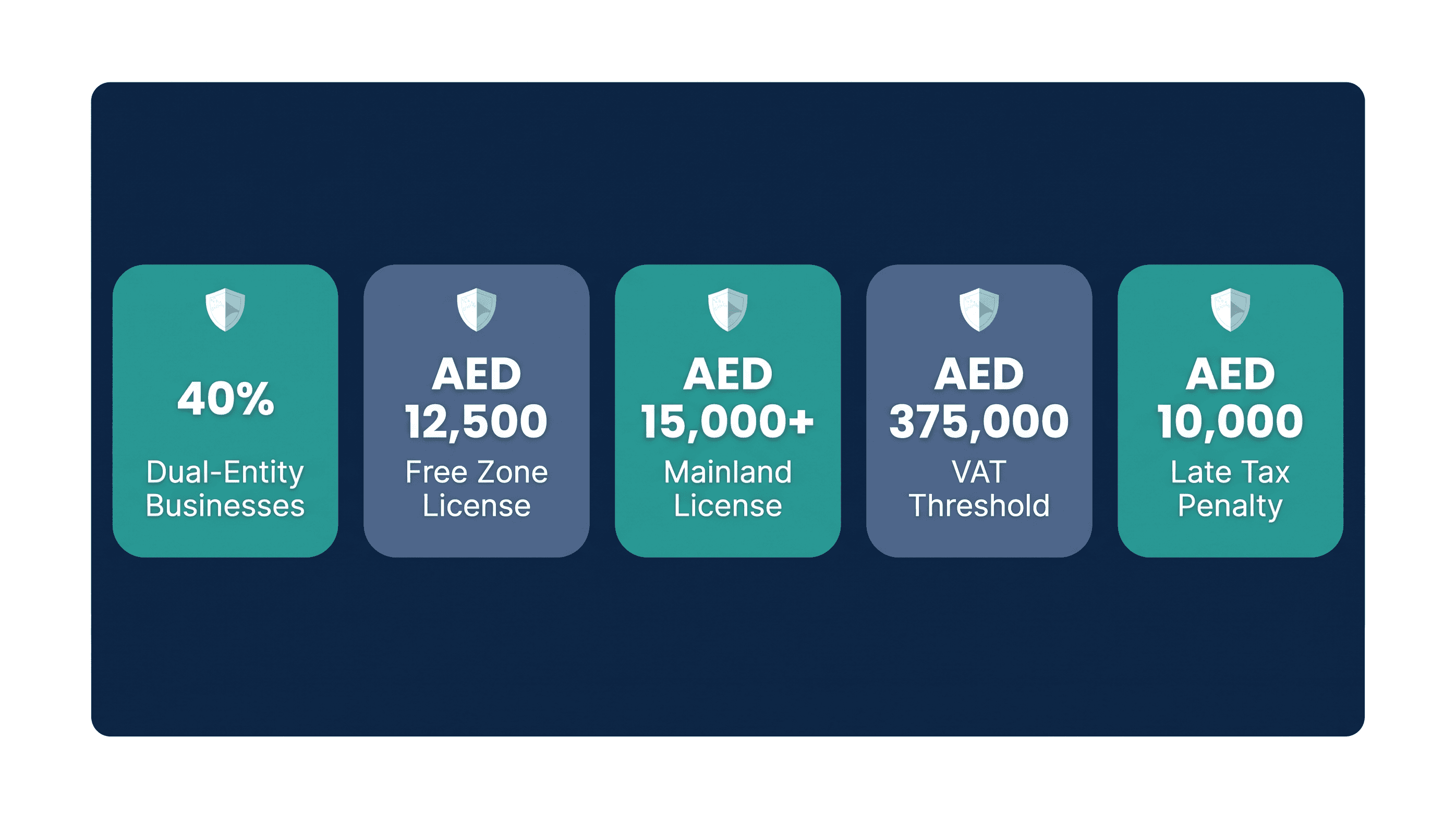
In 2026, more than 40% of UAE-registered businesses operate through more than one legal entity, and a growing share pair a free zone license with an alongside mainland entity Dubai structure to access export markets and the UAE domestic economy at the same time. A Dubai South Business Hub Free Zone (DSBH) license starts at AED 12,500 and is issued in one business day on a complete file. Mainland DET license costs vary by activity but typically start above AED 15,000 before office rent. The VAT registration threshold is AED 375,000 per entity (Federal Tax Authority, 2026). Late corporate tax registration carries a one-time flat penalty of AED 10,000 per entity (Federal Tax Authority, 2026). The 2021 Commercial Companies Law amendment opened 100% foreign ownership on the mainland for most activities (Ministry of Economy, 2021, still accurate as of 2026).
This article covers the legal requirements, realistic costs, and the exact step-by-step process for setting up a Dubai free zone company alongside a mainland entity, so you can structure the dual arrangement correctly from day one.
What Running a Free Zone Company Alongside a Mainland Entity Means
Running a free zone company alongside a mainland entity in Dubai means operating two separately licensed legal structures under the same or different owners: one free zone entity for international trade and one mainland entity for direct access to the UAE domestic market. Each company holds its own trade license, bank account, and regulatory standing.
Why Businesses Use a Dual-Structure Arrangement
The logic is straightforward. Free zone entities can trade internationally and invoice foreign clients without any mainland presence. A mainland entity, by contrast, can contract directly with UAE government bodies and retail customers, activities a free zone company cannot do without a mainland distribution agreement.
The dual structure also lets you segregate revenue streams and cost centres for cleaner financial reporting. That separation matters at audit time and at tax filing time.
Free zone goods entering the UAE mainland are duty-suspended, not duty-exempt: customs duties apply at the point of mainland entry.
100% foreign ownership is available on the mainland for most activities since the 2021 Commercial Companies Law amendment (Ministry of Economy, 2021).
A management consultancy with a Dubai South Business Hub Free Zone license, for example, handles GCC client invoicing through the free zone entity while its alongside mainland entity Dubai counterpart signs UAE federal government service agreements directly. That split keeps the books clean and the contracts valid.
Free Zone Entity vs. Mainland Entity: Key Differences
Feature | Free Zone Entity (DSBH) | Mainland Entity (DET) |
|---|---|---|
License cost | From AED 12,500 (fixed, published packages) | Activity-dependent; check DET fee schedule |
Issuance speed | 1 business day on a complete file | Several days to weeks; Ejari and notary steps add time |
Office requirement | Flexi-desk included in all packages | Physical office with Ejari-registered lease mandatory |
Investor visa allocations | Maximum 2 per DSBH license | Determined by office size and activity type |
Customs on UAE mainland entry | Goods are duty-suspended; customs duties apply at mainland entry point | Mainland entity trades domestically without customs suspension |
Employment governance | Administered by the free zone authority | Governed directly by MOHRE under Federal Law No. 33 of 2021 |
Corporate tax | 0% on qualifying income if all four QFZP conditions are met | 9% on net profit above AED 375,000 |
Key Legal Distinctions Between the Two Entities
The two companies are separate legal persons: separate trade names, separate commercial registrations, and separate Memoranda of Association. Neither entity automatically backs the liabilities of the other unless a formal cross-guarantee is signed. That separation is a genuine liability firewall. If the free zone entity defaults on a supplier invoice, the mainland entity's assets are not automatically at risk.
DET governs mainland commercial registrations; the free zone authority governs the free zone entity. A free zone company wishing to sell on the mainland must either appoint a mainland distributor or hold a separate mainland license. The alongside mainland entity Dubai dual-structure approach removes that dependency entirely. You can set up a company at Dubai South Business Hub Free Zone and begin the mainland registration in parallel once your free zone license is in hand.
Requirements for Running a Free Zone Company Alongside a Mainland Entity
To run a free zone company alongside a mainland entity in Dubai, each entity must be independently licensed, hold its own tenancy or registered address, and maintain separate books. The free zone company needs a valid free zone trade license; the mainland entity requires a DET commercial registration and a physical mainland office lease registered with Ejari.
Free Zone Entity Requirements
Valid free zone trade license covering your intended business activities in Dubai; at DSBH the license is issued in one business day on a complete file.
Registered flexi-desk address within the free zone, included in all DSBH packages at no extra charge.
Articles of Association and share register on file with the free zone authority.
Visa package selection if a visa allocation is needed: the 0 Visa Package at AED 12,500 carries no visa allocation; the 1 Visa Package at AED 16,350 adds one investor visa allocation and the establishment card; the 2 Visa Package at AED 18,200 adds two investor visa allocations and the establishment card.
Visa processing fees (entry permit, status change, medical, Emirates ID, stamping) are quoted separately and vary by nationality and entry status.
Maximum of two visa allocations per DSBH license.
A trading company owner who selects the 1 Visa Package at AED 16,350 receives the license, Articles of Association, share register, flexi-desk space, lease agreement, and one investor visa allocation in a single bundled package.
Mainland Entity Requirements
DET-issued trade license for the relevant mainland activity category.
Physical office or retail space with a valid Ejari-registered lease; flexi-desks are accepted for some professional license categories but not all.
Sector regulator approval for regulated activities: a healthcare consultancy must obtain its DET license and then separately secure Dubai Health Authority approval before signing any clinical contracts (DHA, 2026).
UAE-resident manager or authorised signatory listed on the mainland license.
Notarised Memorandum of Association if the mainland entity is structured as a Limited Liability Company.
Shared Compliance Obligations Across Both Entities
VAT registration: each entity registers independently if taxable turnover exceeds AED 375,000; the two entities do not automatically form a VAT group (Federal Tax Authority, 2026).
Corporate tax registration: required per entity; late registration carries a one-time flat penalty of AED 10,000 per entity.
Ultimate Beneficial Owner (UBO) declarations: filed for both entities with their respective registering authorities.
AML compliance: applies to both entities if they fall within a designated non-financial business or profession category.
If both the free zone entity and the mainland entity each pass the AED 375,000 VAT threshold independently, two separate VAT registrations must be filed with the Federal Tax Authority.
Alongside Mainland Dubai Cost: What to Budget for Both Entities
The alongside mainland Dubai cost for a dual-structure setup combines the free zone license fee and the mainland license fee. A Dubai South Business Hub Free Zone license starts at AED 12,500 for the 0 Visa Package. Mainland DET license costs vary by activity and office size but typically start above AED 15,000 before office rent.
Free Zone License Cost Breakdown
0 Visa Package: AED 12,500, includes the license, Articles of Association, share register, flexi-desk space, and lease agreement.
1 Visa Package: AED 16,350, adds one investor visa allocation and the establishment card.
2 Visa Package: AED 18,200, adds two investor visa allocations and the establishment card.
Visa processing costs (entry permit, status change, medical, Emirates ID, stamping) are charged separately.
An entrepreneur who already holds a mainland residency visa and does not need a second investor visa can select the 0 Visa Package at AED 12,500 for the free zone entity, keeping the alongside mainland company Dubai launch cost as lean as possible. Use the dubai free zone company setup cost calculator to model your exact DSBH figure before committing.
Mainland Entity Cost Breakdown
DET initial registration fees vary by activity type and legal form; professional license fees differ from commercial license fees, so check the current DET fee schedule before budgeting (DET, 2026).
A mainland office lease is a mandatory cost. Central Dubai offices typically run from AED 30,000 per year for a small unit, though co-working Ejari arrangements can reduce this for professional license categories. If the alongside mainland company Dubai entity covers a regulated activity, budget for the sector regulator's application fee on top of the DET license. Annual renewal fees for both entities must also be factored into the ongoing cost model; neither license is a one-time cost.
Step-by-Step Guide to Setting Up Both Entities
Setting up a Dubai free zone company alongside a mainland entity involves ten ordered steps: choose your activities, reserve trade names, incorporate the free zone entity, open its bank account, then incorporate the mainland entity, lease a mainland office, register both entities for tax, and begin trading. Each entity is registered independently.
Steps to Incorporate the Free Zone Entity First
Step 1: Define your business activities for the free zone entity and confirm they are available at Dubai South Business Hub Free Zone. The full list of business activities in Dubai is searchable online before you apply.
Step 2: Reserve your free zone trade name. Names must not duplicate existing registered names and must comply with UAE naming conventions. You can check company name availability online before submission.
Step 3: Select your visa package and submit your application with passport copies and a completed application form. Choose from the 0 Visa Package at AED 12,500, 1 Visa Package at AED 16,350, or 2 Visa Package at AED 18,200.
Step 4: Receive your free zone trade license, Articles of Association, share register, and flexi-desk lease agreement. The license is issued in one business day on a complete file.
Step 5: Open a UAE corporate bank account in the free zone entity's name. Bank account opening in UAE support is available to guide you through lender requirements.
A finance manager at an existing free zone company can add a second entity at DSBH by submitting the application form and passport copies in the morning; by close of business the same day, the license is ready for collection.
Steps to Incorporate the Mainland Entity After
Step 6: Define mainland activities and confirm the legal form (LLC, sole establishment, or civil company) with a mainland formation specialist. The legal form determines notarisation requirements.
Step 7: Reserve the mainland trade name with DET and prepare the Memorandum of Association if an LLC structure is chosen. Have the MOA notarised by a UAE notary public.
Step 8: Secure a mainland office or retail space, sign the lease, and register it on Ejari. The Ejari certificate is required to complete DET license issuance.
Step 9: Submit the DET application with all documents and pay the applicable government fees; receive the mainland trade license (DET, 2026).
Step 10: If the activity is regulated (healthcare, financial services, education, etc.), submit to the relevant sector regulator for approval before trading.
An ICT company, for instance, sets up a free zone entity at DSBH for software exports, then incorporates a mainland LLC for UAE government contracts. The mainland LLC's MOA is notarised and the office lease registered on Ejari before the DET license is issued. Once both entities are licensed, each must register independently for corporate tax; late registration costs AED 10,000 per entity as a one-time flat penalty.
What documents do you need to set up both entities?
For the free zone entity: passport copies, a completed DSBH application form, and your chosen visa package selection. For the mainland LLC: passport copies, a notarised Memorandum of Association, an Ejari-registered office lease, and the DET application form. Regulated activities require the relevant sector regulator's application documents in addition to the DET file.
References
Frequently Asked Questions