
Topic Summary
What Is Gulf Expansion Through a Dubai Free Zone and Why Does It Matter?
To expand business to gulf through dubai is to set up a free zone entity in the UAE and use it to sell, stock and service customers across the GCC. It gives foreign SMEs 100% ownership, fast licensing and banking access without relocating the parent. That's the core of any gcc market entry free zone plan.
Which Entry Model Fits: Branch, Subsidiary, Distributor or Representative Office?
Which Entry Model Fits: Branch, Subsidiary, Distributor or Representative Office?
Why Does a Free Zone Hub Work to Expand Business to Gulf Through Dubai?
A regional hub dubai south places stock beside Al Maktoum International Airport and within reach of Jebel Ali's shipping network. That shortens transit to GCC buyers. A single license and quick banking suit both goods and service firms.
What Is the Step-by-Step Plan to Expand Business to Gulf Through Dubai?
To expand business to gulf through dubai: define your Gulf revenue model, choose branch or subsidiary, select activities, prepare parent documents, get the license, open a bank account, arrange visas and tax registration, then trade and review transfer pricing yearly.
How Do Transfer Pricing and Banking Affect Your Gulf Structure?
Deals between your parent and the Dubai entity must be priced at arm's length and documented, since UAE corporate tax rules include transfer pricing. Banks expect clear ownership, source-of-funds evidence and genuine activity, so plan contracts and invoicing before the first payment.
How Do the Entry Options Compare at a Glance?
A subsidiary offers the strongest protection, a branch the simplest governance, a distributor the lowest commitment, and a representative office the cheapest presence. For subsidiary vs branch dubai decisions, volume and risk appetite decide.
Which Mistakes Should SMEs Avoid When Expanding to the Gulf?
Common errors include choosing a branch when you need liability protection, skipping transfer-pricing records, picking mismatched activities, and assuming free zone licenses allow unrestricted mainland sales. Planning structure, tax and banking together helps you expand business to gulf through dubai without costly restructuring.
The GCC's combined GDP tops USD 2 trillion (World Bank, 2024). To expand business to gulf through dubai, set up a free zone entity and trade across the region from that base. Dubai South Business Hub licenses start from AED 12,500 (T&Cs apply). This guide helps established SMEs pick an entry model, plan tax and banking, and follow a clear step plan. For wider context, see our UAE business setup guide.
What Is Gulf Expansion Through a Dubai Free Zone and Why Does It Matter?
Which Entry Model Fits: Branch, Subsidiary, Distributor or Representative Office?
Why Does a Free Zone Hub Work to Expand Business to Gulf Through Dubai?
What Is the Step-by-Step Plan to Expand Business to Gulf Through Dubai?
How Do Transfer Pricing and Banking Affect Your Gulf Structure?
How Do the Entry Options Compare at a Glance?
Which Mistakes Should SMEs Avoid When Expanding to the Gulf?
What Is Gulf Expansion Through a Dubai Free Zone and Why Does It Matter?
To expand business to gulf through dubai is to set up a free zone entity in the UAE and use it to sell, stock and service customers across the GCC. It gives foreign SMEs 100% ownership, fast licensing and banking access without relocating the parent. That's the core of any gcc market entry free zone plan.
How a Free Zone Entity Works as a GCC Entry Point
A free zone company is a separate UAE legal entity licensed by the zone authority. No local sponsor is needed. Picture a UK components maker that keeps production at home, then holds stock in Dubai and invoices Gulf buyers from there.
Why Established SMEs Choose Dubai as a Middle East Base
English-language business and a deep expatriate talent pool.
Air, sea and road links to Saudi Arabia, Oman, Qatar, Kuwait and Bahrain.
Room to expand to middle east in stages.
An Indian engineering SME, for instance, can test Gulf demand from Dubai before committing to a Riyadh office. Our guide to expanding a free zone company to the mainland covers the later step.
Which Entry Model Fits: Branch, Subsidiary, Distributor or Representative Office?
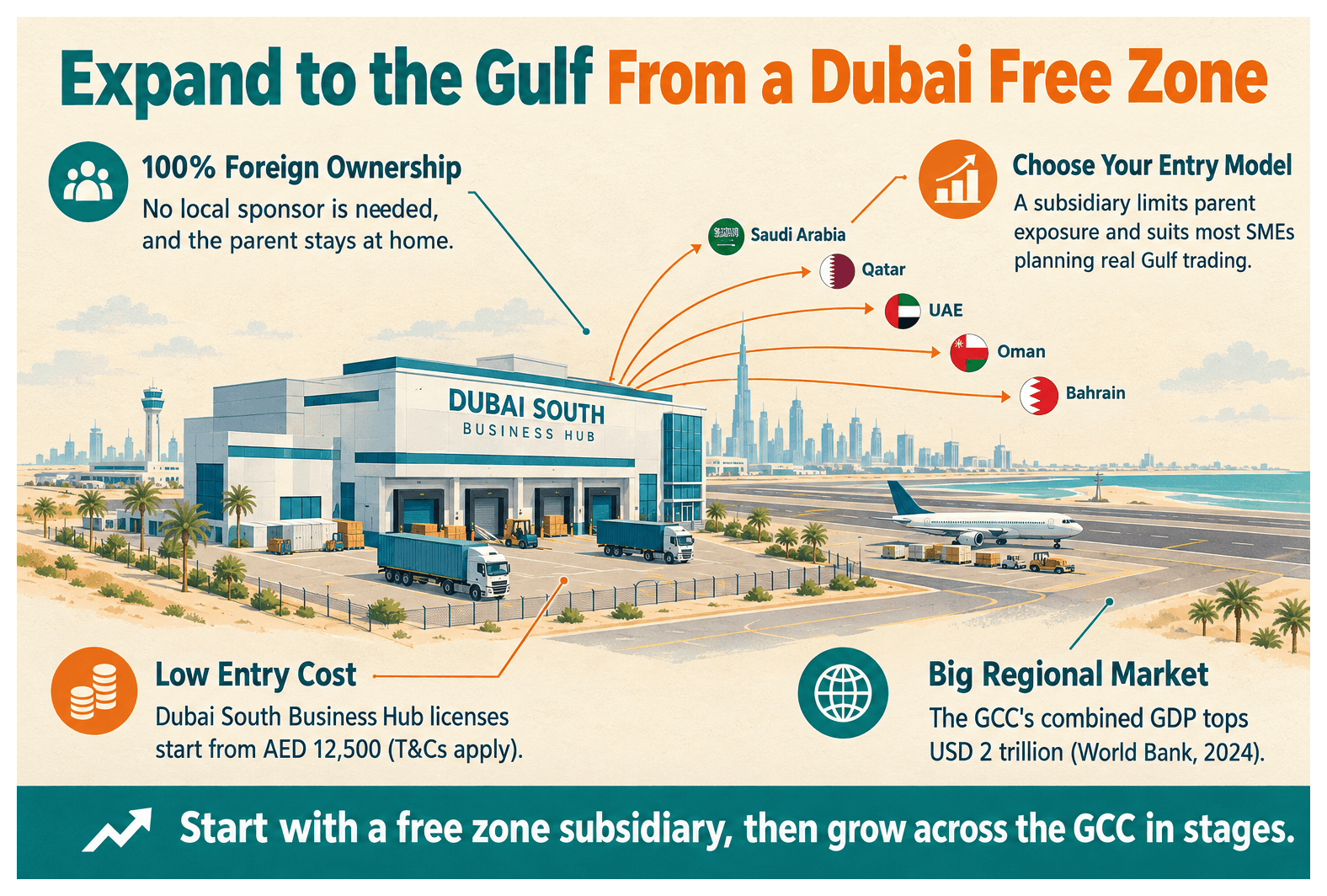
A branch extends your existing company and carries its liability. A subsidiary is a separate legal entity that limits parent exposure. A distributor outsources sales, and a representative office only promotes your brand. Subsidiaries suit most SMEs planning real Gulf trading.
Subsidiary vs Branch in Dubai: Liability, Tax and Control
Branch: same legal person, parent liable, simpler governance.
Subsidiary: ring-fenced liability, cleaner for contracts and banking.
A German services firm might pick a subsidiary to keep Gulf contract risk off its EU balance sheet. Read the branch and subsidiary comparison or how to open a branch office. Check parent attestation needs early, as they differ by model.
When a Distributor or Representative Office Is Enough
Distributor: low capital, less control over pricing and brand.
Representative office: research and leads only, no trading.
Both are stepping stones, not regional hubs.
Setting Up With a Corporate Parent Abroad
Corporate shareholders are common in free zones. Prepare the certificate of incorporation, articles and a board resolution, and plan signatories early. An Indian parent can hold 100% of its Dubai South entity this way. Our guide to setting up with a corporate parent abroad has the detail.
Why Does a Free Zone Hub Work to Expand Business to Gulf Through Dubai?
A regional hub dubai south places stock beside Al Maktoum International Airport and within reach of Jebel Ali's shipping network. That shortens transit to GCC buyers. A single license and quick banking suit both goods and service firms.
Logistics Advantage: Airport, Port and Road Access
Dubai South is built around Al Maktoum International, designed for 150 million passengers at final phase (Dubai Airports). An Italian machinery exporter could ship spares by sea, store them locally and air-freight urgent parts. Roads reach Saudi Arabia and Oman for overland delivery.
Re-Export and Regional Distribution From the Hub
Import, store and re-export under free zone procedures.
Confirm customs treatment before the first shipment.
A South African exporter might consolidate cargo here for Kuwait and Qatar. See our re-export guide.
Dubai South as a Regional Hub Beyond Logistics
Licenses from AED 12,500, flexi-desk, up to 5 activity groups.
Same-day license and instant IBAN for eligible applicants.
All subject to T&Cs. A UK software reseller could use a flexi-desk as its Gulf contracting entity.
What Is the Step-by-Step Plan to Expand Business to Gulf Through Dubai?
To expand business to gulf through dubai: define your Gulf revenue model, choose branch or subsidiary, select activities, prepare parent documents, get the license, open a bank account, arrange visas and tax registration, then trade and review transfer pricing yearly.
Step 1: Define Your Gulf Model and Choose the Entity
Map target countries and whether you sell goods, services or both.
Decide branch or subsidiary.
Estimate costs with the cost calculator.
Step 2: Select Activities and Apply for the License
Pick up to 5 activity groups matching real operations.
Submit parent documents and passport copies.
Eligible applicants may receive a same-day license (T&Cs apply).
Step 3: Open the Bank Account and Arrange Visas
Request an instant IBAN if eligible (T&Cs apply).
Arrange residency visas tied to the license.
Prepare source-of-funds and business-plan papers.
Step 4: Register for Tax, Start Trading and Scale Up
Complete corporate tax registration with the Federal Tax Authority and check tax registration thresholds.
Add mainland access if local sales grow.
Use business support services for compliance.
How Do Transfer Pricing and Banking Affect Your Gulf Structure?
Deals between your parent and the Dubai entity must be priced at arm's length and documented, since UAE corporate tax rules include transfer pricing. Banks expect clear ownership, source-of-funds evidence and genuine activity, so plan contracts and invoicing before the first payment.
Intercompany Pricing and Documentation Basics
Apply arm's-length pricing to goods, services, royalties and management fees. Keep intercompany agreements and benchmarking evidence. A UK parent charging a documented support fee is a typical case. Check current FTA guidance, and never assume the structure is exempt.
Comparison of Gulf Entry Models
Feature | Branch / Subsidiary | Distributor / Representative Office |
|---|---|---|
Legal liability | Branch: parent liable. Subsidiary: ring-fenced. | Limited to contract terms; rep office carries little exposure. |
Trading rights | Full trading within licensed activities. | Distributor trades; rep office cannot trade. |
Control over pricing and brand | Direct control of prices, contracts and brand. | Distributor sets much of the resale approach. |
Setup effort and cost | License, documents, bank account; from AED 12,500 (T&Cs apply). | Lowest commitment; a contract or small presence. |
Best use case | Stock-holding, local contracts, regional HQ. | Market testing and lead generation. |
Banking Readiness for Foreign-Owned Entities
Bring corporate documents, UBO details and expected transactions.
Show purchase orders or contracts.
Instant IBAN helps early receipts (T&Cs apply).
Align currency and payment terms with home-country tax duties.
The Central Bank of the UAE regulates the banks you'll deal with.
How Do the Entry Options Compare at a Glance?
A subsidiary offers the strongest protection, a branch the simplest governance, a distributor the lowest commitment, and a representative office the cheapest presence. For subsidiary vs branch dubai decisions, volume and risk appetite decide.
Picking the Right Model for Your Growth Stage
Test with a distributor or rep office, then scale. Choose a subsidiary early if you hold stock or sign local contracts. A manufacturer, for example, might switch after its first large tender. To expand to middle east markets sustainably, match structure to revenue.
Which Mistakes Should SMEs Avoid When Expanding to the Gulf?
Common errors include choosing a branch when you need liability protection, skipping transfer-pricing records, picking mismatched activities, and assuming free zone licenses allow unrestricted mainland sales. Planning structure, tax and banking together helps you expand business to gulf through dubai without costly restructuring.
Structure and Licensing Errors
Activities that don't match operations.
Underestimating parent document attestation time.
Tax, Banking and Mainland Access Errors
No intercompany agreements.
Assuming free zone status removes all tax duties.
Invoicing Saudi buyers without checking the customs route.
To expand business to gulf through dubai, a free zone subsidiary or branch at Dubai South gives fast licensing from AED 12,500 (T&Cs apply) and GCC reach, if entity choice, transfer pricing and banking are planned together. Use the Dubai South cost calculator or contact the Dubai South Business Hub team to plan your entry.
References
Frequently Asked Questions