
Topic Summary
What Is a Foodstuff Trading License Dubai and Why It Matters
A foodstuff trading license dubai permits a company to import, export, store, and distribute edible goods legally. It requires approval from health and municipal authorities, covers categories like packaged foods, beverages, and perishables, and acts as the legal backbone for any food trading operation in the emirate.
Approvals You Need Before Trading Foodstuff in Dubai
MOCCAE approval is required for most food product categories before import and trading can begin. Dubai Municipality may also require separate clearance for products entering the local retail supply chain. These approvals sit outside the trade license and must be obtained before goods clear customs, so factoring their processing time into your launch plan is essential.
Cost Breakdown for a Foodstuff Trading License Dubai
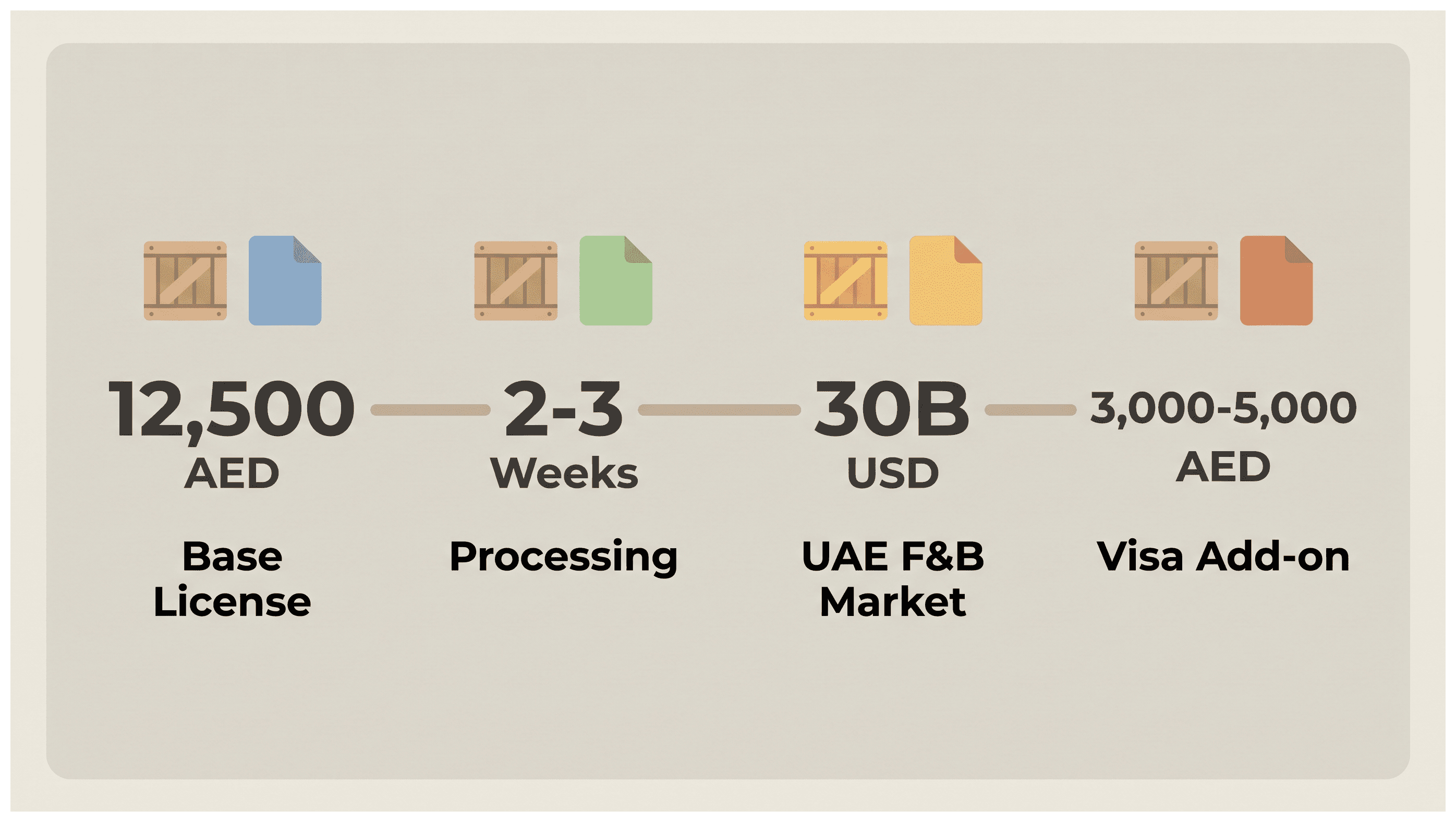
A foodstuff trading license at Dubai South Business Hub Free Zone typically starts near AED 12,500 for base registration, with visa add-ons running AED 3,000 to 5,000 each. Storage, labeling, and inspection fees can add another 10-15% to first-year spend.
Step-by-Step Setup for a Foodstuff Trading License Dubai
Setting up involves choosing a free zone jurisdiction, selecting your food trading activity code, submitting MOHAP and municipal approvals, registering a customs code, and finalizing visa quotas. Most founders complete the process within two to three weeks.
Common Food Categories Covered Under Foodstuff Trading License Dubai
Common categories include packaged groceries, frozen meat and poultry, dairy, beverages, bakery products, and organic foods. Each category may require specific lab certifications or cold-chain compliance, so confirm category-specific rules before importing.
Mistakes That Delay Your Foodstuff Trading License Dubai Approval
Delays usually come from mismatched activity codes, missing lab certificates, incomplete labeling, or incorrect customs documentation. Founders who pre-verify requirements with MOHAP and municipal departments before applying avoid most processing setbacks and save weeks of back-and-forth.
In 2026, Dubai's non-oil trade has crossed AED 2.2 trillion [1], and food products remain one of the busiest categories moving through the emirate's ports. A foodstuff trading license dubai costs around AED 12,500 [2] for base registration. Processing takes roughly two to three weeks [3]. The UAE food and beverage market is worth over USD 30 billion in 2026 [4]. Visa add-ons run AED 3,000 to 5,000 each [5]. Lab testing fees vary per shipment. This guide explains what a foodstuff trading license dubai covers, which approvals you'll need, realistic costs, and the exact setup steps founders follow.
What Is a Foodstuff Trading License Dubai and Why It Matters
A foodstuff trading license dubai permits a company to import, export, store, and distribute edible goods legally. It requires approval from health and municipal authorities, covers categories like packaged foods, beverages, and perishables, and acts as the legal backbone for any food trading operation in the emirate.
Scope of Activities Covered
Your foodstuff trading license dubai can cover packaged and dry goods, beverages, and frozen items under one registration. It grants import, export, and local distribution rights, though certain categories (frozen meat, baby food, dairy) need separate category-specific approvals. The UAE F&B market is valued over USD 30 billion in 2026 [4], and Dubai's share keeps growing as regional demand rises.
Consider a trader who imports canned vegetables alongside bottled beverages. With one foodstuff trading license dubai, he handles both product lines without filing two separate registrations, provided his activity code covers both categories.
Who Needs This License
Importers, wholesalers, and distributors moving packaged or perishable goods
E-commerce food sellers shipping direct to consumers
Entrepreneurs supplying hotels, restaurants, and catering firms
Founders running a foodstuff trading business dubai that bridges overseas suppliers and local retail
Approvals You Need Before Trading Foodstuff in Dubai
Food traders typically need approval from the Ministry of Health and Prevention (MOHAP), municipal food control departments, and customs authorities. These approvals verify product safety, labeling compliance, and import documentation before goods clear Dubai's ports and reach shelves.
Health and Safety Clearances
MOHAP registration applies to most imported food items, and halal certification kicks in for meat, poultry, and derivative products. Certain categories, like dried fruit or nuts, face lab testing before customs releases the shipment. A dried fruit importer, for example, submits samples to an accredited lab and waits for clearance before the container moves out of the port.
Customs and Documentation
Register a customs code tied to your trade license
Prepare certificate of origin and commercial invoices
Submit shipment manifests through the Dubai Trade portal
Dubai processes millions of trade declarations each year [6]
Foodstuff Trading License Cost and Timeline Breakdown
Feature | Cost Item | Typical Range |
|---|---|---|
Base license registration | Covers trade name, activity code, license issuance | AED 12,500 |
Visa processing per person | Medical test, Emirates ID, status change | AED 3,000-5,000 |
Cold storage rental | Required for perishables and frozen goods | Varies by warehouse size |
Lab testing fees | Per shipment, category-dependent | Charged per sample batch |
Customs code registration | One-time setup via Dubai Trade | Nominal flat fee |
Processing time | License plus approvals combined | 2-3 weeks |
Municipal Food Control Approval
Your storage facility must pass municipal inspection, and labels need both Arabic and English text. Expiry date compliance gets checked closely; a warehouse that fails cold-storage inspection can't legally store frozen stock until it corrects the gap.
Is a foodstuff trading license dubai worth the approval process?
Yes. The approvals protect consumers and prevent recalls. Founders who prepare MOHAP and customs files upfront clear inspections faster than those who scramble after rejection.
Cost Breakdown for a Foodstuff Trading License Dubai
A foodstuff trading license at Dubai South Business Hub Free Zone typically starts near AED 12,500 for base registration, with visa add-ons running AED 3,000 to 5,000 each. Storage, labeling, and inspection fees can add another 10-15% to first-year spend.
Base Registration Fees
Your base package usually includes the trade license, activity code registration, and initial office or flexi-desk allocation. Add-ons like extra visas, warehouse space, and document attestation sit outside the base fee. A first-year founder typically budgets AED 12,500 for setup, then layers in visa and storage costs as the team grows. Renewal costs generally mirror the first-year base fee, minus one-time registration charges.
Hidden and Variable Costs
Cold storage rental for frozen or dairy products
Lab testing fees charged per shipment, not per year
Visa processing running AED 3,000-5,000 per employee
Labeling redesign costs if Arabic text is missing
A frozen food trader, for instance, pays extra for refrigerated warehousing that a dry goods trader skips entirely. Budget for this early rather than discovering it mid-shipment.
Step-by-Step Setup for a Foodstuff Trading License Dubai
Setting up involves choosing a free zone jurisdiction, selecting your food trading activity code, submitting MOHAP and municipal approvals, registering a customs code, and finalizing visa quotas. Most founders complete the process within two to three weeks.
Step 1: Choose Your Activity Code
Select an ISIC-aligned food category matching your products
Confirm scope covers all intended product lines
Avoid mismatches that trigger approval delays
A trader picking "wholesale of food, beverages" as the activity code keeps future product expansion simple, provided the scope stays accurate.
Step 2: Register at Dubai South Business Hub Free Zone
Submit trade name and shareholder documents
Select an office or flexi-desk package
Pay initial registration fees
Many founders complete this remotely before relocating, finishing paperwork from overseas and arriving once the license is confirmed.
Step 3: Secure Health and Customs Approvals
File your MOHAP application with product labels attached
Register a customs code on Dubai Trade
Arrange sample testing if your category requires it
Step 4: Finalize Visas and Launch Operations
Apply for residency visas tied to your license
Set up banking and supplier contracts
Begin import documentation for your first shipment
A two-person team, for example, secures both visas before the first container even leaves the origin port, so operations start the moment goods arrive.
Common Food Categories Covered Under Foodstuff Trading License Dubai
Common categories include packaged groceries, frozen meat and poultry, dairy, beverages, bakery products, and organic foods. Each category may require specific lab certifications or cold-chain compliance, so confirm category-specific rules before importing.
Packaged and Dry Goods
Canned foods, grains, and snacks
Shelf-life labeling requirements apply
Lower inspection complexity overall
Perishable and Cold-Chain Products
Frozen poultry and dairy need cold storage licensing and face stricter MOHAP scrutiny than dry goods. A frozen poultry importer must arrange refrigerated transport from the port to the warehouse, maintaining temperature logs the entire way. See our guide on a frozen poultry trading license in dubai for category-specific costs.
Specialty and Organic Foods
Demand for health-focused products keeps climbing, and organic labeling needs its own certification. An entrepreneur sourcing organic snacks from Europe positions them as premium retail items, often at a markup justified by certification costs. Related reading: organic and health food trading in dubai.
Mistakes That Delay Your Foodstuff Trading License Dubai Approval
Delays usually come from mismatched activity codes, missing lab certificates, incomplete labeling, or incorrect customs documentation. Founders who pre-verify requirements with MOHAP and municipal departments before applying avoid most processing setbacks and save weeks of back-and-forth.
Documentation Gaps
Missing certificate of origin remains a top reason shipments stall at port. Incomplete shareholder paperwork and unverified product specifications cause similar bottlenecks. One shipment, held for days over a missing lab report, cost the importer storage fees that exceeded the testing fee itself.
Labeling and Compliance Errors
Arabic-English labeling mismatches trigger rejection
Incorrect expiry date formatting causes holds
Unlisted allergen information violates MOHAP rules
A bakery product line, for instance, got rejected for missing bilingual labels, a fix that took one reprint cycle but delayed the launch by two weeks. Check our notes on a bread & bakery products trading license dubai for labeling specifics before you print.
A foodstuff trading license dubai combines clear activity scoping, health and customs approvals, and predictable setup costs when founders prepare documentation early. Getting the activity code right, lining up MOHAP paperwork, and budgeting for visa and storage costs upfront saves weeks of delay later.
Start your registration at Dubai South Business Hub Free Zone and get your trading activity confirmed before you commit to stock. If you're also exploring import logistics, our guide on starting a food import business in dubai covers the shipment side in more depth.
References
Frequently Asked Questions