
Topic Summary
Four Regulators Every Food Importer Must Know
UAE food imports are governed by MOCCAE, MoIAT, Dubai Municipality, and MOHAP, each playing a distinct role in the compliance framework. Understanding which authority issues each document prevents costly application errors and port delays.
Register on MOCCAE Before Anything Else
No product-level import permit can be issued until a company is listed on MOCCAE's Food Trade Register. Any change in company name, ownership, or activity must be updated in the register immediately, or all downstream permits become invalid.
Every SKU Needs Its Own Import Permit
MOCCAE issues import permits on a per-SKU basis, meaning a single product formulation, brand name, or packaging change triggers a new application. Importers managing large catalogues should build permit renewal schedules into their procurement planning.
The 50% Shelf Life Rule Has No Exceptions
Products must have at least 50% of their total shelf life remaining at the UAE port of entry, and no waiver process exists for commercial shipments. Suppliers should factor in origin-country certification lead times of two to four weeks when scheduling production and shipping.
Halal Certification Must Come From an MoIAT-Approved Certifier
Meat and poultry imports require a halal certificate issued by a certifier on MoIAT's approved foreign certifiers list, which should be verified before each new supplier relationship is established. If the certifier is removed from the list or the production facility changes, the certificate is immediately invalidated.
Arabic Labelling Is a Non-Negotiable Requirement
All food products entering UAE domestic circulation must carry Arabic labelling that complies with GSO standards applicable across the GCC. Importers should confirm label compliance before shipment dispatch, as non-compliant labelling is a common cause of port rejection.
Free Zone Re-Exporters Operate Under Different Rules
Companies re-exporting food from a UAE free zone without releasing goods into domestic circulation fall under a separate permit category, with duties suspended while products remain inside the zone. Once goods are released to the local market, full import registration and customs duties apply.
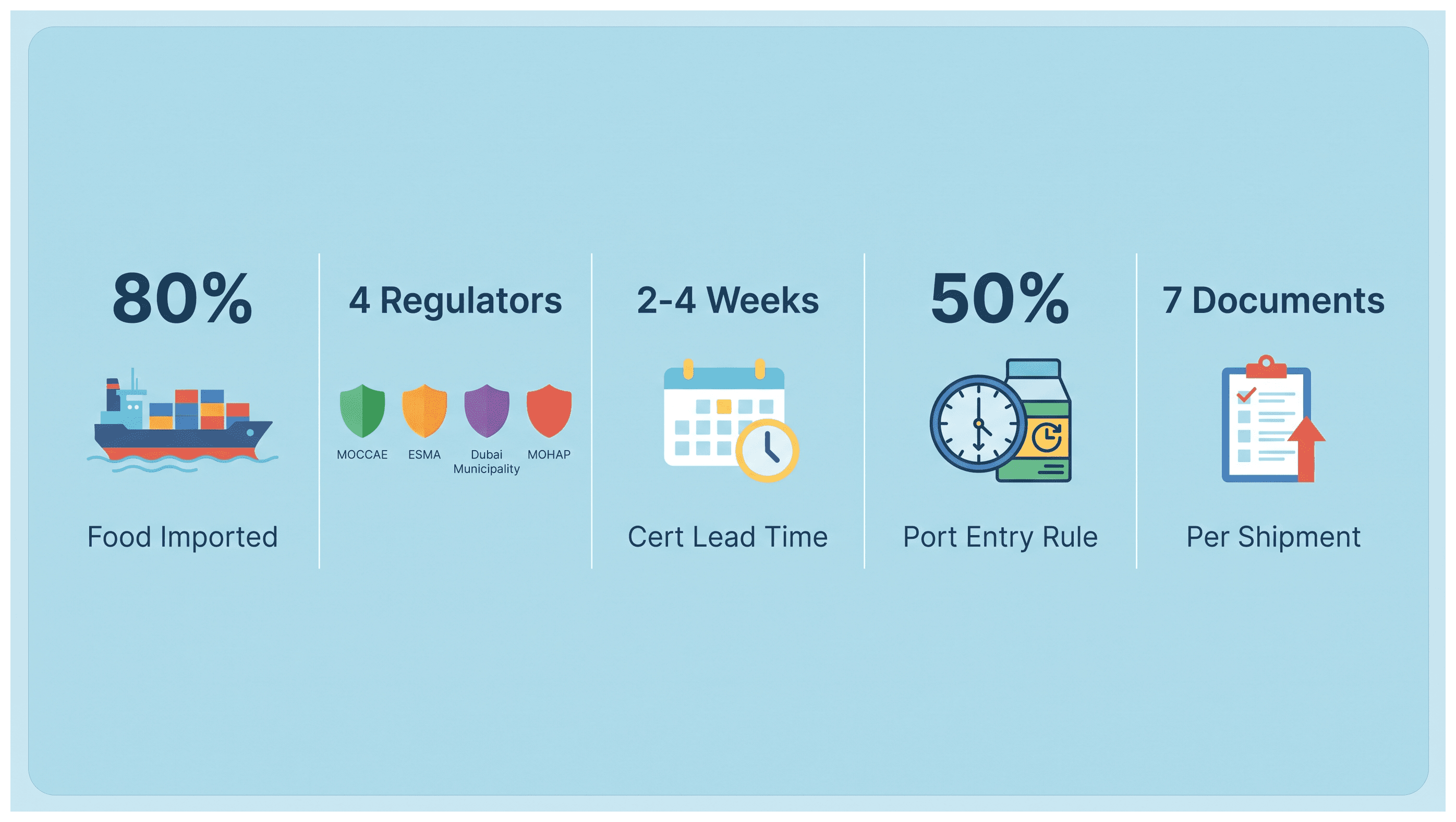
In 2026, the UAE imports more than 80% of its food supply, making it one of the most import-dependent food markets on the planet (u.ae). Every consignment entering the country must clear a multi-authority compliance framework before it reaches a shelf, a restaurant kitchen, or a distribution warehouse. Federal Food Safety Law No. 10 of 2015 is the governing legislation. Four primary regulators are involved: MOCCAE, MoIAT, Dubai Municipality, and MOHAP. Origin-country certification lead times typically run 2 to 4 weeks. The 50% shelf life rule applies at the port of entry, with no waiver process for commercial shipments. MoIAT's approved halal certifiers list must be verified before each new supplier relationship.
This guide covers the full food import registration UAE checklist: which authority issues each document, what each document is used for, what invalidates it, and how Arabic labelling, shelf life rules, and halal certification fit into the process, so your trading or logistics company clears customs without delays or rejections.
Food Import Registration UAE: What It Is and Why It Matters
Food import registration UAE is the process of obtaining prior approval from MOCCAE and relevant emirate-level authorities before a food consignment can clear UAE customs. It ensures products meet Federal Food Safety Law No. 10 of 2015 standards covering safety, labelling, shelf life, and, where applicable, halal requirements.
UAE Food Import Document Checklist: Issuer, Purpose, and Invalidation Triggers
Document | Issuing Authority | Purpose | What Invalidates It |
|---|---|---|---|
Trade license | DET (mainland) or free zone authority | Proves legal authority to trade food products | Expiry or activity change without amendment |
MOCCAE | Gateway to all product-level import permits | Company name, ownership, or activity change without updating the register | |
MOCCAE import permit (per SKU) | MOCCAE | Authorizes port entry of a specific product | Product formulation, brand name, origin, or packaging change |
Health certificate | Exporting country's competent authority | Confirms product meets UAE food safety standards | Issuing authority loses UAE recognition; certificate predates shipment |
Certificate of conformity (CoC) | MOCCAE-recognized conformity body | Verifies compliance with GSO standards across GCC | Failed re-testing or certifying body loses accreditation |
Halal certificate (meat/poultry) | MoIAT-approved foreign certifier | Confirms halal slaughter and processing | Certifier removed from MoIAT list; production facility change |
MoIAT conformity registration | MoIAT | Required for bottled water, supplements, energy drinks | Formula, packaging dimensions, or brand name change |
The Legal Framework Governing Food Imports
UAE Federal Food Safety Law No. 10 of 2015 is the primary legislation. It assigns MOCCAE (Ministry of Climate Change and Environment) as the federal lead authority and empowers emirate-level bodies such as Dubai Municipality to enforce standards locally. Before any product permit application can proceed, importers must register their business on MOCCAE's Food Trade Register.
Non-compliance carries serious consequences. Under Cabinet Decision No. 42 of 2016 on implementing regulations, penalties include shipment confiscation, facility closure, and financial fines. A Dubai-based trading company importing frozen chicken from Brazil, for example, must register with MOCCAE, obtain a product-specific import permit, and present a valid halal certificate, all before the consignment arrives at port.
Who Needs to Register and Who Is Exempt
Any company importing food for commercial sale, distribution, or re-export must complete food import registration UAE. Personal-use quantities below defined thresholds are handled at the port without a trade permit.
Free zone companies re-exporting food without entering UAE domestic circulation operate under a different permit category. Goods remain duty-suspended inside the free zone until released to the local market, duty-suspended is not the same as duty-exempt.
Importers handling regulated categories (meat, dairy, supplements, bottled water) face additional MoIAT or Dubai Municipality product registration requirements on top of the base MOCCAE permit.
Document Checklist for Food Import Registration UAE
The food import registration UAE document checklist includes a valid trade license, MOCCAE food importer registration, a product-specific import permit, a certificate of conformity, a health certificate from the country of origin, a halal certificate for meat and poultry, and an approved Arabic label. Each document has a specific issuing authority.
Company-Level Documents
Trade license, Issued by DET (mainland) or the relevant free zone authority. Proves the company is legally authorized to trade food products. Invalidated by license expiry, an activity change without amendment, or company deregistration.
MOCCAE Food Trade Register entry, Issued by MOCCAE. The mandatory gateway to all product-level import permits; no permit application proceeds without it. Invalidated if the company changes its legal name, ownership structure, or licensed activities without updating the register.
Importer-of-record authorization, Required when a logistics company clears goods on behalf of a product owner. Must be a notarized power of attorney. Invalidated if the authorizing company's trade license lapses.
Need help with business support UAE, including document preparation and government transactions? Dubai South Business Hub Free Zone's support team handles the groundwork so you can focus on your supply chain.
Product-Level Documents
MOCCAE import permit (per SKU), Issued by MOCCAE. Authorizes port entry of a specific food product. Invalidated if product formulation, brand name, country of origin, or packaging changes without re-application.
Health certificate / sanitary certificate, Issued by the competent authority of the exporting country. Confirms the product meets UAE food safety standards. Invalidated if the issuing authority loses UAE recognition or the certificate predates the shipment.
Certificate of conformity (CoC), Issued by a MOCCAE-recognized conformity body. Verifies product compliance with GSO standards, which apply across all GCC member states including the UAE. Invalidated if the product fails re-testing or the certifying body loses accreditation.
Lab test report, Issued by a UAE-accredited or MOCCAE-accepted international laboratory. Confirms pesticide residue, microbial, and additive compliance. Invalidated if test results are more than 6 months old or conducted by a non-approved lab.
A consignment of canned tomatoes from Italy, for instance, must carry a health certificate from the Italian health authority, a CoC from a MOCCAE-approved conformity body, and a MOCCAE import permit referencing the exact product and lot number. All three must be consistent with each other, any discrepancy triggers rejection at the port.
Step-by-Step Guide to Completing Your Food Import UAE Checklist
To complete the food import UAE checklist: obtain a valid trading license covering food activities, register on MOCCAE's food trade portal, apply for a product import permit per SKU, arrange a health certificate and CoC from the origin country, prepare approved Arabic labels, and submit all documents before shipment dispatch.
Step 1: Secure Your Trading License and Business Registration
Confirm your trade license lists food trading or general trading as a licensed activity. A license covering only electronics, for example, won't satisfy MOCCAE's registration requirements. You'll need to check your business activities in Dubai are correctly listed before submitting any application to MOCCAE.
Free zone companies importing food for re-export can operate under a free zone trading license. Goods remain duty-suspended inside the free zone and attract customs duty only when released to the UAE mainland. That distinction matters directly for your landed cost calculations and mainland pricing model.
Step 2: Register on the MOCCAE Food Import Portal
Go to food.moccae.gov.ae, MOCCAE's online portal handles company registration, product registration, and permit applications in one system.
Upload your trade license, memorandum of association, and authorized signatory ID at the company registration stage.
Allow 3 to 5 business days for company registration approval. Product permit applications are then assessed separately, per SKU.
Step 3: Apply for Product Permits and Arrange Origin Documents
Submit a product permit application per SKU, including full product specification, ingredient list, packaging details, and intended shelf life.
Coordinate with the exporting country's competent authority for the health certificate and with a MOCCAE-recognized conformity body for the CoC, before the shipment is loaded. Don't wait until goods arrive.
For meat and poultry, the halal certificate must be in place before the permit application is submitted. Permit applications filed after shipment departure frequently result in port delays and demurrage costs that fall entirely on the importer.
Arabic Labelling Requirements Every Importer Must Meet
This is the food import UAE guide area where most first-time importers get caught out. UAE law requires all packaged food imports to carry Arabic-language labels displaying the product name, ingredient list, allergens, net weight or volume, country of origin, production and expiry dates, storage instructions, and the UAE importer's name and address. Labels must comply with GSO 9:2013 and be approved before customs clearance.
Mandatory Label Fields and the Issuing Standard
GSO 9:2013 (General Standard for Labelling of Prepackaged Foods) is the applicable GCC standard. Both Dubai Municipality's Food Safety Department and MOCCAE enforce it.
Required fields: product name in Arabic, full ingredient list in descending order of weight, net quantity, country of origin, name and address of the UAE importer or distributor, production date, best-before or expiry date, batch/lot number, storage and handling instructions, and allergen declaration.
Nutrition claims: if a nutrition or health claim appears on the label, nutritional information must follow GSO 233 as well.
A UK biscuit brand exporting to a Dubai retailer must print or sticker-apply an Arabic label that includes the Dubai importer's trade name, address, and UAE contact number. The UK manufacturer's address alone is insufficient, inspectors will reject the consignment.
What Invalidates an Arabic Label
Sticker labels that peel, obscure original content, or are applied over existing expiry dates are rejected on inspection.
Labels printed in a font size below the minimum specified in GSO 9: 2013 are non-compliant.
Any discrepancy between the Arabic label and the health certificate or import permit, a different product name, or a different country of origin, triggers rejection.
Labels must be applied in a tamper-evident manner; those that can be removed without visible damage are non-compliant. Dubai Municipality inspectors can seize entire consignments when label non-compliance is found during port inspection.
Do Arabic labels need to be printed at the factory, or can stickers be applied in the UAE?
Sticker labels applied in the UAE are permitted, but they must be tamper-evident, must not obscure original content, and must not be applied over existing expiry dates. Factory-printed Arabic labels are the lower-risk option because they eliminate the risk of sticker misapplication, which is one of the most common causes of consignment rejection at UAE ports.
Shelf Life Rules and Halal Certification for Food Imports
The UAE requires imported food to retain at least 50% of its total shelf life at the point of entry. Halal certification, issued by a UAE-government-accredited certifying body in the country of origin, is compulsory for all meat, poultry, and meat-derived products. MoIAT maintains the approved list of foreign halal certifiers, and food import registration UAE for meat categories cannot proceed without a valid certificate from a listed body.
The 50% Shelf Life Rule: How It Is Applied
Dubai Municipality and MOCCAE both enforce the 50% remaining shelf life rule. A product with a 12-month total shelf life must arrive in the UAE with at least 6 months remaining. The calculation uses the production date and best-before date on the original packaging, not any date on an Arabic sticker.
Here's a concrete example: a consignment of UHT milk with a 9-month shelf life and a production date of 1 January must arrive in the UAE no later than 1 April. Arriving on 2 April triggers rejection. There is no waiver process for commercial consignments that breach the threshold. The importer bears all return freight and demurrage costs.
Halal Certification: Who Issues It and What Invalidates It
Approved issuer: Halal certificates must come from a certifying body listed on MoIAT's approved foreign halal certifiers register. Certificates from non-listed bodies are rejected regardless of international reputation.
Required detail: The certificate must reference the specific slaughterhouse or processing plant, the product type, and the period of validity. A generic company-wide certificate without facility-level detail is not accepted.
What invalidates it: Certificate expiry before shipment arrival; the certifying body being removed from MoIAT's list; any change in production facility; evidence of non-halal inputs found during inspection.
Practical step: MoIAT updates its approved certifiers list periodically. Verify the list before each new supplier relationship, not just at onboarding.
MoIAT Product Registration for Regulated Food Categories
As a food import UAE guide point that surprises many importers: MoIAT product registration is required for bottled water, dietary supplements, energy drinks, and certain fortified foods before they can be imported or sold in the UAE. Registration is product-specific and tied to the product's formulation and packaging. Any change to ingredients or packaging triggers a new registration application.
References
Frequently Asked Questions