Topic Summary
License Fee Is Just the Starting Point
A free zone company at Dubai South Business Hub starts from AED 18,350 all-in for year one, while a mainland LLC can run AED 30,000 to 50,000 before a single visa is processed. The license fee itself is rarely the largest line item on the final invoice.
Free Zones No Longer Have a Monopoly on Foreign Ownership
Federal Decree-Law No. 26 of 2020 extended 100% foreign ownership to mainland LLCs, so choosing a free zone purely for ownership reasons is no longer valid. Founders should base their structure decision on operational scope and total cost instead.
Mainland Access Costs More Than Most Guides Admit
Free zone companies cannot trade directly on the UAE mainland without a licensed distributor or a separate mainland branch, and that branch carries its own licensing fees. This layer is commonly omitted from comparison articles but can significantly change the true cost model.
Duty-Suspended Is Not the Same as Duty-Exempt
Free zone goods are duty-suspended, meaning customs duty applies when products physically cross into the UAE mainland market. An e-commerce founder shipping physical goods to UAE consumers from a free zone must factor that recurring import duty into every single shipment.
Office Requirements Drive a Major Cost Difference
Mainland LLCs typically require an Ejari-registered physical office, adding lease and registration costs on top of the license fee. Free zone companies at Dubai South Business Hub can use a registered address package with no mandatory Ejari lease, keeping year-one overhead lower.
Hidden Recurring Costs Stack Up Fast
Chamber of Commerce membership, notarisation, accounting fees, and banking minimums all add to the annual cost of either structure but rarely appear in headline comparisons. Modelling these recurring obligations alongside one-off setup costs gives a far more accurate picture of long-term spend.
Confirm Activities Before You Apply
Not every business activity is available under a free zone license, and choosing the wrong structure can mean costly restructuring later. Checking the full list of permitted activities at Dubai South Business Hub Free Zone before applying is a practical first step that saves significant time and money.
In 2026, a sole founder setting up a free zone company Dubai at Dubai South Business Hub Free Zone pays from AED 18,350 all-in for year one, covering the license from AED 12,500 and one visa. A comparable mainland LLC typically costs AED 30,000 to 50,000 before a single visa is processed. The license fee is rarely the largest line on the invoice. Office leases, Ejari registration, Chamber of Commerce membership, notarisation, accounting, and banking minimums all stack on top, and most comparison guides ignore half of them. This article breaks down every material cost layer for both structures, one-off and recurring, so you can model the true price before you commit.
What Is a Free Zone Company Dubai and How Does It Differ from a Mainland LLC
A free zone company Dubai is a legal entity licensed and regulated within a designated free zone authority, operating under its own ruleset. A mainland LLC is licensed by DET and can trade anywhere in the UAE without restriction. Both structures now allow 100% foreign ownership, but their cost profiles, operational scope, and compliance obligations differ significantly.
Legal Structure and Ownership Rules
Free zone entities are incorporated under the authority of their respective free zone. Dubai South Business Hub Free Zone issues its own license, sets its own fee schedule, and governs its own compliance calendar, independently of DET. The license is issued in one business day, and zero paid-up share capital is required.
Mainland LLCs are licensed by DET and subject to the UAE Commercial Companies Law. Worth flagging: 100% foreign ownership is available on the mainland too, introduced under Federal Decree-Law No. 26 of 2020. It has nothing to do with free zone status. This distinction matters because some founders choose a free zone purely for ownership reasons, and that rationale no longer holds.
Free zone companies cannot trade directly on the UAE mainland without appointing a mainland distributor or establishing a separate mainland branch. That branch carries its own licensing cost, a layer most comparison articles omit entirely. A logistics consultant incorporated at Dubai South Business Hub Free Zone can serve international clients freely but must route any direct UAE retail sales through a mainland-registered entity or distributor.
Operational Scope: Where Each Structure Can Do Business
The operational boundary between structures matters more than most founders expect. Here's what each can and cannot do:
Free zone companies can invoice UAE mainland clients for services, that's generally permitted.
Physically supplying goods to the UAE mainland from a free zone triggers customs clearance and import duty. Free zone goods are duty-suspended, not duty-exempt, a critical distinction.
Dubai South Business Hub Free Zone is not a designated zone. It carries no designated-zone VAT or customs benefits.
Mainland LLCs have unrestricted access to the UAE domestic market, government tenders, and can open branches across all seven emirates without additional authority approvals.
An e-commerce founder selling physical products to UAE consumers from a free zone must factor customs duty into every mainland delivery. That recurring cost does not appear on the license invoice, but it will appear on every shipment. Check the full list of business activities in Dubai available at DSBH to confirm which activities fit a free zone structure before you apply (u.ae, 2026).
Free Zone Company Dubai vs. Mainland LLC: Cost Beyond the License
Feature | Free Zone Company (DSBH) | Mainland LLC (DET) |
|---|---|---|
License fee | From AED 12,500 | UNVERIFIED: <DET license fee, confirm before publishing> |
Paid-up share capital | Zero required | Share capital notarised at Dubai Courts; fee based on capital value |
Office requirement | No mandatory Ejari lease; registered address package available | Ejari-registered physical office mandatory for most license categories |
Visa costs | Always additional; not included in license fee | Always additional; not included in license fee |
Goods to UAE mainland | Duty-suspended (not duty-exempt); customs clearance applies on mainland entry | Direct mainland market access; no customs duty trigger on domestic sales |
First-year total (sole founder, one visa) | From AED 18,350 | Typically AED 30,000 to 50,000+ before visa costs |
Free Zone Dubai Cost: The Full First-Year Picture for a Sole Founder
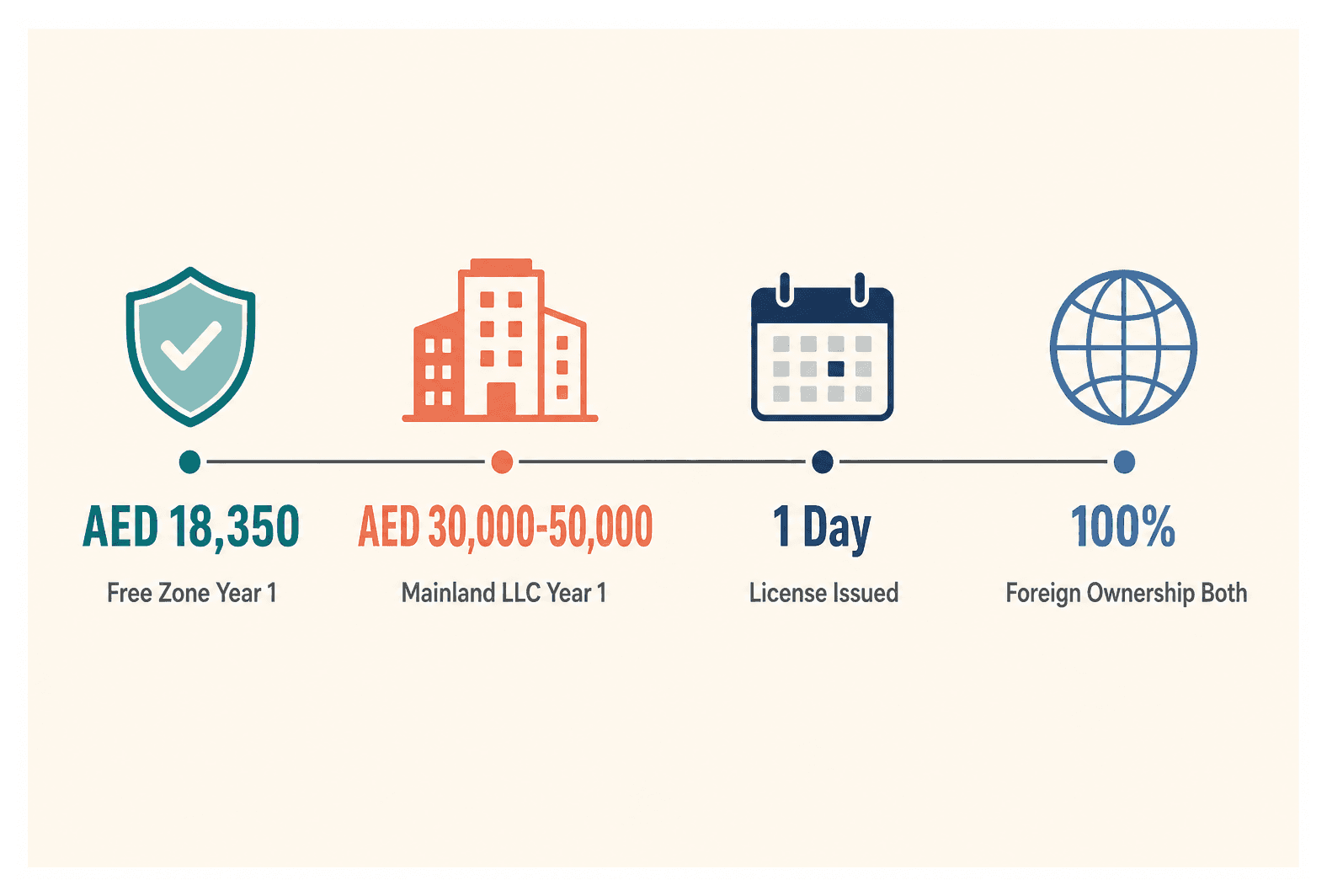
The free zone Dubai cost for a sole founder with one visa at Dubai South Business Hub Free Zone starts from AED 18,350 in year one. That figure covers the license from AED 12,500 plus visa and Emirates ID fees. Office space, banking, and regulated-activity approvals are additional and must be budgeted separately.
One-Off vs. Recurring Cost Breakdown
Dubai South Business Hub Free Zone launched in September 2025 and issues licenses in one business day. Zero paid-up share capital is required, removing a capital deposit cost that some other structures carry. Here's how the cost stack splits between one-off and recurring:
Cost Item | One-Off | Recurring |
|---|---|---|
License fee | From AED 12,500, Year 1 | Annual renewal at prevailing rate |
Visa application and Emirates ID | Per visa at application | Renewed every 2 to 3 years per visa holder |
Medical fitness test | At initial application | Per renewal cycle |
Activity additions (beyond five) | AED 2,000 per additional activity | Applies at each renewal if activities change |
Regulated-activity regulator fee | At initial approval (if applicable) | Annual renewal to named regulator |
NOT included | Bonded warehousing, customs integration, mainland trading rights, office lease |
Dubai South Business Hub Free Zone licenses start from AED 12,500. Confirm exact visa fees with Dubai South Business Hub Free Zone at the time of application, government fee schedules are reviewed annually. Use the business setup cost calculator to model your specific combination before approaching any authority.
Hidden Recurring Costs Founders Routinely Miss
Corporate bank account opening typically requires a minimum average balance. Some banks charge monthly service fees of AED 200 to 500 if the balance falls below the threshold. Review banking and taxation options early in your planning.
Accounting and bookkeeping is mandatory under UAE corporate tax law. Outsourced packages start from approximately AED 3,000 to 6,000 per year for a single-activity free zone entity.
Regulated activities carry a separate regulator fee. A founder launching a health-and-wellness consultancy at Dubai South Business Hub Free Zone pays the free zone license fee and then separately applies to the Dubai Health Authority (DHA) for its approval. The DHA fee is not part of the free zone package.
VAT registration is compulsory once taxable supplies exceed AED 375,000 per year. Late registration carries a flat AED 10,000 penalty (Federal Tax Authority, 2026).
Mainland LLC: What You Actually Pay Beyond the Trade License
A mainland LLC's true first-year cost extends well beyond the DET trade license. Mandatory Ejari-registered office space, Chamber of Commerce membership, local service agent fees for certain activities, and notarisation costs routinely push total spend past AED 30,000 to 50,000 before a single employee visa is processed. Budgeting only for the license is the most common planning error first-time founders make.
Mandatory Office Lease and Ejari Registration
DET requires a mainland LLC to maintain a physical, Ejari-registered office address. Virtual offices are not accepted for most license categories. That requirement alone adds a significant recurring cost that a free zone company Dubai using a registered address package avoids or substantially reduces.
Commercial rents in Dubai vary considerably. A small fitted office in Deira may start around AED 25,000 to 40,000 per year. Business Bay or DIFC addresses run AED 80,000 and above. A mainland LLC consultant in Al Quoz signing a one-year office lease at AED 30,000 spends more on the office alone than a comparable free zone founder spends on their entire first-year license. Ejari registration itself carries a nominal fee, but the tenancy contract must also be notarised, adding further professional fees.
Chamber Membership, Notarisation, and Corporate Bank Account Costs
Dubai Chamber of Commerce membership is a standard requirement for mainland companies. Annual fees depend on share capital and company size (Dubai Chamber, 2026).
Memorandum and Articles of Association must be notarised at the Dubai Courts Notary Public. Notarisation fees are calculated on the share capital value, a cost that does not exist for a free zone entity at Dubai South Business Hub Free Zone, which requires zero paid-up share capital.
A mainland LLC with AED 300,000 share capital pays notarisation fees on that full capital value at incorporation and again whenever the company profile changes.
Corporate bank account opening for a mainland LLC typically requires a higher minimum balance than a free zone entity. Some banks charge AED 5,000 to 10,000 as an account-opening or compliance fee for new companies.
These costs repeat at every license renewal cycle and whenever activities, shareholders, or the registered address changes.
For UAE residency visa services tied to either structure, the government fee stack is the same, the choice of structure does not reduce what you pay ICP or GDRFAD.
Corporate Tax and VAT: What Every Founder Must Budget For
UAE corporate tax applies at 9% on taxable income above AED 375,000 for financial years starting on or after 1 June 2023. Free zone entities may qualify for a 0% rate on qualifying income, but only if they meet all four Qualifying Free Zone Person (QFZP) conditions set by the Federal Tax Authority. VAT at 5% applies to most taxable supplies regardless of whether you hold a free zone or mainland license.
The Four Qualifying Free Zone Person Conditions
To access the 0% corporate tax rate on qualifying income, a free zone entity must satisfy all four conditions under Ministerial Decision No. 265 of 2023:
Maintain adequate substance in the UAE.
Derive only qualifying income as defined under the Ministerial Decision.
Not have elected to be subject to the standard 9% tax rate.
Comply with transfer pricing rules and maintain audited financial statements.
Failing any one condition means the entity is taxed at the standard 9% rate on all taxable income above AED 375,000. Never treat the 0% rate as a blanket benefit, presenting it that way creates real compliance risk for founders who structure their income streams on that assumption.
A free zone technology company deriving 100% of its revenue from non-UAE clients and maintaining genuine UAE substance may qualify for the 0% rate on that qualifying income. But a founder who also invoices UAE mainland clients must assess whether those revenues constitute non-qualifying income subject to 9%. Get qualified UAE tax advice before structuring your income streams (Federal Tax Authority, 2026).
What does "qualifying income" mean for a free zone company Dubai?
Qualifying income is income derived from transactions with other free zone persons or from activities explicitly listed under Ministerial Decision No. 265 of 2023. Income from UAE mainland clients or excluded activities does not qualify for the 0% rate and is taxed at 9% above the AED 375,000 threshold. Always confirm your specific revenue streams with a licensed UAE tax adviser.
VAT Registration and Late-Penalty Costs
VAT registration is mandatory when taxable supplies and imports exceed AED 375,000 in any 12-month period. Voluntary registration is available from AED 187,500.
Late VAT registration carries a flat AED 10,000 penalty. Late corporate tax registration also carries a flat AED 10,000 one-time penalty, neither is a monthly charge.
A founder who delays VAT registration until month nine after crossing the AED 375,000 threshold pays AED 10,000 in penalties on top of back-VAT owed. A calendar reminder costs nothing.
VAT filing (quarterly for most small businesses) requires either in-house accounting capability or an outsourced provider. Budget AED 500 to 1,500 per return for a simple filing.
Both free zone and mainland entities are subject to the same VAT rules. The structure does not change the VAT obligation.
Five Steps to Calculate Your True Setup Cost Before You Commit
Calculating the true cost of a Dubai company setup requires five steps: list your intended business activities, confirm whether any are regulated, cost your visa requirements, model recurring compliance costs, and add a contingency for regulator fees. Only then does the license fee become a meaningful line in your budget, whether you're choosing a free zone company Dubai or a mainland LLC.
Step 1: List Your Activities and Check Regulatory Status
Start by listing every revenue-generating activity you plan to conduct. Each one must appear on your trade license. At Dubai South Business Hub Free Zone, the first five activities are included in the base license fee. Each additional activity beyond five costs AED 2,000, so a founder bundling trading, consultancy, and e-commerce under one license needs to count carefully.
For every activity, check whether a named regulator requires separate approval. The Dubai Health Authority (DHA) governs healthcare activities. The Knowledge and Human Development Authority (KHDA) covers education. The Central Bank of the UAE oversees financial services. If a regulator applies, budget that approval fee as an additional line item, it sits entirely outside the free zone license fee. A founder combining IT consultancy, digital marketing, and e-commerce has three activities, all within the five-activity threshold and requiring no additional regulator approval at DSBH.
Step 2: Model Visa, Compliance, and Banking Costs
Visas are always an additional cost. Each investor or employee visa carries its own application, medical fitness, Emirates ID, none of these are absorbed into the DSBH license fee.
Add annual accounting and bookkeeping: mandatory under UAE corporate tax law, typically AED 3,000 to 6,000 per year for a lean free zone entity.
Factor in corporate bank account opening costs: minimum balance requirements, monthly service fees if the balance falls short, and any one-time compliance or onboarding fees.
A sole founder with two employee visas, outsourced bookkeeping at AED 4,000/year, and a bank account requiring AED 25,000 average balance adds approximately AED 30,000 in non-license costs to their first-year budget beyond the DSBH license fee.
Run the full model through
References
Frequently Asked Questions