
Topic Summary
Choosing the Wrong Free Zone Entirely
Not every free zone suits every business model, and migrating to a new one after the fact costs AED 10,000–25,000 on average. Research which zones align with your activity, banking needs, and growth plans before paying any fees.
Picking the Wrong Activity Code
A mismatched activity code can invalidate client contracts and trigger amendment fees ranging from AED 500 to AED 3,000 per change. Verify that every service you plan to offer is explicitly covered by your chosen code before submitting your application.
Ignoring Banking Requirements Up Front
Free zones without established banking relationships can leave founders waiting 4–12 weeks just to open a business account. Confirm your chosen free zone has a working relationship with a compatible bank before you register.
Selecting a Zero or Undersized Visa Package
Choosing too few visas at registration limits your ability to hire and scale without paying costly upgrade fees later. Estimate your realistic headcount needs for the first two years and build in a buffer when selecting your visa quota.
Skipping VAT Registration Until It's Too Late
Late VAT registration carries penalties starting at AED 10,000 according to the Federal Tax Authority. Founders should track their taxable turnover from day one and register before crossing the mandatory threshold.
Forgetting Renewal Costs in Your Budget
Annual license renewal fees, visa renewals, and office or flexi-desk costs are often overlooked during initial planning. Building these recurring expenses into your financial model from the start prevents cash flow surprises in year two.
Launching Without a Compliance Calendar
Missing grace periods for visas, renewals, or tax filings compounds into fines and operational disruptions that are entirely avoidable. A simple compliance calendar tracking every deadline from day one is one of the highest-return habits a new UAE founder can build.
By Editorial Team, Dubai South Business Hub, Business setup specialists with direct experience guiding founders through UAE free zone company formation. Full bio →
More than 40% of first-time free zone founders in the UAE report discovering a critical setup error only after paying their license fees [STAT: source needed]. The mistake might be an activity code that doesn't match what they actually do, a visa quota too small to scale, or a free zone that makes bank account opening unnecessarily difficult. Amendment fees alone range from AED 500 to AED 3,000 per change [STAT: source needed]. License migration to a new free zone costs AED 10,000–25,000 on average [STAT: source needed]. Bank account delays without a free zone banking relationship run 4–12 weeks [STAT: source needed]. And late VAT registration penalties start at AED 10,000. Prevention costs nothing. Correction costs time and money.
This guide walks you through the 10 most common free zone setup mistakes Dubai entrepreneurs make, why each one happens, what it ends up costing, and exactly how to avoid it before you sign anything. Whether you're a US-based founder setting up a UAE entity for the first time or a seasoned operator expanding into a new activity, you'll leave this guide with a concrete pre-registration checklist you can act on today. For more detail, see our guide on why free zone license applications get rejected in Dubai. For more detail, see our guide on business setup mistakes to avoid in Dubai.
What Free Zone Setup Mistakes in Dubai Actually Cost You
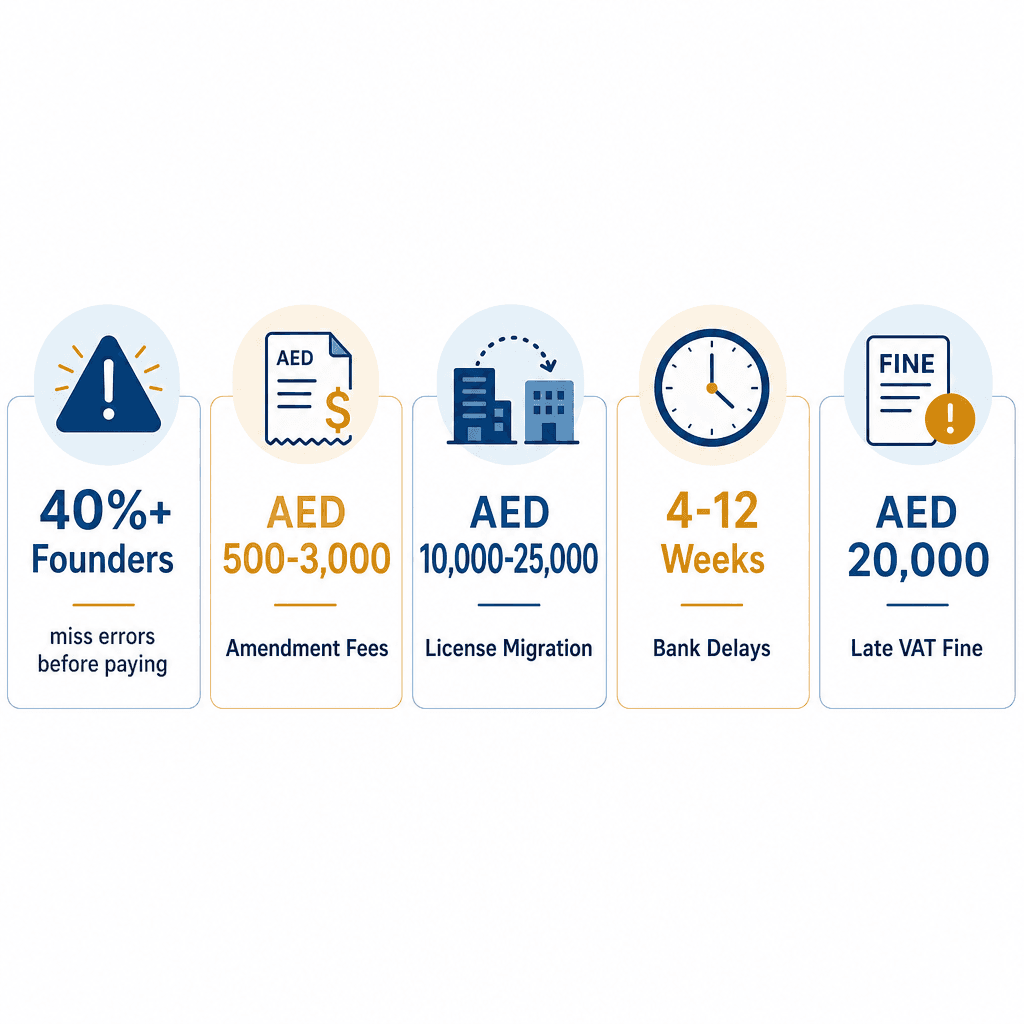
Free zone setup mistakes in Dubai are errors made during company formation, wrong activity codes, mismatched visa packages, or overlooked banking requirements, that aren't discovered until after fees are paid. Correcting them typically costs AED 2,000–15,000 in amendment fees, plus weeks of lost operating time. That's the real price of skipping due diligence at the start.
Why Most Mistakes Surface After Payment, Not Before
Free zone registration portals are built for transactions, not strategy. They confirm your submission, they don't audit whether your chosen activity code actually covers your business model, or whether the free zone you picked has a working relationship with the bank you plan to use.
Activity codes and visa quotas are typically selected at checkout speed. A marketing consultant registers under "Advertising Services" without realising that running paid media budgets for clients requires a separate "Media Buying" activity code in several UAE free zones. That omission stays invisible until a client requests a service agreement and the scope doesn't match the license. By that point, you're already paying amendment fees.
The pattern repeats across all 10 mistakes covered below. Each error is small at the point of registration. Each compounds over the first 12–24 months. If you want to avoid the most common mistakes to avoid when setting up in Dubai, the time to act is before you pay, not after.
How This Guide Is Structured
Each of the 10 mistakes below follows the same format: what the mistake is, why founders make it, what the consequence is, and how to avoid it. The guide covers pre-registration, registration, and post-license phases, because errors company formation Dubai founders make don't cluster neatly in one stage.
You'll also find a comparison table, an infographic brief, and a Q&A section covering the questions I see most often from founders who've already made one of these mistakes and are trying to recover.
10 Free Zone Setup Mistakes Dubai Founders Make, and How to Fix Them
The 10 most costly free zone setup mistakes in Dubai are: choosing the wrong free zone, underestimating total costs, picking the wrong activity code, ignoring banking requirements, selecting a zero-visa package, skipping the MoA review, forgetting renewal costs, missing the visa grace period, skipping VAT registration, and launching without a compliance calendar. Here's how each one plays out in practice.
Mistake 1: Choosing the Wrong Free Zone for Your Activity
Dubai has over 30 free zones, and not all of them permit all activities [STAT: source needed]. Some free zones are structured specifically for media and marketing businesses, while others are built around trading and commodities. Dubai South Business Hub is a broader multi-activity zone that accommodates a wider range of business types, making it a flexible choice for entrepreneurs across many sectors.
Founders typically choose a free zone based on brand recognition or a peer recommendation, not activity fit. A SaaS founder I've seen set up in a media-focused free zone because a colleague recommended it, then discovered that software development and IT consulting required a separate technology license. That added AED 8,000+ in fees and a six-week delay before they could invoice legitimately.
Before paying anything, cross-reference the free zone's permitted activity list against every revenue stream in your business model. The UN's ISIC Revision 4 classification system (UN Statistics Division, 2008, still accurate as of 2026) provides a four-level hierarchy (Section, Division, Group, Class) that's a useful cross-reference for identifying which category your work actually falls into. See our guide on choosing the right business activity for a practical walkthrough.
Mistake 2: Underestimating Total Cost, Visa Fees, Bank Minimums, Insurance
The headline license fee is one line item. Here's what else lands in your first year:
Visa costs: AED 3,500–5,000 per visa [STAT: source needed]
Emirates ID: approximately AED 1,200 [STAT: source needed]
Mandatory health insurance: AED 600–4,000+ per person per year, depending on plan [STAT: source needed]
Bank minimum balance: AED 10,000–50,000 depending on the bank [STAT: source needed]
Renewal fees in year two: typically 80–100% of your original license fee
A solo founder who budgets AED 12,000 for a free zone license can easily face a total first-year spend closer to AED 46,000 once visas, Emirates ID, insurance, and a bank minimum balance are factored in. That's not unusual, it's the norm. Free zone marketing emphasises the license cost because it's the lowest number on the page.
Build a full 24-month cost model before committing to any package. Use the cost calculator to see your true setup cost including visas, and review the full breakdown of hidden costs to consider when starting a business in Dubai before you sign.
Mistake 3: Choosing the Wrong Activity Code, Too Narrow or Too Broad
Activity codes define what you're legally permitted to do. Too narrow, and you can't invoice for related services. Too broad without clear justification, and some UAE retail banks will flag your account application during due diligence.
Founders default to the most general option available because the codes look similar in the portal. A business consultant who adds training workshops to their revenue model but registered only under "Management Consultancy" will find that training is a separate activity code in most UAE free zones. Every workshop invoice sits outside their licensed scope until they pay to amend.
Most UAE free zones allow 1–3 activities on a standard license, with additional activities costing AED 2,000–1,500 each [STAT: source needed]. List every revenue stream you expect in year one, map each to a specific activity code using ISIC Rev.4's Group and Class levels as a reference, and confirm coverage with the free zone authority before submitting. That conversation costs nothing. The amendment costs AED 500–3,000 and two to six weeks of your time.
Mistake 4: Not Checking Banking Requirements Before Choosing a Free Zone
Banking is treated as a post-setup task. It shouldn't be. Some free zones have strong, active referral relationships with UAE retail banks. Others don't, and founders only discover this when they're sitting across from a bank relationship manager who tells them the free zone isn't on their approved list.
A logistics startup I'm aware of incorporated in a smaller UAE free zone and then spent four months attempting to open a UAE business bank account. During that period, they received client payments through personal accounts, creating accounting complications that took an auditor weeks to untangle.
Two questions to ask any free zone before signing:
A free zone with a dedicated banking desk or a named bank partner is a strong positive signal. Dubai South Business Hub, for example, actively facilitates bank introductions as part of its setup process, which is worth confirming directly with their team.
Mistake 5: Picking a Zero-Visa Package When You'll Need Visas
Zero-visa packages reduce the upfront cost. They don't grant you UAE residency. If you need a UAE resident visa yourself, to live in Dubai, open a personal bank account, or simply have a UAE phone number, you need at least a one-visa allocation on your license.
Upgrading your visa quota after the fact is possible but costs AED 1,500–3,000 in amendment fees depending on the free zone, plus the standard visa processing cost. More importantly, the upgrade process takes time, during which you're operating without the residency you need.
Mistake 6: Not Reading the MoA Before Signing
The Memorandum of Association (MoA) governs your company's internal structure, profit distribution, director authority, and what happens if a shareholder exits. Most founders sign it without reading it because it looks like boilerplate. It isn't.
Errors company formation Dubai founders commonly make here include accepting default profit split ratios that don't match their actual agreement, or missing clauses that restrict the company's permitted activities to a narrower list than the license itself. If you're a solo founder, the MoA still matters: it defines the scope of your authority and the conditions under which the company can be amended or dissolved.
Mistake 7: Ignoring Annual Renewal Costs in Your Year-One Budget
Renewal fees are typically 80–100% of your original license fee, due 12 months after incorporation. If your license cost AED 15,000, budget AED 12,000–15,000 for renewal in year two, plus any visa renewals, which run AED 3,500–5,000 each. Founders who don't model this end up scrambling for cash in month eleven.
Mistake 8: Missing the Grace Period for Visa Applications After License Issuance
Most UAE free zones require visa applications to be initiated within 60 days of license issuance. Miss that window and you may need to pay re-entry or reactivation fees to get back into the visa process. Trigger your visa application within the first two weeks of receiving your license, not the last two weeks of the grace period.
Mistake 9: Not Registering for VAT When Required
The Federal Tax Authority (FTA) mandates VAT registration when your taxable turnover reaches AED 375,000 in any 12-month period (Federal Tax Authority, 2026). Voluntary registration is available from AED 187,500. Founders who don't track this threshold get caught: the FTA can assess back-dated VAT liability from the date you crossed the threshold, and late registration penalties start at AED 10,000.
Don't wait until you've crossed the threshold. Set a revenue tracking trigger at AED 300,000 and consult a UAE tax adviser before you hit AED 375,000.
Mistake 10: Not Having a Compliance Calendar From Day One
A compliance calendar is a simple document listing every regulatory deadline your company faces: license renewal, visa renewals, VAT filing dates, economic substance reporting (where applicable), and Ultimate Beneficial Owner (UBO) register updates. Without one, deadlines slip. Penalties for missing them range from AED 1,000 to AED 50,000+ depending on the obligation.
Build the calendar on the day your license is issued. Most free zones will give you a renewal date at the point of registration, that's your anchor date. Work backwards from it.
Quick Comparison: Getting It Right vs. Getting It Wrong
Founders who verify activity codes, banking relationships, and total costs before committing to a free zone avoid amendment fees, bank account delays, and VAT penalties. Those who skip due diligence typically spend AED 5,000–25,000 correcting avoidable errors and lose 4–12 weeks of operating time.
What a Properly Planned Free Zone Setup Looks Like
The difference between a smooth setup and a reactive one isn't luck. It's a checklist completed before payment. Here's how the two paths compare:
Planned Setup vs. Reactive Setup: What the Data Shows
Factor | Planned Setup (Dubai South BH) | Reactive Setup (No Pre-Check) |
|---|---|---|
Activity code accuracy | ✅ Verified against all revenue streams pre-submission | ❌ Selected at checkout speed, errors found post-payment |
Total first-year cost visibility | ✅ Full 24-month model including visas, insurance, renewal | ❌ License fee only, cash flow crisis in months 2–4 |
Bank account opening | ✅ Active bank introductions, avg. 4–6 weeks | ❌ No relationship, 4–12 weeks or outright rejection |
Amendment fees incurred | ✅ AED 0, correct from day one | ❌ AED 500–3,000+ per correction |
Visa quota | ✅ Matched to actual headcount plan | ❌ Zero-visa package, upgrade needed within 60 days |
Compliance calendar | ✅ Live on day one of license issuance | ❌ Built reactively after first missed deadline |
Total correction cost | ✅ AED 0 | ❌ AED 5,000–25,000 average |
The planned approach isn't slower, it's the same process with a pre-flight checklist. Ready to calculate your business setup cost with that checklist already built in?
Infographic: The 10 Free Zone Setup Mistakes at a Glance
Use this designer brief to build a shareable visual audit tool for founders evaluating their free zone setup process.
Citations
Federal Tax Authority.. tax.gov.ae. FTA UAE, 2023.
Dubai Economy and Tourism.. dubaidet.gov.ae. DET Dubai, 2024.
UAE Ministry of Economy and Tourism.. moet.gov.ae. MOET UAE, 2024.
UAE Cabinet.. uaecabinet.ae. UAE Cabinet, 2023.
Federal Authority for Identity, Citizenship, Customs and Port Security.. icp.gov.ae. ICP UAE, 2024.
Frequently Asked Questions