
Topic Summary
Free Zone vs Mainland: The Core Difference
Free zone companies are licensed by their own authority and operate within a separate visa and labour framework, while mainland companies are licensed by DET and can trade anywhere in the UAE. For employers, the decisive factor is not ownership structure but where your staff will physically work.
Free Zone Licensing Costs and Speed
Dubai South Business Hub Free Zone issues licenses from AED 12,500, with a first-year all-in cost for a sole founder with one visa from AED 18,350. Licenses are issued in one business day with zero paid-up share capital required.
Mainland Compliance Carries Real Financial Risk
Late corporate tax registration on the mainland triggers a one-time AED 10,000 penalty. Founders who delay compliance after their first hire often discover these obligations only after the fact.
Free Zone Staff Cannot Freely Work on Mainland
Free zone employees cannot legally work at mainland premises without a No Objection Certificate or a dual-license arrangement. A logistics company learned this the hard way when free-zone-licensed drivers making daily mainland warehouse runs were found non-compliant.
Regulated Activities Require a Second Approval Layer
A free zone or mainland trade license alone is not sufficient for regulated sectors such as health or education. DHA must separately approve health activities and KHDA must approve education activities, regardless of which licensing authority issued the trade license.
Emiratisation Targets Apply Only to Mainland Employers
Mainland companies with 50 or more employees are subject to Emiratisation targets under the UAE's Nafis programme. Free zone companies operate under a separate framework and are not subject to the same obligations.
Foreign Ownership Is Not the Deciding Factor
100% foreign ownership is available under both mainland and free zone structures, so it should not drive your decision between the two. The real differentiator is operational geography and which labour authority will govern your employees.
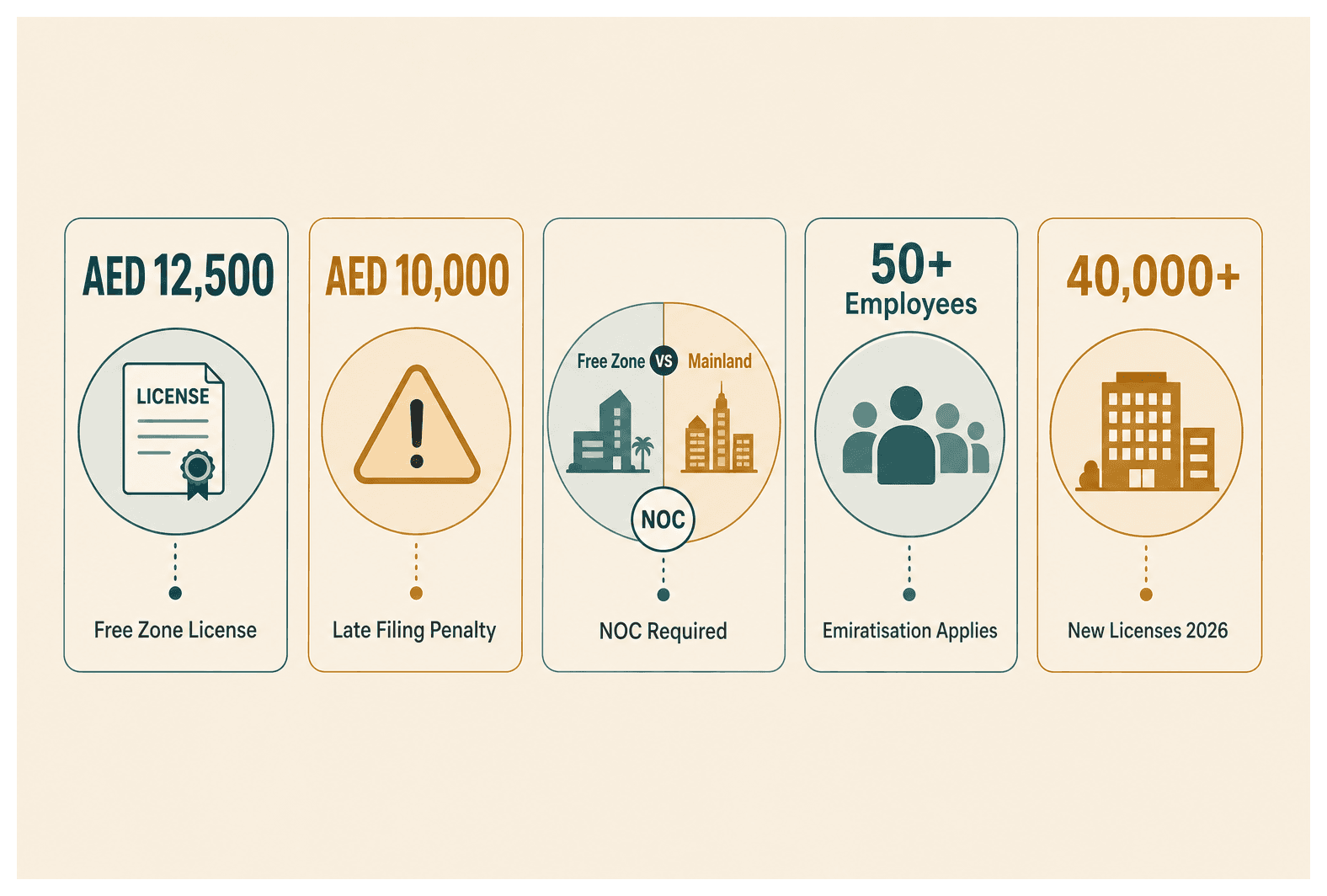
In 2026, more than 40,000 new business licenses were issued in Dubai alone, yet a significant share of founders only discovered their visa quota limits and labour compliance obligations after making their first hire. The free zone vs Dubai mainland decision carries real financial and legal consequences the moment you bring staff on board. Dubai South Business Hub Free Zone issues licenses from AED 12,500 [1], with a first-year all-in cost for a sole founder with one visa from AED 18,350 [2]. Mainland corporate tax registration carries a one-time AED 10,000 penalty for late filing [3]. Free zone staff cannot legally work at mainland premises without a No Objection Certificate [4]. And Emiratisation targets under the Nafis programme apply to mainland companies with 50 or more employees [5].
This article breaks down the free zone vs Dubai mainland decision specifically for companies that plan to hire, covering cost, visa access, labour law scope, and a clear scenario-by-scenario recommendation so you can choose the right structure before you sign a single employment contract.
What Is the Free Zone vs Dubai Mainland Distinction for Employers
A free zone is a designated economic area governed by its own authority, where companies operate under a separate licensing and visa framework. Mainland companies are licensed by DET and can trade anywhere in the UAE. For employers, the key difference is where staff can work and which labour authority regulates the relationship.
How Each Structure Is Licensed and Governed
Free zone companies receive their trade license from the relevant free zone authority, not DET. Each authority sets its own fee schedule, visa package tiers, and office requirements. Dubai South Business Hub Free Zone, launched in September 2025, issues licenses in one day from AED 12,500, with zero paid-up share capital required.
Mainland companies are licensed by DET and can operate across all seven emirates without geographic restriction. For any regulated activity, the licensing structure is two-part: the free zone authority (or DET for mainland) licenses the activity, and the named sector regulator approves it separately. DHA approves health activities; KHDA approves education activities. The free zone license alone is not sufficient for regulated sectors.
DSBH license from AED 12,500
License issued in one business day
Zero paid-up share capital required at DSBH
Regulated activities require separate sector regulator approval in addition to the license
A consulting firm licensed at Dubai South Business Hub Free Zone can bill UAE clients directly. But if it wants to station staff permanently at a Dubai mainland client site, it needs either a mainland entity or a formal secondment arrangement, the free zone license alone does not cover that operational model.
The Core Employment Jurisdiction Split
Free zone employees are registered with the free zone authority and, where applicable, MoHRE under a separate free zone labour card. Mainland employees fall directly under MoHRE jurisdiction, the UAE Labour Law (Federal Decree-Law No. 33 of 2021), and the Wages Protection System. These are not interchangeable frameworks.
Worth flagging: 100% foreign ownership is available on both mainland and free zone structures. It is not a differentiator between the two and should not drive your decision. The real differentiator is operational geography.
Free zone labour cards are issued by the free zone authority
Mainland labour cards are issued by MoHRE under Federal Decree-Law No. 33 of 2021
Free zone staff cannot legally work at mainland premises without a No Objection Certificate or dual-license arrangement
Both structures require ICP-issued residency visas
An HR manager at a logistics company discovered that three free-zone-licensed drivers were technically non-compliant the moment they began daily runs to mainland warehouses. Resolving it required a mainland license, a structural fix, not an administrative one. Check your list of business activities in Dubai carefully before choosing your jurisdiction.
Free Zone vs Dubai Mainland: Employer Comparison
Feature | Free Zone | Mainland |
|---|---|---|
License authority | Relevant free zone authority (e.g., Dubai South Business Hub Free Zone) | DET (Dubai Department of Economy and Tourism) |
First-year cost (sole founder, 1 visa) | From AED 18,350 at DSBH (license from AED 12,500; visa costs additional) | DET license fee + mandatory physical office lease + MoHRE registration; typically higher total |
Visa quota basis | Set by free zone authority; tied to office package type (flexi-desk, shared, dedicated) | Set by MoHRE based on office area (approx. one visa per nine sq m) |
Labour authority | Free zone authority; some align with UAE Labour Law, others use own templates | MoHRE; Federal Decree-Law No. 33 of 2021; Wages Protection System mandatory |
Geographic trading scope | Free zone premises and overseas clients; mainland trading requires NOC or separate entity | Unrestricted across all seven emirates; direct UAE consumer and government contract access |
Share capital required | Zero paid-up share capital at DSBH | Varies by activity and legal structure; typically required for LLC formation |
Customs treatment on goods | Goods duty-suspended (not duty-exempt); DSBH is not a designated zone and receives no designated-zone customs or VAT benefit | Standard UAE customs duties apply; no duty-suspension benefit |
Free Zone vs Dubai Mainland: Side-by-Side Comparison Table
The key employer variables in the free zone vs Dubai mainland decision are license cost, visa quota, labour law authority, geographic scope of operations, and customs treatment. Free zones suit service exporters and remote-delivery models; mainland suits businesses with physical UAE-wide client presence and high staff headcount needs.
Cost, Visa, and Scope at a Glance
The comparison table above gives you the full picture at a glance. A few points need unpacking. DSBH's first-year cost for a sole founder with one visa starts from AED 18,350, but visas are always an additional cost, never bundled into the license fee. Each activity beyond the first five costs AED 2,000, so a multi-activity setup needs careful budgeting from the start.
Mainland license costs vary significantly by activity and office requirement. A physical office is mandatory for most mainland setups, and that lease cost is a recurring overhead that compounds annually. A free zone tech startup with five developers working remotely for overseas clients pays substantially less in overhead than a mainland equivalent, but the moment it wins a government contract requiring local presence, the structure must change.
Use the business setup cost calculator to model your exact scenario before committing to either structure.
Visa Quota Mechanics: Free Zone vs Mainland
Free zone visa quotas are set by the free zone authority and tied directly to your office package type. A flexi-desk package supports a lower headcount than a dedicated unit. Mainland visa quotas work differently: MoHRE calculates allowable headcount based on your office's physical area, at approximately one visa per nine square metres.
Scaling from five to twenty staff on a mainland license means upgrading your office space to open up the quota. On a free zone license, it means moving to a higher-tier office package. Neither route is free.
Free zone: quota tied to office package tier chosen at setup
Mainland: MoHRE quota at approx. one visa per nine sq m of office space
Residency visas are always an additional cost on top of the license fee, regardless of jurisdiction
A retail chain hiring twenty store assistants across Dubai needs a mainland license. The MoHRE-based quota tied to its retail floor area is the natural mechanism for that headcount, and it scales predictably as the business grows.
How Visa Quotas and Labour Rules Differ Between Free Zone and Mainland
Mainland employers register staff directly with MoHRE and must comply with the Wages Protection System and Emiratisation targets. Free zone employers register with the free zone authority; some free zones have MoHRE-aligned contracts, others use their own template. Both require ICP-issued residency visas, which are always an additional cost.
MoHRE Obligations and the Wages Protection System
Mainland employers must register every employee with MoHRE, issue a MoHRE-approved contract, and pay salaries via the Wages Protection System. There is no opt-out. Emiratisation (Nafis) targets apply to mainland private sector companies with 50 or more employees, missing quarterly targets carries financial penalties that accumulate quickly.
Free zone companies sit outside direct MoHRE jurisdiction, though many free zones now align their employment contract templates with UAE Labour Law standards. Before you hire from another entity, use the MoHRE inquiry tools to verify a worker's existing contract status, especially important when poaching talent from a competitor.
A mainland staffing agency with 60 employees received an Emiratisation penalty notice after missing its quarterly Nafis target. A same-size free zone competitor operating under its free zone authority's rules did not face the same obligation. That is a material cost difference at scale.
Entry Permits, Labour Cards, and ICP Processing
Here is the common thread between both structures: both free zone and mainland companies sponsor employee residency visas through ICP. The entry permit process, medical fitness requirements, and Emirates ID application are identical regardless of your license type.
ICP entry permit: required for all sponsored employees
Medical fitness test: mandatory pre-residency requirement
Emirates ID: issued post-residency stamping
Labour card: issued by the free zone authority (free zone) or MoHRE (mainland)
A founder setting up at Dubai South Business Hub Free Zone budgets AED 18,350 for year one as a sole founder with one visa. The visa costs sit entirely outside the license fee. Missing corporate tax registration triggers a one-time AED 10,000 flat penalty; missing VAT registration (once taxable turnover exceeds AED 375,000) triggers a separate one-time AED 10,000 penalty (Federal Tax Authority, 2023). Neither is avoidable.
Step-by-Step Guide to Choosing Your Structure Before Your First Hire
To choose correctly between free zone vs Dubai mainland before hiring, map your client location, staff work-site needs, and headcount growth plan against each structure's visa quota mechanics, labour authority, and geographic trading scope. Then match the result to your first-year budget.
Step 1: Map Where Your Staff Will Physically Work
This is the single most important question. If your staff deliver services at mainland client sites daily, a mainland license removes compliance risk from day one. If staff work remotely, from your own free zone office, or serve overseas clients, a free zone license is operationally clean.
Hybrid models, free zone license plus a mainland branch, are possible but add cost and administrative load. A creative agency whose designers work from a free zone hub and present to clients via video call has no operational need for a mainland license. But the moment a designer is seconded full-time to a client's Dubai office, the compliance picture changes.
Step 2: Project Your Headcount for 24 Months and Match to Quota
Estimate realistic headcount at 12 and 24 months, not just on launch day. Then check whether your chosen structure can actually support that number.
Free zone: confirm the authority's visa package tier supports your target headcount before signing
Mainland: calculate the office area needed to support MoHRE quota for your projected team
Mainland: factor Emiratisation obligations if you expect to cross 50 employees within two years
A fintech planning to hire 15 developers within 18 months should confirm the free zone's flexi-desk package supports that quota before committing, or budget for an office upgrade at renewal. Getting this wrong mid-year is expensive.
Step 3: Run the First-Year Cost Comparison and Decide
Run the numbers before you commit. Free zone: DSBH license from AED 12,500; first-year total for a sole founder with one visa from AED 18,350; each activity beyond the first five costs AED 2,000. Mainland: DET license fee plus mandatory physical office lease plus MoHRE registration per employee, total first-year cost is typically higher.
Neither structure is tax-efficient. Corporate tax at 9% applies above AED 375,000 net profit for most entities. Qualifying Free Zone Person (QFZP) status requires four specific conditions and cannot be assumed simply because you hold a free zone license. A sole consultant projecting AED 600,000 in year-one revenue should model both structures against the 9% threshold, not assume free zone status removes the liability. Use the Dubai free zone company setup cost calculator to model your actual scenario.
When Mainland Is the Right Call for Your Hiring Plan
Mainland licensing is the better choice when your staff physically work at UAE client sites, your business model depends on walk-in retail or direct government contracts, or your headcount will exceed the visa quota your free zone office package supports within the first two years of operation.
Business Models That Need Mainland Access
Retail, food and beverage, and hospitality businesses serving walk-in UAE consumers need a mainland DET license
Government contracts and federal tenders almost always require a mainland-registered entity
Construction, facility management, and field-service companies whose crews work across Dubai require mainland labour cards
Real estate license holders need RERA registration, which is tied to a mainland DET license
A property management company handling 200 units across Dubai needs RERA registration, a DET-issued real estate license, and MoHRE labour cards for its maintenance crew. A free zone structure cannot support this model, the operational geography makes it unworkable from day one.
Scenarios Where Free Zone Wins Instead
Service exporters billing overseas clients with staff working from a single Dubai office are the ideal free zone profile
Tech companies and consultancies with remote delivery models save significantly on overhead in a free zone structure; an ICT license in Dubai through a free zone is a natural fit
Import-for-re-export models benefit from duty-suspension on goods, but goods are duty-suspended, not duty-exempt, and DSBH does not provide bonded warehousing or customs integration
Early-stage companies keeping headcount under ten and costs low suit a free zone flexi-desk setup
A software-as-a-service company with eight engineers serving European clients from a Dubai office has no operational reason to carry the higher overhead of a mainland license. The free zone vs Dubai mainland decision here is clear: free zone wins on cost, speed, and structural simplicity. The pattern is consistent, if your clients are overseas and your staff stay in one place, free zone is the lower-cost, lower-risk default.
Key Compliance Costs Every UAE Employer Must Budget For
Beyond the license fee, UAE employers in both free zone and mainland structures must budget for residency visa fees, Emirates ID, medical testing, ICP entry permits, and corporate tax registration. Missing corporate tax or VAT registration deadlines each triggers a one-time AED 10,000 penalty from the Federal Tax Authority.
Per-Employee Costs That Apply in Both Structures
ICP entry permit: applies to every sponsored employee, free zone or mainland
Medical fitness test: mandatory pre-residency requirement for all nationalities
Emirates ID: issued post-residency stamping; annual renewal applies
Residency visa stamping: employer-borne cost regardless of jurisdiction
PRO service fees: relevant if you are processing multiple visas without in-house government relations support
A free zone company adding five employees in year two should pre-budget for five sets of entry permits, medical tests, Emirates IDs, and residency stamps. These are never included in the DSBH license fee. For UAE residency visa packages tied to your company license, confirm costs upfront rather than discovering them at the point of hiring.
Tax Registration and Penalty Exposure
Corporate tax registration is mandatory for all UAE entities. Late registration carries a one-time AED 10,000 flat penalty from the Federal Tax Authority, it is not a monthly charge, but it is unavoidable once triggered. VAT registration is required once taxable turnover exceeds
References
Frequently Asked Questions