Topic Summary
A City Built Around One Airport
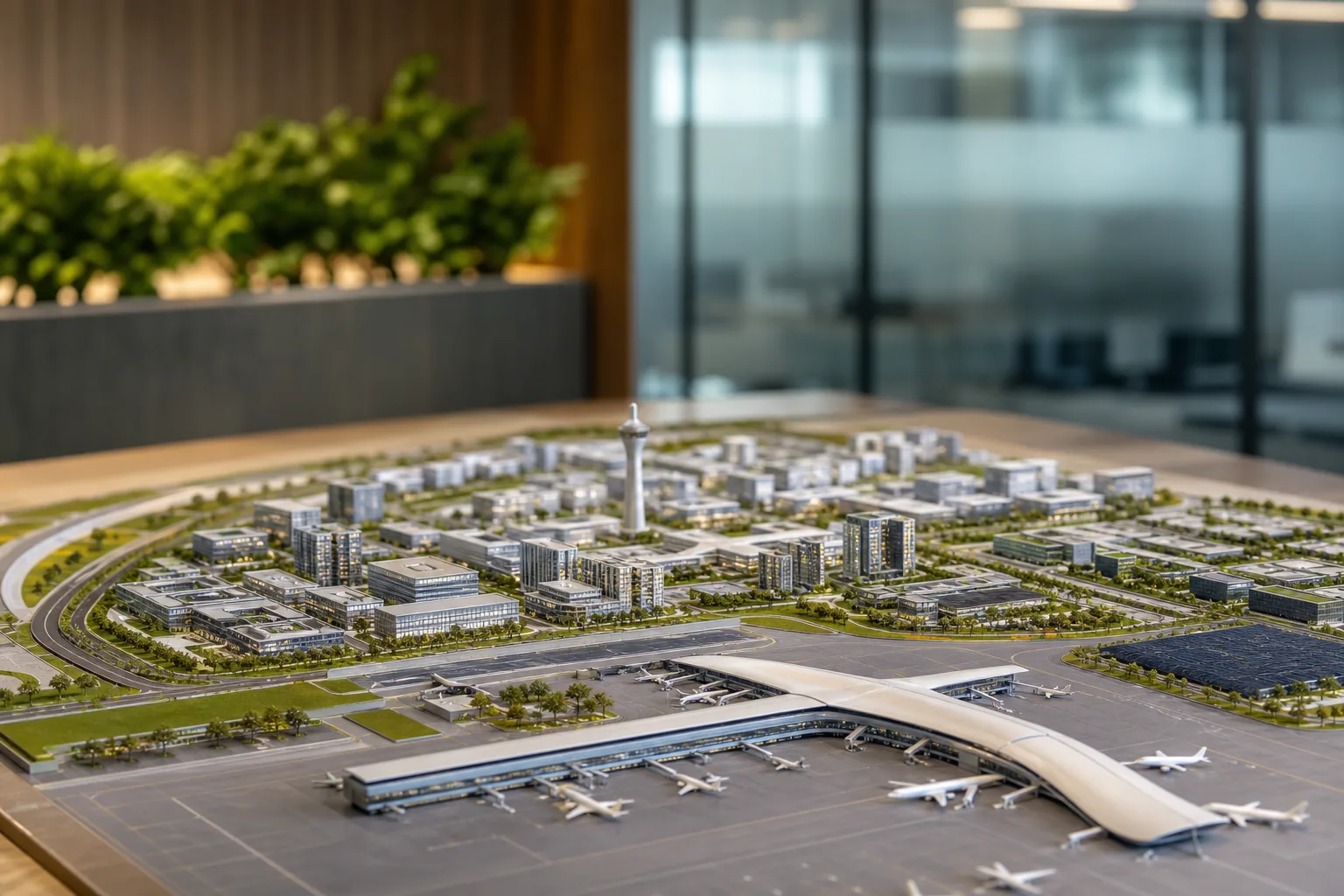
Dubai South spans 145 square kilometres of 100% government-owned land centred on Al Maktoum International Airport. With no private landowners to slow decisions, the master plan for 1 million residents and 500,000 jobs can move at a pace few urban projects can match.
World's Largest Airport Under Construction
A USD 35 billion expansion is already underway to bring Al Maktoum International Airport to a capacity of 160 million passengers per year. That is nearly double the roughly 86 million passengers Dubai International Airport handled in 2023.
Six Districts, Each With a Clear Purpose
Dubai South is divided into six named districts covering aviation, logistics, commercial, residential, golf, and the Expo City innovation hub. Businesses choose the district that matches their actual operations rather than fitting into a generic free zone.
A Cargo Hub Rivalling Memphis and Hong Kong
At full capacity, Al Maktoum International Airport is designed to handle 12 million tonnes of cargo per year, which would make it the world's busiest air freight hub. Combined with DP World's Jebel Ali Port just 15 km away, the zone offers a rare sea-to-air logistics advantage.
Fast and Affordable Business Setup
License packages inside the Dubai South Business Hub Free Zone start from AED 12,500 per year, with setup completed in as little as 3 to 5 working days. Over 25,000 businesses are already operating through the zone.
No Need to Wait for Full Build-Out
The airport is operational now and actively growing, meaning freight forwarders, e-commerce operators, and logistics firms can benefit from the zone's infrastructure today. Businesses that establish early gain a foothold before competition intensifies at scale.
In 2026, Dubai South covers 145 square kilometres of 100% government-owned land next to Al Maktoum International Airport, with a USD 35 billion airport expansion already underway and over 25,000 businesses already operating through the Dubai South Business Hub Free Zone (Dubai South, 2026). The airport is designed for 160 million passengers at full capacity. That is nearly twice what Dubai International Airport handled in 2023. The master plan targets 1 million residents and 500,000 jobs. License packages start from AED 12,500 per year. Setup takes 3 to 5 working days.
This article breaks down what the future of Dubai South looks like, why it matters for businesses and investors, and what steps you can take right now to get a foothold in one of the world's fastest-growing economic zones.
What Is the Future of Dubai South
The future of Dubai South is a government-backed plan to build a city of 1 million residents and 500,000 jobs around Al Maktoum International Airport. It targets aviation, logistics, e-commerce, and tech. The USD 35 billion airport expansion is already underway, making it one of the world's largest urban projects.
A City Built Around an Airport
Dubai South is a full city district built from scratch on 145 square kilometres of government-owned land. That ownership matters: there are no private landowners to negotiate with, no fragmented decisions to slow the plan down.
Al Maktoum International Airport (DWC) sits at the heart of it. At full capacity, DWC handles 160 million passengers a year. Dubai International Airport (DXB) handled roughly 86 million in 2023. The scale gap tells you everything about the ambition here.
The master plan targets 1 million residents and 500,000 jobs at build-out. Those are numbers that rival entire national capitals. The USD 35 billion airport expansion budget is already committed and under active construction.
Six Districts, One Vision
Dubai South is divided into 6 named districts, each with a defined role:
Aviation District, cargo ops, ground handling, MRO, and aviation training
Logistics District, warehousing, freight forwarding, and supply chain
Commercial District, retail, offices, and business services
Residential District, housing communities for the zone's growing population
Golf District, leisure, hospitality, and open green space
Expo City District, built on the Expo 2020 site, now a permanent innovation and business hub
A logistics firm handling air freight can base its warehouse in the Logistics District, within minutes of the airport cargo terminal. That cuts delivery time and cost in a way no other UAE location can match right now.
The six-district structure means you pick a location that fits your actual work. You are not forced into a one-size zone. Check the full list of business activities at Dubai South to see which district and license type fits your model.
The Airport Driving It All
Al Maktoum International Airport is the engine behind the future of Dubai South. Its USD 35 billion expansion will make it the world's largest airport by capacity. Cargo, passenger, and logistics operations are all scaling together, creating demand for businesses across every sector based in the zone.
Why This Airport Changes Everything
DWC was designed as a multimodal hub from day one. Air, road, and eventually rail all converge at one point. That is the core logic of the whole zone.
At full build, DWC handles 12 million tonnes of cargo per year. That figure alone would make it the world's busiest air freight hub, ahead of Memphis and Hong Kong. DP World's Jebel Ali Port sits 15 km from DWC. A business at Dubai South can move goods from sea to air without leaving the zone. For any import-export operation, that is a genuine logistical edge that is very hard to replicate elsewhere.
What This Means for Businesses Now
You do not need to wait for full build-out. The airport is operational now and growing fast. These business types are already active inside the zone:
Freight forwarders and customs brokers
E-commerce fulfilment and last-mile delivery firms
Aviation services and ground handling companies
Warehousing and cold-chain logistics operators
Proximity to the airport is a real cost advantage: less road haulage, faster customs clearance, shorter supply chains. An e-commerce company storing inventory in the Logistics District can clear customs at DWC and dispatch internationally within hours of an order being placed. As passenger numbers grow, demand for hospitality, retail, and professional services inside the zone will rise with them.
How Dubai South Fits the 2040 Plan
Dubai South is one of five urban centres named in the Dubai 2040 Urban Master Plan. The plan redirects city growth away from the coast and toward inland economic zones. Dubai South is set to absorb a large share of the city's new residents, workers, and businesses over the next 15 years.
Five Urban Centres, One of Them Dubai South
The Dubai 2040 Urban Master Plan names five urban centres, each with its own growth targets for population, jobs, and green space:
Deira, heritage retail and tourism core
Bur Dubai, established mixed-use centre
Dubai Creek Harbour, waterfront development hub
Dubai Marina, residential and hospitality corridor
Dubai South, aviation, logistics, and economic production engine
Dubai South is the only one of the five built around an airport and a logistics corridor. That makes it the economic production engine of the group, not just a residential or leisure node. The plan commits to growing green and recreational space from 7.2% to 60% of the city's total area. Dubai South's Golf District and open parkland are already aligned with that target (u.ae, 2021).
The plan runs to 2040. That gives businesses a 15-year runway of government-backed investment and infrastructure spending. Few economic zones anywhere offer that kind of policy certainty.
Population and Jobs Growth
Dubai's population is expected to reach 5.8 million by 2040, up from around 3.6 million now. Dubai South is set to absorb a meaningful share of that growth, both residents and workers.
More people means more demand for housing, schools, healthcare, retail, and professional services inside the zone. A professional services firm that sets up in Dubai South in 2026 will be embedded before the planned residential communities reach full occupation. That is first-mover status with a growing local client base, available right now.
Is Dubai South a good place to set up a business in 2026?
Yes, for businesses in logistics, aviation, tech, and professional services. The airport expansion is funded and under construction. The 2040 master plan gives policy certainty to 2040. Over 25,000 businesses are already inside the zone. Setup takes 3 to 5 working days and costs from AED 12,500 per year. The timing advantage goes to businesses that act before population and infrastructure milestones push costs higher.
5 Sectors That Will Shape Dubai South
The five sectors set to define the future of Dubai South are aviation and aerospace, logistics and e-commerce, technology and ICT, real estate and construction, and professional services. Each one is supported by dedicated infrastructure, government licensing, and direct access to Al Maktoum International Airport and Jebel Ali Port.
Top 5 Growth Sectors
Aviation and aerospace, MRO, ground handling, aircraft parts, and aviation training. All licensed and operating at DWC now.
Logistics and e-commerce, warehousing, freight forwarding, last-mile delivery, and fulfilment centres. Airport and port proximity is the core draw.
Technology and ICT, software, data, fintech, and digital services. Companies are drawn by 100% foreign ownership and 0% personal income tax in the free zone.
Real estate and construction, residential communities, commercial towers, and industrial builds are all in active development phases right now.
Professional services, legal, finance, consulting, and marketing firms serving the growing business population inside the zone.
A fintech startup that needs a technology license can get an ICT business license in Dubai through DSBH, giving it a regulated base inside one of the UAE's fastest-growing economic corridors. That license comes with 100% foreign ownership and no personal income tax.
Which Sector Fits Your Business
The right sector depends on where your clients are and how your goods or services move. If you sell physical goods internationally, logistics is your anchor. Warehouse near the airport, clear customs fast, and dispatch the same day.
If you sell knowledge or digital services, professional services or ICT gives you the license you need with minimal physical setup. A US-based consulting firm opening a UAE office can use a professional business license in Dubai at DSBH. It gets a legal entity, a UAE bank account, and visa eligibility for its team, without needing a physical office from day one. Flexi-desk options are available, and visa eligibility is tied to your trade license.
Risks and Challenges to Watch
The future of Dubai South faces real risks: long build timelines, global economic shifts, and the gap between planned and actual population growth. Businesses should plan around what exists today, not just what is promised. Infrastructure is advancing fast, but full build-out is still decades away.
Timeline Risk: What Is Built Now vs Later
Large master-plan projects often take longer than their published timelines suggest. The airport expansion is the most concrete near-term driver. It is funded and under active construction. Residential and retail parts of the plan are further out.
A retail business banking on 1 million Dubai South residents should note that the zone currently houses far fewer. The residential pipeline is real, but the timeline extends beyond 2040. Plan for what is here now, and build your model to grow as the population arrives.
Global Factors That Could Shift the Picture
Trade risk. A slowdown in global trade would reduce cargo volumes through DWC. That weakens demand for logistics businesses inside the zone. Watch global freight indices as a leading signal.
Real estate risk. Rising interest rates globally affect real estate investment and construction timelines. If credit tightens, some residential and commercial phases could slow.
Tax risk. Corporate tax at 9% on income above AED 375,000 now applies across the UAE. Free zone companies can still access a 0% rate, but only if they meet the Qualifying Free Zone Person conditions the Federal Tax Authority (FTA) sets. A free zone company that earns income from UAE mainland clients may not qualify. Check your position before you file (Federal Tax Authority, 2023).
Dubai South vs Mainland Dubai: Key Setup Differences
Feature | Dubai South Free Zone (DSBH) | Dubai Mainland (DET) |
|---|---|---|
Foreign ownership | 100% foreign ownership, no local partner needed | 100% now permitted for most activities after 2021 reforms; some regulated sectors still require local involvement |
Client access | Best suited to international clients and cross-border trade | Open UAE market access; sell directly to mainland businesses and consumers |
Office requirement | Flexi-desk options available; no dedicated office needed from day one | Physical office address typically required for DET license approval |
Setup time | 3 to 5 working days typical | Variable; often longer depending on activity and approvals needed |
License cost | From AED 12,500 per year; clear package pricing | Varies by activity, DET package, and office lease cost |
Corporate tax | 0% possible for Qualifying Free Zone Persons; conditions set by the FTA apply | 9% on taxable income above AED 375,000; no qualifying exemption available |
How to Set Up at Dubai South Today
Setting up at Dubai South Business Hub takes as few as 3 to 5 working days for a free zone trade license. You choose your activity, book your trade name, submit your papers, pay your fee, and collect your license. Visa packages for you and your team are available from the same point.
Step-by-Step: Your Setup Guide
Step 1, pick your activity: Check the full list of business activities at DSBH and confirm your activity code before anything else.
Step 2, check your trade name: Check company name availability using the DSBH name-check tool, the name must not clash with an existing UAE company.
Step 3, choose your package: Work out how many visas you need and whether you want a flexi-desk or a dedicated office.
Step 4, submit your papers: You need your passport copy, a passport photo, and proof of address. No local sponsor is required.
Step 5, pay and collect: Pay the license fee and collect your trade license. Visa applications for you and your team follow from there.
A US national setting up a consulting company at DSBH in 2026 can complete the process remotely in most cases, collect their license digitally, and apply for a UAE investor visa, all without needing an in-country agent.
Costs and What You Get
Free zone license packages at DSBH start from AED 12,500 per year. Use the DSBH cost calculator to get a clear figure for your specific activity and visa count before you commit.
The license fee covers your trade license and one visa allocation as standard. Extra visas are priced separately. Corporate tax registration with the FTA is mandatory once your company exists, whatever your turnover.
Free zone companies can pay 0% corporate tax if they meet the Qualifying Free Zone Person conditions the FTA sets. Get advice on your specific position before you file. Do not assume free zone status means no tax bill.
What Investors Are Watching Right Now
Investors tracking the future of Dubai South are focused on three signals: airport construction progress, residential community occupancy rates, and the pace of new business license approvals. All three are moving in the right direction in 2026, making Dubai South one of the most closely watched urban development projects in the world.
Real Estate and Commercial Property
Residential unit prices in Dubai South have tracked upward since 2022, as DWC expansion announcements have landed. Demand is moving ahead of supply in some segments, a pattern typical of airport-adjacent development globally.
Warehouse and industrial space near the airport cargo terminal is in high demand from logistics and e-commerce firms. Investors buying into Dubai South real estate are betting on long-term capital growth tied to airport and population milestones. The USD 35 billion airport budget makes that thesis more concrete than most.
Business License Growth as a Signal
Three investor signals worth watching right now:
License count growth, over 25,000 businesses already operate through DSBH Free Zone. A rising count signals zone health and growing B2B opportunity.
Airport construction milestones, each phase completion brings more cargo and passenger volume, and more demand for businesses inside the zone.
Residential occupancy rates, as communities fill up, consumer spending inside the zone rises. That lifts retail, hospitality, and professional services demand.
New business registrations in UAE free zones rose sharply after the 2021 foreign ownership reforms, and Dubai South benefited directly (u.ae, 2021). Watching the pace of new license approvals gives you a read on investor confidence that real estate prices alone do not show.
What does the 25,000 business figure tell us about Dubai South?
It tells you the zone already has critical mass. A base of 25,000+ registered businesses means a deep local B2B market, a growing talent pool, and enough economic activity to support service businesses from day one. Most free zones take a decade or more to reach that level. DSBH reached it faster, which reflects both the airport's draw and the 2021 ownership reforms that opened the zone to full foreign ownership.
The Future of Dubai South: What to Do Next
The future of Dubai South is already taking shape. The airport expansion is funded, the master plan is active, and over 25,000 businesses are already inside the zone. The practical next step is to check which business activities fit your model, calculate your setup cost, and apply for your free zone trade license.
Three Actions You Can Take Today
Check which business activities are open to you at DSBH, the list covers trading, services, technology, and more.
Calculate your setup cost using the DSBH cost calculator, get a real number for your license and visa package before you commit.
Search your trade name now, the name-check tool takes seconds and saves you a rejection later.
The future of Dubai South is not a promise. It is a funded, phased, government-backed build that is already underway. The USD 35 billion airport expansion, the Dubai 2040 Urban Master Plan, and the 25,000+ businesses already at DSBH are all moving in the same direction at the same time.
Businesses that act in 2026 get into the zone before the population and infrastructure milestones push costs higher. A logistics company that sets up at DSBH now locks in its position inside the world's largest planned airport city, at today's setup costs, before tomorrow's demand arrives.
Start by exploring the full list of business activities at Dubai South, then use the cost calculator to get your number. Dubai South Business Hub is the practical entry point, licenses, visas, and business support all in one place.
References
Frequently Asked Questions