
Topic Summary
What Is a Dubai South E-Commerce License for Omani Entrepreneurs and Why It Matters
A Dubai South e-commerce license lets an Omani entrepreneur run an online trading company from Dubai South Business Hub Free Zone with 100% ownership. One license covers selling through your own website and marketplaces, and it ties to residency visa packages for the owner.
How GCC National Status and the Land Border Help Omani Founders
How GCC National Status and the Land Border Help Omani Founders
Step-by-Step Guide to Setting Up Your Dubai South E-Commerce License for Omani Entrepreneurs
Setting up an e-commerce company in Dubai South takes six steps: check your company name, choose your activity, submit documents, receive the license, start residency visa processing and activate payment gateways. Gateway approval runs alongside the license.
How Payment Gateway Approval Runs Alongside Your License
Payment gateway approval doesn't have to wait for the license. Omani founders can prepare website policies, bank documents and KYC (know your customer) files while incorporation proceeds, then submit the license on issue. Approval times depend on the provider, so build a buffer before launch.
How Much Does It Cost and How Long Does It Take to Launch
Costs depend on license type, visa count and office option. All figures should be quoted in AED with the date they were checked. Use the cost calculator for a current estimate. Gateway review is the most variable step in the Dubai South e-commerce license for Omani entrepreneurs timeline.
Which Regulations in the UAE Apply to an E-Commerce Company in Dubai South
An e-commerce company in Dubai South must follow UAE regulations on consumer protection, VAT, corporate tax and customs for imported stock. Keep records, display clear policies and check Federal Tax Authority requirements before trading.
What Should You Do Next to Start Your Dubai South E-Commerce Business
Check your company name, run the cost calculator, prepare your passport and website policies, and start the gateway application alongside your license. Confirm documents and current AED fees with the Dubai South team before you commit.
An Omani national can hold 100% of an e-commerce company in Dubai South Business Hub Free Zone under one trade license. Payment gateway approval runs alongside the license, so you can plan to sell soon after incorporation.
UAE e-commerce revenue is projected to pass USD 9 billion in 2026 (Statista, 2025). Over 90% of UAE free zone applications are processed digitally (Dubai Chamber, 2026). This guide covers the Dubai South e-commerce license for Omani entrepreneurs: scope, setup steps, costs and regulations.
What Is a Dubai South E-Commerce License for Omani Entrepreneurs and Why It Matters
A Dubai South e-commerce license lets an Omani entrepreneur run an online trading company from Dubai South Business Hub Free Zone with 100% ownership. One license covers selling through your own website and marketplaces, and it ties to residency visa packages for the owner.
How One License Covers Online Retail and Marketplace Activities
Picture a Muscat home-fragrance brand running a Shopify store and a regional marketplace listing. Both sit under a single trade license. That's because activities are classified by what you sell, not the channel, which matches the logic of ISIC Rev.4 (UN Statistics Division, 2008).
Need to add a related activity later? You can request a license amendment. For activity detail, see the online internet retail trading license in Dubai guide.
Why Omani Founders Choose a Free Zone Structure
Take a founder weighing a home-country entity against a UAE free zone entity for GCC sales. These are the points that usually tip the decision:
100% foreign ownership.
Digital application from start to finish.
Corporate tax applies. Qualifying free zone treatment has conditions, so it isn't blanket tax relief.
A dedicated route for Omani nationals, explained in our Omani national setup guide.
How GCC National Status and the Land Border Help Omani Founders
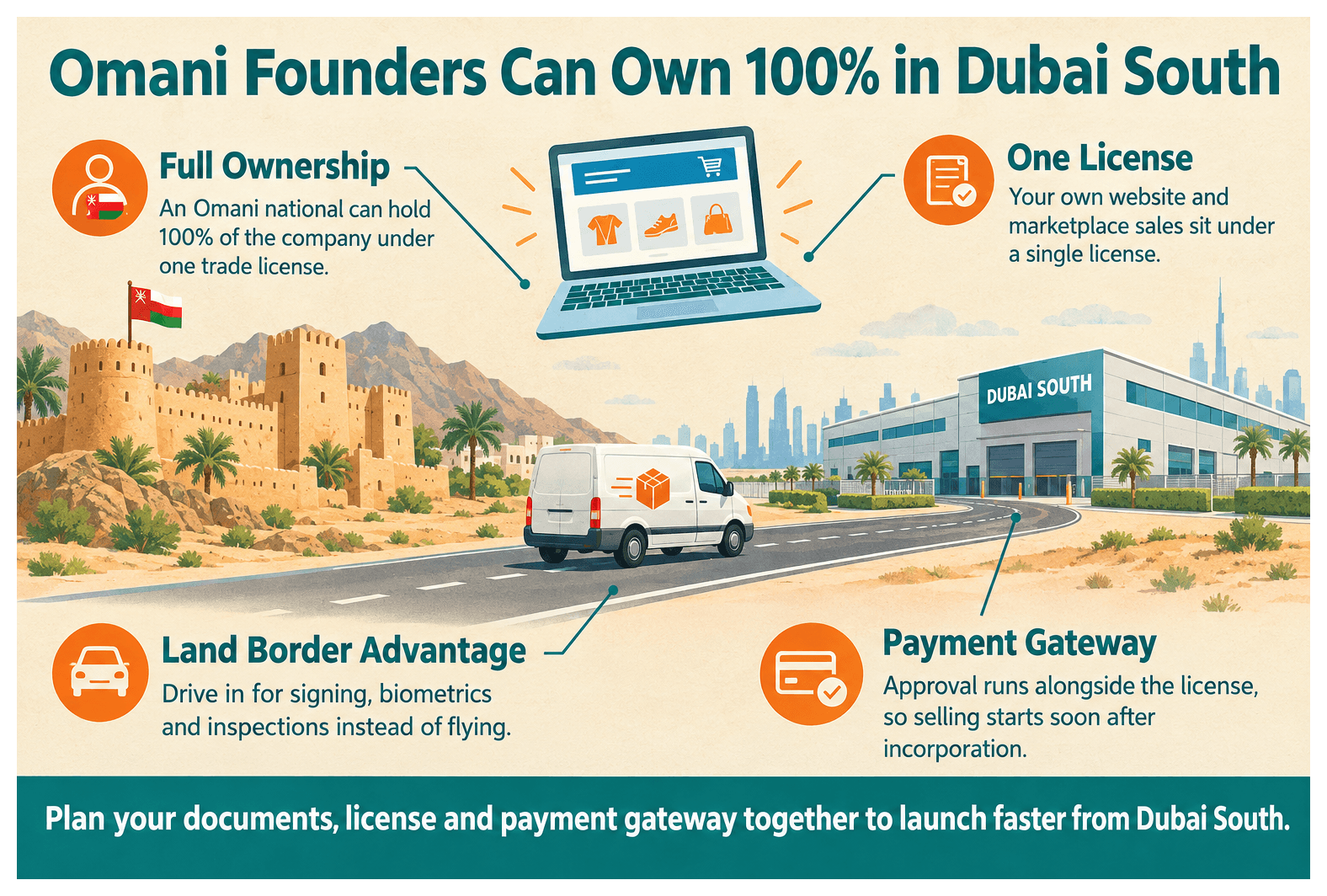
Omani nationals benefit from GCC status, which supports straightforward ownership and documentation. The land border with the UAE makes site visits and stock movements practical. For business setup Dubai from Oman, you can drive to Dubai South for signing and inspections instead of relying on flights.
What GCC National Status Changes in Practice
A Sohar-based founder can onboard with a valid Omani ID and passport, with full ownership available. Document requirements can change, so confirm them with the team rather than assuming. Our guide on what Omani founders need to know covers the wider picture.
Using the Land Border for Visits and Stock Movement
Drive in for meetings and biometrics.
Move samples and inventory by road. Customs documents are still required.
Dubai South sits close to Al Maktoum International Airport and key logistics corridors.
Example: a Muscat seller driving stock to a Dubai South fulfilment partner.
Step-by-Step Guide to Setting Up Your Dubai South E-Commerce License for Omani Entrepreneurs
Setting up an e-commerce company in Dubai South takes six steps: check your company name, choose your activity, submit documents, receive the license, start residency visa processing and activate payment gateways. Gateway approval runs alongside the license.
Step 1: Check Your Company Name and Choose Your Activity
Run your Arabic and English trade name through the name-check tool.
Match the activity to what you sell.
Avoid restricted terms.
Step 2: Submit Documents and Receive Your License
Provide passport and ID copies, the application form and a short business plan.
Submit digitally from Oman.
Make one border-crossing visit for biometrics.
The license is issued on approval.
Step 3: Run Payment Gateway Approval in Parallel
Prepare refund, delivery and privacy pages early.
Open a corporate bank account at the same time.
Payment services fall under Central Bank of the UAE oversight.
For platform options, read e-commerce business setup in Dubai.
How Payment Gateway Approval Runs Alongside Your License
Payment gateway approval doesn't have to wait for the license. Omani founders can prepare website policies, bank documents and KYC (know your customer) files while incorporation proceeds, then submit the license on issue. Approval times depend on the provider, so build a buffer before launch.
What Gateways and Banks Typically Ask For
License copy and shareholder ID.
Live website and business description.
Proof of products and supplier relationships.
Bank account for settlement.
Estimated Setup Costs in AED (Date Quoted)
Cost Item | Amount in AED (as of quoted date) |
|---|---|
E-commerce trade license | Quoted in AED and date-stamped in the cost calculator |
Company registration | Quoted in AED and date-stamped at application |
Owner residency visa | Depends on visa package; confirm current AED figure |
Establishment card | Confirm current AED figure with the team |
Optional storage or office | Varies by space; quoted in AED on request |
Avoiding Common Delays
Three issues cause most rejections: a trade name on the site that differs from the license, a missing refund policy and vague product descriptions. One apparel seller was bounced for lacking a returns page. Adding it and resubmitting cleared the review. See why e-commerce entrepreneurs choose Dubai South for more.
How Much Does It Cost and How Long Does It Take to Launch
Costs depend on license type, visa count and office option. All figures should be quoted in AED with the date they were checked. Use the cost calculator for a current estimate. Gateway review is the most variable step in the Dubai South e-commerce license for Omani entrepreneurs timeline.
Fee Breakdown in AED
The table above lists the cost items. Build a first-year budget for one owner visa from those lines, then verify each figure in the calculator on the day you apply. Fees change, so we don't publish unconfirmed numbers.
Timeline From Application to First Sale
There are three stages: license, visa and gateway. Doing gateway prep during licensing shortens the total. A founder aiming for a seasonal sales window should start gateway paperwork the day the application goes in.
Which Regulations in the UAE Apply to an E-Commerce Company in Dubai South
An e-commerce company in Dubai South must follow UAE regulations on consumer protection, VAT, corporate tax and customs for imported stock. Keep records, display clear policies and check Federal Tax Authority requirements before trading.
VAT and Corporate Tax Basics
Check VAT registration thresholds with the Federal Tax Authority.
Corporate tax applies. Qualifying free zone treatment has conditions.
Keep full accounting records.
Say an Omani seller crosses the threshold. They'd register promptly and file on schedule.
Consumer Protection and Customs Rules
Show clear pricing, returns and delivery terms. Declare imported goods at customs, including stock driven in from Oman, and check restricted product categories first.
What Should You Do Next to Start Your Dubai South E-Commerce Business
Check your company name, run the cost calculator, prepare your passport and website policies, and start the gateway application alongside your license. Confirm documents and current AED fees with the Dubai South team before you commit.
Your Pre-Application Checklist
Name check complete.
Activity chosen.
Passport or ID ready.
Bank plan and website policies drafted.
Where to Get Help
Book a consultation after using the calculator. Our Dubai South Business Hub for e-commerce page is a good next read.
The Dubai South e-commerce license for Omani entrepreneurs gives you 100% ownership, one license for online selling, land-border access and parallel gateway approval. Fees should be confirmed in AED as of the quoted date. Check your name, run the calculator and speak to the Dubai South Business Hub team to start.
References
Frequently Asked Questions