Topic Summary
Understand What the License Actually Covers
A furniture trading license authorizes your company to import, export, wholesale, and retail furniture and home furnishings in Dubai. Without it, you cannot legally invoice customers, open a corporate bank account, or clear goods through UAE customs.
Know Your First-Year Costs Upfront
At Dubai South Business Hub Free Zone, a furniture trading license starts from AED 18,350 for a sole founder with one visa included. The license fee alone starts from AED 12,500, with zero paid-up share capital required.
Separate One-Off Costs From Recurring Fees
Incorporation and establishment card fees are paid once in Year 1, while the license renewal, visa renewals, and Emirates ID biometrics recur annually or per visa cycle. Planning for these recurring charges from the start prevents cash-flow surprises.
Pick the Right ISIC Activity Code at Registration
Wholesale furniture sales to businesses fall under ISIC Division 46, while retail sales to end consumers use Division 47. Choosing the wrong code is the most common cause of license amendment requests and can trigger bank account rejections.
Understand Duty-Suspended, Not Duty-Exempt, Status
Goods imported through a free zone arrive in duty-suspended status, meaning the standard 5% GCC customs duty on furniture is deferred rather than permanently waived. This distinction has real cash-flow implications when goods move into the mainland market.
Budget for Tax Penalty Risks Early
Late VAT or corporate tax registration each carries a flat AED 10,000 penalty in the UAE. Registering on time as your revenue thresholds are approached is a straightforward way to avoid a significant and entirely avoidable cost.
Choose Free Zone or Mainland Based on Your Sales Channel
A free zone license offers 100% foreign ownership and faster setup, making it well suited for import-focused or B2B operations. A mainland DET license is better if you need unrestricted direct retail access across the UAE without a local distributor.
In 2026, Dubai's furniture and home-furnishings sector is projected to generate over USD 2.1 billion in retail revenue, with import volumes rising year-on-year as developers complete new residential and commercial units across the emirate (Statista, 2025). A furniture trading license in Dubai lets you import, stock, and sell furniture to both retail and wholesale buyers. At Dubai South Business Hub Free Zone, that license is issued in as little as one business day, with first-year costs starting from AED 18,350 for a sole founder with one visa. The license fee starts from AED 12,500. Zero paid-up share capital is required. The GCC standard customs duty on furniture is 5% of CIF value. Late VAT or corporate tax registration each carries a flat AED 10,000 penalty. This guide covers every material cost, regulatory requirement, and setup step a first-time founder needs to trade furniture legally in Dubai.
What Is a Furniture Trading License in Dubai and Why It Matters
A furniture trading license in Dubai is a commercial trade license that authorises a company to import, export, wholesale, and retail furniture and home furnishings. Without it, you cannot legally invoice customers, open a corporate bank account, or clear goods through UAE customs. The license is issued by a free zone authority or the DET for mainland companies.
Furniture Trading License Dubai: One-Off vs. Recurring Costs at Dubai South Business Hub Free Zone
Cost Item | One-Off Cost (Year 1 Only) | Recurring Annual Cost |
|---|---|---|
License registration fee | From AED 12,500, paid at incorporation | From AED 12,500, due each year at renewal |
Establishment card / company incorporation fee | Paid once at registration; included in first-year total from AED 18,350 | Not a recurring charge; renewal is captured in the license renewal fee |
Investor visa stamping and entry permit (per visa) | Additional cost; one visa package included in the AED 18,350 first-year total | Visa renewal charged separately per visa, per renewal cycle |
Emirates ID biometrics (per applicant) | Additional cost per applicant; not included in base license fee | Charged again at each visa renewal cycle per applicant |
License renewal | Not applicable in Year 1, this is a Year 2+ charge | From AED 12,500 annually |
Visa renewal (per visa) | Not applicable in Year 1, renewal falls due after visa validity period | Quoted separately per visa; includes medical, Emirates ID, and permit fees |
Flexi-desk or office space renewal (if applicable) | First-year flexi-desk cost included where applicable in setup package | Renewed annually; cost varies by workspace tier selected |
How the License Is Classified Under ISIC
Furniture trading falls under ISIC Rev.4 Division 46 (wholesale) or Division 47 (retail) within Section G, which covers all wholesale and retail trade. Free zone authorities and the DET map these ISIC classes to their own business activities lists; the underlying economic activity is identical regardless of jurisdiction.
Division 46 applies when you sell to other businesses (B2B, wholesale, hotel projects).
Division 47 applies when you sell directly to end consumers through a showroom or e-commerce channel.
Selecting the correct code at registration prevents invoicing mismatches and bank account rejections from day one, activity mismatches are the single most common cause of license amendment requests.
A founder importing office chairs for corporate clients selects a wholesale furniture activity code. One selling directly to homeowners through a showroom selects a retail code. Different codes, different permitted channels.
Free Zone vs. Mainland: Which Suits Furniture Trading?
A free zone license at Dubai South Business Hub Free Zone (launched September 2025) offers 100% foreign ownership and zero paid-up share capital. Goods entering the UAE through a free zone arrive in duty-suspended status, not duty-exempt. That distinction matters: duty is deferred, not waived.
A mainland license via the DET also permits 100% foreign ownership following the 2021 reforms under Federal Decree-Law No. 26 of 2020. The mainland route lets you sell directly to UAE consumers without routing through a distributor, which suits founders wanting their own retail showroom.
A European furniture brand routing shipments through a free zone company and selling to UAE retailers via a local distributor keeps its free zone structure cleanly. A brand wanting its own retail showroom on Sheikh Zayed Road typically opts for a mainland entity instead. Dubai South Business Hub Free Zone does not provide bonded warehousing or customs integration; founders arrange third-party logistics separately.
Furniture Trading License Dubai: Full Cost Breakdown
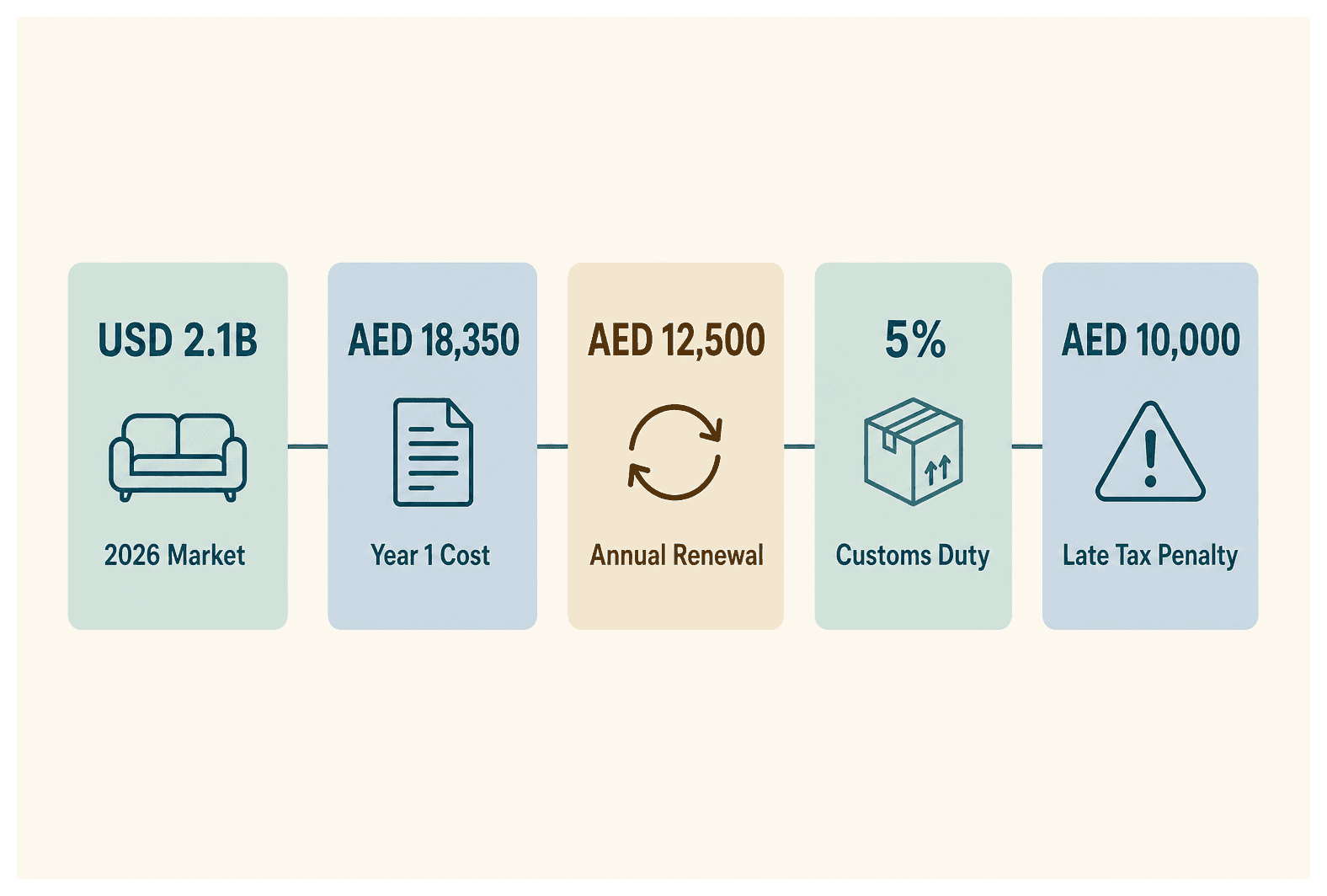
A furniture trading license in Dubai at Dubai South Business Hub Free Zone starts from AED 12,500. The first-year total for a sole founder with one visa starts from AED 18,350. Costs not included are visa medical tests, Emirates ID fees, office rent beyond the flexi-desk, third-party logistics, and customs duties on mainland-bound goods.
One-Off vs. Recurring Cost Table
The table above separates what you pay once from what recurs annually. Zero paid-up share capital is required at Dubai South Business Hub Free Zone, so you're not tying up working capital just to register.
A founder trading five furniture categories, sofas, beds, office furniture, outdoor furniture, and lighting accessories, fits within the base activity allowance. Adding a sixth category, such as kitchen cabinets, triggers an additional AED 2,000 activity fee. Plan your full product range before you submit.
Not included in any package: visa medical fitness tests, Emirates ID biometric fees, customs importer code registration, VAT registration, third-party warehousing and logistics, and GCC customs duty on mainland-bound stock.
Visa Costs: Always an Additional Line Item
Visas are always an additional cost. They are never bundled into the base license price. Each investor or employee visa requires its own medical fitness test, Emirates ID application, and entry permit fees, all charged separately.
A husband-and-wife founding team setting up a furniture import business needs two investor visas, two medical tests, and two Emirates ID applications. All of that is charged on top of the AED 18,350 first-year base, which covers only one visa package. Request a precise quote based on your headcount before you commit to a budget. You can explore UAE residency visa options through Dubai South Business Hub Free Zone's residency services.
Step-by-Step Guide to Getting Your Furniture Trading License in Dubai
Getting a furniture trading license in Dubai involves five main steps: choosing your jurisdiction, reserving your trade name, submitting incorporation documents, paying the license fee, and applying for visas. At Dubai South Business Hub Free Zone the license is issued in as little as one business day once documents are complete and payment is received.
Step 1: Choose Your Jurisdiction and Activity List
Decide between free zone and mainland based on your sales channel. Free zone suits import and wholesale distribution; mainland suits direct retail to UAE consumers. A founder planning to import Scandinavian flat-pack furniture and sell to UAE retailers chooses a free zone wholesale activity. One opening a showroom on a Dubai high street selects mainland retail via the DET instead.
Confirm your activity list covers every furniture category you plan to trade. Each activity beyond the first five costs AED 2,000. Check the full list of business activities in Dubai at Dubai South Business Hub Free Zone before you submit, corrections after registration cost more than getting it right first time.
Step 2: Reserve Your Trade Name and Submit Documents
Your trade name must comply with UAE naming guidelines: no offensive terms, no names implying government affiliation, and no names that duplicate an existing registered entity. Check company name availability online before paying any fees to avoid rejection delays.
Required documents at Dubai South Business Hub Free Zone typically include:
Passport copy (all shareholders and directors)
Passport-size photograph
Completed application form
No notarised Memorandum of Association is required at Dubai South Business Hub Free Zone, which removes a common bottleneck. A founder naming their company "Nordic Home Trading LLC" checks availability first; if the name is taken, they adjust to "Nordic Interiors Trading LLC" before proceeding to payment.
Step 3: Pay, Receive Your License, and Open a Bank Account
The license is issued in as little as one business day after payment and document approval. Bank account opening follows license issuance; most UAE banks require the license, the company's constitutional documents, and proof of registered address. You can review bank account opening in UAE options through Dubai South Business Hub Free Zone's banking support services.
Furniture traders with import activity also need to register with UAE Customs to obtain an importer code before clearing the first shipment. VAT registration is mandatory once taxable supplies exceed AED 375,000 in any 12-month period; late registration carries a flat AED 10,000 penalty (UAE Federal Tax Authority, 2026).
A sole founder receives their furniture trading license on Day 1, submits bank account documents on Day 2, and has an active importer code within the same week, placing their first overseas purchase order inside a fortnight.
Regulatory Requirements and Approvals for Furniture Trading in Dubai
A furniture trading license in Dubai is issued by the free zone authority or DET, but certain product categories require separate regulatory approvals. Upholstered furniture must meet UAE fire-safety standards set by the Ministry of Industry and Advanced Technology. Importers also need an importer code from UAE Customs before clearing the first shipment.
Product Safety and Standards Compliance
The UAE applies GSO (Gulf Standardization Organization) standards to furniture. These cover materials, fire retardancy for upholstered items, and formaldehyde emission limits on wood-based panels. GSO standards apply across all GCC states, so compliance also opens doors to regional re-export markets.
Non-compliant goods can be held at customs or recalled from the market. Founders should obtain conformity certificates from suppliers before the first shipment departs. MoIAT (Ministry of Industry and Advanced Technology) is the UAE conformity authority for product standards. Dubai South Business Hub Free Zone licenses the trading activity; product compliance is separately the responsibility of MoIAT.
A trader importing foam sofas from China should request a fire-retardancy test certificate from the factory and verify it meets GSO standards before the container departs the port of origin, not after it arrives in Dubai.
Customs Importer Code and Duty Rates
All furniture importers must register with UAE Customs to obtain an importer code before clearing goods. The standard GCC customs duty on furniture is 5% of CIF (cost, insurance, and freight) value. This applies when free zone goods are moved to the UAE mainland market.
Free zone status means goods are duty-suspended on arrival, not duty-exempt. Duty is assessed at the point of mainland clearance. Dubai South Business Hub Free Zone does not offer customs integration or bonded warehousing; founders contract with licensed customs brokers and third-party logistics providers independently.
A free zone furniture company receives a container in Dubai and holds it in a third-party bonded warehouse. When it sells a batch to a Dubai retailer, the customs broker files the import declaration and the 5% GCC duty is assessed on that consignment's CIF value. Plan that cost into your pricing from day one.
VAT and Corporate Tax Obligations for Furniture Traders
Furniture traders in Dubai must register for VAT at a 5% rate once taxable supplies exceed AED 375,000 in any 12-month rolling period. Corporate tax at 9% applies to taxable income above AED 375,000 for financial years starting on or after 1 June 2023. Late registration for either carries an AED 10,000 penalty.
VAT Registration and Filing for Furniture Sales
VAT rate: 5% on furniture sales within the UAE.
Mandatory registration threshold: AED 375,000 taxable supplies in any 12-month period.
Voluntary registration: available from AED 187,500.
Late registration penalty: AED 10,000 flat, plus VAT owed from the date the threshold was crossed.
Export sales: zero-rated for overseas buyers, a practical advantage for furniture exporters.
A furniture trader turning over AED 400,000 in their first year must register for VAT with the UAE Federal Tax Authority. Failing to do so triggers the AED 10,000 penalty plus any VAT owed from the date the threshold was crossed.
Corporate Tax: What Furniture Traders Need to Know
UAE corporate tax at 9% applies to taxable income above AED 375,000 for financial years starting on or after 1 June 2023. Small business relief is available for companies with revenue under AED 3 million, consult a UAE tax advisor to confirm eligibility for your specific structure.
Qualifying Free Zone Person (QFZP) status can attract a 0% corporate tax rate, but all four conditions must be met:
Maintain adequate substance in a UAE free zone.
Derive qualifying income as defined by the Ministry of Finance.
Not elect to be subject to standard corporate tax.
Comply with transfer pricing rules.
A free zone furniture wholesaler generating AED 2 million in revenue from overseas buyers may qualify for QFZP status if it meets all four conditions. One selling primarily to UAE mainland retailers is unlikely to meet the qualifying income test. The late corporate tax registration penalty is AED 10,000, a one-time flat penalty, not a monthly charge. Note that Dubai South Business Hub Free Zone is not a designated zone and carries no designated-zone customs or VAT benefit.
Key Benefits of a Furniture Trading License in Dubai for First-Time Founders
A furniture trading license in Dubai gives founders access to one of the world's highest-spending consumer markets, a strategic re-export hub serving the GCC and Africa, 100% foreign ownership, zero paid-up share capital at Dubai South Business Hub Free Zone, and a one-business-day license issuance timeline. The regulatory framework is transparent and internationally benchmarked.
Market Access and Re-Export Potential
Dubai's Jebel Ali port is the largest port in the Middle East and a primary re-export gateway to the GCC, East Africa, and South Asia (DP World, 2025). A free zone license is well-suited to the re-export model: goods arrive duty-suspended, are consolidated or repackaged, then shipped onward without triggering UAE import duty.
An Italian furniture brand uses a Dubai free zone entity to consolidate shipments bound for Saudi Arabia, Kenya, and Pakistan, treating Dubai as a regional distribution hub rather than a final market. That structure keeps landed costs predictable and removes the need for a separate regional warehouse in each destination country.
Ownership, Capital, and Speed Advantages
Here's what makes Dubai South Business Hub Free Zone particularly attractive for first-time founders:
100% foreign ownership, no local partner or sponsor required.
Zero paid-up share capital, no funds locked in a bank account just to register.
License issued in as little as one business day after document approval and payment.
Multiple investor visas can be tied to a single license, making it straightforward to bring in co-founders or key staff.
A solo founder relocating from Europe can start a business in Dubai, receive the furniture trading license the next business day, and begin the investor visa process immediately, without depositing share capital or waiting weeks for government approvals. Use the business setup cost in Dubai calculator to build your own budget before your first consultation.
Common Mistakes to Avoid When Setting Up a Furniture Trading Business in Dubai
The most frequent setup mistakes for furniture trading in Dubai are: selecting the wrong activity codes, underestimating customs duty exposure on mainland sales, missing the VAT registration threshold, assuming free zone status removes all import duties, and failing to budget for visa costs separately from the license fee.
Activity Code Errors and How to Avoid Them
Selecting only a retail furniture activity when you also intend to wholesale blocks you from issuing B2B invoices legitimately. A founder who registers only a retail furniture activity and then wins a contract to supply a hotel project is technically trading outside their licensed scope. The amendment to add a wholesale activity takes additional time and cost, both of which are avoidable.
Adding activities after registration is possible, but it triggers an amendment fee. If your furniture range spans more than five sub-categories, budget the AED 2,000 per extra activity at the outset. Review the complete trading license activities in Dubai before submitting your application.
Misunderstanding Free Zone
References
Frequently Asked Questions