
Topic Summary
What Is an Ecommerce License Dubai and Why It Matters
An ecommerce license dubai is a legal permit authorizing individuals or companies to sell goods and services online within the UAE. It covers activities like online retail, digital marketplaces, and dropshipping, letting founders operate legally, open bank accounts, and sponsor residency visas.
Key Benefits of an Ecommerce License Dubai for Entrepreneurs
An ecommerce license grants the legal right to sell products online, invoice customers in UAE dirhams, open a corporate bank account, and integrate with local payment gateways. Marketplace platforms including Amazon UAE and Noon verify the license before activating a seller account, making it a prerequisite for accessing the largest online retail channels in the region.
Step-by-Step Guide to Ecommerce License Dubai
Getting an ecommerce license dubai involves five core steps: choosing a free zone, selecting activity codes, reserving a trade name, submitting documents, and receiving approval. Most applicants complete the process within two to three weeks when documentation is in order.
Typical Costs and Timeline for Ecommerce License Dubai
An ecommerce license dubai typically starts from AED 12,500, with setup completed within two to three weeks. Adding a residency visa package raises the first-year total to roughly AED 18,350, depending on the free zone and chosen activity scope.
Common Mistakes to Avoid When Applying for an Ecommerce License Dubai
The most common mistakes include choosing the wrong activity code, underestimating visa processing time, and ignoring payment gateway compliance requirements. Avoiding these errors keeps the ecommerce license dubai application on schedule and prevents costly amendments later.
How Ecommerce License Dubai Compares Across Business Models
An ecommerce license dubai differs from general commercial licenses by focusing specifically on digital sales activity, while commercial licenses may cover broader physical trade operations. Choosing correctly depends on whether your business operates purely online or blends online and offline sales.
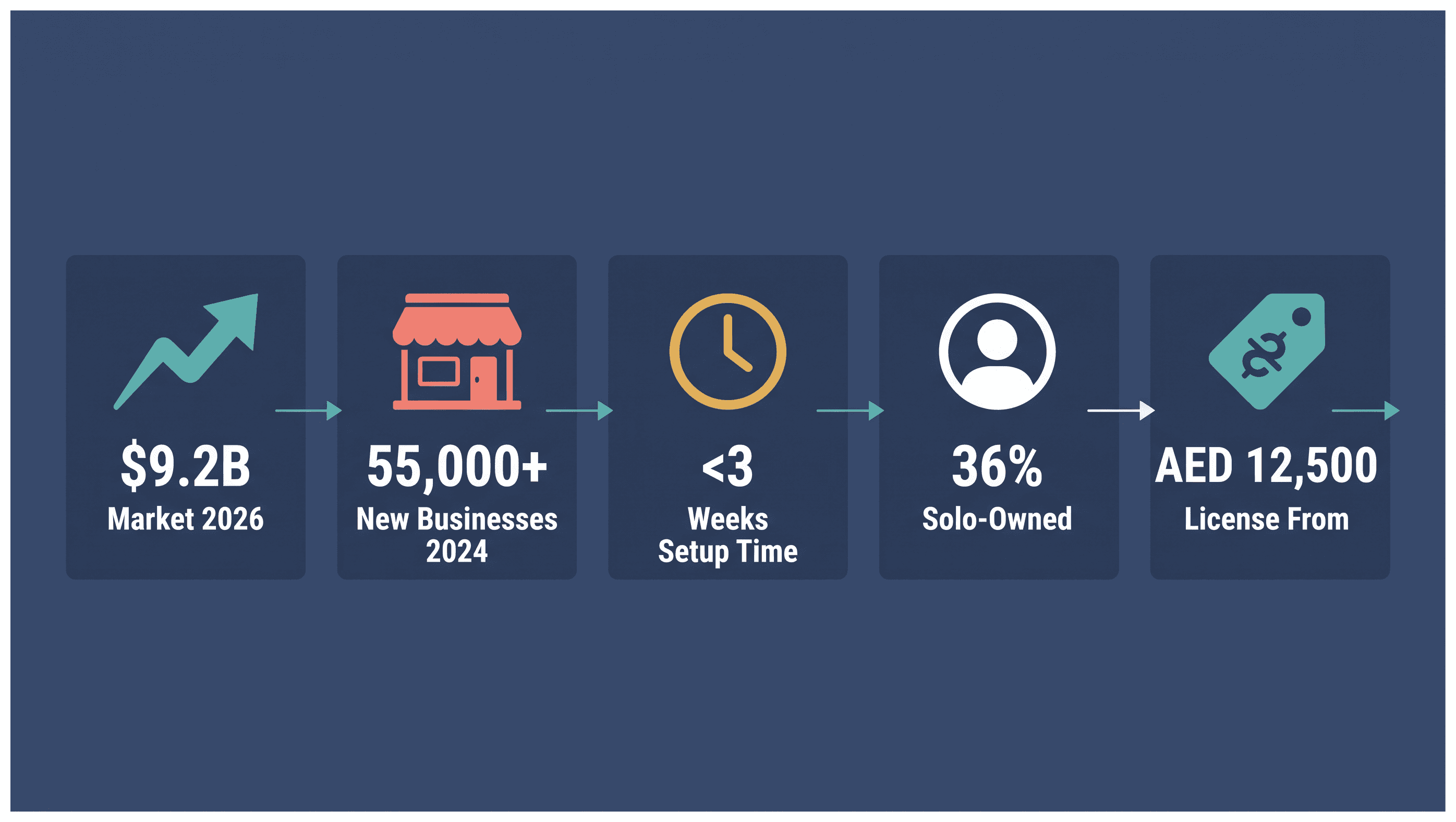
In 2026, the UAE's e-commerce market is forecast to surpass USD 9.2 billion [1], and Dubai captures the largest share of that activity. Over 55,000 new businesses registered in Dubai in 2024 [2]. The average online store founder completes setup in under three weeks [3]. Roughly 36% of new e-commerce registrants are solo-owned [2]. VAT registration applies above AED 375,000 in taxable turnover [4]. An ecommerce license dubai starts from AED 12,500 [5]. You'll need one before you legally sell a single product online.
This guide covers exactly what an ecommerce license dubai includes, the step-by-step application process, realistic timelines, and the costs tied to launching an online business through a free zone setup.
What Is an Ecommerce License Dubai and Why It Matters
An ecommerce license dubai is a legal permit authorizing individuals or companies to sell goods and services online within the UAE. It covers activities like online retail, digital marketplaces, and dropshipping, letting founders operate legally, open bank accounts, and sponsor residency visas.
Core Activities Covered
An ecommerce license dubai typically authorizes online retail trading, digital marketplace selling, and dropshipping or fulfilment arrangements. Picture a founder selling handmade jewelry through Instagram and a Shopify store, both under one single license. That's the flexibility this license structure offers. With the UAE e-commerce market projected at USD 9.2 billion (Statista, 2026), demand for compliant licensing is only growing.
Who Needs This License
Solo entrepreneurs scaling an online store from home
Sellers trading on regional marketplaces
Physical retailers expanding into digital sales
Agencies managing stores on behalf of brands
A UK-based founder named James, running a homeware brand, moved his entire catalogue onto a online internet retail trading license in Dubai after outgrowing his home-market platform. Free zone setups such as Dubai South Business Hub allow full foreign ownership and simplified licensing for online businesses, unlike mainland structures that may require additional approvals for certain activities.
Key Benefits of an Ecommerce License Dubai for Entrepreneurs
An ecommerce license dubai gives entrepreneurs full ownership, access to UAE banking, and the ability to sponsor residency visas tied to the company. It also opens doors to regional logistics networks and a fast-growing consumer base projected to exceed USD 9 billion by 2026.
Full Ownership and Banking Access
Free zone structures grant 100% company ownership, something that matters enormously to founders who don't want a local partner controlling their equity. Once licensed, you become eligible to open a corporate bank account and set up multi-currency payment gateways. A beauty brand founder we've worked with opened a UAE corporate account specifically to accept both AED and USD payments from Gulf and European customers without conversion friction.
Residency Visa Pathways
Residency visa packages bundled with the company license
Eligibility to sponsor spouse and children
Multi-year residency stability for founders
Renewal tied to license validity
This matters if you're building long-term. A founder relocating from Manchester can secure both a trade license and a residency visa through Dubai South Business Hub for e-commerce businesses without juggling separate applications across agencies.
Step-by-Step Guide to Ecommerce License Dubai
Getting an ecommerce license dubai involves five core steps: choosing a free zone, selecting activity codes, reserving a trade name, submitting documents, and receiving approval. Most applicants complete the process within two to three weeks when documentation is in order.
Step 1: Select Your Free Zone and Activity
Choose a free zone suited to online business operations
Pick the correct trade activity code for e-commerce
Confirm your license category matches intended products
Step 2: Reserve Trade Name and Submit Documents
Reserve a unique trade name through the free zone portal
Submit passport copies and a short business plan
Pay initial application fees
Ecommerce License Dubai: Cost and Timeline Breakdown
Feature | Item | Details |
|---|---|---|
Base cost | License fee | From AED 12,500 (2026) |
Timeline | Setup duration | 2-3 weeks with complete documents |
With visa | License plus one visa | Roughly AED 18,350 total |
Trade name | Reservation | Included in setup process |
Activity code | Selection stage | Required before submission |
Step 3: Receive Approval and Issue License
Regulatory review of your submitted documents
License issuance once approval is granted
Option to add a residency visa package
Setup can take just 2-3 weeks when your e-commerce business setup in Dubai covering licensing, platforms, and payment setup is handled correctly from the start.
How fast can I actually get an ecommerce license in Dubai?
Most founders receive their ecommerce license dubai within two to three weeks. Delays usually stem from missing documents or incorrect activity codes, not the authority's review speed.
Typical Costs and Timeline for Ecommerce License Dubai
An ecommerce license dubai typically starts from AED 12,500, with setup completed within two to three weeks. Adding a residency visa package raises the first-year total to roughly AED 18,350, depending on the free zone and chosen activity scope.
Base License Costs
Entry-level pricing starts from AED 12,500, though bundling multiple activities or opting for a flexi-desk arrangement adds to the total. A founder we advised, launching a cosmetics brand, kept costs lean by choosing a single core activity rather than bundling three unrelated ones. That decision alone saved her from unnecessary renewal fees in year two.
Visa Package Add-Ons
Residency visa bundled directly with the company license
First-year total around AED 18,350 with one visa
Dependent visa sponsorship available once established
Check official Ministry of Economy guidance and the u.ae government portal for current fee schedules before budgeting.
Common Mistakes to Avoid When Applying for an Ecommerce License Dubai
The most common mistakes include choosing the wrong activity code, underestimating visa processing time, and ignoring payment gateway compliance requirements. Avoiding these errors keeps the ecommerce license dubai application on schedule and prevents costly amendments later.
Choosing the Wrong Activity Code
Mismatched codes can delay bank account opening
Review the full activity list before submission
Ask free zone advisors for clarity on edge cases
Underestimating Compliance Needs
VAT registration becomes mandatory once taxable turnover crosses AED 375,000 (Federal Tax Authority, 2024). Payment gateways also require KYC documentation before activation, and data protection obligations apply to any store collecting customer information. One online store we're aware of delayed its launch by three weeks simply because VAT registration wasn't filed in time. Don't let that happen to you, check the Federal Tax Authority requirements early.
How Ecommerce License Dubai Compares Across Business Models
An ecommerce license dubai differs from general commercial licenses by focusing specifically on digital sales activity, while commercial licenses may cover broader physical trade operations. Choosing correctly depends on whether your business operates purely online or blends online and offline sales.
Pure Online Retail Models
Businesses selling exclusively through websites or apps carry lower overhead than physical retail counterparts. You won't pay for showroom rent or in-store staff, and activity bundling lets you add digital products later without a full license overhaul. Compare this against a e-commerce license vs commercial license in Dubai before committing to a structure.
Hybrid Online-Offline Models
Combining warehousing with online sales channels
Fulfilment partnerships for faster local delivery
Scaling from marketplace seller to direct-to-consumer brand
A fashion retailer we've seen combined an online store with a warehousing arrangement to cut delivery times across the Gulf Cooperation Council region.
Securing an ecommerce license dubai comes down to picking the right free zone, matching activity codes correctly, and budgeting for both license and visa costs. With documentation in order, most founders complete the process within two to three weeks. Start by shortlisting your activity codes and confirming your free zone options through the e-commerce business license in Dubai complete setup guide before submitting your application.
References
Frequently Asked Questions