
Topic Summary
What Is Maintain QFZP Status: A Practical Checklist and Why It Matters
To maintain QFZP status means meeting every Qualifying Free Zone Person condition in each tax period: adequate substance, qualifying income, audited financial statements, transfer pricing compliance, and no election for standard tax. Meet them and qualifying income stays at 0%. Fail one and you drop to 9% above AED 375,000.
The Conditions You Must Meet Every Tax Period
The Conditions You Must Meet Every Tax Period
Numbered Process to Maintain QFZP Status: A Practical Checklist
Maintain QFZP status by running one repeatable routine: confirm activities, log income by type, test the de minimis limit quarterly, keep evidence, document related-party pricing, appoint an auditor early, and file within nine months of year-end.
Protecting Qualifying Income and the De Minimis Limit
Separate revenue streams, review mainland sales before invoicing, and track the threshold continuously. Crossing the lower of 5% of revenue or AED 5 million costs you QFZP status for the whole period.
Deadlines and Filings That Keep Your 0% Rate Intact
The FTA expects timely registration, a return within nine months of year-end, and audited statements. Late registration costs a fixed AED 10,000 [1]. A compliance calendar keeps every date visible.
Working With Your Free Zone Authority and Auditor
Your free zone authority keeps license, premises and activity records current, while your auditor tests the statements behind QFZP status. Share documents early and confirm changes before they affect income or substance.
Final Thoughts
To maintain QFZP status: a practical checklist comes down to habits. Tag income, test the limit, keep evidence, appoint an auditor, file on time. Review your income mix this quarter, then speak with the Dubai South Business Hub team about license and compliance alignment.
More than 350,000 businesses are registered with the Federal Tax Authority (FTA) [1]. A free zone company that slips out of Qualifying Free Zone Person status pays 9% on taxable income above AED 375,000 instead of 0% on qualifying income. This guide helps Dubai South founders maintain QFZP status: a practical checklist of conditions, documents and deadlines.
What Is Maintain QFZP Status: A Practical Checklist and Why It Matters
To maintain QFZP status means meeting every Qualifying Free Zone Person condition in each tax period: adequate substance, qualifying income, audited financial statements, transfer pricing compliance, and no election for standard tax. Meet them and qualifying income stays at 0%. Fail one and you drop to 9% above AED 375,000.
Defining Qualifying Free Zone Person Status
QFZP is a tax status under Federal Decree-Law No. 47 of 2022, not a license type. It's tested every tax period, never granted for life. Picture two Dubai South trading companies: one earns from other free zone companies and keeps 0%, while the other breaches a condition and loses it. For a deeper primer, read about the qualifying free zone person rules.
QFZP Conditions and Evidence to Keep
Feature | Condition | Evidence to Keep |
|---|---|---|
Adequate substance: lease, payroll, management records | Staff, premises and decisions based in the free zone | Lease, payroll records, signed management minutes |
Qualifying income: tagged invoices and ledger split | Revenue from qualifying activities and permitted counterparties | Tagged invoices, ledger split by income type |
De minimis limit: quarterly revenue percentage report | Non-qualifying revenue at or below the lower of 5% or AED 5 million | Quarterly report showing running percentage |
Audited financial statements: signed auditor report | Audit required every period, whatever the revenue | Signed auditor report and final accounts |
Transfer pricing: related-party agreements and benchmarking | Related-party deals at arm's length | Signed agreements, benchmarking notes |
Why Losing Status Costs More Than the Tax Rate
Loss applies to the current period and the next four.
That's five tax periods of exposure.
Standard 9% hits all taxable income, not just the failed slice.
Banks and counterparties ask harder questions after reassessment.
A consultancy that fails in year one pays standard tax for five consecutive periods. Ouch.
The Conditions You Must Meet Every Tax Period
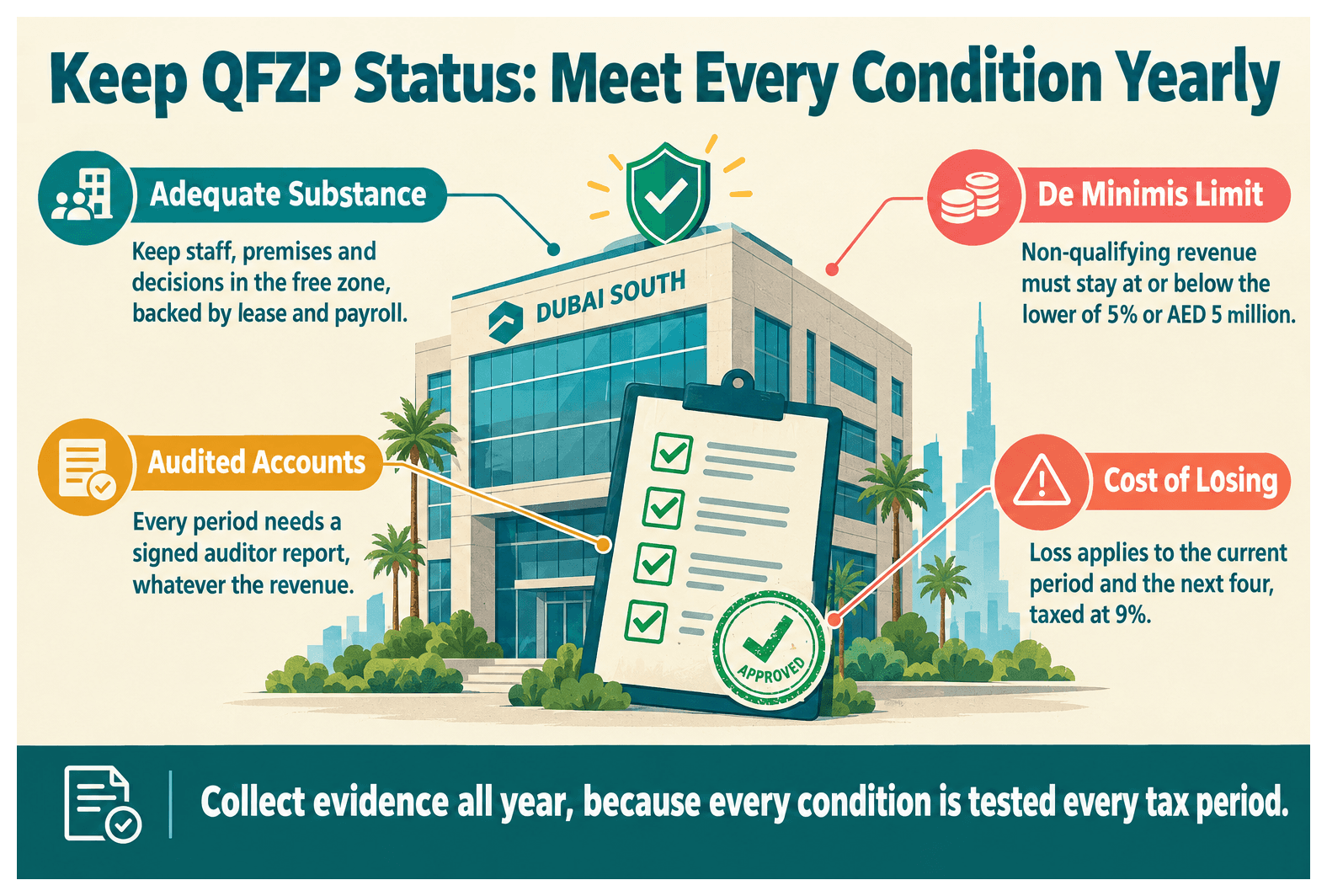
A QFZP must keep adequate substance in the free zone, earn qualifying income, stay within the de minimis limit, prepare audited statements, follow transfer pricing rules, and never elect standard tax. Each is tested annually, so collect evidence all year to maintain QFZP status: a practical checklist works only if it's continuous.
Adequate Substance in the Free Zone
Qualified staff and premises sit in the free zone.
Core income-generating work happens there.
Keep lease, payroll and board records together.
Qualifying Activities and Income Sources
Income must come from activities listed in Ministerial Decision No. 265 of 2023. Dealings with other free zone persons and mainland sales need careful review, and excluded activities push income into the 9% bracket. A logistics firm, for example, keeps qualifying revenue separate from retail-style mainland sales in its ledger. See the qualifying activities for UAE free zone corporate tax.
Audited Accounts, Transfer Pricing, and No Tax Election
Every QFZP needs audited accounts.
Related-party pricing must be arm's length.
Document management fees before year-end.
Electing standard tax can't be undone mid-period.
Numbered Process to Maintain QFZP Status: A Practical Checklist
Maintain QFZP status by running one repeatable routine: confirm activities, log income by type, test the de minimis limit quarterly, keep evidence, document related-party pricing, appoint an auditor early, and file within nine months of year-end.
Step 1: Confirm Activities and Tag Income Monthly
Map each revenue stream to a qualifying or excluded activity.
Tag every invoice in your accounting software.
Flag a new mainland consulting client at onboarding.
Step 2: Test the De Minimis Limit Every Quarter
Keep non-qualifying revenue at or below the lower of 5% or AED 5 million.
Escalate internally at 3%.
With AED 4 million revenue, stay under AED 200,000.
Step 3: Keep Substance and Transfer Pricing Files Current
Refresh lease, payroll and meeting evidence each quarter. Update related-party agreements and store everything in one shared folder. A finance manager can book a quarterly review with the director.
Step 4: Appoint an Auditor and File the Return
Engage an approved auditor before year-end; here's guidance on choosing an approved auditor in the UAE for your company. File through EmaraTax within nine months. A December year-end means 30 September.
Protecting Qualifying Income and the De Minimis Limit
Separate revenue streams, review mainland sales before invoicing, and track the threshold continuously. Crossing the lower of 5% of revenue or AED 5 million costs you QFZP status for the whole period.
Handling Mainland Clients Without Triggering the 9% Rate
Write contracts that describe the service clearly. Check treatment before accepting a large order. A software reseller in Dubai South should test any big mainland order against its headroom first. More in corporate tax for free zone companies with mainland clients.
Spotting Early Warning Signs
Non-qualifying share climbing past 3%.
New business lines outside the qualifying list.
Staff or premises changes weakening substance.
One founder watched it rise from 2% to 4.5% in two quarters and renegotiated two contracts in time.
Deadlines and Filings That Keep Your 0% Rate Intact
The FTA expects timely registration, a return within nine months of year-end, and audited statements. Late registration costs a fixed AED 10,000 [1]. A compliance calendar keeps every date visible.
Registration, Return, and Payment Dates
Register through EmaraTax.
File and pay within nine months.
Set internal deadlines at 30 June for a 31 December year-end.
Building a Compliance Calendar
Combine tax, VAT, license renewal and audit dates, assign an owner to each, and review at every quarter-end. Start with the compliance calendar for year one in Dubai.
Working With Your Free Zone Authority and Auditor
Your free zone authority keeps license, premises and activity records current, while your auditor tests the statements behind QFZP status. Share documents early and confirm changes before they affect income or substance.
Keeping the License and Activities Aligned
Licensed activities should match real work.
Request changes before starting new work.
Renew license and lease on time.
A Dubai South Business Hub company adding consulting, for instance, amends its license before accepting the client.
Choosing and Briefing Your Auditor
Pick an auditor approved for UAE corporate tax work. Hand over substance and transfer pricing files at the start, and request a pre-year-end QFZP risk review. One auditor caught a related-party loan with no written agreement before the books closed.
Final Thoughts
To maintain QFZP status: a practical checklist comes down to habits. Tag income, test the limit, keep evidence, appoint an auditor, file on time. Review your income mix this quarter, then speak with the Dubai South Business Hub team about license and compliance alignment.
References
Federal Tax Authority, Corporate Tax guidance, 2026.
Ministry of Finance, Ministerial Decision No. 265 of 2023 and Cabinet Decision No. 100 of 2023.
Dubai Chamber, business registration data, 2024.
Frequently Asked Questions