Topic Summary
UAE Market Size Makes Amazon.ae Unmissable
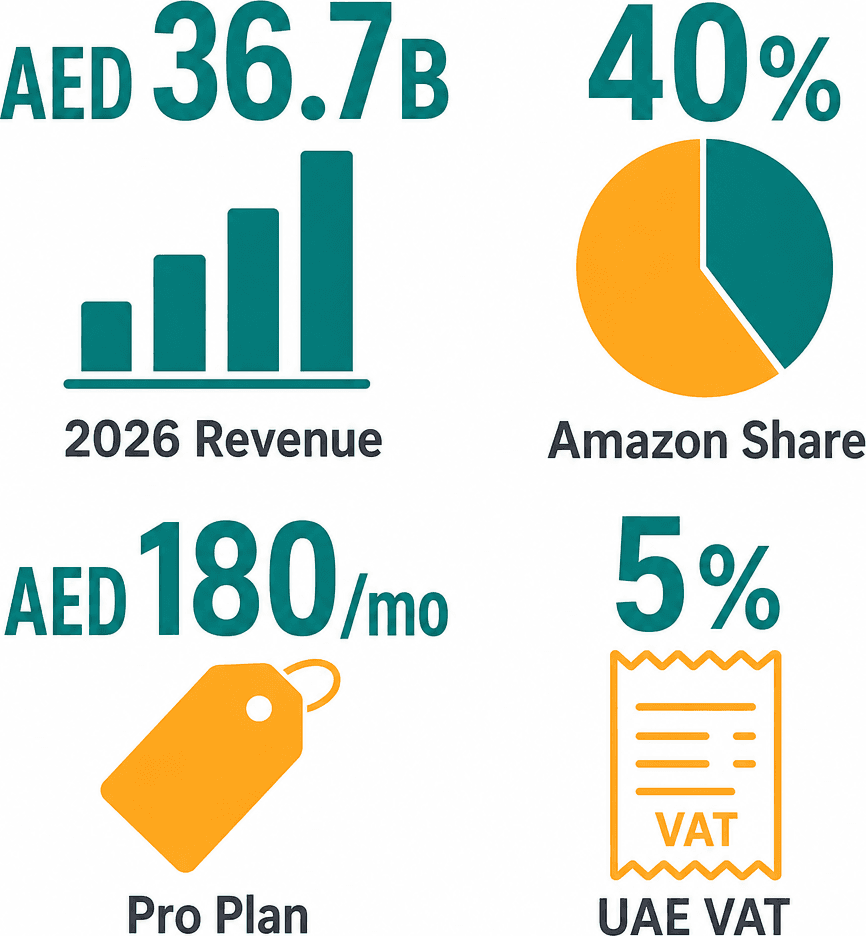
UAE e-commerce revenue is projected to hit AED 36.7 billion in 2026, with Amazon.ae controlling roughly 40% of online retail GMV. Sellers gain instant access to millions of high-spending shoppers without building an audience from scratch.
A Trade License Is Non-Negotiable to Start
A valid UAE trade license is a hard requirement to activate a Professional seller account on Seller Central Amazon UAE — it is not optional. Free zone e-commerce licenses can be issued in as few as 3–5 business days, making this a fast first step.
Professional Plan Fees Are Straightforward and Predictable
The Professional seller plan costs a flat AED 180 per month, with referral fees ranging from 5% on electronics to 15% on fashion per sale. Knowing these costs upfront makes margin planning simple before you list a single product.
FBA Unlocks Prime Badges and Next-Day Delivery
Using Fulfilment by Amazon gives your listings the Prime badge and next-day delivery eligibility in Dubai and Abu Dhabi. This removes the need to run your own warehouse or manage last-mile logistics entirely.
UAE's 5% VAT Keeps Your Margins Healthier
At just 5%, UAE VAT is among the lowest consumption tax rates globally, protecting seller margins compared to most comparable markets. VAT registration only becomes mandatory above AED 375,000 in annual taxable turnover, so smaller sellers can launch without immediate compliance burden.
Built-In Advertising Tools Drive Sales From Day One
Amazon's Sponsored Products and Sponsored Brands ad formats let sellers target UAE audiences precisely as soon as their listing goes live. Combined with Amazon's existing buyer trust, this dramatically shortens the time to first sale versus building a standalone store.
Real Sellers Are Scaling Fast on Amazon UAE
A Dubai home décor startup launched on Amazon.ae using FBA in Q1 2025 and reached AED 50,000 in monthly revenue within 90 days, with no physical retail presence. The combination of existing traffic, Prime delivery, and low tax overhead makes rapid growth achievable for new sellers.
In 2026, UAE e-commerce revenue is projected to reach AED 36.7 billion (Statista, 2026). Amazon.ae holds approximately 40% of UAE online retail GMV (Euromonitor International, 2025). The UAE has 99% internet penetration, one of the highest rates on earth (TDRA, 2025). UAE VAT sits at just 5%, among the lowest consumption tax rates globally. Free zone e-commerce licenses can be issued in as few as 3-5 business days. If you want to know how to sell on Amazon UAE and reach millions of shoppers in a high-spending, low-tax market, this guide covers everything: registration, fees, FBA, listing optimisation, payments, and the fastest way to get your trade license in place.
What You Need to Know
Amazon UAE (amazon.ae) launched in 2019 after Amazon acquired Souq.com, the Souq brand was fully retired by 2021.
A valid UAE trade license is a hard requirement to activate a Professional seller account at sellercentral.amazon.ae, not optional. An e-commerce license from Dubai South Business Hub Free Zone allows you to sell on Amazon UAE with 100% foreign ownership from AED 12,500.
The Professional seller plan costs AED 180 per month flat; referral fees range from 5% (electronics) to 15% (fashion) per sale (Amazon UAE, 2026).
FBA (Fulfilment by Amazon) gives your listings the Prime badge and next-day delivery eligibility in Dubai and Abu Dhabi.
UAE VAT registration is mandatory above AED 375,000 annual taxable turnover, sellers are responsible for their own FTA compliance.
Want to get your trade license sorted before you register? Get your e-commerce license at Dubai South Business Hub Free Zone and be ready to activate your seller account in days.
What is Amazon UAE and Why Sell There
Amazon UAE (amazon.ae) is the official Amazon marketplace for the United Arab Emirates, launched in 2019 following Amazon's acquisition of Souq.com. It gives sellers access to millions of UAE-based shoppers, established logistics infrastructure, and the trust of the world's largest e-commerce brand, all in a high-spending, low-tax market. As an amazon uae marketplace seller, you're not building an audience from scratch. You're plugging into one that already exists.
The Amazon UAE Marketplace in 2026
Amazon.ae replaced Souq.com entirely by 2021. The platform now carries millions of active listings across electronics, fashion, home, beauty, and books. UAE e-commerce revenue is projected at AED 36.7 billion in 2026 (Statista, 2026), and amazon.ae accounts for roughly 40% of UAE online retail GMV (Euromonitor International, 2025). That's a dominant position in a market where shoppers spend heavily and expect fast delivery.
A UAE-based electronics accessories brand listing phone cases on amazon.ae can reach customers in Dubai, Abu Dhabi, and Sharjah within 24 hours using FBA, without building its own delivery network. That kind of reach, at that speed, would cost significantly more to replicate through a standalone store. Sellers who want to sell on Amazon UAE gain access to Amazon's trust signals, the Prime delivery badge, and integrated advertising tools from day one.
Why UAE Entrepreneurs Choose Amazon Over Building Their Own Store
Building your own e-commerce store means spending months on traffic acquisition before your first sale. On amazon.ae, buyers are already searching. Amazon's payment infrastructure, fraud protection, and customer service reduce operational overhead considerably, you're not managing chargebacks or disputed deliveries yourself.
FBA removes the need to operate a warehouse or manage last-mile delivery. The Amazon Ads platform (Sponsored Products, Sponsored Brands) lets you target UAE audiences precisely from the moment your listing goes live. A home décor startup in Dubai launched on amazon.ae using FBA in Q1 2025 and reached AED 50,000 in monthly revenue within 90 days, without a physical retail presence. UAE VAT at 5% keeps margins healthier than in most comparable markets globally.
Read our full e-commerce licensing in Dubai complete guide if you're still deciding on the right business structure before you register.
Requirements to Become an Amazon UAE Seller
To become an Amazon UAE seller, you need a valid UAE trade license, a UAE or international bank account, a nationally recognised ID or passport, and tax information. A UAE trade license is mandatory for the Professional seller plan, without one, Amazon will not activate your sellercentral.amazon.ae account. Knowing how to become an Amazon seller UAE starts with getting this license in place first.
UAE Trade License: The Non-Negotiable Requirement
Amazon UAE requires a valid UAE trade license to register as a Professional seller. This is a hard platform requirement, not a recommendation you can work around. The license must cover e-commerce or trading activities. A mainland DET license with the correct e-commerce activity code qualifies, and so does a free zone e-commerce license.
Free zone licenses from Dubai South Business Hub Free Zone are accepted by Amazon UAE and can be issued in as few as 3-5 business days, typically faster than mainland DET processing. Without a trade license, you're limited to the Individual seller plan, which charges per item and blocks access to FBA and bulk listing tools. That's a significant competitive disadvantage on a platform where Prime eligibility drives conversions.
A seller registering with a free zone e-commerce license from Dubai South Business Hub Free Zone can submit it directly at sellercentral.amazon.ae as proof of business registration. The free zone registered address also satisfies Amazon's business address requirement.
Full Document Checklist for Amazon UAE Seller Registration
A sole trader operating under a Dubai South Business Hub Free Zone license submits their license certificate, passport, and Payoneer account details at sellercentral.amazon.ae to complete verification. The process is straightforward when documents are prepared in advance. Get your e-commerce license at Dubai South Business Hub Free Zone to satisfy Amazon's registration requirements from day one.
How to Register as an Amazon UAE Seller - Step by Step
To sell on Amazon UAE, visit sellercentral.amazon.ae, choose the Professional plan, enter your trade license details, upload identity documents, add your bank account or Payoneer details, and complete identity verification. The full process takes 3-7 business days once all documents are ready. Here's exactly how to do it.
Step-by-Step: Opening Your Amazon UAE Seller Account
A Dubai-based beauty brand completed Amazon UAE seller registration in 4 business days after submitting their Dubai South Business Hub Free Zone e-commerce license and a verified Payoneer account. Having clean, matching documents is the single biggest factor in a fast approval.
Common Registration Errors and How to Avoid Them
Using a personal Amazon email: Always create a new business email before registering at sellercentral.amazon.ae.
Expired trade license: Amazon rejects licenses within 30 days of expiry. Renew before you apply.
Mismatched business names: The name on your trade license must match your bank account exactly. Even minor discrepancies cause rejections.
Wrong marketplace selected: Always confirm you're registering on amazon.ae, not amazon.com or amazon.co.uk. Sellers who register under amazon.com face currency conversion fees and incorrect VAT treatment.
Do I need a UAE trade license to sell on Amazon UAE?
Yes. A valid UAE trade license is mandatory to activate a Professional seller account at sellercentral.amazon.ae. Without one, you're restricted to the Individual plan, which charges per item and blocks FBA access. A free zone e-commerce license from Dubai South Business Hub Free Zone qualifies and can be issued in 3-5 business days.
Amazon UAE Seller Fees and Commission Rates
Amazon UAE charges AED 180 per month for the Professional seller plan, plus referral fees of 5-15% per sale depending on category. FBA sellers pay additional storage and fulfilment fees per unit. There is no setup fee to open a seller account at sellercentral.amazon.ae.
Referral Fees by Product Category
Referral fees are the percentage Amazon deducts from each sale. Electronics carries the lowest rate at 5%, making it the most margin-friendly category. Fashion and apparel sits at 12-15%, the highest standard rate on the platform. Home and kitchen and beauty both fall in the 8-10% range. Books use a flat AED fee per unit in some sub-categories rather than a straight percentage.
A seller listing a AED 200 smartphone case in the electronics category pays AED 10 in referral fees (5%), plus their share of the AED 180 monthly plan fee spread across all units sold that month. Compare that to a fashion seller listing a AED 200 item at 15%, AED 30 in referral fees per unit. Category selection significantly affects your margin model.
Amazon UAE Seller Fees 2026, Cost Breakdown by Category | ||
Fee Type | Rate / Amount | Example on AED 200 Product |
|---|---|---|
Professional Plan (monthly) | AED 180/month flat | Spread across all units sold |
Electronics Referral Fee | 5% | AED 10 |
Home and Kitchen Referral Fee | 8-10% | AED 16-20 |
Fashion and Apparel Referral Fee | 12-15% | AED 24-30 |
Beauty and Personal Care Referral Fee | 8-10% | AED 16-20 |
FBA Fulfilment Fee (standard small item) | AED 7-12 per unit | AED 7-12 per unit shipped |
Individual Plan (under 40 units/month) | Per-item fee | No monthly subscription |
FBA Storage and Fulfilment Fees in AED
FBA fulfilment fees depend on item size and weight. Standard small items start from approximately AED 7-12 per unit. Monthly storage fees are charged per cubic metre. Long-term storage (items sitting over 365 days) attracts a significant surcharge, worth monitoring closely for slow-moving SKUs.
FBA fees stack on top of referral fees. A seller shipping 500 units of a AED 150 home product to Amazon UAE's fulfilment centre would pay approximately AED 5,500-6,000 in FBA fulfilment fees for that batch, roughly AED 11-12 per unit. Always model your full cost structure using Amazon UAE's FBA Revenue Calculator at sellercentral.amazon.ae before committing to FBA on a new product. Peak season storage fees (October to January) rise considerably, so plan inventory levels carefully.
For a full breakdown of what licenses cost and which structure suits your business, read our e-commerce licensing in Dubai complete guide.
FBA vs FBM on Amazon UAE - Which is Better
FBA (Fulfilment by Amazon) on Amazon UAE means you ship stock to Amazon's UAE warehouse and Amazon handles storage, packing, and delivery. FBM (Fulfilment by Merchant) means you manage your own warehousing and shipping. FBA suits high-volume sellers wanting Prime eligibility; FBM suits sellers with existing logistics or bulky low-margin products. The right choice depends on your product type and margin structure.
How FBA Works on Amazon UAE
You ship inventory to Amazon UAE's fulfilment centre. Amazon stores, picks, packs, and ships each order.
FBA listings are eligible for Amazon Prime. The Prime badge significantly increases conversion rates on amazon.ae.
Amazon UAE handles customer returns, refunds, and customer service for all FBA orders.
You pay FBA fulfilment fees per unit plus monthly storage fees, stacked on top of referral fees.
FBA is the recommended model for high-volume sellers and those targeting same-day or next-day delivery in Dubai and Abu Dhabi.
A kitchen accessories brand using amazon fba uae saw a 35% increase in units sold after gaining the Prime badge, customers in Dubai received orders within 24 hours of purchase. That conversion uplift typically offsets the additional FBA cost for most standard-sized products. FBA orders are eligible for Amazon UAE's guaranteed next-day delivery in major UAE cities.
When FBM Makes More Sense on Amazon UAE
FBM works best for bulky, heavy, or slow-moving products where FBA storage fees would destroy the margin. A furniture seller with oversized sofas uses FBM on amazon.ae, FBA storage fees for large items would make the unit economics unworkable, and the seller already has a Dubai warehouse with its own delivery fleet. That's a sensible call.
Worth flagging: FBM listings are not Prime-eligible by default, which reduces visibility in amazon.ae search results. You'll also need to keep your late shipment rate below 4% to maintain Good Standing status, Amazon UAE enforces this threshold strictly. FBM sellers are responsible for return logistics too, which adds operational overhead that FBA sellers don't face.
How to List Products on Amazon UAE
To list products on Amazon UAE, log into sellercentral.amazon.ae, navigate to 'Add a Product', select or create a product detail page, set your price in AED, upload images, write your title and bullet points, and assign the correct ASIN or create a new one. Optimised listings with strong images and keywords rank higher in amazon.ae search. Selling on Amazon Dubai means competing for the Buy Box, listing quality is your primary lever.
Product Listing Best Practices for Amazon UAE
Title: Include brand, product type, key feature, and size or colour. Keep it under 200 characters.
Bullet points: Write five bullet points covering top features and benefits in English. Adding Arabic translations increases reach to Arabic-speaking UAE shoppers, a meaningful portion of the amazon.ae customer base.
Images: Minimum six images: a main white background shot (1000x1000px minimum for zoom), lifestyle images, and infographic-style detail images.
Price in AED: Price competitively. Amazon UAE's Buy Box algorithm rewards competitive pricing combined with strong seller metrics.
Backend keywords: Add Arabic transliterations and UAE-specific search terms in the keyword fields inside Seller Central.
A beauty brand listing a face serum on amazon.ae with Arabic bullet points and six product images achieved a 22% higher click-through rate versus their English-only listing. Arabic content is a genuine competitive differentiator on amazon.ae, most international sellers skip it entirely, which means it's an easy win for UAE-registered sellers who invest the time.
Amazon UAE Brand Registry and A+ Content
Amazon Brand Registry protects your trademark on amazon.ae and gives you access to A+ Content, Sponsored Brands ads, and the Amazon Storefront feature. To enrol, you need a registered UAE or international trademark, UAE trademark registration is handled through the Ministry of Economy. A+ Content is free for Brand Registry sellers and allows enhanced product descriptions with comparison charts, lifestyle imagery, and brand storytelling.
A UAE-based skincare brand enrolled in Amazon Brand Registry and added A+ Content to their top 10 listings, they reported a 30% increase in conversion rate on amazon.ae within 60 days. Brand Registry also gives access to counterfeit reporting tools, which matters significantly in electronics and fashion where fake listings are common.
What products sell best on Amazon UAE?
Electronics, home and kitchen, fashion, beauty, and books are the top-performing categories on amazon.ae in 2026. Electronics benefits from a low 5% referral fee, making margins more workable. Beauty and home products see strong repeat purchase rates. Arabic-language products and locally relevant items consistently outperform generic international listings in UAE-specific search results.
How Amazon UAE Compares to Noon UAE
Amazon UAE has a larger international brand presence, more advanced advertising tools, and a bigger English-language customer base. Noon UAE has stronger Arabic-language reach, deeper penetration with UAE and Saudi national shoppers, and a more accessible onboarding process for regional sellers. Most serious amazon uae marketplace sellers list on both platforms to maximise reach.
Amazon UAE vs Noon: Side-by-Side Comparison
Amazon UAE vs Noon UAE, Platform Comparison for Sellers 2026 | ||
Feature | Amazon UAE (amazon.ae) | Noon UAE |
|---|---|---|
Market Reach | Stronger for English-language and international brand searches | Stronger for Arabic-language and Gulf regional shoppers |
Monthly Fee | AED 180/month (Professional plan) | Commission-based; varies by category |
Referral Fees | 5-15% depending on category | Broadly similar; varies by category |
Fulfilment Programme | FBA, established warehouse network | NowGo fulfilment programme |
Advertising Tools | Amazon Ads (Sponsored Products, Sponsored Brands, DSP) | More limited ad tools currently |
Geographic Reach | UAE-focused marketplace | UAE, Saudi Arabia, and Egypt from one account |
Onboarding Speed | 3-7 business days with full documents | Often cited as faster for UAE-registered sellers |
A UAE fashion brand selling modest wear lists on both amazon.ae and Noon, Amazon UAE drives 60% of English-language search traffic while Noon generates stronger sales from Arabic-speaking customers in the UAE and KSA. UAE e-commerce shoppers use an average of 2.3 platforms for price comparison before purchasing (YouGov, 2025), so listing on both platforms captures buyers at different stages of their decision process.
Should You Sell on Amazon UAE, Noon, or Both
Both platforms: Recommended for established sellers with sufficient stock. Maximises reach across the UAE's bilingual shopper base.
Amazon UAE first: Best if your products are international brands, electronics, or English-language content.
Noon first: Better starting point if your target customer is Arabic-speaking, your products are locally manufactured, or you want faster onboarding.
Multi-channel management: Sellers managing both platforms use inventory tools like Linnworks or Expandly to sync stock and avoid overselling.
A UAE-based home and kitchen brand started on amazon.ae in Q1 2025, then added
Citations
Dubai Economy and Tourism.. dubaidet.gov.ae. DET Dubai, 2024.
Federal Tax Authority.. tax.gov.ae. FTA UAE, 2023.
Ministry of Human Resources and Emiratisation.. mohre.gov.ae. MOHRE UAE, 2024.
Federal Authority for Identity, Citizenship, Customs and Port Security.. icp.gov.ae. ICP UAE, 2024.
General Directorate of Residency and Foreigners Affairs Dubai.. gdrfad.gov.ae. GDRFA Dubai, 2024.
Frequently Asked Questions