Topic Summary
Licensing Takes Just One Business Day
Dubai South Business Hub Free Zone processes new company registrations in a single business day, making UAE offshore setup one of the fastest globally. Zero paid-up share capital is required, removing a common barrier for first-time founders.
Costs Start From AED 12,500
The base licensing fee at Dubai South Business Hub Free Zone begins at AED 12,500, with a sole founder's all-in year-one cost starting from AED 18,350. Breaking costs down line by line before committing helps avoid surprises at incorporation.
100% Foreign Ownership, No Local Partner
UAE offshore companies registered through a free zone authority allow full foreign ownership without requiring a local sponsor or partner. This makes the structure particularly attractive for international founders holding regional subsidiaries or cross-border assets.
Access to UAE Banking and Multi-Currency Accounts
UAE corporate accounts support transactions in USD, EUR, GBP, and AED subject to applicable tax obligations, AML and CFT requirements and banking compliance. This gives offshore entities practical utility for founders receiving international payments and managing global cash flows.
Double-Taxation Treaties Cover Over 100 Countries
The UAE holds double-taxation agreements with more than 100 countries, reducing withholding tax friction on cross-border income flows. Founders routing payments through a UAE holding structure can benefit significantly from this treaty network.
Corporate Tax Registration Is Mandatory From Day One
Every UAE entity, including offshore companies, must register for corporate tax from the date of incorporation regardless of revenue level. Corporate tax applies at 9% above AED 375,000 taxable income, though a 0% rate is available to Qualifying Free Zone Persons who meet all four QFZP conditions.
Offshore Entities Cannot Trade Inside the UAE
The defining restriction of an offshore company is that it may only conduct business internationally, not within the UAE domestic market. Founders who also need UAE residency or the ability to invoice local clients should consider a standard free zone trade license instead.
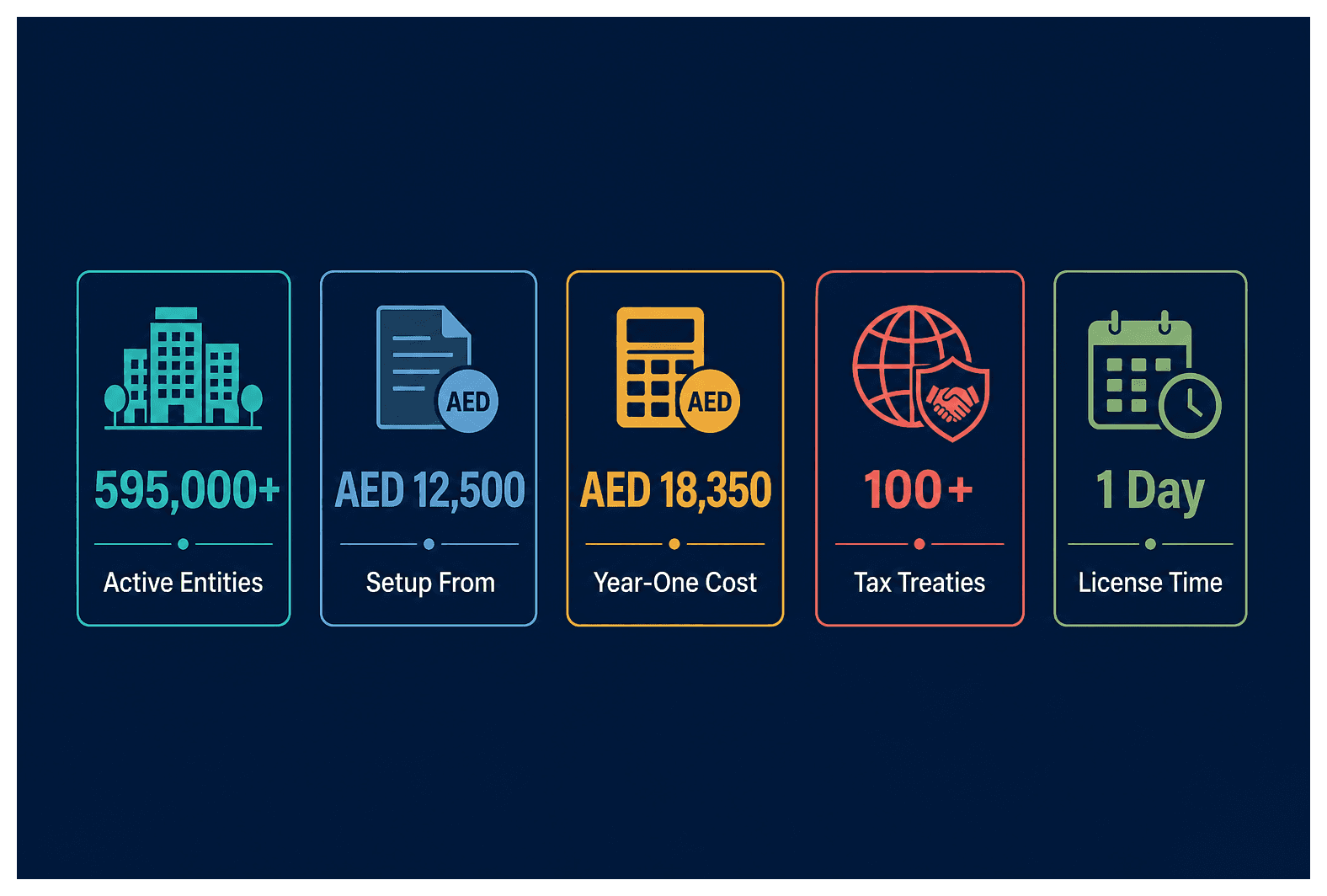
In 2026, the UAE hosts over 595,000 active commercial entities (Ministry of Economy, 2024). The cost to set up an offshore company in the UAE starts from AED 12,500 at Dubai South Business Hub Free Zone. A sole founder's all-in year-one cost runs from AED 18,350. The UAE holds double-taxation agreements with over 100 countries (u.ae, 2024). First-time founders choose this jurisdiction because licensing takes one business day and zero paid-up share capital is required. That combination is rare globally.
This guide covers the exact documents you'll need, realistic costs broken down line by line, and a clear five-step process so you can set up an offshore company in the UAE with no surprises. By the end, you'll know exactly what to prepare, what it costs, and what compliance obligations kick in on day one.
What Is an Offshore Company in the UAE and Why It Matters
An offshore company in the UAE is a legal entity registered in a UAE free zone that conducts business outside the UAE. It offers 100% foreign ownership, a respected international address, and access to UAE banking without requiring a physical office or a local partner. If you want to hold international assets, receive cross-border payments, or structure regional subsidiaries under a single holding entity, this is one of the most practical structures available globally.
How an Offshore Structure Differs from a Free Zone Company
An offshore company is registered through a free zone authority but is not permitted to trade inside the UAE domestic market. That's the defining restriction. A standard free zone company at Dubai South Business Hub Free Zone can invoice clients both globally and within the UAE. An offshore entity is limited to international operations only.
Visa eligibility is another key difference. Standard free zone licenses allow the license holder to sponsor employment and investor visas directly. Pure offshore structures typically have more limited visa access, making a free zone trade license the stronger option for founders who also need UAE residency.
Tax registration applies equally to both structures. Every UAE entity, offshore or otherwise, must register for corporate tax from the date of incorporation regardless of revenue. A European logistics consultant, for example, might register an offshore holding company in the UAE to hold shares in regional subsidiaries with no UAE office and no local partner required. That structure works precisely because it's designed for international operations, not domestic trade.
Why Founders Choose the UAE as an Offshore Base
Strategic location: The UAE sits at the crossroads of Europe, Asia, and Africa, with world-class air and sea logistics infrastructure supporting international business.
Political and regulatory stability: A transparent legal framework and consistent regulatory environment make UAE entities credible to international banking partners and investors.
Banking access: UAE corporate accounts support multi-currency transactions in USD, EUR, GBP, and AED, subject to applicable tax obligations, AML and CFT requirements and banking compliance.
Tax position: There is no personal income tax and no inheritance tax. Corporate tax applies at 9% above AED 375,000 taxable income, with a 0% rate available to Qualifying Free Zone Persons who satisfy all four QFZP conditions.
Free zone depth: The UAE operates over 40 free zones serving distinct industry verticals, giving founders real choice in jurisdiction (u.ae, 2024).
A South Asian e-commerce founder, for instance, uses a UAE offshore holding structure to receive payments in USD and EUR, repatriating profits without restriction. The UAE's treaty network, covering more than 100 countries, reduces withholding tax friction on those flows.
Worth flagging: Dubai South Business Hub Free Zone offers standard free zone licenses from AED 12,500. For many founders, a free zone company serves the same international holding and service functions as a traditional offshore registration, with the added benefit of visa eligibility. Confirm which structure fits your operational model before committing.
Requirements to Set Up an Offshore Company in the UAE
To set up an offshore company in the UAE you need a valid passport, proof of residential address, a business plan or activity description, and a registered agent or free zone authority to file on your behalf. Some jurisdictions also require a memorandum of association and bank reference letters. Here's exactly what to prepare.
Documents Every Applicant Must Prepare
Notarised passport copy: All pages, including valid visa stamps. Attestation requirements vary by nationality and are confirmed by ICP.
Proof of residential address: A utility bill or bank statement dated within the last three months is standard.
Business activity description: A brief outline of intended operations. For free zone licenses, this maps directly to the activity list you select.
Corporate shareholder documents (if applicable): Certificate of incorporation, memorandum and articles of association, and a board resolution authorising the UAE entity. Countries outside the Hague Convention may need apostille certification.
Bank reference letter: Required by most registrars to satisfy anti-money laundering checks. Your primary bank should issue this on headed paper.
A practical note: a UK-based founder who attests their passport copy at a UAE consulate before travelling cuts processing time by roughly two days compared to attesting on arrival. Small preparation steps like this genuinely accelerate the timeline.
Ownership and Activity Eligibility Rules
100% foreign ownership: Available in UAE free zones and also on the mainland. This is not a benefit exclusive to offshore or free zone structures.
Regulated activities: Financial services, healthcare, and education each require a separate approval from the named regulator (Central Bank, DHA, or KHDA respectively) in addition to the free zone license. Both steps are mandatory.
Domestic trading restriction: Offshore companies cannot conduct business within the UAE or directly own UAE real estate without a separate onshore entity.
Zero paid-up share capital: DSBH requires no capital deposit to satisfy a formation requirement. This removes a common cash-flow barrier for early-stage founders.
A fintech founder wanting to offer payment services is a good illustration here. Obtaining a free zone license is step one. Central Bank approval from the Central Bank of the UAE is step two. Neither replaces the other. Skipping the regulator approval and trading on the license alone is a compliance breach.
Registered Agent and Physical Address Requirements
Most UAE offshore jurisdictions require a licensed registered agent to submit formation documents on your behalf. You don't need to be physically present in Dubai for the application itself, but a UAE registered address is mandatory for all official legal correspondence.
At Dubai South Business Hub Free Zone, a registered address is included as part of the license package. There's no separate office lease required at the entry level. A solo founder launching a consulting holding company can use DSBH's registered address for all official correspondence, keeping year-one overhead minimal. DSBH does not provide bonded warehousing or customs integration; if you need those services, you'll need to arrange them separately through a third-party logistics provider.
DSBH launched in September 2025 and issues licenses in one business day. That's considerably faster than jurisdictions requiring physical presence or multi-week processing windows.
Step-by-Step Process to Set Up an Offshore Company in the UAE
Setting up an offshore company in the UAE takes five core steps: choose your jurisdiction and activity, prepare and attest documents, submit your application through a registered agent, receive your license, then open a UAE bank account. At Dubai South Business Hub Free Zone the license can be issued in one business day.
The Five Steps to Get Your Offshore Company Registered
Step 1: Select your jurisdiction and confirm your business activities. Use the DSBH business activities list to match your operations to a licensed category. Getting this right upfront avoids costly amendments later.
Step 2: Prepare and attest all required documents. Passport copies, proof of address, corporate documents if applicable, and bank reference letters. Attest at a UAE consulate in your home country where possible.
Step 3: Reserve your trade name and submit your application. Do this through the free zone directly or via a licensed registered agent. A name availability check before submission avoids rejection delays.
Step 4: Pay the license fee and receive your certificate of incorporation and trade license. At DSBH this happens in one business day, from AED 12,500. You'll receive your official documents digitally.
Step 5: Open a UAE corporate bank account using your license documents. A UAE registered address significantly improves bank onboarding success rates. Most banks require in-person signing for the initial account setup.
A European holding company founder, for instance, completes Steps 1 through 4 remotely in under 72 hours, then flies to Dubai specifically for in-person bank onboarding in Step 5. The whole process, including banking, can be wrapped up in a single short trip.
Trade Name Check and Activity Selection
Your trade name must be unique. It can't be identical or confusingly similar to an existing registered name in the UAE.
Check your company name availability before committing. Rejection at this stage delays the entire application.
Activity selection determines your license type: professional, trading, or ICT. Selecting the wrong category can result in rejection or a post-registration amendment fee.
At DSBH, up to five activities are included in the base license. Each additional activity beyond five costs AED 2,000.
A founder running both a consulting and training business can select 'management consulting' and 'professional training' as two activities under a single DSBH professional license, rather than registering two separate entities. That's a meaningful cost and admin saving from day one.
Year-One Cost Summary: Sole Founder at Dubai South Business Hub Free Zone
Cost Item | Amount (AED) |
|---|---|
Free zone trade license (standard) | From AED 12,500 |
Free zone trade license (B2C) | From AED 12,500 |
One visa package (additional cost) | Additional, never included in base license price |
Total first-year cost (sole founder, one visa) | From AED 18,350 |
Paid-up share capital required | AED 0 (zero) |
Each additional activity beyond five | AED 2,000 per activity |
Cost to Set Up an Offshore Company in the UAE
A sole founder setting up at Dubai South Business Hub Free Zone pays from AED 18,350 in year one, covering a license from AED 12,500, one visa package, and zero paid-up share capital. Visas are always an additional cost. Dubai South Business Hub Free Zone licenses start from AED 12,500. Use the DSBH cost calculator to model your specific figures before applying.
Year-One Cost Breakdown for a Sole Founder
Standard free zone trade license: From AED 12,500. Dubai South Business Hub Free Zone licenses start from AED 12,500.
One visa package: An additional cost on top of the license. Visas are never described as included in the base license price.
Total year-one cost with one visa: From AED 18,350 for a sole founder.
Zero paid-up share capital: No funds need to be deposited with a bank or authority to satisfy a capital formation requirement.
Additional activities: Each business activity beyond the first five costs AED 2,000 per activity.
A solo digital marketing consultant launching at DSBH budgets AED 18,350 for year one: AED 12,500 for the license plus one visa package, with no share capital tied up in a bank account. That's a genuinely lean entry point for an internationally structured business.
Ongoing and Hidden Costs to Plan For
Annual license renewal: Budget similarly to the initial license cost for year two onwards.
Corporate tax registration: Mandatory for every UAE entity regardless of profit. Late registration carries a one-time AED 10,000 flat penalty (not monthly).
VAT registration: Required once taxable supplies exceed AED 375,000 in any 12-month period. Late registration also carries an AED 10,000 penalty.
Bank account maintenance: Fees vary by institution. Factor in monthly account charges and minimum balance requirements when choosing a banking partner.
Accounting and bookkeeping: UAE corporate tax law requires financial records to be maintained for a minimum of seven years. Budget for a bookkeeper or accounting software from year one.
A founder who delays corporate tax registration by six months faces a one-time AED 10,000 penalty from the Federal Tax Authority. Registering on incorporation day costs nothing and eliminates that risk entirely.
Corporate Tax and VAT Obligations When You Set Up an Offshore Company in the UAE
Every UAE company must register for corporate tax regardless of profit. The standard rate is 9% above AED 375,000 taxable income. Qualifying Free Zone Persons may access a 0% rate on qualifying income only if they meet all four QFZP conditions. VAT registration is required once taxable supplies exceed AED 375,000 annually.
Corporate Tax Registration: What Every Offshore Founder Must Know
Registration is mandatory from day one. There is no minimum revenue threshold for the registration obligation itself.
Standard rate: 9% on taxable income above AED 375,000.
QFZP 0% rate: Available only when all four conditions are satisfied: (1) the entity is a free zone person, (2) it maintains adequate substance in the UAE, (3) it earns qualifying income, and (4) it has not elected to be subject to the standard rate.
Late registration penalty: AED 10,000, charged once as a flat fee, not monthly.
Where to register: Via the Federal Tax Authority portal at tax.gov.ae.
A free zone company earning consulting fees from overseas clients may qualify for the 0% QFZP rate on that income. But "may qualify" is the operative phrase. Confirm substance requirements and income classification with a UAE-qualified tax adviser before filing, not after.
VAT and Free Zone Goods: What Offshore Founders Get Wrong
VAT registration is required once taxable supplies or imports exceed AED 375,000 in any 12-month period. The late registration penalty is AED 10,000, matching the corporate tax penalty.
Here's a distinction that trips up a lot of founders: free zone goods are duty-suspended, not duty-exempt. Duties may crystallise when goods enter the UAE domestic market. DSBH is not a designated zone and receives no designated-zone customs or VAT benefits. 100% foreign ownership in a free zone is entirely unrelated to designated-zone status. A trading company at a non-designated free zone must charge standard VAT on UAE domestic sales. Assuming designated-zone exemptions apply when they don't is a common and costly error. Review your banking and taxation position with a specialist before your first domestic sale.
Is a free zone license the same as an offshore company for tax purposes?
No. Both require mandatory corporate tax registration from incorporation. A free zone company may qualify for the 0% QFZP rate on qualifying income if all four conditions are met. An offshore holding entity is assessed on its own income profile and substance. Neither structure is automatically exempt from UAE corporate tax obligations.
UAE Residency Visas When You Set Up an Offshore Company in the UAE
A UAE free zone company license allows the founder to apply for a UAE investor or partner residency visa. The visa is always a separate cost from the license. At Dubai South Business Hub Free Zone, a sole founder with one visa package pays from AED 18,350 all-in for year one.
Investor Visa Eligibility Through a Free Zone License
A UAE free zone trade license qualifies the license holder to apply for a UAE investor or partner visa.
The visa is processed separately from the license. It is never included in the base license price.
Visa processing involves a medical fitness test, Emirates ID application, and entry permit, each with its own government fee.
ICP manages visa status and Emirates ID issuance. The free zone facilitates the application process but does not control ICP processing times.
Visa validity is typically two or three years depending on the visa type, with renewal required before expiry.
References
Frequently Asked Questions