
Topic Summary
What Is a Dubai South E-Commerce License for Turkish Entrepreneurs and Why It Matters
A Dubai South e-commerce license lets Turkish founders own 100% of a free zone company selling goods online to UAE, GCC and international buyers. It covers online retail trading and supports a residency visa package tied to the license. It suits founders wanting a UAE base for cross-border sales.
Which Requirements Must Turkish Entrepreneurs Meet to Qualify
Which Requirements Must Turkish Entrepreneurs Meet to Qualify
Step-by-Step Guide to Setting Up Your Dubai South E-Commerce Company
Setup takes six steps: confirm your activity, check the name, submit the application, pay fees, receive the license, then apply for visas and open a bank account. Start payment gateway approval once the license is issued, so your store can go live soon after.
How Much Does It Cost and How Long Does It Take to Launch
Costs depend on license type, office or flexi-desk choice and visa count, all in AED. Free zone pricing changes, so record the date of every quote. Licensing and visas usually take a few weeks, and gateway approval often runs alongside.
How Payment Gateway Approval Runs Alongside Your License
Gateway approval can start once your company name and license draft are ready, in parallel with visa and banking steps. Providers typically want the license, passports, website details and a bank account. Preparing these early shortens the wait before your store takes payments.
How the UAE-Turkey CEPA Tariff Reductions Support Turkish E-Commerce Sellers
The UAE-Turkey CEPA (Comprehensive Economic Partnership Agreement) reduces or removes tariffs on many traded goods, which can lower landed costs for Turkish products sold from Dubai. Confirm tariff lines, rules of origin and documents for each category before importing stock.
Which Regulations in the UAE Apply to an E-Commerce Company in Dubai South
You must follow UAE consumer protection, VAT, corporate tax and data protection rules. Register for VAT when taxable supplies pass AED 375,000, keep records, and show clear prices, return terms and business details on your site.
In 2026, UAE e-commerce revenue is projected to pass AED 33 billion (Statista, 2025) [1]. Dubai's online market is growing above 20% a year (Dubai Chamber) [2], and Turkey-UAE bilateral trade has topped AED 55 billion (UAE Ministry of Economy, 2026) [3].
Turkish nationals can own 100% of an e-commerce company at Dubai South Business Hub Free Zone. Payment gateway approval runs in parallel with setup, so you can sell soon after licensing. This guide covers eligibility, steps, dated costs, CEPA benefits and compliance for the Dubai South e-commerce license for Turkish entrepreneurs.
What Is a Dubai South E-Commerce License for Turkish Entrepreneurs and Why It Matters
A Dubai South e-commerce license lets Turkish founders own 100% of a free zone company selling goods online to UAE, GCC and international buyers. It covers online retail trading and supports a residency visa package tied to the license. It suits founders wanting a UAE base for cross-border sales.
What the License Covers and Who It Suits
Picture a home-textile brand in Istanbul. It already ships across Turkey but wants GCC customers. An e-commerce company in Dubai South lets it sell through its own website and marketplace storefronts under one online internet retail trading license in Dubai.
Why Dubai South Works for Online Sellers
Al Maktoum International Airport sits close by.
Warehousing and fulfilment options are nearby.
Stock held near the airport supports same-day dispatch.
Read why choose Dubai South for ecommerce for more.
Which Requirements Must Turkish Entrepreneurs Meet to Qualify
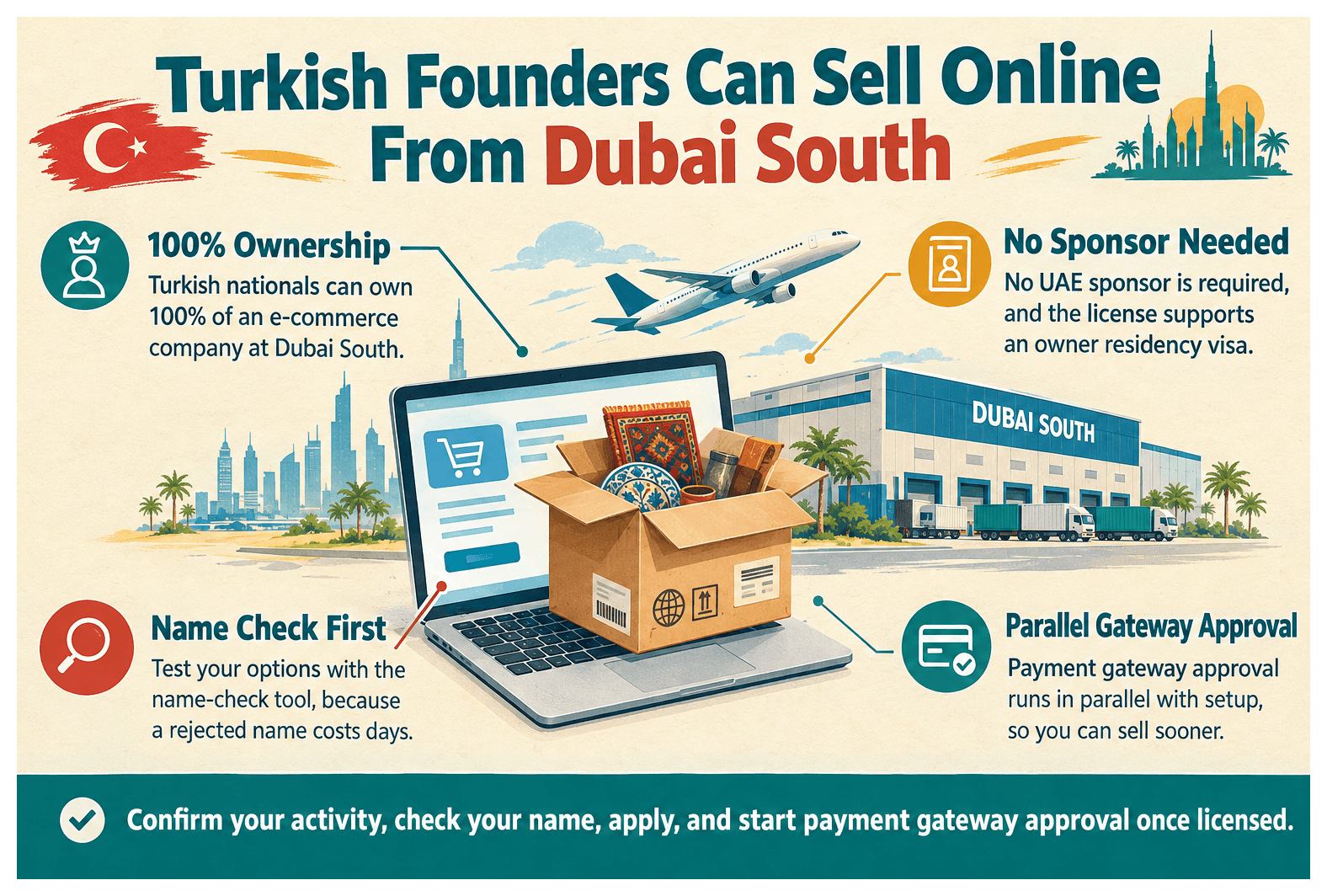
You need a valid passport, a proposed company name, a defined e-commerce activity, a shareholder structure and the applicable fees. No UAE sponsor is required. The license supports an owner residency visa once the company is established. That's the core of business setup in Dubai from Turkey.
Documents and Ownership Rules
Passport copy and passport-size photo.
Shareholder and manager details.
A business plan listing product categories.
Two Turkish co-founders registering a fashion store, for example, submit both passports and name one as manager.
Checking Your Company Name Before You Apply
Test your options with the name-check tool first. One founder we'd advise would test three options, because a rejected name costs days. Keep trading names distinct from existing registrations.
Visa Options Linked to Your License
The license supports investor and employee visas. Identity and residency rules sit with the Federal Authority for Identity, Citizenship, Customs and Port Security. Read the UAE investor visa for Turkish nationals guide before relocating with family.
Step-by-Step Guide to Setting Up Your Dubai South E-Commerce Company
Setup takes six steps: confirm your activity, check the name, submit the application, pay fees, receive the license, then apply for visas and open a bank account. Start payment gateway approval once the license is issued, so your store can go live soon after.
Step 1: Choose Your Activity and Check the Name
Pick online retail trading.
Define your categories, such as consumer electronics accessories.
Confirm the name is available.
Step 2: Submit Documents and Pay Fees
Upload passports and application forms.
Run the cost calculator to compare office options.
Pay fees and note the date of each quote.
Step 3: Receive the License and Start Visas
Receive your license.
Complete the visa application, medical test and Emirates ID.
Open a corporate bank account.
How Much Does It Cost and How Long Does It Take to Launch
Costs depend on license type, office or flexi-desk choice and visa count, all in AED. Free zone pricing changes, so record the date of every quote. Licensing and visas usually take a few weeks, and gateway approval often runs alongside.
License, Office and Visa Cost Breakdown
Estimated Setup Costs for a Dubai South E-Commerce Company (AED, Fees as of Date Checked)
Cost Item | Estimated Amount (AED) and Date Checked |
|---|---|
E-commerce trading license fee | Quoted in the cost calculator; record the quote date |
Registration and approval fees | Set at application; confirm the date with an adviser |
Office or flexi-desk package | Varies by package; compare flexi-desk, office and warehouse |
Residency visa package per person | Per visa; one visa for a single-shareholder company |
Payment gateway setup (provider dependent) | Set by your chosen provider; check its current pricing |
Realistic Timeline From Application to Live Store
Licensing comes first, then visas. Gateway approval overlaps both. A founder can test the store while visa processing continues, so launch rarely waits on the Emirates ID.
How Payment Gateway Approval Runs Alongside Your License
Gateway approval can start once your company name and license draft are ready, in parallel with visa and banking steps. Providers typically want the license, passports, website details and a bank account. Preparing these early shortens the wait before your store takes payments.
What Gateway Providers Typically Ask For
License copy and owner ID.
A live website with prices in AED, returns policy and terms.
Corporate bank account details.
Aligning Banking, Gateway and Store Launch
Sequence it: bank account, gateway application, then checkout testing. Payment services fall under the Central Bank of the UAE, so use a licensed provider. See the e-commerce setup requirements for more.
How the UAE-Turkey CEPA Tariff Reductions Support Turkish E-Commerce Sellers
The UAE-Turkey CEPA (Comprehensive Economic Partnership Agreement) reduces or removes tariffs on many traded goods, which can lower landed costs for Turkish products sold from Dubai. Confirm tariff lines, rules of origin and documents for each category before importing stock.
Where CEPA Tariff Cuts Help Product Margins
Textiles, food, furniture and consumer goods are typical categories. A Turkish ceramics brand shipping to a Dubai South warehouse should verify the tariff line per product, since not every item qualifies. Bilateral trade above AED 55 billion (UAE Ministry of Economy, 2026) shows the corridor is busy.
Rules of Origin and Import Documentation
Certificate of origin.
Commercial invoice and packing list.
Customs declaration.
Our import and export between Turkey and Dubai guide covers licensing.
Which Regulations in the UAE Apply to an E-Commerce Company in Dubai South
You must follow UAE consumer protection, VAT, corporate tax and data protection rules. Register for VAT when taxable supplies pass AED 375,000, keep records, and show clear prices, return terms and business details on your site.
VAT and Corporate Tax Basics
VAT sits under Federal Decree-Law No. 8 of 2017. Corporate tax follows Federal Decree-Law No. 47 of 2022. Free zone companies get 0% only on qualifying income and must meet conditions, so it isn't automatically tax free. Check with the Federal Tax Authority.
Consumer Protection and Website Compliance
Show VAT-inclusive prices in AED at checkout.
Publish a clear returns and refund policy.
Handle personal data under Federal Decree-Law No. 45 of 2021.
Stock holders should read the e-commerce warehousing and storage license guide.
What Should You Do Next to Start Your Dubai South E-Commerce Business
Check your name, estimate costs, prepare passports and a business plan, then apply and begin gateway onboarding in parallel. This gets your Dubai South e-commerce license for Turkish entrepreneurs issued with minimal delay.
Your Pre-Application Checklist
Run the name check.
Estimate costs and note the date.
Gather passports and photos.
List your first product categories.
Where to Get Tailored Support
Speak with Dubai South Business Hub advisers before you apply. Start your application today: the Dubai South e-commerce license for Turkish entrepreneurs offers 100% ownership, a license-linked visa route, CEPA advantages and parallel gateway approval.
References
Frequently Asked Questions