Topic Summary
Get a UAE Trade License First
You need a UAE trade license listing import, export or general trading activities. A free zone license from Dubai South Business Hub lets a Turkish-owned company trade legally, with base licensing from AED 12,500.
Register for a Dubai Customs Code
The license authorises the activity, but the customs code lets you clear cargo. Dubai Customs issues it after the license, and both must exist before your first shipment.
Use CEPA Tariff Advantages
The Turkey-UAE Comprehensive Economic Partnership Agreement, in force since 2023, offers preferential tariffs on qualifying goods. You must meet rules of origin and hold documents such as a certificate of origin.
Choose Between General and Specialised Licenses
A general trading license covers several product categories with fewer approvals. A specialised license suits one commodity line, such as food or machinery, but needs product-specific permits.
Weigh Free Zone Against Mainland
Free zones allow 100% foreign ownership and suit re-export and international sales. Direct mainland sales normally need a distributor.
Follow the Six-Stage Licensing Process
Choose activities, pick a package, submit documents, receive the license, register with Dubai Customs and open a Dubai Trade account. Straightforward applications finish within a few weeks.
Secure Approvals Before Ordering Stock
Restricted goods such as food need approval from Dubai Municipality or another authority. Timelines vary by product, so apply before placing orders.
Dubai's non-oil foreign trade runs past AED 2.2 trillion in 2026 (Dubai Chamber, 2024). This guide covers import and export between Turkey and Dubai: what license you need, what it costs and how to clear your first shipment.
What Is Import and Export Between Turkey and Dubai: What License You Need and Why It Matters
You need a UAE trade license listing import, export or general trading activities, plus a Dubai Customs import-export code. A free zone license from Dubai South Business Hub lets a Turkish-owned company trade legally and clear cargo. Base licensing starts from AED 12,500.
Trade License Versus Customs Code
The license authorises the activity. The customs code lets you clear cargo, and Dubai Customs issues it after the license. An Istanbul textile agent, for example, licenses a company first, then registers to clear fabric re-exports to East Africa. Both must exist before shipment one.
Which Activities to List
General trading covers mixed categories.
Commodity activities suit single product lines.
A food importer should list foodstuff trading, not a general activity.
Restricted goods need extra approvals.
Our import export license in Dubai guide covers activity choice in more depth.
Why Turkish Entrepreneurs Trade Through Dubai
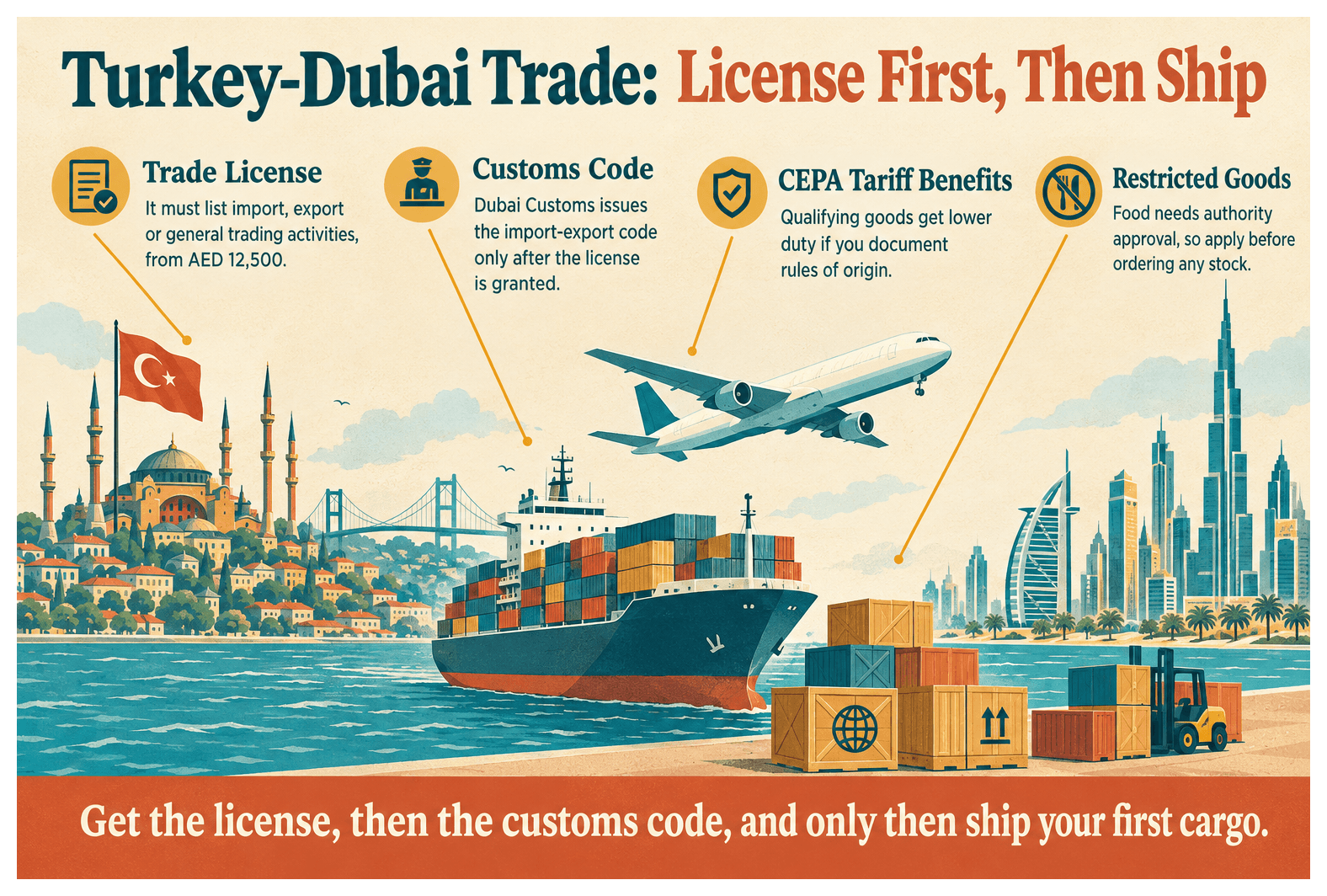
The Turkey-UAE Comprehensive Economic Partnership Agreement, in force since 2023, gives Turkey and Dubai preferential tariff treatment on qualifying goods. Add strong port and air links and quick formation, and one Dubai entity reaches Gulf, African and South Asian buyers.
Turkey-UAE CEPA Tariff Advantages
Goods must meet rules of origin, and you must document it. A Turkish ceramic tile exporter, for instance, needs a certificate of origin to claim the lower duty.
Logistics Reach From Dubai South
Close to Al Maktoum International Airport and Jebel Ali corridors.
Over 14 million TEUs handled annually (DP World, 2025).
Turkish machinery parts can be stocked and re-exported to Gulf customers. See setting up a re-export business.
License Options for Turkey-Dubai Trading
Feature | General Trading License | Specialised Trading License |
|---|---|---|
Product scope | Several categories under one license | One commodity line, such as food or machinery |
Typical approvals | Few for non-regulated goods | Product-specific, such as food authority approval |
Best suited for | Diversified Turkish exporters | Dried fruit, poultry or machinery specialists |
Customs code needed | Yes, before the first shipment | Yes, before the first shipment |
Setup complexity | Lower | Higher, due to permits |
Choosing the Right License Type for Trading Between Turkey and Dubai
The right license depends on what you move. General licenses cover many categories, specialised ones suit food or machinery. Free zones allow 100% foreign ownership, but direct mainland sales normally need a distributor.
General Trading License Explained
A Turkish FMCG trader can combine packaged goods and home textiles under one license. See how to get general trading license Dubai for details.
Specialised and Restricted Activities
Food needs Dubai Municipality or other authority approval.
Timelines vary by product.
Apply for approvals before ordering stock.
A Turkish dried fruit exporter would add a foodstuff import export business Dubai activity.
Free Zone Versus Mainland
Free zones suit re-export and international sales. A Turkish founder serving GCC distributors works well from a Dubai South Business Hub office, with residency visa packages tied to the license.
Process for Securing Import and Export Between Turkey and Dubai: What License You Need
Securing the license takes six stages: choose activities, pick a package, submit documents, receive the license, register with Dubai Customs and open a Dubai Trade account. Straightforward applications finish within a few weeks.
Step 1: Define Activities and Choose a Package
Match your goods' HS codes to activities.
Pick a license and visa package.
Step 2: Submit Documents and Receive the License
Turkish passport copies, application form and business plan summary.
Remote applications from Istanbul work.
Step 3: Register With Dubai Customs and Dubai Trade
Obtain your import-export code.
Dubai Trade Portal registration handles declarations; it processes over 98% digitally (Dubai Trade, 2026).
Customs Registration and Compliance for Turkish Traders
Dubai Customs requires a code linked to a valid license. You file declarations, classify goods by HS code, pay duty (generally 5%) and keep records. CEPA claims need origin proof.
HS Codes, Declarations and Origin Proof
One shipment was held because its HS code didn't match the invoice. Prepare the commercial invoice, packing list, bill of lading and certificate of origin.
Restricted Goods and Permits
Food, pharmaceuticals and chemicals need approvals. A Turkish cosmetics exporter should secure product registration first.
Costs, Taxes and Duties to Budget For
Budget for the license from AED 12,500, visa fees, 5% customs duty where applicable and 5% VAT with the Federal Tax Authority. Corporate tax is 9% above AED 375,000, though qualifying free zone income may be taxed at 0%.
Setup and Visa Costs
A single-founder package includes one residency visa. Compare trading importing exporting business Dubai options.
VAT and Corporate Tax
Qualifying Free Zone Person conditions apply, so don't assume tax-free status. Review how VAT treats your exports.
Common Mistakes Turkish Founders Should Avoid
Common errors between Turkey and Dubai include narrow activity lists, skipped customs registration, wrong HS codes and missing origin papers. Each causes delays or penalties.
Shipping stock before approval triggers daily storage charges.
A missing origin certificate removes the tariff benefit.
Keep invoices and customs records for at least five years.
Your Next Move
Import and export between Turkey and Dubai: what license you need comes down to a free zone trade license, a customs code, a Dubai Trade account and correct VAT and origin paperwork. Contact Dubai South Business Hub to match your products to the right activity and package.
References
Frequently Asked Questions