
Topic Summary
What Is Import and Export Between Ethiopia and Dubai: What License You Need and Why It Matters
Import and export between Ethiopia and Dubai requires a UAE trade license listing your goods as approved activities, plus a customs code to clear shipments. A Dubai South Business Hub free zone license lets Ethiopian nationals own the company fully and trade internationally.
Which License You Need for Import and Export Between Ethiopia and Dubai
Which License You Need for Import and Export Between Ethiopia and Dubai
Document Attestation Requirements for Ethiopian Nationals
Ethiopian nationals typically need a valid passport, photos and, where required, attested supporting documents. Ethiopian papers are usually authenticated by the Ministry of Foreign Affairs, then legalised by the UAE Embassy. Confirm the current checklist with your adviser.
Step-by-Step Guide to Getting Your Trade License and Customs Code
To start trading, choose your activities, apply to Dubai South Business Hub, register the company, receive the license, then get a customs code through Dubai Trade. Then bank, register for tax and ship.
Tax, VAT and Customs Duty Rules for Ethiopian Traders
UAE customs duty is generally 5% on imported goods, and VAT is 5%, with registration required above AED 375,000 of taxable supplies. Corporate tax is 9% on profit above AED 375,000. No Ethiopia-UAE deal removes these duties.
Residency Visa and Banking Steps for Ethiopian Founders
A licensed company can sponsor a residency visa: entry permit, medical test, Emirates ID biometrics and stamping through GDRFA and ICP. Banks require company documents and proof of trade, and Ethiopian nationals should expect enhanced due diligence.
Common Mistakes to Avoid in Import and Export Between Ethiopia and Dubai: What License You Need
The usual errors are wrong license activities, skipped HS checks, ignored restricted goods, late attestation and slow bank onboarding. Plan goods, activities and documents together before applying.
Dubai's non-oil foreign trade runs above AED 2.2 trillion a year (Dubai Chamber, 2024), and UAE ports handle over 14 million TEUs annually (DP World, 2025). This guide covers import and export between Ethiopia and Dubai: what license you need, and the documents, tax and banking steps that follow. You'll finish with a clear sequence to act on.
What Is Import and Export Between Ethiopia and Dubai: What License You Need and Why It Matters
Import and export between Ethiopia and Dubai requires a UAE trade license listing your goods as approved activities, plus a customs code to clear shipments. A Dubai South Business Hub free zone license lets Ethiopian nationals own the company fully and trade internationally.
How the Trade Link Between Addis Ababa and Dubai Works
Dubai works as a re-export hub. Ethiopian exporters of coffee, oilseeds, leather and flowers reach Gulf, Asian and European buyers through it. Importers in Addis Ababa source electronics, machinery and building materials there.
Picture an Ethiopian exporter licensing a Dubai South company to sell washed Sidamo beans straight to Gulf and Asian buyers, with no chain of intermediaries taking a cut.
Why a License Is Mandatory Before Your First Shipment
UAE customs won't register a trader without a valid license. Wording matters too: electronics held at the port because the license said "food trading" is a classic case. For the wider picture, read which license you need to import goods into Dubai.
Which License You Need for Import and Export Between Ethiopia and Dubai
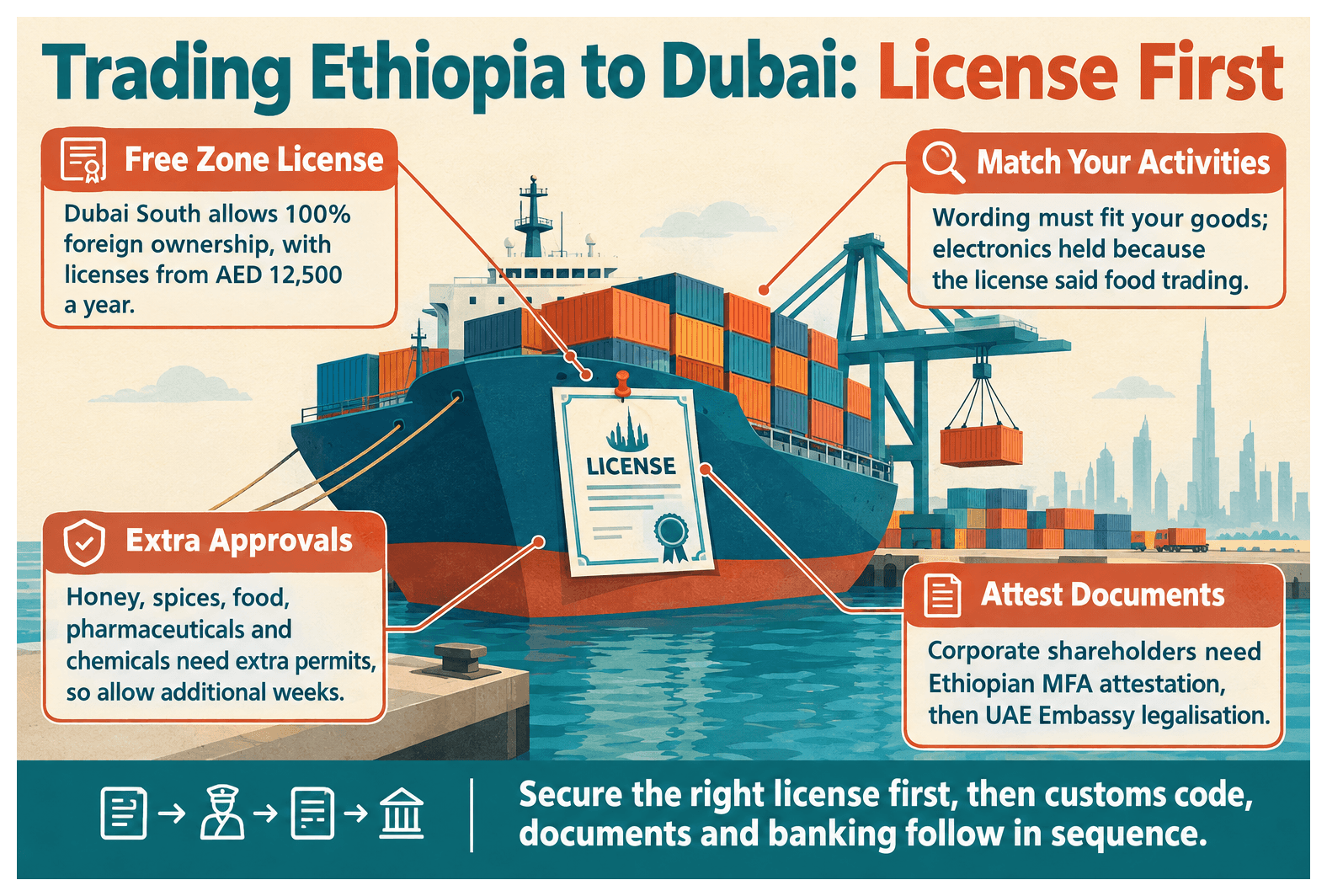
Most Ethiopian traders need a free zone trade license with import, export or general trading activities, since it allows 100% foreign ownership. Food, pharmaceuticals and chemicals need extra approvals from bodies like the Ministry of Economy or health regulators.
Choosing the Right Trade Activities for Your Goods
Match activities to your product, not just "general trading".
Align wording with the HS codes you'll declare.
Add activities at setup to avoid amendments.
Example: "coffee, tea and spices trading" suits a coffee cargo.
Goods That Need Extra Approvals
Honey and spices entering the UAE trigger food import checks, so confirm requirements before ordering stock. Check restricted lists early and allow extra weeks for permits. A leather goods exporter, by contrast, can usually proceed on a standard trade license. See how to get an import export license in Dubai.
Document Attestation Requirements for Ethiopian Nationals
Ethiopian nationals typically need a valid passport, photos and, where required, attested supporting documents. Ethiopian papers are usually authenticated by the Ministry of Foreign Affairs, then legalised by the UAE Embassy. Confirm the current checklist with your adviser.
Which Documents Need Attestation and Which Don't
A passport copy and photo usually suffice for a single-shareholder company. Corporate shareholders need attested commercial registration, a good standing certificate and a board resolution.
License and Registration Checklist for Ethiopian Traders
Feature | Requirement | What You Need to Know |
|---|---|---|
Free zone trade license with import and export activities | Activities matching your goods | Full foreign ownership; licenses start from AED 12,500 a year |
Customs code through Dubai Trade | Valid license and company documents | Issued only against a license; a clearing agent can file for you |
Attested documents for corporate shareholders | Registration, good standing, board resolution | Ethiopian MFA, then UAE Embassy; start early |
VAT and corporate tax registration with the FTA | FTA portal registration | VAT 5% above AED 375,000; corporate tax 9% above AED 375,000 profit |
Residency visa and corporate bank account | Entry permit, medical, Emirates ID; business plan | Expect enhanced due diligence and bring supply contracts |
The Attestation Route From Addis Ababa to Dubai
Start attestation while the license application is pending, so documents arrive on time. Budget for courier and translation into English or Arabic.
Step-by-Step Guide to Getting Your Trade License and Customs Code
To start trading, choose your activities, apply to Dubai South Business Hub, register the company, receive the license, then get a customs code through Dubai Trade. Then bank, register for tax and ship.
Define goods and HS codes. Map sesame seeds to the right code first.
Apply for the license. Send passports and name options; you can finish remotely.
Register your customs code. Use a clearing agent for early shipments.
Bank, book freight, ship. Test with one air consignment before containers.
Tax, VAT and Customs Duty Rules for Ethiopian Traders
UAE customs duty is generally 5% on imported goods, and VAT is 5%, with registration required above AED 375,000 of taxable supplies. Corporate tax is 9% on profit above AED 375,000. No Ethiopia-UAE deal removes these duties.
Customs Duty, Re-Export and Free Zone Treatment
Goods re-exported to East Africa through a free zone warehouse can avoid local duty, subject to customs conditions. Check each HS code before quoting buyers.
VAT and Corporate Tax Registration With the FTA
Register for VAT once invoicing passes AED 50 million.
Register for corporate tax with the Federal Tax Authority.
A 0% rate applies only to qualifying income.
Never assume tax-free status.
Ethiopia-Side Duties and Trade Agreements
Goods entering Ethiopia face duties through the Ethiopian Revenue and Customs Authority. Confirm treaty relief and foreign currency settlement rules locally before pricing.
Residency Visa and Banking Steps for Ethiopian Founders
A licensed company can sponsor a residency visa: entry permit, medical test, Emirates ID biometrics and stamping through GDRFA and ICP. Banks require company documents and proof of trade, and Ethiopian nationals should expect enhanced due diligence.
Opening a Corporate Bank Account as an Ethiopian National
Bring license, passport, Emirates ID and a business plan.
Expect questions on source of funds.
Show a signed Gulf buyer contract.
Follow Central Bank of the UAE rules.
Common Mistakes to Avoid in Import and Export Between Ethiopia and Dubai: What License You Need
The usual errors are wrong license activities, skipped HS checks, ignored restricted goods, late attestation and slow bank onboarding. Plan goods, activities and documents together before applying.
License and Compliance Errors That Delay Cargo
A spice consignment stalls without a certificate of origin. Mismatched activities and wrong HS codes cause the same trouble.
Planning Errors Around Payments and Logistics
Plan foreign currency settlement and Djibouti sea routing early. Traders on the Kenya, Uganda and Tanzania corridors face similar steps.
Next Steps: Start Your Import and Export Between Ethiopia and Dubai With the Right License
List your goods and HS codes, apply for a Dubai South Business Hub trade license with matching activities, and run attestation, customs, banking and residency in parallel.
A Practical Timeline for Your First Shipment
Week 1: confirm goods, activities, documents.
Weeks 2 to 3: formation and license.
Weeks 3 to 5: customs code, bank, residency.
Get a Free Consultation With Dubai South Business Hub
Import and export between Ethiopia and Dubai: what license you need comes down to a UAE trade license with the right activities, backed by customs, tax, attested documents and a bank account. Contact Dubai South Business Hub for a free consultation and a written setup plan.
References
Frequently Asked Questions