Topic Summary
Choose the Right License Type First
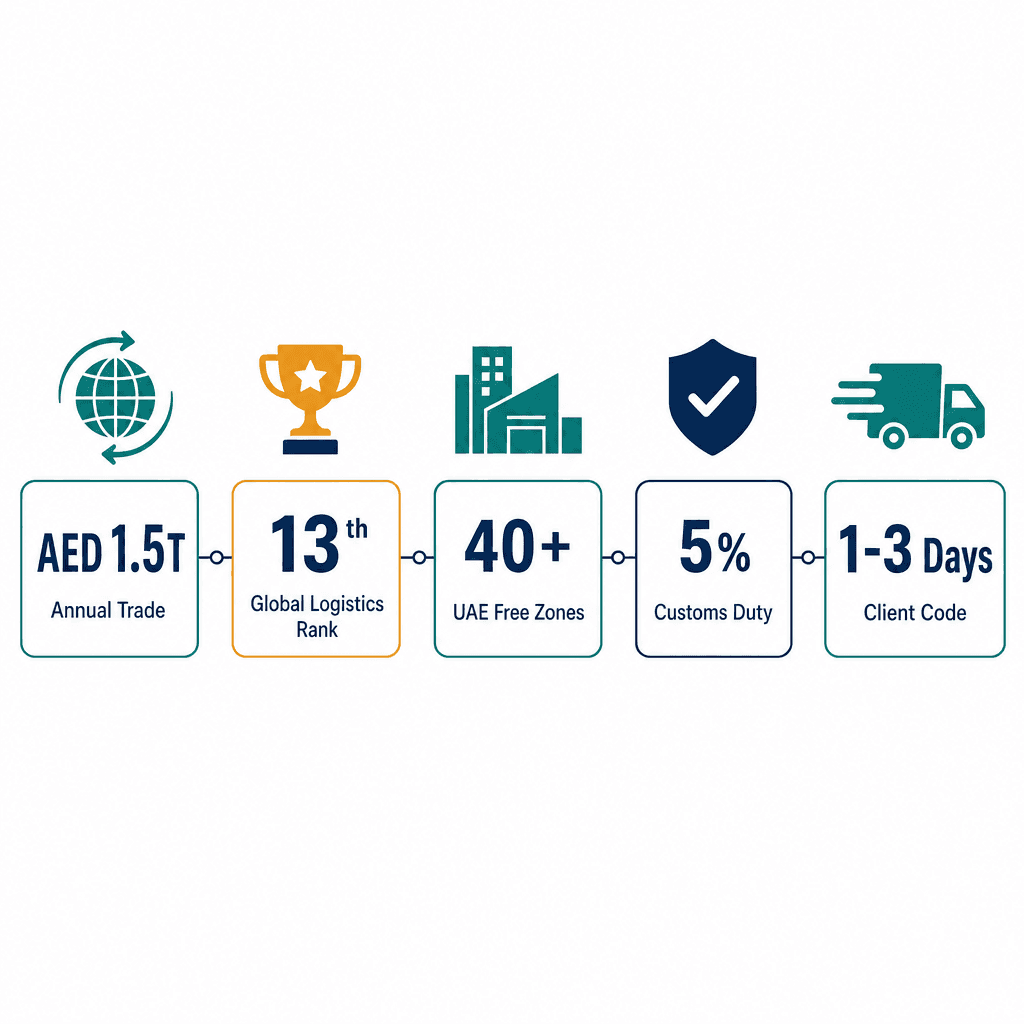
Dubai offers commercial licenses (mainland, via DET) and trading licenses (free zone), both of which can cover import and export when the correct activity codes are added. Picking the wrong type or skipping activity codes creates compliance gaps that will halt your shipments at the port.
Add Import and Export Activity Codes Explicitly
A standard trading license only covers domestic buying and selling — it does not automatically authorize cross-border movement of goods. You must specify both 'import of goods' and 'export of goods' as distinct activity codes, which typically cost AED 300–500 each through DET.
Register for a Dubai Customs Client Code
A Customs Client Code from the Dubai Trade portal is mandatory alongside your license to legally clear shipments. Most registrations are processed within just 1–3 business days, making this a quick but essential step.
General vs. Specific Trading License: Know the Difference
A general trading license lets you trade across multiple product categories under one document — ideal for diversified traders. A specific trading license is cheaper upfront but restricts you to listed commodities, meaning costly amendments if you later expand your product range.
Weigh Free Zone Against Mainland Setup Costs
Over 30 of the UAE's 40+ free zones offer trading licenses that include import and export activity codes, often with competitive pricing and streamlined processes. Mainland setups via DET offer broader local market access but operate under a different customs regime and fee structure.
Check Whether Your Goods Need Extra Approvals
Certain product categories require additional regulatory approvals beyond the standard trading license and Customs Client Code. Identifying these requirements early prevents costly delays once goods are already in transit.
Understand UAE Customs Duty Obligations
Standard UAE customs duty sits at 5% of the CIF (cost, insurance, and freight) value for most goods entering the mainland. Factoring this into your pricing and margins from day one is essential for accurate landed cost calculations.
By Editorial Team, UAE business setup specialists with direct experience in free zone licensing, customs registration, and trading company formation across Dubai. Full bio →
In 2026, Dubai processes over AED 1.5 trillion in trade annually, making it one of the world's most active commercial corridors (Dubai Statistics Center, 2025). The UAE ranks 13th globally for trade logistics performance (World Bank Logistics Performance Index, 2023). Over 40 free zones operate across the UAE, with more than 30 offering trading licenses that include import and export activity codes (UAE Ministry of Economy, 2024). Standard UAE customs duty sits at 5% on CIF value for most goods entering the mainland (Federal Customs Authority, 2025). And the Dubai Trade portal processes most Customs Client Code registrations within 1 to 3 business days (Dubai Customs, 2025). For more detail, see our guide on cargo freight and import export business in Dubai. For more detail, see our guide on customs client code for Dubai importers. For more detail, see our guide on Dubai Trade Portal registration for importers. For more detail, see our guide on import business setup guide for Dubai.
For entrepreneurs who want a piece of that volume, whether importing goods for local sale or exporting UAE products to global markets, the right import export license dubai and customs registration are the non-negotiable foundation. This guide covers exactly what license type covers import and export activity, how a standard trading license differs from a full import-export license, what the Dubai Customs Client Code requires, which goods need additional approvals, how free zone and mainland setups compare on cost and flexibility, and the step-by-step process to get fully operational. For more detail, see our guide on importing and trading auto parts in Dubai.
An import export license dubai is a commercial or trading license issued by the Department of Economy and Tourism (DET) or a free zone authority that includes import and export as approved business activities. It legally permits you to move goods across UAE borders and, combined with a Dubai Customs Client Code, is the minimum requirement to clear shipments. There is no standalone "import-export permit" issued as a separate document in Dubai, the activity codes on your license do the work.
Commercial License vs. Trading License: Which One Covers Import-Export?
The distinction matters more than most new traders realise. Here's how the two license types break down:
Commercial license (mainland, issued by DET): Covers buying and selling goods, including cross-border movement, when import and export activity codes are explicitly added. The DET can include hundreds of approved activity codes on a single commercial license (Department of Economy and Tourism, 2025).
Trading business license in Dubai (free zone): Functions identically to a mainland commercial license for customs purposes but operates within that free zone's jurisdiction and customs regime.
General trading license: Lets you trade across multiple product categories under one license, the most flexible option for diversified traders.
Specific trading license: Restricts you to listed commodity types only. Cheaper upfront, but you'll need amendments if you expand your product range.
A Dubai South free zone company importing electronics and re-exporting to East Africa, for example, holds a single general trading license Dubai with import and export activity codes, no separate import-export permit required.
The Difference Between a Standard Trading License and a Full Import-Export License
A standard trading license permits domestic buying and selling only. It does not automatically authorise cross-border movement of goods. A full import-export license, in practice, a trading or commercial license with import and export activity codes explicitly added, is what authorises clearance through Dubai Customs.
When you apply, you must specify "import of goods" and "export of goods" as distinct activity codes. Omitting either creates a compliance gap that will surface the moment your first shipment hits the port. Activity code additions at DET typically cost AED 300 to 500 per code (DET fee schedule, 2025). That's a small fee with large consequences if skipped.
A retailer in Deira learned this the hard way: their mainland trading license covered local sales only. When a shipment arrived from China, Dubai Customs rejected clearance because the import activity code was absent. Adding the code at DET took 2 to 3 business days, but the shipment sat in a bonded warehouse the entire time, accruing storage fees.
Import-Export Activity Codes: What Each Covers
Activity Code | Standard Trading License | Trading License + Import/Export Codes |
|---|---|---|
Domestic buying and selling | ✅ Permitted | ✅ Permitted |
Cross-border import clearance | ❌ Not authorised | ✅ Authorised |
Export declarations filing | ❌ Not authorised | ✅ Authorised |
Re-export through Dubai Customs | ❌ Not authorised | ✅ Authorised |
Customs broker filing on your behalf | ❌ Requires Client Code | ✅ With Client Code registered |
Code addition cost (DET mainland) | N/A | AED 300–500 per code |
Dubai Customs Client Code: The Registration Every Importer and Exporter Needs
A Dubai Customs Client Code is a mandatory registration number issued by Dubai Customs that identifies your business in all import and export declarations. Without it, no shipment can be cleared through Dubai ports or airports. Registration is done online via the Dubai Trade portal and typically takes one to three business days (Dubai Customs, 2025).
Who Must Register and What the Code Does
Every business, mainland or free zone, that imports or exports goods through Dubai must hold a Dubai Customs Client Code. The code links your trade license to every customs declaration, enabling Dubai Customs to verify your eligibility and track your trade history in real time.
Worth flagging: freight forwarders and customs brokers cannot file declarations on your behalf without your Client Code already on record. Registration is free of charge, the only cost is time and document preparation. A other UAE free zones-licensed company shipping consumer goods to Europe, for instance, must present its Client Code on every export declaration even though other UAE free zones issues its own trading license.
Documents Required to Register Your Dubai Customs Client Code
Gather these before you start the online application at dubaitrade.ae:
Dubai South Business Hub Free Zone provides onboarding coordination that includes guidance on Customs Client Code registration, reducing the administrative burden significantly for new trading companies. See the full essential documents for import export business in Dubai for a broader checklist.
Is the Dubai Customs Client Code the same as a customs license dubai?
Not exactly. A customs license dubai refers to the activity authorisation on your trade license. The Client Code is a separate registration number issued by Dubai Customs that activates your ability to file declarations. You need both: the license activity codes come first, then the Client Code registration follows.
Goods That Need Additional Approvals Before You Can Import or Export
Certain product categories, including food, pharmaceuticals, chemicals, medical devices, and electronics, require pre-approval from UAE regulatory authorities before import or export is permitted. These approvals are separate from your import export license dubai and Dubai Customs Client Code and can add weeks to your setup timeline if not planned in advance.
Regulated Categories and the Authorities That Oversee Them
Food and beverages: Dubai Municipality Food Safety Department registration required. Each product and its foreign manufacturer must be registered before the first shipment. Registration can take 2 to 6 weeks per product (Dubai Municipality, 2025).
Pharmaceuticals and medical devices: Dubai Health Authority (DHA) or Ministry of Health and Prevention (MOHAP) product registration required before first import. Timelines range from 3 to 18 months depending on product classification (MOHAP, 2024).
Chemicals and hazardous materials: UAE Ministry of Climate Change and Environment approval plus mandatory safety data sheets.
Electronics and telecommunications equipment: Telecommunications and Digital Government Regulatory Authority (TDRA) type approval required for any device with wireless components.
Dual-use goods (civilian and military applications): UAE Strategic Goods Control List compliance and an export permit from the UAE Ministry of Economy.
A company importing protein supplements must register each SKU with Dubai Municipality's food import portal before the first shipment arrives. Skip this step and your goods sit at the port indefinitely, there's no expedited workaround once the container is already on the water.
How to Check Whether Your Product Needs a Special Permit
An electronics trader importing Bluetooth-enabled devices discovered through HS code lookup that TDRA type approval was mandatory. Sourcing the approval added 4 weeks to their launch timeline, but it prevented a port hold that would have cost far more.
6 stepsh2>
Getting an import export license in Dubai involves six steps: choose your jurisdiction (mainland or free zone), select your business activity codes including import and export, submit your trade name and incorporation documents, obtain your trade license, register for a Dubai Customs Client Code, and secure any product-specific regulatory approvals your goods require.
Step 1: Choose Your Jurisdiction and Legal Structure
Mainland (DET) gives you direct access to the UAE domestic market and lets you import and export without a local distributor. Free zones offer 100% foreign ownership and 0% customs duty on goods stored and re-exported without entering the mainland, but direct UAE retail sales require a local distributor or a dual-license arrangement.
A Kenyan entrepreneur setting up a re-export business, importing from Asia, shipping to Africa, chose Dubai South Free Zone over mainland specifically because duty-free warehousing and proximity to Al Maktoum International Airport cut logistics costs significantly. For re-export-focused businesses, free zones are almost always the more cost-effective structure.
Step 2: Register Your Trade Name and Submit Incorporation Documents
Reserve your trade name through DET's online portal (mainland) or your chosen free zone authority. You'll need passport copies of all shareholders, a proposed activity list with import and export codes named explicitly, a Memorandum of Association draft, and proof of business address, either an office lease or a flexi-desk agreement.
Free zone authorities typically offer bundled packages covering name registration, license issuance, and visa allocation in a single application. Processing runs 3 to 7 business days for most free zones and 5 to 10 business days for mainland DET applications. At Dubai South Business Hub Free Zone, the incorporation package includes trade name registration, license issuance, and Customs Client Code coordination, reducing total setup to under two weeks for a standard trading company. Free zone license packages start from approximately AED 12,500 to 15,000 for a trading license; mainland DET commercial licenses with import and export activity codes typically run AED 15,000 to 25,000.
Step 3: Obtain Your License, Register with Dubai Customs, and Secure Product Approvals
Once your trade license is issued, register for your Dubai Customs Client Code immediately via the Dubai Trade portal. Don't wait. Apply for product-specific approvals in parallel, not after your first shipment is booked. Open a UAE corporate bank account at the same time; most UAE banks require 2 to 6 weeks for KYC processes, and you'll need the account for customs bonds and supplier payments.
A medical device importer did exactly this: registered with Dubai Customs and simultaneously submitted MOHAP product registration applications. By the time the Client Code was issued, the product approvals were already in process, cutting total time-to-trade by six weeks. Brief your freight forwarder on your commodity HS codes early so they can flag any last-minute compliance gaps before goods are shipped. You can also explore DHL international shipping for UAE free zone businesses for logistics connectivity options.
Ready to start your trading business at Dubai South Business Hub Free Zone? The onboarding team coordinates license issuance and Customs Client Code registration together.
Free Zone vs. Mainland for Your Import Export Business in Dubai
Free zones offer 100% foreign ownership, duty-suspended warehousing, and faster setup, ideal for re-export and international trade. Mainland licenses allow direct UAE market access and broader activity scope. The right choice for your import export business license uae depends on whether your primary market is the UAE domestic market or international re-export routes.
Free Zone vs. Mainland: Side-by-Side Comparison
Feature | Free Zone | Mainland (DET) |
|---|---|---|
Foreign ownership | ✅ 100% | ✅ Up to 100% (post-2021 reforms) |
Import duty on re-exported goods | ✅ 0% | ❌ 5% CIF on mainland imports |
Direct UAE market access | ❌ Requires local distributor | ✅ Direct sales permitted |
License cost (annual) | AED 12,500–15,000+ | AED 15,000–25,000+ |
Setup time | 3–7 business days | 5–10 business days |
Warehouse access | ✅ Purpose-built, on-site | Third-party arrangement required |
Dubai Customs Client Code required | ✅ Yes | ✅ Yes |
A US-based consumer goods brand chose Dubai South Free Zone for its regional distribution hub. The 0% duty on goods transiting through the free zone to GCC markets made the economics significantly better than a mainland warehouse setup (Federal Customs Authority, 2025).
Which Setup Is Right for Your Trade Model?
Re-export focus, buying internationally, selling internationally through Dubai, almost always favours a
Citations
UAE Ministry of Economy and Tourism.. moet.gov.ae. MOET UAE, 2024.
Dubai Economy and Tourism.. dubaidet.gov.ae. DET Dubai, 2024.
Dubai Chamber of Commerce.. dubaichamber.com. Dubai Chamber, 2024.
Dubai Health Authority.. dha.gov.ae. DHA UAE, 2024.
DP World.. dpworld.com. DP World, 2024.
Frequently Asked Questions