
Topic Summary
What Import and Export Between Saudi Arabia and Dubai: What License You Need Means
Import and export between Saudi Arabia and Dubai: what license you need starts with a UAE trade license listing your goods as approved activities, plus a customs code to clear cargo. A Dubai free zone company covers both and supports your residency visa.
GCC Trade Rules Between Saudi Arabia and the UAE
GCC Trade Rules Between Saudi Arabia and the UAE
Step-by-Step Guide to Import and Export Between Saudi Arabia and Dubai: What License You Need
Define your goods and HS codes, pick a free zone license with trading activities, register, attest documents, bank, get your customs code, then your visa. Sequence matters.
Customs Codes and Documents for Import and Export Between Saudi Arabia and Dubai
Cargo needs a commercial invoice, packing list, bill of lading or airway bill, certificate of origin and a declaration under your customs code. Regulated goods need extra approvals.
Attestation, Ownership and Compliance for Saudi Nationals
Saudi nationals need a valid passport. Corporate shareholders need attested documents, usually via Saudi MOFA, the UAE embassy, then UAE MOFA.
Banking Considerations for Import and Export Between Saudi Arabia and Dubai: What License You Need
UAE banks run strict KYC on trading firms. Bring your license, passports, business plan, buyer details and proof of source of funds.
Why Dubai South Business Hub Suits Import and Export Between Saudi Arabia and Dubai: What License You Need
Dubai South Business Hub offers free zone formation, trade licenses and visa packages tied to your license. Its position near Al Maktoum International Airport suits Saudi-bound cargo. Free zones suit international trade; mainland suits direct UAE sales.
Import and export between Saudi Arabia and Dubai: what license you need is the first question Saudi founders ask. Dubai's non-oil foreign trade tops AED 2.2 trillion a year (Dubai Chamber, 2024). Dubai handles over 16 million customs declarations annually (Dubai Trade, 2025). This guide is for Saudi nationals relocating to Dubai who want a clear route from license to first shipment.
What Import and Export Between Saudi Arabia and Dubai: What License You Need Means
Import and export between Saudi Arabia and Dubai: what license you need starts with a UAE trade license listing your goods as approved activities, plus a customs code to clear cargo. A Dubai free zone company covers both and supports your residency visa.
Trade License and Customs Code Defined
The trade license authorises specific activities, so import-export or general trading must appear on it. The customs code from Dubai Customs is separate and lets you file declarations. You need both before the first shipment moves.
Picture a Riyadh founder trading building materials. She adds "building materials trading" to the license, then registers her customs code before ordering the first container.
Why Saudi Nationals Choose Dubai as a Trade Base
Jebel Ali moves over 14 million TEUs a year (DP World, 2025).
Road and air links reach Riyadh, Jeddah and Dammam quickly.
Free zone ownership comes with residency tied to the license.
A Jeddah distributor, for instance, can use Dubai as a re-export hub for Asian goods bound for the GCC.
GCC Trade Rules Between Saudi Arabia and the UAE
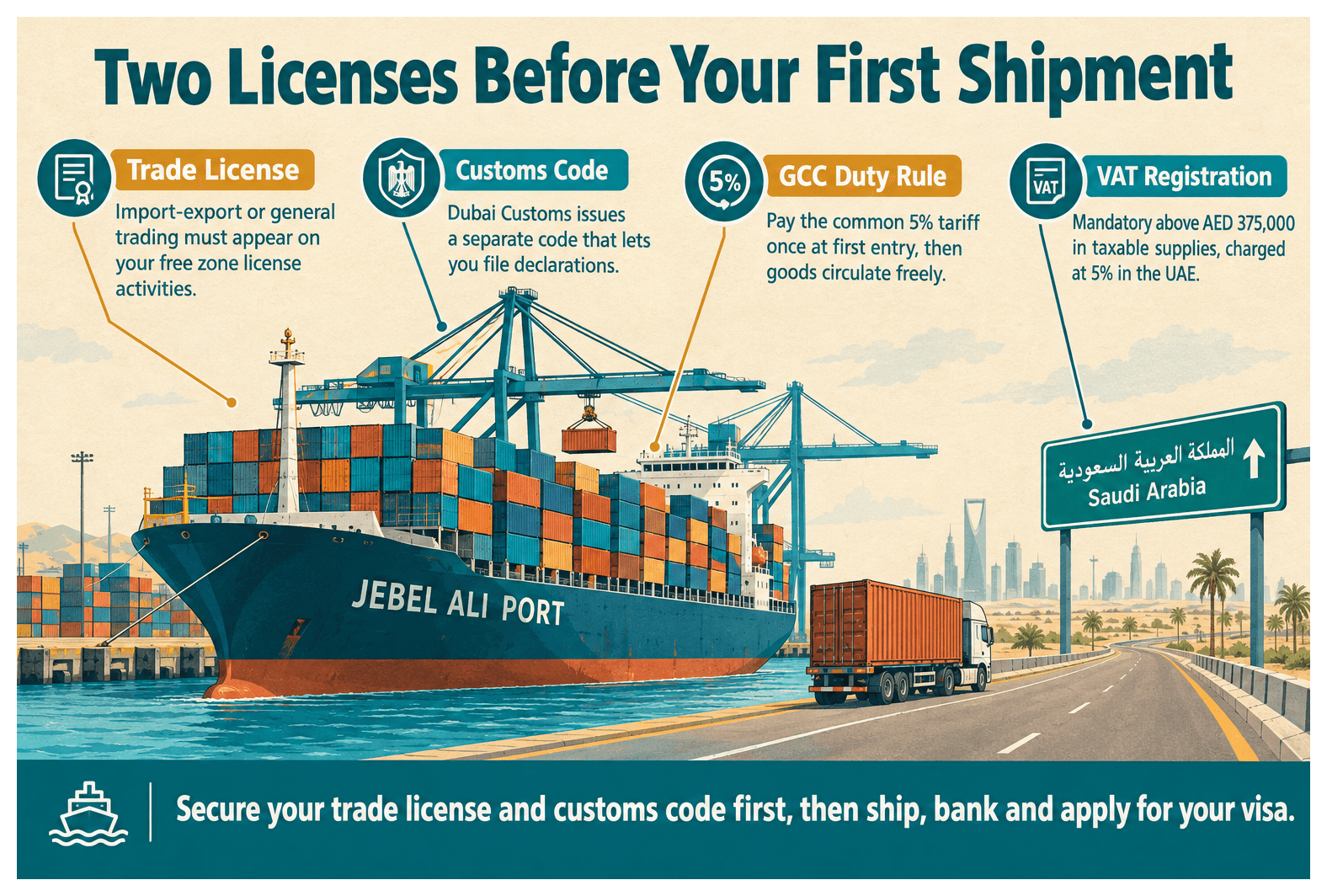
Both countries sit in the GCC Customs Union, with a common external tariff of generally 5%. Duty is paid at first entry, then goods circulate freely. You still need origin papers, declarations and correct VAT treatment per shipment.
A food importer clears goods at Jebel Ali, pays duty once, then trucks them to Dammam on transit paperwork. ZATCA handles the Saudi side and Dubai Customs the UAE side.
Licenses and Registrations for Saudi-UAE Trade
Feature | Requirement | Purpose |
|---|---|---|
Free zone trade license | Import-export or general trading activity | Legal right to trade your listed goods |
Customs code (Dubai Customs) | Registration through Dubai Trade | Filing customs declarations |
VAT registration (FTA) | Mandatory above AED 375,000 in taxable supplies | Charging and reclaiming 5% UAE VAT |
Corporate tax registration (FTA) | Registration with the Federal Tax Authority | Compliance with 9% tax above AED 375,000 profit |
Residency visa and Emirates ID | Medical test and biometrics | Living and banking in the UAE |
Tax Treaty and Trade Agreement Notes
A UAE-Saudi double taxation agreement exists. Confirm current terms with the Federal Tax Authority.
VAT is 5% in the UAE and 15% in Saudi Arabia.
Restricted goods lists differ by country.
Selling to a Saudi buyer? Apply the right cross-border VAT treatment before you invoice.
Step-by-Step Guide to Import and Export Between Saudi Arabia and Dubai: What License You Need
Define your goods and HS codes, pick a free zone license with trading activities, register, attest documents, bank, get your customs code, then your visa. Sequence matters.
Step 1: Define Goods and Select License Activities
List products with HS codes.
Match them to trading activities.
Flag food, pharma or chemicals for extra approvals.
A Dammam electronics trader lists HS codes upfront and avoids a later license amendment.
Step 2: Set Up the Company and Secure Your License
Register with Dubai South Business Hub.
Submit passport, photo and business plan details.
Receive your license and establishment documents.
Step 3: Bank, Customs Code and Residency
Open a corporate account with KYC papers ready.
Register your customs code on Dubai Trade.
Apply for residency through ICP, then book the medical and Emirates ID.
Compare routes in our guides on import and export between Egypt and Dubai and import and export between Jordan and Dubai.
Customs Codes and Documents for Import and Export Between Saudi Arabia and Dubai
Cargo needs a commercial invoice, packing list, bill of lading or airway bill, certificate of origin and a declaration under your customs code. Regulated goods need extra approvals.
Commercial invoice and packing list
Bill of lading or airway bill
Certificate of origin attested by Dubai Chamber
A licensed clearing agent can file for you. One new importer used an agent for three shipments, then moved filing in-house. Check HS classification carefully to avoid duty disputes, and keep records for audit. Traders sourcing from the Levant may also read import and export between Lebanon and Dubai.
Attestation, Ownership and Compliance for Saudi Nationals
Saudi nationals need a valid passport. Corporate shareholders need attested documents, usually via Saudi MOFA, the UAE embassy, then UAE MOFA.
A Saudi holding company attests its commercial registration and board resolution.
Allow extra time for translation.
Ongoing Compliance Duties
Renew your license annually.
Register for VAT above AED 375,000.
Register for corporate tax with the FTA.
Banking Considerations for Import and Export Between Saudi Arabia and Dubai: What License You Need
UAE banks run strict KYC on trading firms. Bring your license, passports, business plan, buyer details and proof of source of funds.
One founder brought two supplier quotes and a Saudi purchase order to the meeting. Both SAR and AED are pegged to the USD, so a multi-currency account suits invoicing Saudi buyers in SAR and paying UAE suppliers in AED. Keep payments aligned with invoices.
Why Dubai South Business Hub Suits Import and Export Between Saudi Arabia and Dubai: What License You Need
Dubai South Business Hub offers free zone formation, trade licenses and visa packages tied to your license. Its position near Al Maktoum International Airport suits Saudi-bound cargo. Free zones suit international trade; mainland suits direct UAE sales.
Turkish sourcing? See import and export between Turkey and Dubai.
Your Next Step
Import and export between Saudi Arabia and Dubai: what license you need comes down to a free zone trade license, a customs code, attested documents, VAT awareness and a supportive bank. Contact Dubai South Business Hub for a free consultation on your license activities, visa package and timeline.
References
Frequently Asked Questions