
Topic Summary
Dubai's Geography Gives Importers a Head Start
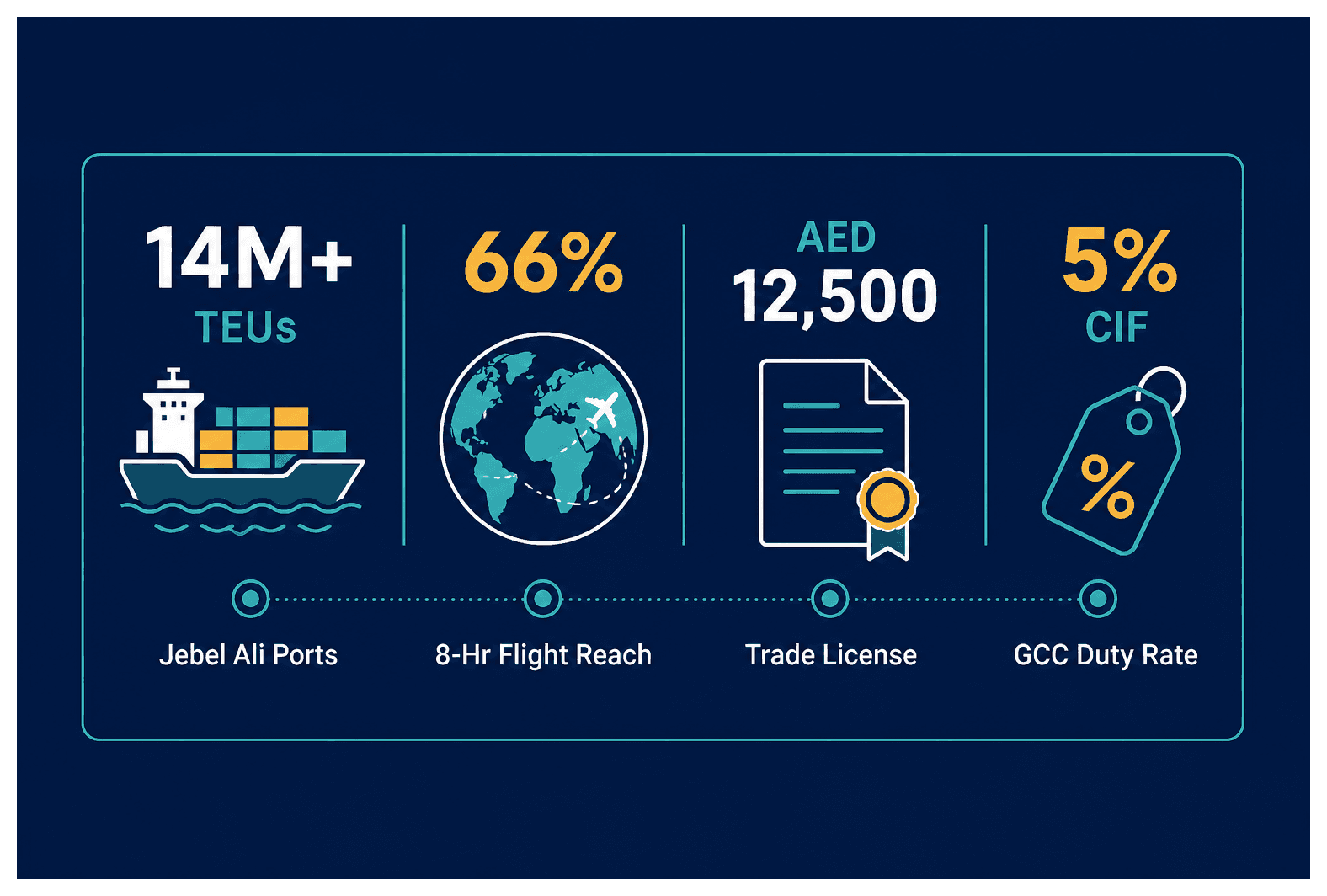
Dubai sits within an eight-hour flight radius covering 66% of the world's population, compressing supply chains significantly. Jebel Ali port processes over 14 million TEUs annually, connecting importers to one of the world's most capable logistics networks.
A Trade License Starts at AED 12,500
At Dubai South Business Hub Free Zone, an import trade license starts from AED 12,500 and is issued in just one business day. Zero paid-up share capital is required, making it accessible for first-time founders.
First-Year Costs Are Predictable From Day One
A sole founder with one visa can expect total first-year costs starting from AED 18,350, covering the license and visa expenses. Knowing this upfront helps founders plan capital requirements before committing to the structure.
Customs Duty and VAT Rules Apply Immediately
The standard GCC customs duty rate is 5% on CIF value, applied when goods enter the UAE mainland. VAT registration becomes mandatory once taxable supplies exceed AED 375,000, so founders should track revenue from the first shipment.
Activity Scope Must Match Your Actual Imports
License activities must align with declared import categories, as mismatches trigger customs holds at the port. Each activity beyond the first five on a DSBH license costs an additional AED 2,000, so accurate planning at setup saves money later.
Restricted Goods Require Extra Regulatory Approvals
Food, pharmaceuticals, and chemicals all require sector-specific regulatory approvals from the relevant authority before the first shipment can clear customs. A general trading license alone is not sufficient for these categories.
Dubai Enables Fast GCC-Wide Re-Export
Goods cleared in Dubai can be redistributed across the GCC and onward to East Africa, South Asia, and Europe within days. An importer sourcing from Shenzhen, for example, can clear, warehouse, and re-export to Saudi Arabia and Egypt within the same week.
In 2026, the UAE processes over 14 million TEUs of container throughput annually through its ports and free zones (Dubai Chamber, 2024). A trade license for an import business in Dubai at Dubai South Business Hub Free Zone (DSBH) starts from AED 12,500. It's issued in one business day. Zero paid-up share capital is required. First-year costs for a sole founder with one visa start from AED 18,350. The standard GCC customs duty rate is 5% on CIF value. VAT registration is mandatory once taxable supplies cross AED 375,000.
This guide walks first-time founders through every layer of setting up an import business in Dubai: the license structure, customs registration steps, mandatory regulatory approvals, a clear cost breakdown separating one-off from recurring expenses, and the compliance obligations that apply from day one.
What Is an Import Business in Dubai and Why It Matters
An import business in Dubai is a licensed commercial entity that sources goods from overseas suppliers and brings them into the UAE for resale, distribution, or manufacturing input. It requires a trade license, a customs registration number, and where applicable, sector-specific regulatory approvals before the first shipment clears.
How Dubai's Position Makes It an Ideal Import Hub
Dubai sits within an eight-hour flight radius covering 66% of the world's population. That geography alone compresses supply chains in ways that most other jurisdictions simply can't match. Port infrastructure at Jebel Ali handles over 14 million TEUs annually (Dubai Chamber, 2024), giving high-volume importers access to one of the world's most connected logistics networks.
The UAE also functions as a re-export platform. Goods cleared in Dubai can be distributed across the GCC and onward to East Africa, South Asia, and Europe within days. Consider this: a consumer electronics importer sourcing from Shenzhen can clear goods at Jebel Ali, warehouse them in Dubai, and re-export to Saudi Arabia and Egypt within the same week. That speed-to-market advantage is a core reason why an import business in Dubai remains one of the most practical structures for internationally minded founders.
66% of the world's population within an 8-hour flight
14 million+ TEUs processed annually through UAE ports
GCC re-export access without additional import licensing in most member states
Which Goods and Activities Fall Under Import Licensing
Not all goods are treated equally under UAE import rules. Here's what you need to know before selecting your business activities:
General trading licenses cover a broad range of goods; restricted goods (food, pharma, chemicals) require additional regulatory approval from the relevant authority
Under ISIC Rev.4, import-for-resale falls under wholesale and retail trade (Section G); import for manufacturing input falls under Section C, your license activities should reflect which applies to you
Activity scope on the license must match your declared import categories; mismatches trigger customs holds at the port
Each activity beyond the first five on a DSBH license costs AED 2,000 per activity
A founder importing both food ingredients and packaging materials, for example, needs food-handling approval from the relevant authority and a general trading activity on the same license. Both are mandatory; neither substitutes for the other.
Worth flagging: DSBH is not a designated zone, so it doesn't carry designated-zone customs or VAT benefits. Free zone goods are duty-suspended while held within the zone. When goods move from the free zone to the UAE mainland, applicable customs duties apply at that point of entry.
How to License Your Import Business in Dubai
Licensing an import business in Dubai involves choosing a jurisdiction, registering a trade name, selecting the correct business activities, obtaining the trade license, and then registering with UAE Customs. At DSBH, a license starts from AED 12,500, is issued in one business day, and requires zero paid-up share capital.
Free Zone vs. Mainland: Choosing the Right Setup
Both free zone and mainland structures now permit 100% foreign ownership in most sectors. The 2021 amendments to the UAE Commercial Companies Law extended 100% foreign ownership to the mainland for the majority of business activities, so ownership percentage alone shouldn't drive your jurisdiction decision.
The more practical distinction is market access. A founder importing industrial components for B2B wholesale may prefer a free zone license for the administrative simplicity and duty suspension on goods stored within the zone. A founder selling directly to UAE retail consumers may find a mainland license more practical, since it allows direct retail without requiring a local distributor.
DSBH is a free zone jurisdiction. It does not carry designated-zone customs or VAT treatment. Goods stored within the DSBH zone are duty-suspended, not duty-exempt. The moment those goods enter the UAE mainland, standard customs duties apply. Plan your distribution model before choosing your jurisdiction, not after.
Selecting Business Activities for an Import License
Activities must reflect the specific goods you're importing; "general trading" is broad but restricted categories still require named activities on the license
DSBH includes up to five activities in the base license; each additional activity beyond five is AED 2,000
Regulated goods (food, pharmaceuticals, electronics with radio frequency) require the relevant regulatory body's approval in addition to the DSBH license
Check the trading license activity list before applying to confirm your specific goods are covered
An importer of dietary supplements must list that specific activity on the license and then obtain separate approval from the relevant health authority. DSBH licenses the activity; the health authority approves it independently. Both steps are non-negotiable.
The DSBH License Application Process
DSBH launched in September 2025 and issues licenses in one business day. Dubai South Business Hub Free Zone licenses start from AED 12,500. Zero paid-up share capital is required for either structure.
Visas are always an additional cost at DSBH and are never included in the license fee. A sole founder setting up a general trading import company at DSBH in year one would budget from AED 18,350, which covers the license and one visa package. If you need two visa allocations, budget the license fee plus the cost of both visa packages separately.
Ready to start your business in Dubai? Use the name availability check first, then apply directly through the DSBH portal once your activity list is confirmed.
Step-by-Step Guide to Customs Registration for Your Import Business in Dubai
After obtaining a trade license, an import business in Dubai must register with UAE Customs to receive an importer code, then register each port of entry on the Dubai Trade portal. This customs number is mandatory before any commercial shipment can be cleared through UAE ports or airports.
Step 1: Obtain Your Trade License and Corporate Documents
Your trade license, memorandum of association, and passport copies of all shareholders are the foundational documents for customs registration. Get these in order before you touch the customs portal.
A DSBH licensee receives their trade license within one business day and can immediately begin the customs registration process. Before you do, confirm that the business activities listed on your license match the goods you intend to import. For regulated goods, have the relevant regulatory approval ready before beginning customs registration, not after.
Step 2: Register on the Dubai Trade Portal and Obtain an Importer Code
Dubai Trade is the central platform for customs registration and shipment declarations
Your importer code (also called a customs registration number) is assigned upon approved registration
Registration requires your trade license, establishment card, and owner identification documents
Without an active importer code, freight forwarders cannot file import declarations on your behalf
A trading company importing consumer goods would appoint a licensed customs broker who then files all import declarations through the Dubai Trade portal using the company's importer code. That code is the key that opens every subsequent step.
Step 3: Classify Goods and Confirm Duty Rates
All goods must be classified using the GCC Common Customs Tariff (HS codes). Incorrect classification leads to customs holds, delays, and potential financial penalties, so this step deserves more attention than most first-time importers give it.
The standard GCC customs duty is 5% on CIF value for most goods. Some categories, including alcohol, tobacco, and certain luxury goods, attract higher rates. An importer of stainless-steel kitchenware, for instance, must confirm the correct HS code to determine whether the standard 5% rate applies or whether any anti-dumping measures are in effect for that specific origin country.
DSBH does not provide bonded warehousing or customs integration services. You'll need to arrange your own logistics provider and licensed clearance agent separately.
Import Business Dubai Cost: One-Off vs. Recurring Expenses
Cost Item | One-Off Setup Costs | Recurring Annual Costs |
|---|---|---|
Trade License | From AED 12,500 | Annual renewal mirrors the initial license fee; due on the license anniversary date |
Visa Package | Additional cost per visa holder; never included in the license fee. First-year total from AED 18,350 (license + one visa) | Visa renewal fee applies per holder annually; Emirates ID renewal also required |
Additional Business Activities | AED 2,000 per activity beyond the first five, paid at license issuance | Activity fees recur at renewal if activities remain on the license |
Customs Registration | UNVERIFIED: confirm fee directly with UAE Customs before publishing | Customs broker fees per shipment: recurring operational cost, varies by port and commodity |
Customs Duties | Not applicable at setup stage | Typically 5% of CIF value per shipment; assessed at point of mainland entry |
VAT and Corporate Tax Filing | Registration fees apply once thresholds are crossed (AED 375,000 for both) | Quarterly VAT returns; annual corporate tax filing; accountancy costs apply |
Not Included in DSBH Figures | Warehouse rent, cargo insurance, regulatory approval fees, bank account fees | Storage costs, staff payroll, logistics, insurance, sector-specific authority renewals |
Step 4: Appoint a Licensed Customs Broker
UAE law requires import declarations to be filed by a licensed customs broker or clearing agent. This isn't optional, and it's not something you can handle yourself as the business owner. Broker fees vary by shipment volume, port, and commodity type, so treat them as a recurring line item in your operational budget from the outset.
Establish the broker relationship before your first shipment arrives. A first-time importer who skips pre-appointing a broker risks demurrage charges of USD 50-150 per container per day while paperwork is sorted at the port. That cost accumulates quickly and is entirely avoidable.
Import Business Dubai Cost: One-Off and Recurring Expenses
Import business Dubai costs split into one-off setup fees and recurring annual expenses. One-off costs include the license, visa fees, and customs registration. Recurring costs include license renewal, visa renewal, customs broker fees, and applicable duties. Warehouse rent, staff salaries, and insurance are additional and not included in DSBH's published figures.
One-Off Setup Costs
Dubai South Business Hub Free Zone licenses start from AED 12,500. Zero paid-up share capital is required. Each business activity beyond the first five costs AED 2,000. Visa packages are always an additional cost and are never included in the license fee.
A sole founder registering a general trading import company at DSBH with two visa allocations would budget from AED 18,350 for the license and first visa, plus the cost of the second visa package on top. Use the business setup cost calculator to build an accurate budget before you apply.
Recurring Annual Costs
Annual license renewal mirrors the initial license cost
Visa renewal fees apply per holder annually
Customs broker fees per shipment are recurring operational costs outside DSBH's scope
Customs duties at 5% CIF are per-shipment recurring costs triggered at mainland entry
VAT registration and quarterly filing costs apply once taxable supplies exceed AED 375,000
The scale of duty costs is worth illustrating concretely. An importer bringing in AED 2 million of goods annually at 5% duty pays AED 100,000 in customs duties alone, before broker fees or VAT implications. Budget these figures separately from your DSBH license costs.
What Is Not Included in DSBH's Published Figures
The AED 12,500 license figure covers the license only. A food importer licensing at DSBH should separately budget for:
Cold-chain storage rental
Food safety authority registration and renewal
Recurring customs broker fees per shipment
Cargo insurance
Staff salaries and MoHRE-registered employment costs
Bank account opening and maintenance fees
None of these appear in the AED 12,500 license figure. Plan for them from day one.
VAT, Corporate Tax and Customs Compliance for Your Import Business in Dubai
An import business in Dubai must register for VAT if taxable supplies exceed AED 375,000 annually. Corporate tax at 9% applies to taxable income above AED 375,000. Late registration for either carries a flat AED 10,000 penalty. Import duties are separate from VAT and are assessed at customs clearance on the CIF value.
VAT on Imports: Registration, Filing and Import VAT Recovery
VAT registration is mandatory when your taxable supplies or imports exceed AED 375,000 per year (Federal Tax Authority). The UAE is not tax-free; VAT at 5% applies to most imported goods sold domestically. Late VAT registration carries a flat AED 10,000 penalty, so register before you cross the threshold, not after.
Import VAT is paid at the point of customs clearance. If you're VAT-registered and the goods are used for a taxable business purpose, you can recover that VAT through your quarterly return. A trading company importing AED 500,000 of goods in year one must register for VAT before crossing the threshold, then reclaim import VAT through those quarterly filings.
Corporate Tax Obligations for Import Businesses
UAE corporate tax at 9% applies to taxable income exceeding AED 375,000 per financial year (Federal Decree-Law No. 47 of 2022). Free zone entities may qualify as Qualifying Free Zone Persons (QFZP) and apply a 0% rate on qualifying income, but only if all four conditions are met:
Adequate substance maintained within the free zone
Income qualifies as "qualifying income" as defined under the corporate tax law
No election made to be taxed under the standard regime
Full compliance with transfer pricing rules
An import company operating from DSBH that sells goods to UAE mainland customers generates non-qualifying income under QFZP rules and is taxed at 9% on income above AED 375,000. Never assume the 0% rate applies without verifying all four conditions. Late corporate tax registration carries a one-time flat AED 10,000 penalty, not a monthly charge.
Is import VAT recoverable for a free zone import business in Dubai?
Yes, if your import business in Dubai is VAT-registered and the imported goods are used for taxable business purposes, you can recover import VAT paid at customs clearance through your quarterly VAT return filed with the Federal Tax Authority. The recovery is not automatic; you must be registered and file correctly.
Regulated Goods and Sector-Specific Approvals for Import Businesses in Dubai
Certain imported goods require approvals from named regulators in addition to a trade license. Food products need authority clearance, pharmaceuticals need Ministry of Health approval, and electronics with radio frequency require a telecommunications regulator permit. DSBH licenses the import activity; the named regulator approves the specific goods or sector independently.
Common Regulated Import Categories and Their Approving Bodies
Food and agricultural products: approval from the relevant food safety authority; phytosanitary certificates required at customs for plant-based goods
Pharmaceuticals and medical devices: Ministry of Health and Prevention (MOHAP) registration required for each product before import; import permits issued per shipment
Chemicals and hazardous materials: environment and safety authority clearance required before each consignment
Electronics with radio frequency components: Telecommunications and Digital Government Regulatory Authority (TDRA) type approval required
For every regulated category: DSBH licenses the activity, and the named regulator approves it separately. Both steps are mandatory. Neither substitutes for the other.
An importer of medical diagnostic equipment must register each device with MOHAP and obtain import permits per shipment, in addition to holding a valid DSBH trade license with the medical equipment import activity listed. Skipping either step means the shipment won't clear.
How Restricted and Prohibited Goods Affect Your License Scope
Prohibited goods cannot be licensed regardless of jurisdiction. If you attempt to list a prohibited activity, the application will be rejected outright. Restricted goods can be licensed but require pre-clearance from the relevant authority before each individual shipment, not just once at setup.
Declaring restricted goods without prior approval leads to seizure, financial penalties, and possible license suspension. A founder who lists "
References
Frequently Asked Questions