Topic Summary
Licensing Is Mandatory Before Any Paid Brief
Cabinet Resolution No. 43 of 2021 requires every creator who charges a fee for content promotion to hold a valid NMC media activity license. This applies regardless of follower count, covering accounts with 500 followers just as strictly as those with 5 million.
Disclose Every Paid Post in Arabic and English
The National Media Council enforces post-level disclosure rules separately from the licensing requirement, meaning each sponsored piece of content must be labeled as a paid partnership or ad in both languages. Even receiving a free product of material value — like a hotel stay — counts as consideration and triggers the disclosure obligation.
Platform Doesn't Matter — the Creator Does
UAE disclosure and licensing rules cover the individual creator, not the specific platform used. Instagram, TikTok, YouTube, X, and Snapchat all fall within the definition of electronic media activity, so switching channels does not change your compliance obligations.
Know When VAT Registration Kicks In
Creators whose income reaches the AED 375,000 threshold must register for VAT with the Federal Tax Authority. Missing this deadline carries a one-time AED 10,000 penalty, making it critical to track revenue carefully as your business grows.
A Written Contract Protects Both Sides
Without a signed agreement, brands have no enforceable legal basis to demand content removal or enforce exclusivity if a creator goes off-brief. UAE courts apply the Civil Transactions Law to commercial agreements, so specifying governing law and dispute resolution in the contract can save months of costly litigation.
Seven Clauses Every Influencer Contract Needs
A compliant UAE influencer contract must cover deliverables, payment schedule, content approval rights, exclusivity period, intellectual property ownership, disclosure obligations, and a kill-fee or termination clause. Both parties should sign before any content is created to ensure the agreement is enforceable from day one.
Free Zone Licensing Offers a Fast Setup Path
A Dubai South Business Hub free zone trade license starts from AED 12,500 and can be issued in a single business day. This gives creators a straightforward route to establishing a fully licensed influencer business with minimal administrative delay.
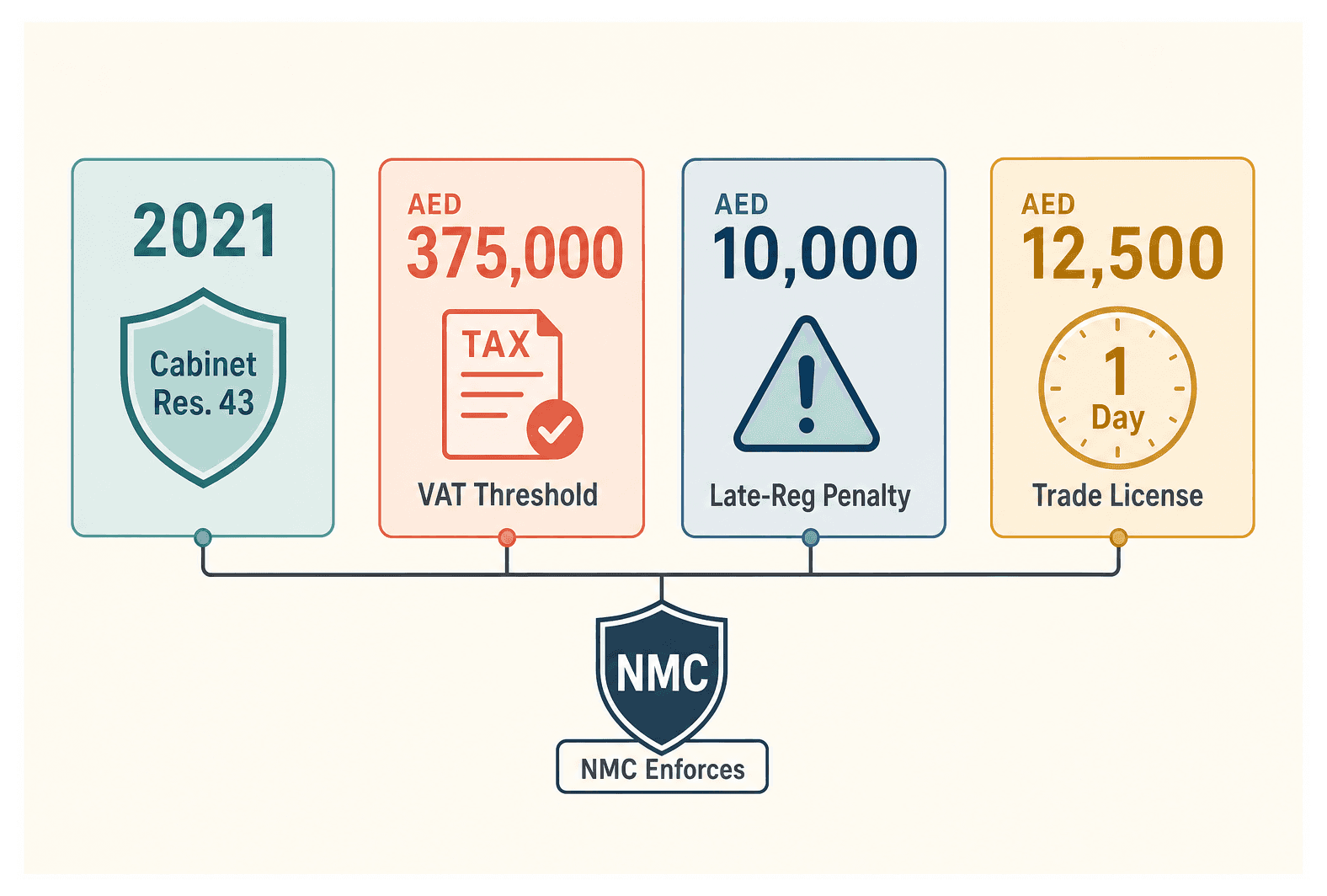
In 2026, the UAE's influencer economy spans hundreds of thousands of registered content creators, yet a significant share of branded partnerships still lack a compliant written contract or a properly worded paid-partnership disclosure. Cabinet Resolution No. 43 of 2021 (UAE Cabinet, 2021) made influencer licensing mandatory. The mandatory VAT registration threshold sits at AED 375,000, with a one-time AED 10,000 Federal Tax Authority penalty for late registration (Federal Tax Authority, 2026). The National Media Council (NMC) is the named enforcement authority for disclosure non-compliance. A Dubai South Business Hub (DSBH) free zone trade license starts from AED 12,500 and is issued in one business day. Both brands and creators face real regulatory exposure when contracts and disclosures are missing.
This guide covers what influencer contracts disclosure UAE law actually requires, which regulator enforces what, how to structure a compliant paid-partnership agreement, when VAT applies to creator income, and how to set up a licensed influencer business so your commercial activity is fully above board from day one.
What Are Influencer Contracts and Disclosure Rules in the UAE
Influencer contracts in the UAE are legally binding agreements between a brand and a content creator setting out deliverables, fees, and usage rights. Disclosure rules, enforced by the National Media Council, require creators to label every paid post as a sponsored or commercial partnership so audiences can identify paid content.
The Regulatory Framework Behind Creator Partnerships
The NMC introduced a dedicated influencer licensing regime under Cabinet Resolution No. 43 of 2021, requiring any individual who charges a fee for content promotion to hold a valid media activity license before accepting a single paid brief (National Media Council, 2021). That licensing requirement applies whether you have 500 followers or 5 million.
Disclosure obligations work differently. They're separate from the license itself and apply at the post level, every time money or a free product of material value changes hands. A Dubai-based lifestyle creator who receives AED 5,000 plus a hotel stay in exchange for three Instagram posts must hold an NMC-approved media license and label each post with the Arabic and English equivalent of "paid partnership" or "ad." The hotel stay counts as consideration, not a gift.
The UAE Cabinet and the NMC jointly define "electronic media activity" to include Instagram, TikTok, YouTube, X, and Snapchat. Any platform where content reaches a paying audience falls within scope. Influencer contracts disclosure UAE compliance, in other words, is not platform-specific. It covers the creator, not the channel.
Why Contracts Matter Beyond the Regulatory Minimum
A signed contract converts a verbal brief into an enforceable obligation. It covers content approval rounds, exclusivity windows, kill-fee provisions, and intellectual property ownership. Without one, a brand has no legal basis to demand content removal if the creator publishes something off-brief or damaging.
UAE courts apply the Civil Transactions Law to commercial agreements. A well-drafted contract specifying governing law and dispute resolution saves months of litigation. Consider what happened to a beauty brand that paid a creator AED 20,000 upfront with no written agreement: it had no enforceable right to demand content deletion after the creator posted a rival brand's product in the same video. A signed exclusivity clause would have prevented that entirely.
Core Requirements Every Influencer Contract Must Cover
A compliant UAE influencer contract must define deliverables, payment schedule, content approval rights, exclusivity period, intellectual property ownership, disclosure obligations, and a termination or kill-fee clause. Both parties should sign before any content is created, and the agreement should specify UAE law as the governing jurisdiction.
UAE Influencer Compliance Requirements at a Glance
Compliance Area | Key Requirement |
|---|---|
NMC Media License | Required before accepting any paid partnership; issued via NMC portal; separate from your trade license |
Paid-Post Disclosure Label | #ad, #sponsored, platform-native "Paid partnership" tag, or Arabic equivalents (إعلان / برعاية) on every sponsored post |
VAT Registration Threshold | Mandatory at AED 375,000 annual taxable turnover; voluntary registration from AED 187,500 |
Late VAT Registration Penalty | One-time AED 10,000 FTA penalty; applies from the date registration was due |
Written Contract Requirement | Signed before content creation begins; must specify UAE law as governing jurisdiction and include a disclosure clause |
Record Retention Period | Minimum two years for screenshots of sponsored posts with disclosure labels visible |
Deliverables, Timelines, and Approval Rounds
State the exact number of posts, stories, reels, or videos; the platforms; the posting dates; and any required captions or hashtags.
Define how many rounds of brand review are included. Two rounds is the market standard; turnaround time for feedback should be written in, not assumed.
Specify whether the creator must submit content for approval before posting, or whether the brand holds a right of removal after publishing.
A contract for a Ramadan campaign might read: "Three Instagram Reels and six Stories across the period 1–30 Ramadan 2026, each submitted for brand approval five working days before the agreed posting date, with one round of revisions included." That level of specificity is enforceable. "Three posts about our product" is not.
Intellectual Property, Exclusivity, and Usage Rights
Clarify who owns the content after posting. Creator ownership with a brand usage license is the default under most UAE commercial agreements; full assignment must be stated explicitly if that's what the brand wants.
Set the usage period clearly. A brand repurposing creator content in paid ads for six months should pay a separate usage fee on top of the creation fee.
Write exclusivity clauses to name the category specifically. "Skincare" is enforceable; "beauty" is too broad and will be challenged. Always attach a time limit.
Payment, Kill Fees, and Termination Provisions
State the total fee in AED, and the milestone that triggers each payment. A 50% deposit on signing and 50% on final posting is the accepted market standard.
Include a kill fee of 25%–50% of the agreed total. This protects the creator when a brand cancels after content production has started.
Add a termination-for-cause clause. Either party should be able to exit if the other breaches NMC disclosure rules, the UAE's cybercrime law, or the contract's content standards.
Step-by-Step Guide to Meeting UAE Disclosure Requirements
UAE disclosure rules require creators to label paid content clearly on every post. The steps are: obtain your NMC media license, agree disclosure wording in the contract, apply the label before publishing, keep records of each sponsored post, and review your disclosures if the platform changes its tagging format.
Step 1: Obtain Your NMC Electronic Media Activity License
Any individual or company charging for content promotion in the UAE must hold an NMC-approved electronic media activity license before accepting paid partnerships. That's not optional. The NMC is the sole authority for this approval, and operating without it exposes you to enforcement action regardless of how compliant your contracts are.
Applications go through the NMC portal at uaemc.gov.ae. Supporting documents typically include a valid Emirates ID or passport copy, a trade license or freelance permit, and a portfolio of your existing channels. Worth noting: DSBH issues the underlying trade license covering your business activities. The NMC approval is a separate, mandatory step on top of that. You need both before signing any paid-partnership contract.
Step 2: Agree Disclosure Language in the Contract Itself
Lock the exact disclosure wording into the contract. Neither party should be able to argue later about what label was required.
Accepted labels include #ad, #sponsored, #paidpartnership, the platform's native "Paid partnership with [brand]" tag, and Arabic equivalents such as إعلان (i'lan) or برعاية (bi-ri'aya).
Brands should contractually prohibit the creator from burying the disclosure in a string of hashtags or placing it below the "more" fold on caption-heavy posts. Visibility matters to the NMC.
Step 3: Apply, Archive, and Audit
Apply the agreed label at or before the point of publishing. Post-publication edits are permitted but a disclosure added days after launch still signals non-compliance.
Archive screenshots of every sponsored post with the disclosure label clearly visible. Retain them for at least two years in case of a regulatory inquiry.
Run a quarterly audit of all live posts. Platform algorithm updates sometimes strip custom labels from older content, creating accidental non-disclosure that neither party intended.
VAT Obligations and Financial Disclosures for UAE Influencers
UAE creators earning above the AED 375,000 mandatory VAT registration threshold must register with the Federal Tax Authority, charge 5% VAT on taxable supplies to UAE-based clients, and issue compliant tax invoices. Failure to register on time carries a one-time AED 10,000 FTA penalty. Voluntary registration opens at AED 187,500.
When Creator Income Becomes a Taxable Supply
Fees paid by a UAE-registered brand to a UAE-registered creator for content services are standard-rated supplies subject to 5% VAT. A creator invoicing AED 400,000 annually in brand fees must register for VAT, add 5% to every invoice to UAE-based brands, file quarterly VAT returns, and pay net VAT collected to the Federal Tax Authority.
Fees paid by an overseas brand to a UAE creator may qualify as zero-rated exports of services if the place of supply rules confirm the client is outside the UAE. Verify that with a UAE tax advisor before assuming zero-rating applies. Gifted products above the de minimis threshold count as consideration in kind and may need to be valued and included in your taxable turnover. That hotel stay, again, is not a free perk.
Including VAT and Tax Invoice Terms in Your Influencer Contract
State whether the agreed fee is inclusive or exclusive of VAT. "Plus VAT where applicable" is the safest phrasing for creators who are or may become VAT-registered.
Require the creator to provide a compliant tax invoice with their TRN (Tax Registration Number) before payment is released. Brands need this to reclaim input VAT.
Add a clause confirming each party's responsibility for their own tax filings. Neither side should be able to claim the other agreed to absorb a tax liability that wasn't discussed.
You'll also want to open a Dubai bank account online that supports AED invoicing and VAT payment transfers. Keeping creator income separate from personal funds makes quarterly VAT filing significantly cleaner.
How to License Your Influencer Business in the UAE
To legally operate as a paid content creator in the UAE, you need a trade license covering media or marketing activities, an NMC electronic media activity approval, and a registered business address. Dubai South Business Hub Free Zone issues licenses in one business day from AED 12,500, with zero paid-up share capital required.
Choosing the Right License Activity for Content Creators
Relevant DSBH license activities for influencers include social media management, digital marketing, media production, and public relations. Each covers a distinct revenue stream. A creator who produces branded video content, manages a brand's Instagram account, and consults on campaign strategy could cover all three under a single DSBH license by combining social media management, digital marketing, and media production as activities.
You can hold up to five activities on a single DSBH license. Each activity beyond the first five costs AED 2,000. DSBH licenses the commercial activity; the NMC separately approves the electronic media component. Both are required before you sign a paid-partnership contract. DSBH launched in September 2025 and issues licenses within one business day, with zero paid-up share capital required. Explore the full list of business activities to identify which combination fits your creator revenue model. For ICT-adjacent work, an ICT license in Dubai may also be relevant.
First-Year Cost Estimates for a Sole Creator Setting Up
A sole founder with one visa at DSBH can expect a first-year all-in cost from AED 18,350, covering the base license and one residency visa package.
Visa costs are always an additional line item. They're not bundled into the base license fee, which starts from AED 12,500.
100% foreign ownership is available at DSBH as a free zone entity. It's also available on the UAE mainland under current company law and is unrelated to any zone-specific designation.
Use the business setup cost calculator to model your exact first-year outlay before committing. A UAE residency visa tied to your DSBH license gives you legal residence alongside your trading rights.
Common Contract Mistakes UAE Influencers and Brands Make
The most common UAE influencer contract mistakes are vague deliverable descriptions, missing disclosure clauses, no kill-fee provision, unsigned agreements, and contracts that ignore VAT. Each error can result in payment disputes, NMC enforcement action, or FTA penalties, all avoidable with a properly drafted agreement reviewed before signing.
Vague Briefs and Missing Approval Clauses
A contract that says "three posts about our product" without specifying platform, format, caption requirements, or posting dates is not enforceable as written.
Without a defined approval process, the brand cannot require revisions and the creator cannot cap revision rounds. Both parties end up frustrated and legally exposed.
Always attach a content brief as a schedule to the contract. It then forms part of the legally binding document, not a separate informal email thread.
Skipping the Disclosure Clause and the VAT Line
Many contracts prepared outside the UAE omit the NMC disclosure requirement entirely. This transfers regulatory risk to the creator who actually posts the content, even if the brand drafted the agreement.
Failing to address VAT in the contract means brands may refuse to pay 5% on top of an agreed fee, leaving the creator to absorb it from their net income.
One line closes the compliance gap: "Creator shall apply a paid-partnership disclosure label on each piece of sponsored content as required by the National Media Council." Add it before signing.
Is a verbal agreement enough for a UAE influencer partnership?
No. UAE courts apply the Civil Transactions Law to commercial agreements. A verbal brief is difficult to enforce without corroborating evidence. A signed written contract specifying deliverables, payment terms, disclosure obligations, and governing law is the only reliable protection for both the brand and the creator.
Getting Your Influencer Business Fully Compliant
Influencer contracts disclosure UAE compliance comes down to three parallel tracks: a valid NMC-approved media license, a written contract covering deliverables and disclosure obligations, and correct VAT treatment of creator income. Getting all three right protects both brand and creator from regulatory and commercial risk.
Obtain your NMC electronic media activity license before signing any paid brief.
Use a written contract that names deliverables, approval rounds, exclusivity categories, IP ownership, payment milestones, and a kill-fee provision.
Include a disclosure clause that specifies the exact label format required on every sponsored post.
Address VAT in the contract with "plus VAT where applicable" and require a TRN-bearing tax invoice before releasing payment.
Archive screenshots of every sponsored post for at least two years and audit live posts quarterly.
The UAE's creator economy is one of the most commercially active in the world, and the regulatory framework around influencer contracts disclosure UAE rules is maturing quickly. Brands and creators who treat compliance as a baseline rather than a burden are the ones who build durable commercial relationships here.
Ready to start your business on a solid legal footing? Dubai South Business Hub Free Zone issues media and marketing trade licenses from AED 12,500 in one business day, with zero paid-up share capital required. Check your business name availability and take the first step toward a fully licensed influencer operation.
References
Frequently Asked Questions