
Topic Summary
UAE Law Overrides Your Home-Country Wishes
Without a registered will, UAE Personal Status Law (Federal Law No. 28 of 2005) governs your entire estate by default, regardless of your nationality or what your home country's laws would dictate. This applies to every expat resident, covering property, bank accounts, and company shares.
Children's Guardianship Is Not Automatic
UAE law does not automatically assign guardianship of your children to the surviving parent after death, which shocks most expat families. A guardian will registered at the DIFC Wills Service Centre is the only legally enforceable way for non-Muslims to appoint a guardian in the UAE.
Asset Freezes Can Last Years Without a Will
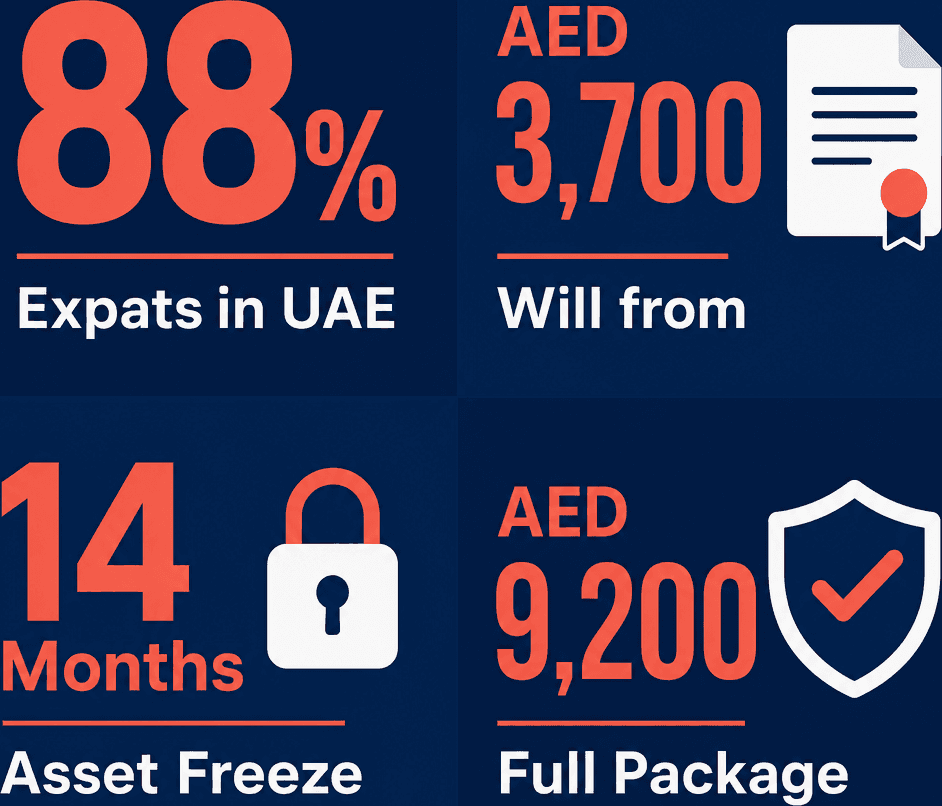
UAE courts can freeze all assets, including bank accounts and free zone company shares, for months or even years while the estate is administered. A real 2025 case saw a British national's company frozen for 14 months, leaving his spouse unable to pay staff or renew the trade license.
DIFC Is the Specialist Body for Non-Muslim Wills
The DIFC Wills Service Centre is the dedicated registration body for non-Muslim wills covering Dubai and Ras Al Khaimah assets, with wills drafted and enforceable in English under DIFC Law No. 4 of 2023. Registration costs range from AED 3,700 for a single will type to AED 9,200 for a comprehensive package.
Free Zone Company Shares Need a Business Assets Will
Free zone company shares are registrable assets that do not transfer automatically to your chosen heirs without a specific DIFC business assets will. Without one, courts control who inherits your shares and on what terms, potentially crippling business operations.
88% of UAE Residents Are Exposed Without a Will
Expatriates make up approximately 88% of the UAE's population, yet the vast majority have no registered will in place. That leaves the overwhelming majority of residents with their assets, businesses, and families unprotected under a legal framework they may never have anticipated.
In 2026, approximately 88% of the UAE's population are expatriates (UAE Government, 2024). Most have no registered will. That means their bank accounts, property, company shares, and children's guardianship are exposed to UAE Personal Status Law, a framework that distributes estates according to fixed legal shares regardless of your nationality, your home-country wishes, or what you told your family you wanted. Making a will in the UAE is the single most important legal step any expat or business owner can take. This guide tells you exactly how to do it, what it costs, and what happens if you don't.
What You Need to Know
Making a will in the UAE is essential for every non-Muslim expat. Without one, UAE courts distribute your estate under UAE Personal Status Law or Sharia principles, regardless of your nationality or home-country intentions.
The DIFC Wills Service Centre (difc.ae/wills) is the specialist non-Muslim will registration body covering Dubai and Ras Al Khaimah assets. Wills are drafted and registered in English.
DIFC will registration costs from AED 3,700 for a single will type to AED 9,200 for a comprehensive package covering property, financial assets, guardianship, and business shares (DIFC Wills Service Centre, 2026).
UAE courts may freeze all assets, including bank accounts and free zone company shares, for months or years while determining distribution when no will exists (UAE Ministry of Justice, 2024).
Free zone company shares are registrable assets. A DIFC business assets will is the only enforceable instrument that directs who inherits your company shares and on what terms.
The scale of the exposure is significant. Expatriates make up 88% of the UAE population (UAE Government, 2024), yet UAE Personal Status Law, Federal Law No. 28 of 2005, governs all estates by default without a registered will. DIFC will registration starts from AED 3,700 (DIFC Wills Service Centre, 2026). Asset freeze periods without a will can extend to multiple years (UAE Ministry of Justice, 2024).
Consider what happened to one British national holding a Dubai free zone trade license who died intestate in 2025. UAE courts froze the company account and shares for 14 months while the estate was administered under UAE Personal Status Law. His spouse could not access operating funds, pay staff, or renew the trade license. A registered UAE will would have prevented every one of those consequences.
If your company shares, property, or family are in the UAE, get this sorted now. Dubai South Business Hub Free Zone business support can connect you with a UAE-qualified will drafter today. For more detail, see our guide on UAE family business succession planning guide.
Why Expats in UAE Need a Will
Making a will in the UAE is the only way a non-Muslim expat can control how their assets, guardianship of children, and company shares are distributed after death. Without one, UAE Personal Status Law, and in some cases Sharia principles, automatically govern distribution, overriding home-country intentions entirely.
How UAE Law Applies to Non-Muslim Expats
UAE law defaults to UAE Personal Status Law (Federal Law No. 28 of 2005) for all residents. Sharia principles of inheritance apply as the default framework unless a valid will directs otherwise. For non-Muslims, UAE courts can apply the deceased's home country law for personal assets, but only if a valid registered will exists. Without one, UAE law applies regardless of your passport.
Children's guardianship is not automatically assigned to the surviving parent under UAE law. This surprises most expat parents. A guardian will registered at the DIFC Wills Service Centre is the only legally enforceable mechanism for non-Muslims to appoint a guardian in the UAE. DIFC wills are enforceable under DIFC Law No. 4 of 2023.
Take the case of a Canadian couple living in Dubai with two children and a free zone company. On the father's death with no will in place, UAE courts did not automatically transfer guardianship to the mother. A guardian will registered at the DIFC Wills Service Centre would have resolved this instantly, without court proceedings or uncertainty.
Asset Freeze Risk and Timeline
When a UAE resident dies without a will, courts can freeze all UAE-based assets, bank accounts, property, and company shares, while the estate is administered. Freeze periods range from several months to multiple years, depending on estate complexity and whether heirs are located overseas (UAE Ministry of Justice, 2024).
UAE banks are legally required to freeze accounts on notification of an account holder's death. A registered will with a named executor allows the bank to act on clear instructions rather than awaiting a court order. That distinction can mean the difference between a family accessing funds within weeks or waiting years.
For a broader view of your UAE compliance obligations, the UAE corporate tax and compliance guide covers the key regulatory frameworks every business owner should know.
What Happens If You Die Without a Will in UAE
Without a will in the UAE, your estate is distributed under UAE Personal Status Law or Sharia principles. UAE courts freeze your assets, including bank accounts and company shares, while the distribution is determined. This process can take months or years and may produce outcomes entirely different from your intentions.
Intestate Distribution Under UAE Law
UAE Personal Status Law (Federal Law No. 28 of 2005) prescribes fixed inheritance shares based on familial relationship. Spouses, children, and parents each receive legally defined portions. Sharia principles of inheritance apply as the default framework for Muslim estates and, without a will, to all UAE residents regardless of faith.
Here's a detail that catches many expats off guard: a surviving spouse does not automatically inherit 100% of the estate under UAE intestate law. Fixed Sharia shares may direct portions to the deceased's parents or siblings even if the couple had no children. An unmarried partner has zero inheritance rights under UAE law. Only a registered will can direct assets to a non-spouse partner.
Impact on Your UAE Business and Company Shares
Free zone company shares are classified as UAE-based assets and are subject to UAE succession law if no will addresses them. Without a will, a free zone authority may freeze or suspend the company license pending a court-ordered transfer of shares. Business operations stop. Contracts can't be signed. Bank accounts are inaccessible.
A sole shareholder of a Dubai South Business Hub Free Zone company who dies without a will leaves the free zone authority no choice but to suspend the license pending a court order. Surviving business partners or family members have no legal standing to act until that order arrives. A DIFC business assets will is the enforceable instrument that prevents this entirely, it directs who inherits your company shares and on what terms from day one.
UAE Will Registration Options Compared - 2026
Feature | DIFC Wills Service Centre | Dubai Courts |
|---|---|---|
Language | English, no translation required | Arabic, certified translation required for non-Arabic speakers |
Registration cost (AED) | AED 3,700–9,200 (registration fees only; legal drafting extra) | AED 900–2,000 including certified translation |
Asset coverage | Property, financial assets, guardianship of children, free zone business shares | Property and personal assets only, limited for business interests |
Jurisdiction | Dubai and Ras Al Khaimah | Dubai only |
Remote registration | Yes, virtual appointment at difc.ae/wills; no in-person attendance needed | No, in-person attendance at Dubai Courts required |
Best suited for | Non-Muslim expats with property, minor children, or UAE business interests | Expats with simple Dubai personal assets and no business interests or children |
Options for Registering a Will in UAE
Non-Muslim expats in the UAE have three main will registration options: the DIFC Wills Service Centre for English-language wills covering Dubai and Ras Al Khaimah assets; Dubai Courts for an Arabic-language registered will; and the Abu Dhabi Judicial Department for Abu Dhabi-based assets. Each has different costs, languages, and coverage.
DIFC Wills Service Centre
The DIFC Wills Service Centre at difc.ae/wills is the primary route for non-Muslim expats. Wills are drafted and registered in English, making them immediately accessible to most expats without translation. They are fully enforceable in Dubai and Ras Al Khaimah under DIFC Law No. 4 of 2023.
The service covers property, financial assets, guardianship of minor children, and business assets including free zone company shares. Remote registration with a virtual appointment is available, you don't need to attend in person. A German national registered a DIFC property will and guardian will in a single virtual appointment in 2025, completing the entire process from enquiry to registration in under two weeks.
Dubai Courts and Abu Dhabi Judicial Department
Dubai Courts accepts Arabic-language will registrations at dc.gov.ae. The cost is lower than DIFC, approximately AED 900 to AED 2,000 including certified translation, but the scope is more limited for expats with complex asset structures or business interests. In-person attendance is required.
The Abu Dhabi Judicial Department (ADJD) offers a dedicated non-Muslim will registration service for Abu Dhabi-based assets at adjd.gov.ae. If you hold assets in multiple emirates, you may need wills registered across more than one authority. An expat with a Dubai apartment and an Abu Dhabi bank account, for example, may need both a DIFC will for the property and an ADJD-registered will for the Abu Dhabi financial assets. Legal advice is essential for multi-emirate estates.
DIFC Wills - The Most Common Option for Expats
A DIFC will is an English-language will registered with the DIFC Wills Service Centre and enforceable across Dubai and Ras Al Khaimah. It is the most common option for non-Muslim expats because it covers property, financial assets, guardianship of children, and business assets including free zone company shares, all in a single enforceable English-language document.
Four Types of DIFC Will
The DIFC Wills Service Centre offers four distinct will types, each covering a specific category of asset. A property will covers UAE real estate, freehold or leasehold property in Dubai or Ras Al Khaimah. A financial assets will covers UAE bank accounts, investment portfolios, and brokerage holdings. A guardian will legally appoints a guardian for minor children and is the only enforceable mechanism for non-Muslims in the UAE. A business assets will covers free zone company shares and other UAE business interests, critical for any shareholder or director (DIFC Wills Service Centre, 2026).
A UK national with a Dubai apartment, a savings account, two minor children, and a Dubai South Business Hub Free Zone company would need all four will types. The good news: these can be registered as a combined package at the DIFC, often in a single appointment, rather than as separate processes.
Who Can Register a DIFC Will
DIFC wills are available to any non-Muslim individual aged 21 or older. There is no UAE residency requirement, overseas property owners can register too. A non-resident investor who owns a Dubai Marina apartment but lives in the UK can register a DIFC property will remotely, without visiting the UAE at all.
Registration is completed via virtual appointment at difc.ae/wills. Both UAE residents and non-residents who own Dubai or Ras Al Khaimah assets are eligible. That remote option removes one of the most common reasons expats delay making a will in the UAE.
Is a DIFC will valid outside Dubai?
A DIFC will is enforceable for Dubai and Ras Al Khaimah assets under DIFC Law No. 4 of 2023. It does not automatically cover assets in other emirates or overseas. For Abu Dhabi assets, a separate will registered with the Abu Dhabi Judicial Department (ADJD) at adjd.gov.ae is required. Overseas assets require a will in the relevant home jurisdiction.
Dubai Courts Will Registration
Dubai Courts will registration is an Arabic-language process available to all UAE residents at dc.gov.ae. It is lower cost than a DIFC will but requires certified translation and is less comprehensive for expats with complex asset structures or business interests. It is enforceable in Dubai and does not require a notary.
When Dubai Courts Is the Right Choice
Dubai Courts will registration suits expats with straightforward Dubai-based personal assets who are comfortable with Arabic-language legal documents. The cost is approximately AED 900 to AED 2,000 including certified translation (Dubai Courts, 2026), significantly lower than the DIFC route. For a single expat with no children and one Dubai bank account, this may be sufficient.
Here's the limitation to understand clearly: Dubai Courts wills do not cover guardianship of minor children or business assets as comprehensively as a DIFC will. A business owner or parent who registers only a Dubai Courts will is leaving significant gaps. The practical recommendation is to use Dubai Courts for simple personal assets and register a separate DIFC guardian will or business assets will for everything else.
Key Steps for Dubai Courts Will Registration
What Can and Cannot Be Covered in a UAE Will
A UAE will registered through the DIFC Wills Service Centre can cover Dubai and Ras Al Khaimah real estate, bank accounts, investments, free zone company shares, and guardianship of minor children. It cannot override UAE employment end-of-service benefits, UAE pension entitlements, or assets located outside the UAE.
Assets Covered by a DIFC Will
A DIFC will can cover four categories of UAE-based assets. Real estate: freehold and leasehold property in Dubai and Ras Al Khaimah. Financial assets: UAE bank accounts, savings, investments, and brokerage holdings. Business assets: free zone company shares, partnership interests, and other UAE business interests. Guardianship: legal appointment of a guardian for minor children, enforceable in UAE courts (DIFC Wills Service Centre, 2026).
A DIFC business assets will explicitly names the beneficiary of a free zone company share transfer. Without it, a free zone authority has no legal instruction and will await a court order before transferring or acting on those shares. That wait can halt an entire business.
What Falls Outside a UAE Will
Assets located outside the UAE require a separate will in the relevant jurisdiction. Overseas property, foreign bank accounts, and international investment portfolios are outside the scope of a DIFC will entirely. An expat with a UK pension and Dubai property needs both a DIFC will for the UAE assets and a UK will for the pension and UK estate, they are separate legal documents.
UAE employment end-of-service gratuity is governed by Federal Decree-Law No. 33 of 2021 (administered by MOHRE at mohre.gov.ae) and is paid directly to named next of kin. A will does not alter this. Life insurance policy payouts are also directed by the policy's named beneficiary designation, not the will. These are important planning distinctions that a UAE-qualified will drafter will walk you through.
UAE Will Registration Costs in AED
DIFC will registration costs from AED 3,700 for a single will type to AED 9,200 for a comprehensive multi-will package covering property, financial assets, guardianship, and business assets. Dubai Courts will registration costs approximately AED 900 to AED 2,000 including certified translation. All figures are current for 2026.
DIFC Will Fees by Type - 2026
Will Type | Approx. AED Cost (Registration) | Notes |
|---|---|---|
Property will | From AED 3,700 | Covers freehold/leasehold property in Dubai and RAK |
Financial assets will | From AED 3,700 | Covers UAE bank accounts, investments, brokerage |
Guardian will | From AED 3,700 | Appoints legal guardian for minor children, non-Muslims only |
Business assets will | From AED 3,700 | Covers free zone company shares and UAE business interests |
Comprehensive package (all four) | Up to AED 9,200 | Confirm exact fees at difc.ae/wills, legal drafting is additional |
Dubai Courts will |
Citations
Dubai International Financial Centre.. difc.ae. DIFC, 2024.
UAE Cabinet.. uaecabinet.ae. UAE Cabinet, 2023.
Dubai Health Authority.. dha.gov.ae. DHA UAE, 2024.
Ministry of Human Resources and Emiratisation.. mohre.gov.ae. MOHRE UAE, 2024.
UAE Ministry of Economy and Tourism.. moet.gov.ae. MOET UAE, 2024.
Frequently Asked Questions