Topic Summary
Choose Your License Before Your Payment Tool
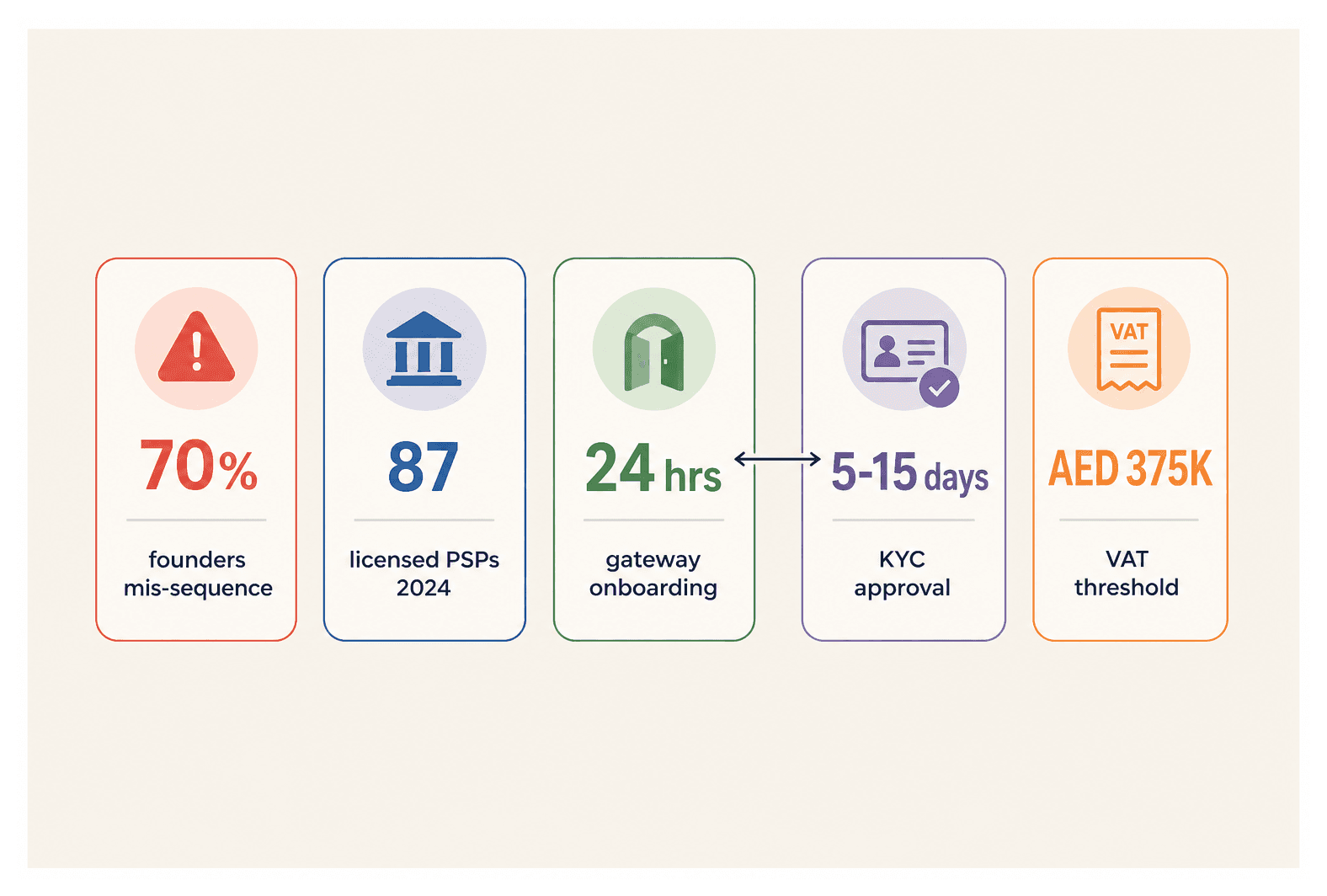
More than 70% of first-time Dubai founders pick a payment solution before confirming what their UAE trade license permits them to collect. This sequencing mistake can cost weeks of re-application time and up to AED 10,000 in FTA late VAT registration penalties.
Merchant Accounts Require a Licensed Acquiring Bank
In the UAE, a merchant account is a formal agreement with an acquiring bank licensed under the Central Bank's Retail Payment Services and Card Schemes Regulation (2021). Funds settle into your operating account within 1–3 business days, during which the bank carries the settlement risk.
Mismatched License Codes Are the Top Rejection Cause
UAE acquiring banks check your license category and activity codes before approving card collection. A trading license must explicitly cover online retail, not just physical retail, or your merchant account application will be rejected.
Bundled Gateways Let You Skip the Bank Application
Providers like Telr, PayTabs, and Checkout.com offer aggregated merchant accounts built into their gateway product, processing payments under their own master acquiring license. This reduces onboarding to as little as 24 hours, compared to 5–15 business days for a standalone merchant account.
Higher Per-Transaction Rates Are the Trade-Off
Bundled gateways typically charge 2–3.5% per transaction, slightly more than a dedicated merchant account, because you are operating under the provider's license rather than your own. For early-stage businesses, that cost is often worth the elimination of setup friction.
Free Zone Founders Can Access Full Banking Options
Free zone license holders, including those with a DSBH license obtainable in one day from AED 12,500, are eligible to open UAE bank accounts and apply for merchant accounts with local acquiring banks. The license activity code must still match the goods or services being sold.
Know the VAT Threshold Before You Start Collecting
UAE businesses must register for VAT once taxable turnover reaches AED 375,000, and the Federal Tax Authority enforces this with financial penalties. Setting up your payment infrastructure correctly from day one ensures your revenue collection and tax obligations stay aligned.
In 2026, more than 70% of first-time founders in Dubai choose a payment tool before they understand what their UAE trade license actually permits them to collect, and that sequencing error costs them weeks of re-application time and, in some cases, AED 10,000 in late VAT registration penalties from the Federal Tax Authority (Federal Tax Authority, 2024). The UAE Central Bank licensed 87 payment service providers as of 2024 (Central Bank of the UAE, 2024). Merchant account applications take one working day for eligible activities for KYC approval. Bundled gateway onboarding completes in as little as 24 hours. The VAT mandatory registration threshold sits at AED 375,000 in taxable turnover. And a DSBH free zone license issues in one day from AED 12,500.
This article breaks down the merchant account vs UAE payment gateway decision in plain terms, gives you a side-by-side comparison across cost, scope, and visa impact, and tells you exactly which option fits your business model, so you can set up once and collect revenue from day one.
What Is a Merchant Account and What Is a Payment Gateway
A merchant account is a dedicated bank-like holding account that receives card payments before they settle into your business account. A payment gateway is the technology layer that authorises and routes those transactions. In the UAE, you typically need both, but not always from the same provider.
Defining a Merchant Account in the UAE Context
A merchant account is a formal agreement between your business and an acquiring bank. In the UAE, acquiring banks must hold a license issued by the Central Bank of the UAE under the Retail Payment Services and Card Schemes Regulation (2021). That regulation sets the legal framework for who can hold card funds on your behalf.
Funds from card transactions sit in the merchant account for a settlement period of typically 1–3 business days before transferring to your operating account. During that window, the acquiring bank carries the settlement risk, which is exactly why they scrutinise your application so carefully.
Before approving a merchant account, UAE acquiring banks assess your business activity type, license category, and historical chargeback rate. Mismatched license activity codes are the leading cause of rejection. A Dubai-based e-commerce founder with a trading license, for instance, must show that the license activity explicitly covers online retail, not just physical retail, before the bank will approve card collection.
Defining a Payment Gateway in the UAE Context
A payment gateway is software that encrypts card data, sends an authorisation request to the relevant card network (Visa, Mastercard, or local schemes), and returns an approval or decline in seconds. Providers operating in the UAE include Telr, PayTabs, and Checkout.com, each integrating with your website or point-of-sale terminal.
Here's the part many founders miss: some gateways bundle an aggregated merchant account into their product. That means you do not open a separate merchant account with a bank, the gateway processes payments under its own master acquiring license. This is common for early-stage businesses and removes the bank application step entirely at launch.
Gateway fees are charged per transaction, typically 2–3.5% plus a fixed fils amount (UNVERIFIED: exact fils figure. Confirm before publishing.)
Bundled merchant accounts sit under the gateway provider's acquiring license, not yours
You trade slightly higher per-transaction rates for zero setup friction
A SaaS founder in Dubai who uses a bundled gateway handles both authorisation and settlement under the provider's master merchant account, no separate bank application required at launch. That's a meaningful time advantage in the early months.
Free zone license holders can open bank accounts in the UAE and apply for merchant accounts with UAE acquiring banks. The critical point: the license activity code must match the goods or services being sold. DSBH licenses issued in one day give founders a clean, complete activity record to present to the bank immediately after incorporation.
Merchant Account vs Payment Gateway: Side-by-Side Comparison
A merchant account controls where card funds land and who holds them; a payment gateway controls how transactions are processed and authenticated. Cost, approval timeline, chargeback liability, and who the product suits differ significantly between the two, UAE founders should evaluate both axes before choosing.
Merchant Account vs Payment Gateway: UAE Business Comparison
Feature | Dedicated Merchant Account | Bundled Payment Gateway |
|---|---|---|
Setup / Onboarding Time | 5–15 business days (bank KYC review) | 24–72 hours after submitting trade license and passport |
Upfront Cost / Security Deposit | Security deposit often required; monthly account fee applies | Zero setup deposit; no monthly account fee |
Per-Transaction Fee | Interchange-plus pricing, lower at high volume | Flat rate 2–3.5%; slightly higher to cover risk pooling |
Best Monthly Card Volume | AED 100,000+ per month | Under AED 50,000 per month |
Multi-Currency Settlement | Flexible, USD, EUR, GBP, AED options available | Limited; typically AED settlement only |
Chargeback Liability | Direct liability; USD 15–25 per dispute fee | Pooled under gateway provider; same dispute fee applies |
Who It Suits | High-volume retailers, subscription businesses, multi-currency operators | Early-stage founders, service businesses, digital goods sellers |
Cost Structure: What You Actually Pay
A dedicated merchant account typically carries a monthly account fee plus per-transaction interchange-plus pricing. Setup often requires a security deposit held by the acquiring bank, the amount varies by activity risk category (UNVERIFIED: exact AED range. Confirm before publishing.). That deposit is a real cash drag for a founder who is watching every dirham in year one.
Bundled payment gateways charge no setup deposit, but their flat per-transaction rates run slightly higher to cover the provider's risk pooling across all merchants on their platform. Chargeback fees apply in both models, typically USD 15–25 per dispute. For a founder processing under AED 50,000 per month in card volume, a bundled gateway is almost always cheaper in year one.
Approval Timeline and Eligibility in the UAE
A dedicated merchant account requires a full bank KYC review: 5–15 business days, with audited financials or 6-month bank statements for established businesses, or a formal business plan for startups. A bundled gateway completes onboarding in 24–72 hours after you submit your trade license, passport copy, and proof of a UAE bank account.
Both routes require a valid UAE trade license. A founder who registers at Dubai South Business Hub (DSBH) on a Monday can submit gateway onboarding documents by Tuesday. A competitor waiting two weeks for their license elsewhere then faces another two-week bank review, a full month before they can collect a single card payment. High-risk activity codes (crypto, financial intermediation, regulated health services) face additional scrutiny regardless of which route you choose.
Visa Impact: Does Your Payment Setup Affect Your Residency?
Your payment processing choice has no direct effect on your UAE residency visa eligibility. Visas are tied to your trade license and establishment card, not your payment provider. That said, your license category determines how many visas you can sponsor, and the cost of each visa is always an additional expense on top of your license fee.
At DSBH, a sole founder with one visa starts from AED 18,350 in first-year costs. The visa component is separate and additional, never bundled into the license price. Worth flagging: banks running merchant account KYC sometimes request your Emirates ID and residence visa as part of UBO (Ultimate Beneficial Owner) verification. Founders who have their UAE residency visa already processed clear this step in a single submission, rather than holding up the application while residency is still pending.
VAT, Corporate Tax, and Payment Compliance for UAE Businesses
Every card transaction you collect in the UAE is subject to VAT rules if your taxable turnover exceeds AED 375,000. Late VAT registration carries a one-time AED 10,000 penalty. Corporate tax late registration also carries a one-time AED 10,000 flat penalty. Your payment setup must support compliant invoicing from the first transaction.
VAT Registration and Your Payment Processor
If your business collects payments that push taxable turnover above AED 375,000 in any 12-month period, VAT registration with the Federal Tax Authority is mandatory (Federal Tax Authority, 2024). Your payment gateway or merchant account does not file VAT for you, you need accounting software or a tax agent to reconcile transaction records with your quarterly VAT returns.
The late registration penalty is AED 10,000, one-time and flat. A Dubai founder using a bundled gateway who processes AED 40,000 per month from month one will cross the AED 375,000 threshold by month ten. Register before you hit that mark, not after. Choose a gateway that exports transaction-level reports in a format your accountant can reconcile, this is an operational requirement, not optional.
Corporate Tax and Payment Record-Keeping
UAE corporate tax applies at 9% on taxable income above AED 375,000 for financial years starting on or after 1 June 2023. Qualifying Free Zone Persons (QFZPs) may access a 0% rate on qualifying income, but only if they satisfy all four conditions: (1) maintain adequate substance in the free zone, (2) earn qualifying income as defined under the Corporate Tax Law, (3) do not elect to be subject to standard rates, and (4) comply with transfer pricing rules. Failing any single condition removes the benefit entirely.
A DSBH-registered SaaS company earning qualifying income from foreign clients may access the 0% QFZP rate, but domestic UAE revenue from local clients is taxed at 9% regardless. Late corporate tax registration carries a one-time AED 10,000 flat penalty, not a monthly charge. Your merchant account or gateway records are primary source documents for corporate tax computation. Retain them for a minimum of seven years.
DSBH is not a designated zone and carries no designated-zone VAT or customs benefit. Founders must not assume any tax advantage beyond what the standard QFZP framework provides, subject to meeting all four qualifying conditions.
How to Choose Between a Merchant Account and a Payment Gateway: 6 Steps
To choose correctly between a merchant account and a payment gateway in the UAE, map your monthly card volume, check your license activity codes, assess your chargeback risk, confirm VAT obligations, select a provider licensed under UAE Central Bank rules, and test the integration before going live.
Steps 1–3: Assess Your Business Before Choosing
Step 1: Calculate your projected monthly card volume. If it is under AED 50,000, a bundled payment gateway with an aggregated merchant account is almost always the lower-cost starting point. The economics only shift in favour of a dedicated merchant account once you are consistently above AED 100,000 per month.
Step 2: Verify your UAE trade license business activities cover every product or service you plan to sell. Mismatched activity codes are the top reason acquiring banks reject merchant account applications. Check your activities list before you approach any payment provider, not after rejection.
Step 3: Score your chargeback risk. Subscription businesses, digital goods sellers, and travel companies face higher chargeback rates and may be required to hold a security deposit regardless of which route they choose. A Dubai-based digital marketing consultant with a services license and AED 25,000 per month in projected revenue clears Steps 1–3 quickly: low volume, matching activity code, low chargeback risk, bundled gateway is the right call.
Steps 4–6: Select, Register, and Go Live
Step 4: Confirm VAT registration status. If you expect to cross AED 375,000 in taxable turnover within 12 months, register with the Federal Tax Authority before your first transaction. The AED 10,000 penalty for late registration is avoidable, but only if you act before you cross the threshold.
Step 5: Select a provider whose acquiring license or payment service provider license is issued by the Central Bank of the UAE. Never process payments through an unlicensed entity. The Central Bank publishes a register of licensed payment service providers (Central Bank of the UAE, 2024).
Step 6: Run a full integration test, including a refund scenario, a declined card scenario, and a chargeback simulation, before accepting live payments. A DSBH-registered e-commerce brand can complete Steps 4–6 in under a week: VAT registration submitted online, gateway provider confirmed as Central Bank licensed, integration tested with three transaction scenarios, and live by Friday.
How Your UAE License Structure Affects Your Payment Setup
Your UAE trade license category, issuing authority, and listed activity codes directly determine which payment providers will onboard you, what documents they require, and how long approval takes. A free zone license with precise activity codes accelerates both bank account and payment gateway onboarding compared to a vague or mismatched license.
Free Zone License vs Mainland License: Payment Provider Perspective
UAE acquiring banks and payment gateways treat free zone and mainland licenses equally for merchant account eligibility. The issuing authority is less important than the activity code and the founder's KYC profile. 100% foreign ownership is available on both the mainland and in free zones, it is not a free zone exclusive and has no effect on payment provider eligibility.
Free zone licenses can collect payments from UAE-based customers and international customers without restriction, subject to the activity code covering the relevant goods or services. DSBH free zone licenses carry zero paid-up share capital requirement, a point that simplifies the bank's financial health assessment during onboarding. A UK national who sets up a professional services company at DSBH with a license from AED 12,500 and zero paid-up capital presents a clean, fully issued license with matching activity codes. The acquiring bank's KYC team approves the merchant account without a capital adequacy query.
Activity Codes and Payment Provider Approval
Each activity on your license corresponds to an ISIC-derived code that acquiring banks use to assess risk category and permitted transaction types. The ISIC (International Standard Industrial Classification) framework, published by the UN Statistical Commission, underpins how banks categorise your business activity globally (UN Statistics Division, 2008, still accurate as of 2026).
Adding activities beyond the first five at DSBH costs AED 2,000 per activity. If you plan to sell across multiple categories, budget for this before applying to a payment provider with an incomplete activity list. Regulated activities require dual approval: financial services, health services, and education each require both the DSBH license and a separate approval from the named regulator. The Central Bank of the UAE approves financial services; the Dubai Health Authority (DHA) approves health services. A health-tech startup at DSBH that lists telemedicine as an activity must obtain DHA approval before any payment gateway will process patient payments, the DSBH license alone is not sufficient.
Clear Recommendations by Business Scenario
Low-volume service businesses and early-stage startups in the UAE should start with a bundled payment gateway. High-volume retailers, subscription businesses, and companies with complex multi-currency needs benefit from a dedicated merchant account. Regulated businesses must secure regulator approval before either option will onboard them.
When a Bundled Payment Gateway Is the Right Choice
You are in your first 12 months of trading and monthly card volume is below AED 50,000
You want to go live quickly, bundled gateways onboard in 24–72 hours vs 5–15 business days for a dedicated merchant account
You sell digital services, consulting, or low-chargeback-risk products where a security deposit would be an unnecessary cash drag
You are a sole founder managing costs tightly, a DSBH license from AED 12,500 plus a zero-deposit gateway keeps first-year cash outlay predictable
A solo management consultant who sets up at DSBH, gets a license in one day, and is processing invoice payments through a bundled gateway by the end of the same week pays zero upfront deposit on the payment side. That's a meaningful cash-flow advantage in the early months when every dirham counts.
When a Dedicated Merchant Account Is the Right Choice
Monthly card volume exceeds AED 100,000, at this level, interchange-plus pricing typically undercuts bundled gateway flat-rate fees
You need multi-currency settlement in USD, EUR, or GBP alongside AED, dedicated accounts offer far more flexible settlement currency options
You operate a subscription or recurring billing model where control over retry logic and failed payment handling is operationally critical
Your business has 12+ months of clean transaction history, this is the profile that gets the best pricing from acquiring banks
A B2C e-commerce brand at DSBH processing AED 150,000 per month can negotiate an interchange-plus rate with an acquiring bank, saving approximately 0.5–1.0 percentage points per transaction compared to the bundled gateway flat rate (UNVERIFIED: exact saving. Confirm before publishing.). At that volume, those basis points add up to real money across a full year.
Is a bundled gateway enough for a UAE startup in year one?
For most UAE startups processing under AED 50,000 per month in card volume, a bundled payment gateway is sufficient in year one. It requires no security deposit, onboards in 24–72 hours, and carries no monthly account fee. Switch to a dedicated merchant account when monthly volume consistently exceeds AED 100,000 and interchange-plus pricing becomes cost-competitive.
References
Frequently Asked Questions