
Topic Summary
List All Activities Before You Register
Every activity on your license determines what contracts you can legally sign and what invoices you can issue. Adding activities later requires a paid amendment, so planning upfront saves both time and money.
First Five Activities Cost Nothing Extra
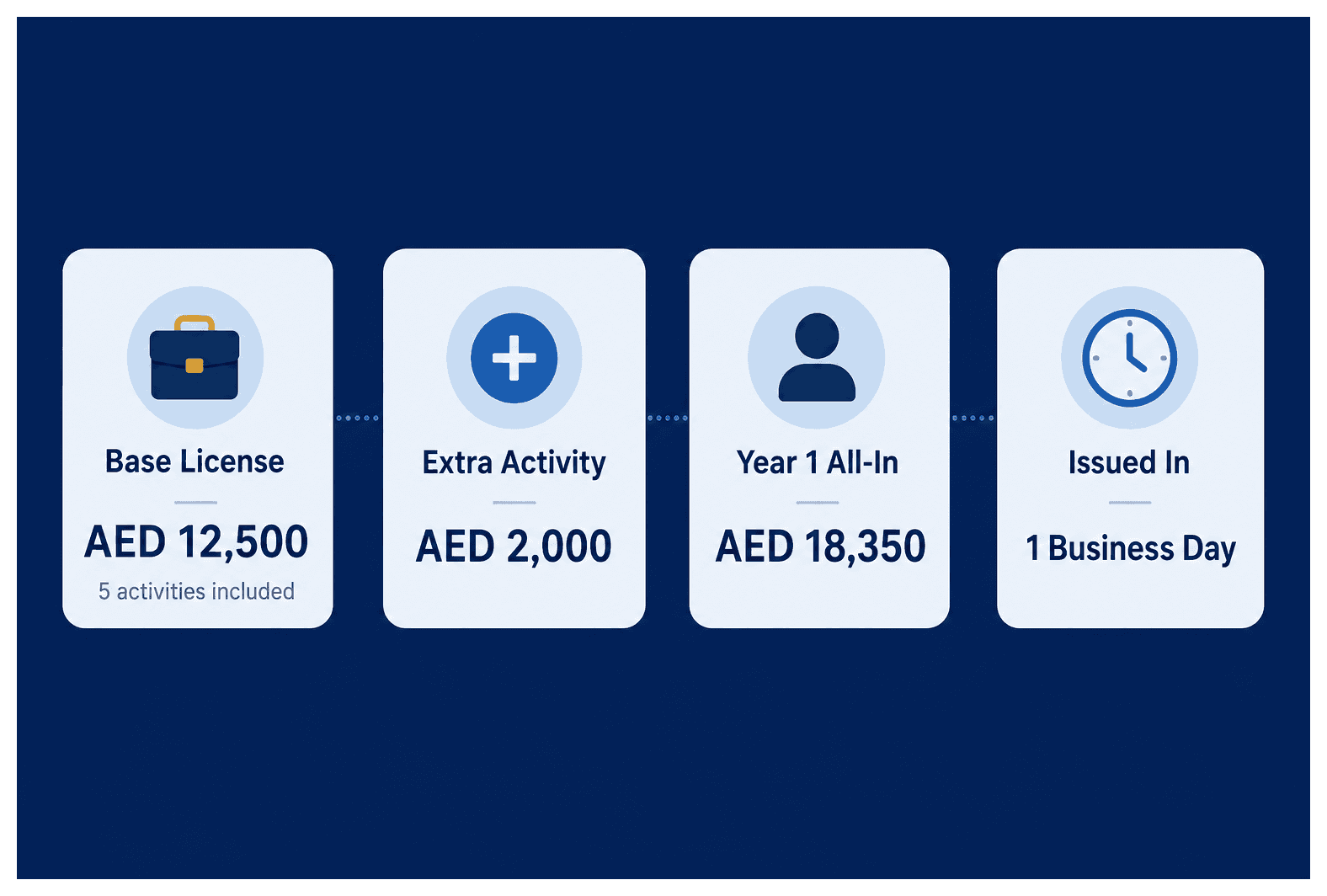
At Dubai South Business Hub Free Zone, the base license from AED 12,500 includes your first five activities at no additional charge. Each activity beyond five adds AED 2,000 to your cost.
Compatible Activity Groups Must Stay Together
Dubai licenses group activities into four broad categories: commercial/trading, professional/service, industrial, and tourism. Mixing incompatible categories typically requires separate licenses or explicit regulator approval.
One Code Does Not Cover Related Activities
A tech consultancy that also resells software subscriptions needs both a professional services activity and a trading activity explicitly listed on the same license. Assuming one code covers the other is a common and costly mistake.
Banks Cross-Check Your License Activity List
UAE banks regularly compare your license activities against incoming transactions during account reviews. Mismatches can trigger compliance queries that delay or freeze your account operations.
Unlicensed Activities Carry Real Financial Penalties
Operating an activity not listed on your license exposes your company to fines and potential suspension. VAT late registration carries a penalty of AED 10,000, and corporate tax late registration adds another flat AED 10,000.
Free Zone and Mainland Lists Are Not Identical
The same business activity can carry a different code depending on whether your license is issued by a free zone or the mainland authority DET. Always verify the approved activity list for your specific jurisdiction before registering.
In 2026, a single Dubai trade license can legally carry dozens of approved business activities, yet most first-time founders register only one and leave revenue streams off the table entirely. At Dubai South Business Hub Free Zone (DSBH), a base license starts from AED 12,500 and includes the first five activities at no extra charge. Each additional activity beyond five costs AED 2,000. The first-year all-in cost for a sole founder with one visa starts from AED 18,350. Zero paid-up share capital is required. Licenses are issued in one business day. This guide explains exactly how multiple activities under one Dubai trade license work, what the rules are in free zones and on the mainland, what each extra activity costs, and how to structure your license from day one so you never pay to amend it twice.
What Multiple Activities on One Dubai Trade License Actually Means
A Dubai trade license lists every business activity a company is legally permitted to conduct. Running multiple activities under one license means a single legal entity can carry out several revenue-generating operations without incorporating separate companies, provided all listed activities are approved by the relevant licensing authority.
How Activities Are Defined and Grouped
Each activity on a Dubai trade license corresponds to a coded category in the licensing authority's approved activity list. These codes align broadly with ISIC Rev.4, the United Nations' international classification standard covering 21 top-level economic sections used globally for activity classification (UN Statistics Division, 2008, still accurate as of 2026).
Dubai licensing authorities group activities into four broad categories: commercial/trading, professional/service, industrial, and tourism. A license can only hold activities within compatible groups. Mixing incompatible categories, such as industrial and professional, typically requires separate licenses or explicit regulator sign-off. Free zones and the mainland each maintain their own approved activity lists, so the same activity description may carry a different code depending on jurisdiction.
Take a practical example: a founder launching a tech consultancy that also resells software subscriptions needs both a professional services activity and a trading license in Dubai on the same license. These are compatible in most free zones but must be explicitly listed, one activity code does not automatically cover the other.
Why the Number of Activities on Your License Matters
Every activity listed on your license determines what contracts you can legally sign, what invoices you can issue, and which VAT categories apply to your supplies. Conducting an unlicensed activity exposes the company to fines and potential license suspension, and the penalties are real. VAT late registration carries a penalty of AED 10,000, and corporate tax late registration carries a one-time flat penalty of AED 10,000 (Federal Tax Authority, 2023).
Banks in the UAE regularly cross-check the license activity list against incoming transactions during account reviews. Mismatches trigger compliance queries that can delay or freeze account operations. A Dubai-based e-commerce seller whose license only lists "retail trading" but who also offers paid product photography sessions is technically operating an unlicensed professional activity, a situation that creates both regulatory and banking risk. Listing all activities upfront is always cheaper than adding them later via an amendment, especially when a regulator approval is also required.
How Multiple Activities Work on a Dubai Mainland License
On a Dubai mainland license issued by DET (Dubai Department of Economy and Tourism), each activity must fall within a compatible category and be approved at the time of incorporation or via a paid amendment. Regulated activities require additional approvals from the relevant sector regulator before DET will add them to the license.
DET Rules on Activity Combinations
DET classifies activities into professional, commercial, industrial, and tourism categories. A single license can typically hold multiple activities within the same category. Mixing commercial and professional activities on one DET license is possible but requires a specific legal structure, usually an LLC with a professional activity endorsement confirmed by DET before submission.
DET also requires that the company's stated legal form is compatible with the activity type. Sole establishments, for example, are restricted to professional or small commercial activities. A mainland LLC wanting to list both "general trading" and "management consultancy" must confirm with DET that both activities are approved under its chosen legal structure before submitting the application. Worth flagging: 100% foreign ownership is available on the mainland under the UAE Commercial Companies Law amendments, but this is unrelated to any designated-zone status or customs benefit (UAE Ministry of Economy, 2021).
Regulated Activities and Dual-Approval Requirements
Certain activities require pre-approval from a named sector regulator before DET will issue or amend the license.
Healthcare activities require Dubai Health Authority (DHA) approval; DET licenses the activity and DHA approves it separately (Dubai Health Authority, 2024).
Financial services activities require Central Bank of the UAE or the relevant authority approval; the licensing authority issues the license and the named regulator approves it separately (Central Bank of the UAE, 2024).
Education activities require KHDA or the relevant education authority approval alongside the trade license.
Failure to obtain regulator approval before operating a regulated activity carries penalties independent of the trade license itself.
A founder adding a health and wellness coaching activity to an existing management consulting license must obtain DHA clearance first. DET will not process the amendment without it. Mainland licenses under DET involve more regulatory touchpoints for mixed-activity licenses compared to most free zones, where the zone authority manages the process end-to-end.
How Dubai South Business Hub Free Zone Handles Multiple Activities
Dubai South Business Hub Free Zone, launched in September 2025, allows multiple activities on a single free zone license starting from AED 12,500. The first five activities are included in the base license fee. Each activity beyond the first five costs AED 2,000. Licenses are issued in one business day.
What the Base License Fee Covers
DSBH base licenses start from AED 12,500, which includes up to five activities at no additional charge. Zero paid-up share capital is required, which reduces the upfront financial burden for first-time founders significantly compared to jurisdictions that mandate minimum capital deposits.
Licenses are issued in one business day, making it practical to list all intended activities before trading begins rather than amending later. A founder setting up a digital marketing agency that also offers graphic design, content writing, social media management, and e-commerce consulting can list all five as separate activities within the AED 12,500 base fee. Visas are always an additional cost and are never included in the license fee. The first-year all-in cost for a sole founder with one visa starts from AED 18,350.
Costs for Activities Beyond the First Five
Each activity added beyond the first five costs AED 2,000 per activity. There is no published cap on the total number of activities a DSBH license can hold, but each activity must appear on DSBH's approved list. A founder who wants eight activities on their DSBH license pays the base fee of AED 12,500 plus AED 6,000 for the three activities beyond the first five, for a total activity cost of AED 18,500 before visa fees.
Regulated activities follow the same dual-approval rule at DSBH: DSBH licenses the activity, and the named regulator approves it separately. Also worth noting: DSBH does not provide bonded warehousing or customs integration. It is not a designated zone and carries no designated-zone customs or VAT benefit. Free zone goods are duty-suspended, not duty-exempt, a meaningful distinction for any founder planning import-heavy operations.
Choosing the Right Activities Before You Apply
Review the full DSBH business activities list before applying to avoid amendment fees and processing delays.
Group related revenue streams under compatible activity codes from the outset.
If a planned activity requires a named regulator's approval, factor that timeline into your launch schedule.
UAE residency visa processing can run alongside the license application, but visa costs are always separate and never included.
An ICT entrepreneur planning to offer software development, IT consultancy, and cybersecurity training should confirm all three activity codes exist on the DSBH approved list before submitting the application. Checking the ICT business license in Dubai activity categories at DSBH is the right starting point for that search.
Step-by-Step Guide to Adding Multiple Activities on Your Dubai License
To add multiple activities to a Dubai trade license, identify all approved activity codes you need, confirm compatibility with your chosen license category and legal structure, check whether any activity requires a separate regulator approval, then submit the full activity list at incorporation to avoid amendment fees.
Step 1: Map Every Revenue Stream to an Approved Activity Code
List every service or product you plan to sell in the first 24 months, not just at launch. Future revenue streams are easier to license upfront than to add later.
Search the relevant licensing authority's approved activity database to find the exact code for each planned service. DSBH publishes its approved activity list online, and codes align broadly with ISIC Rev.4 classifications.
Where two services could sit under one broad activity code, confirm with the authority whether one code suffices or both must be listed separately.
Note which activities appear on regulated lists requiring secondary approvals, these need extra lead time.
A founder offering both HR consulting and payroll software reselling needs to check whether "management consultancy" covers both or whether a separate "software trading" activity code is required. Getting this wrong at incorporation means a paid amendment later.
Step 2: Confirm Activity Compatibility and Legal Structure
Verify that all chosen activities fall within compatible categories for your chosen jurisdiction and legal form.
On the mainland, DET must confirm that the legal structure (LLC, sole establishment, or branch) supports the activity mix before the application is submitted.
In a free zone, confirm that no activity on your list is restricted to mainland or onshore operations only.
If any activity requires physical premises, such as a warehouse or clinic, confirm the address and facility type before submission.
Real estate brokerage is a good example of where this step matters. RERA governs real estate brokerage in Dubai, and a founder cannot simply list it on a free zone license and begin operating without that separate RERA approval in place. Free zone licenses restrict the holder to activities within the zone's approved scope, and some activities simply cannot be conducted from a free zone entity.
Multiple Activities Dubai Cost Breakdown: One-Off vs Recurring Fees at DSBH
Fee Item | One-Off Costs | Recurring Annual Costs |
|---|---|---|
Base license fee (first 5 activities included) | From AED 12,500 at incorporation | Same base rate applies at annual renewal |
Per-activity fee beyond the first five | AED 2,000 per activity at incorporation | AED 2,000 per retained activity at each renewal |
Name reservation and registration processing | Paid once at initial application | Not applicable, name is registered once |
Regulator approval fee for regulated activities | Charged by the named regulator (e.g., DHA, Central Bank), not part of DSBH fee | Regulator license renewal fee charged annually by the named regulator |
Costs not included in any DSBH fee | Visa fees, office lease, bank account fees, document attestation, insurance | Visa renewal fees, regulator-specific annual fees, professional service retainers |
Step 3: Submit the Full Activity List at Incorporation
Submit all intended activities at the time of initial application, not in stages. This is the single most cost-effective decision in the whole process.
At DSBH, the first five activities are included in the base fee. Adding activities after license issuance incurs amendment processing costs and additional time.
For the mainland, adding activities post-issuance requires a DET amendment, which carries its own fee and processing time separate from the original application.
Keep a copy of the approved license with all activities listed for bank account opening, contract execution, and VAT registration purposes.
A sole founder incorporating at DSBH with six planned activities saves time and potential amendment costs by listing all six at the initial application stage, paying AED 2,000 for the sixth activity upfront. The license is issued in one business day. Free zone incorporation portals typically allow founders to select all activities in one digital submission, whereas mainland DET amendments require a separate application stream after the initial license is issued.
Multiple Activities Dubai Cost: A Full Breakdown
The cost of multiple activities on a Dubai trade license depends on jurisdiction. At DSBH, the base license from AED 12,500 includes five activities; each additional activity costs AED 2,000. Visa fees, regulator approval fees, and professional service fees are separate and always additional.
One-Off Versus Recurring Cost Categories
A DSBH founder with seven activities pays a one-off AED 2,000 for the sixth activity and another AED 2,000 for the seventh at incorporation. These costs recur at renewal if the activities are retained. So the activity cost structure is transparent and predictable from day one, which matters when you're building a pre-incorporation budget.
One-off costs: Registration fee, name reservation, initial license issuance from AED 12,500, per-activity fees beyond the first five at AED 2,000 each, and any regulator approval fees for regulated activities.
Recurring annual costs: License renewal at the same base rate, per-activity renewal fees for activities beyond five, and any regulator license renewal fees charged by the named regulator.
Always additional: Visa costs for investors, employees, or dependants, never described as included in any license package. First-year all-in cost from AED 18,350 for a sole founder with one visa.
Zero paid-up share capital at DSBH reduces the upfront cash requirement compared to jurisdictions that mandate minimum capital deposits.
What Is Not Included in the License Fee
Visa fees for investors, employees, or dependants are always an additional cost.
Regulator approval fees (DHA, Central Bank of the UAE, KHDA, etc.) are charged by the respective regulator and are not part of the DSBH license fee.
DSBH does not provide bonded warehousing or customs integration; any logistics infrastructure costs are entirely separate.
Professional service fees for document preparation, attestation, or translation are additional.
Corporate tax registration and VAT registration are managed separately with the Federal Tax Authority. Late VAT registration carries a penalty of AED 10,000. Late corporate tax registration carries a one-time flat penalty of AED 10,000 (Federal Tax Authority, 2023).
A healthcare startup at DSBH must budget for the DSBH license fee, plus a separate DHA facility and professional licensing fee, plus visa fees for each licensed health professional. None of the latter two are included in the DSBH license cost. The healthcare business license in Dubai section of the DSBH activity list is the right place to start identifying which DHA approvals apply to your specific services.
Tax and Compliance Implications of Running Multiple Activities
Running multiple activities under one Dubai trade license does not automatically change your VAT or corporate tax obligations, but it can affect which transactions are taxable, which are exempt, and how you document different revenue streams. Each activity must be accurately reflected in your accounting and tax filings.
VAT Obligations Across Multiple Activities
VAT registration is mandatory once taxable supplies exceed AED 375,000 in any 12-month period, regardless of how many activities generate those supplies. Different activities on the same license may attract different VAT treatments: standard-rated at 5%, zero-rated, or exempt. Mixed-supply scenarios require careful VAT apportionment in your accounting records.
A DSBH company with both a consulting activity (potentially standard-rated) and an education training activity (potentially exempt) must track revenue by activity to correctly calculate input tax recovery. Free zone companies, including those at DSBH, are not automatically zero-rated. DSBH is not a designated zone and carries no designated-zone VAT benefit. For detailed guidance on VAT registration thresholds and obligations, the Federal Tax Authority portal is the primary reference.
Corporate Tax Considerations for Multi-Activity Entities
UAE corporate tax applies to taxable income above AED 375,000 at 9%. The 0% rate for Qualifying Free Zone Persons (QFZPs) requires meeting four specific conditions: deriving qualifying income, maintaining adequate substance in the free zone, not electing to be subject to standard corporate tax, and complying with transfer pricing rules. A company with mixed activities may find that some revenue qualifies under QFZP rules and some does not, requiring income segregation in the accounts.
References
Frequently Asked Questions