
Topic Summary
Gather Every Required Document Before Applying
Banks need a certified trade license, notarised memorandum and articles of association, valid passport copies, a board resolution, and a source-of-funds declaration. Missing even one item is the leading cause of delays, so compile the full set before submitting a single form.
Expect Enhanced Scrutiny in Your First Year
UAE banks automatically classify companies under 12 months old as higher-risk and apply enhanced due diligence regardless of license type. Preparing a clear two-page business plan that details your clients, revenue sources, and projected monthly transaction volumes significantly reduces back-and-forth.
A Corporate Account Is Legally Mandatory
UAE corporate tax and VAT rules require all business transactions to flow through a named corporate account to maintain auditable records. Receiving client payments into a personal account breaches UAE commercial law and can trigger a AED 10,000 penalty for delayed tax registration.
Non-Resident Shareholders Face Extra Document Demands
If any shareholder lives outside the UAE, their proof of address must be notarised and apostilled and dated within the past three months. A newly licensed trading company with foreign-based shareholders will typically receive far more document requests than a locally resident sole founder.
Choose From a Wide Range of Licensed Banks
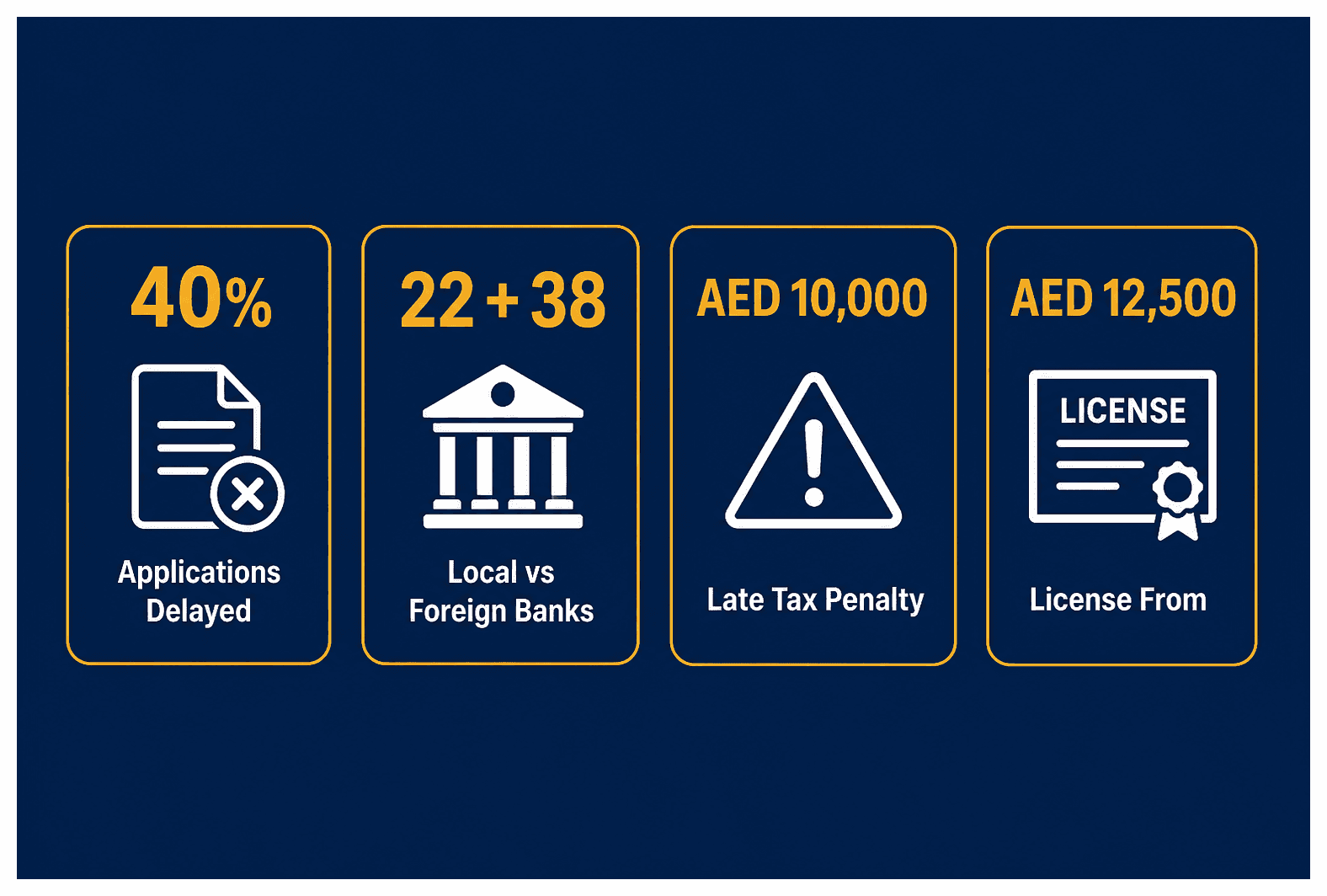
The UAE hosts 22 locally incorporated banks and 38 foreign bank branches, giving founders genuine options across service levels, fee structures, and minimum balance requirements. Comparing several institutions before applying improves your chances of finding a bank whose risk appetite matches your business profile.
Your Trade License Must Have Sufficient Validity
Most banks will reject an application outright if the trade license is due for renewal within 30 days of the application date. Renew early or time your application carefully so the license shows a comfortable validity window when the bank reviews your file.
Account Approval Unlocks Commercial Operations
Even after a free zone like Dubai South Business Hub issues a trade license in one business day, the company cannot legally invoice or receive payments until a live corporate account is active. Treating the bank application as part of the setup process rather than an afterthought prevents costly operational delays.
Roughly 40% of first-time founders who set up a company in Dubai report that their corporate bank account application is delayed or declined at least once before approval, according to business setup consultants active in the market. The UAE has 22 locally incorporated banks and 38 foreign bank branches (Central Bank of UAE, 2024). Late corporate tax registration carries a one-time flat penalty of AED 10,000. Dubai South Business Hub Free Zone (DSBH) issues trade licenses in one business day from AED 12,500. First-year costs for a sole founder with one visa start from AED 18,350. This guide covers exactly what banks require from a newly formed Dubai company, what it costs to get banked, and the step-by-step process to move from trade license to active corporate account without losing weeks to avoidable back-and-forth.
What Is Opening a Bank Account for a Newly Formed Dubai Company
Opening a bank account for a newly formed Dubai company means applying for a corporate current account at a UAE-licensed bank after incorporation. The bank runs AML and KYC checks on the company, its shareholders, and its directors before granting access to payment rails, trade finance, and foreign currency transfers.
Corporate Bank Account Opening in Dubai: Key Requirements at a Glance
Requirement | Details |
|---|---|
Valid trade license | Must be current; most banks reject if renewal falls within 30 days |
Memorandum and articles of association | Certified copy issued by the licensing authority; scans are not accepted by most banks |
Passport copies for all shareholders and signatories | Valid for at least six months; certified copies required |
Board resolution authorising the account signatory | Must be signed and dated after the company's incorporation date; company stamp may be required |
Source-of-funds declaration | Explains origin of initial capital and projected revenues; vague answers are the top cause of rejection |
Business plan summary (two pages minimum) | Covers business model, client geographies, revenue sources, and projected monthly transaction volumes |
Proof of address for non-resident shareholders (notarised, within three months) | Utility bill or bank statement; must be notarised and apostilled if issued outside the UAE |
Why a Corporate Account Is Not Optional
UAE corporate tax law and VAT regulations require every business to transact through a named corporate account to maintain auditable records. Clients, payment gateways, and most B2B suppliers will not send funds to a personal account held in a director's name. A sole founder with a consulting license who receives a client retainer on day one cannot invoice from a personal account without breaching UAE commercial law. The corporate account is the legal vehicle for every single transaction.
Late corporate tax registration carries a one-time flat penalty of AED 10,000; a missing bank account delays registration and compounds the risk.
DSBH issues free zone licenses in one business day, but the company cannot operate commercially until a live corporate account is in place.
The UAE has 22 locally incorporated banks and 38 foreign bank branches, giving founders a genuine range of options (Central Bank of UAE, 2024).
How UAE Banks Categorize Newly Formed Companies
Banks treat companies under 12 months old as higher-risk applicants and apply enhanced due diligence as a default. This applies regardless of whether you hold a free zone or mainland license; the licensing authority does not change which banks you can approach or how they assess your file.
Banks look at three things above all else: the credibility of the business model, the source of shareholder funds, and the expected transaction profile. A newly licensed trading company whose shareholders are based outside the UAE will face significantly more document requests than a locally resident sole founder running a service business, even if both hold identical free zone licenses. Minimum average balance requirements vary by bank, typically ranging from AED 25,000 to AED 50,000 for SME accounts (UNVERIFIED: confirm before publishing). Compare fee schedules before you apply.
Requirements for Opening a Bank Account in Dubai
Banks in Dubai require a valid trade license, memorandum of association, passport copies and Emirates IDs for all shareholders and signatories, a business plan or model summary, proof of address, and source-of-funds documentation. Regulated activities need additional approval letters from the relevant authority before a bank will proceed.
Core Company Documents Every Bank Requests
Valid trade license: Must be current and not within 30 days of renewal. Most banks reject on this technical ground alone.
Certificate of incorporation and memorandum and articles of association: Certified by the licensing authority. Scans are not accepted by the majority of UAE banks.
Share certificate(s): Show the ownership structure. Banks cross-check these against the trade license.
Board resolution: Authorises the named signatory to open and operate the account. Must be signed and dated after the company's incorporation date.
Company stamp (where applicable): Some banks still require a physical stamp on resolution documents.
A DSBH company with two shareholders, for example, needs a board resolution signed by both, a share register showing the ownership split, and certified copies of both passports, even if only one director will operate the account day to day.
Shareholder and Signatory Identity Documents
Passport copies: Required for every shareholder, director, and authorised signatory. Must be valid for at least six months.
Emirates ID: Required for UAE residents. Non-resident shareholders must provide a notarised proof of address dated within three months.
Corporate shareholder documentation: If a holding company owns the Dubai entity, banks request the full corporate structure chart, the parent company's incorporation documents, and a beneficial ownership declaration traced to the natural person level.
Source-of-funds declaration: Banks need to know where initial capital and projected revenues originate. Vague answers are the single most common cause of rejection for new companies.
A founder living in Germany who holds 100% of a Dubai free zone company will need a notarised utility bill or bank statement from Germany, plus a signed source-of-funds letter explaining the origin of the AED 18,350 first-year setup investment. Anonymous holding structures are not accepted under UAE AML regulations (Ministry of Economy, 2024).
Additional Requirements for Regulated Business Activities
Financial services: DSBH licenses the activity on the trade license; the Central Bank of UAE issues a separate regulatory approval. Both documents must be presented to the bank together.
Healthcare: DSBH licenses the activity; Dubai Health Authority (DHA) issues the approval separately. The bank requires both.
Education: KHDA issues the approval separately from the DSBH license.
Real estate brokerage: RERA registration is required in addition to the trade license.
A fintech startup holding a financial services license at DSBH must show the bank both the DSBH trade license and the Central Bank of UAE approval letter. Without the second document, no UAE bank will open the account.
Step-by-Step Guide to Opening a Bank Account in Dubai
To open a corporate bank account in Dubai, incorporate your company first, then compile KYC documents, shortlist two or three banks that serve your business type, submit a pre-screening inquiry, attend the in-person interview, respond to any additional requests, and activate the account once the bank issues approval. The process typically takes two to four weeks.
The Seven Steps From License to Live Account
Step 1: Incorporate your company and receive your trade license. DSBH issues the license in one business day once documents clear.
Step 2: Register for corporate tax with the Federal Tax Authority (tax.gov.ae). Late registration is a one-time flat AED 10,000 penalty.
Step 3: Compile your full KYC document pack. This includes the trade license, MOA, passports, Emirates IDs or notarised proof of address, board resolution, source-of-funds letter, and business plan summary.
Step 4: Research and shortlist two or three banks whose SME account products match your projected transaction volume and currency needs. The UAE has 22 locally incorporated banks and 38 foreign bank branches.
Step 5: Submit a pre-screening inquiry. Many banks now offer an online pre-application form to filter eligibility before a full submission.
Step 6: Attend the in-person KYC interview. Bring original documents. Answer questions about your business model consistently with your written plan.
Step 7: Respond to any additional requests promptly, then activate the account once the bank issues approval.
A sole founder setting up a consulting company at DSBH can realistically complete steps one through three within the first week: the license arrives on day one, corporate tax registration follows within days, and the document pack can be assembled in parallel. DSBH's banking and taxation support service can help prepare your application package, though account approval decisions rest entirely with the bank.
How to Write a Business Plan That Satisfies Bank Compliance
Banks do not need a 40-page investor deck. They need a two-page summary covering what the company does, who its clients are, how revenue is generated, and where funds flow in and out. Include projected monthly transaction volumes and average transaction values. Vague projections raise flags; specific, defensible numbers build confidence.
Name your key client and supplier geographies. A digital marketing consultant whose Dubai company will invoice three European clients monthly for a combined AED 40,000 should state that exact transaction profile in the business plan. It makes the bank's risk assessment straightforward. If you have an existing business elsewhere, attach bank statements from that entity as supporting evidence of your financial track record.
What Does Opening a Bank Account in Dubai Cost
Opening a corporate bank account in Dubai typically involves no application fee, but banks require a minimum average monthly balance ranging from AED 25,000 to AED 50,000 for most SME accounts. Monthly account maintenance fees apply if the balance falls below the threshold. Some banks charge a one-time account setup fee.
Bank Fees and Minimum Balance Requirements
Application fee: Zero at most UAE banks, but minimum average monthly balance requirements apply, commonly AED 25,000 to AED 50,000 for SME current accounts (UNVERIFIED: confirm before publishing).
Below-minimum penalty: A monthly fee of AED 100 to AED 500 is typically charged if the balance falls below the threshold (UNVERIFIED: confirm before publishing).
International wire transfers: Fees range from AED 25 to AED 100 per transaction depending on the bank and destination currency (UNVERIFIED: confirm before publishing).
New company waivers: Some banks waive the minimum balance for the first three to six months for newly incorporated companies. Ask the relationship manager explicitly before submitting.
A sole founder whose first-year DSBH setup costs from AED 18,350 should budget separately for the bank's minimum balance requirement. That capital sits in the account and remains accessible, but must be maintained to avoid monthly penalties. Use the business setup cost calculator to plan your full first-year budget before you apply.
Hidden Costs Founders Overlook
Document attestation: Notarisation and apostille of overseas documents can cost AED 500 to AED 2,000 depending on the country of origin (UNVERIFIED: confirm before publishing).
Translation fees: Required if shareholder documents are not in Arabic or English. A German-national founder whose passport and proof of address are in German will need certified translations before any UAE bank will accept those documents.
Corporate tax registration penalty: Free to register with the Federal Tax Authority, but late registration triggers the AED 10,000 one-time flat penalty.
VAT registration penalty: Late VAT registration also carries an AED 10,000 penalty. Register as soon as your taxable supplies cross the mandatory threshold (Federal Tax Authority, 2023).
Choosing the Right Bank for Your Dubai Company
Choose a UAE corporate bank based on your transaction profile: the currencies you send and receive, your average monthly volume, whether you need trade finance or payment gateway integration, and how quickly the bank's SME team responds. Approach two or three banks in parallel, rejection from one does not affect your application with another.
Matching Your Business Model to the Right Bank
Locally incorporated banks tend to process SME applications faster and often have dedicated relationship managers for free zone companies. Foreign bank branches in the UAE typically carry higher minimum balance requirements but offer stronger international correspondent banking networks, relevant if your clients pay in non-AED currencies.
An ICT company at DSBH receiving SaaS subscription payments in USD from US clients should prioritise a bank with a strong USD correspondent network and a payment gateway partnership, not just the one with the lowest monthly fee. If your business activities include physical goods trading, look for banks offering trade finance facilities such as letters of credit and bank guarantees from the outset. Digital-only bank options exist in the UAE market and may suit service businesses with low transaction volumes, but confirm whether their accounts are accepted by your target clients and payment processors before committing.
How to Improve Your Approval Odds Before You Apply
Certify everything before the first meeting. Incomplete files are the primary reason banks park applications.
Be consistent across all documents. The business description on your license, your business plan, and your verbal explanation in the KYC interview must align precisely.
Keep your activity list focused. A founder who lists 12 business activities on their license but describes a single-service consulting business in their plan will face immediate questions. Each activity beyond the first five at DSBH costs AED 2,000, keep the list purposeful.
Get a warm introduction. If a relationship manager refers you, your file moves to the front of the queue. Ask your free zone, business setup consultant, or accountant for an introduction.
Common Reasons Banks Reject New Dubai Company Applications
Banks most commonly reject new Dubai company applications because of incomplete KYC documents, vague source-of-funds explanations, a mismatch between the stated business model and the licensed activities, or shareholders from high-risk jurisdictions without adequate supporting documentation. Addressing these issues before submission eliminates the majority of rejections.
Document and Compliance Gaps That Trigger Rejection
Expired or near-expiry passports: A passport expiring within six months is treated as invalid by most compliance teams.
Unsigned or undated board resolutions: Banks check dates carefully. A resolution signed before the company's incorporation date is void.
Untraceable beneficial ownership: Corporate shareholder structures where beneficial ownership cannot be traced to a named natural person cannot be onboarded under UAE AML regulations.
Vague source-of-funds letters: "Savings" is not a sufficient explanation for a AED 500,000 opening deposit.
A holding company in the British Virgin Islands that owns 60% of a Dubai entity will require full corporate documentation for the BVI entity, its own certificate of incorporation, directors list, and beneficial ownership declaration, before any UAE bank will proceed.
Business Model Red Flags Banks Watch For
High-risk industry sectors: Certain trading activities, crypto-adjacent businesses, and cash-intensive models face automatic enhanced due diligence.
References
Frequently Asked Questions