
Topic Summary
What Is Opening a UAE Corporate Bank Account as a Ethiopian Entrepreneur and Why It Matters
Opening a UAE corporate bank account as an Ethiopian entrepreneur means getting a licensed UAE bank to onboard your free zone company after KYC and compliance checks. The account lets you receive client payments, pay suppliers and staff, and keep company money separate from personal funds.
Documents and Attestation Ethiopian Nationals Need Before Applying
Documents and Attestation Ethiopian Nationals Need Before Applying
How UAE Banks Assess Ethiopian Founders and Manage Compliance
UAE banks assess founders through KYC, anti-money-laundering screening, and a review of business substance, ownership, and source of funds, under Central Bank of the UAE rules.
Step-by-Step Guide to Opening a UAE Corporate Bank Account as a Ethiopian Entrepreneur
Register your free zone company, secure residency, attest documents, prepare your funds file, choose a bank, apply, interview, and fund. Each stage builds trust.
Tax Registration and Treaty Considerations for Ethiopian-Owned UAE Companies
Most licensed companies must register for corporate tax with the Federal Tax Authority. Qualifying income is taxed at 0%, and taxable income above AED 375,000 at 9% (FTA, 2023).
Funding Your Account and Moving Money Between Ethiopia and the UAE
Document capital origin and follow National Bank of Ethiopia foreign-exchange directives, which change, so verify them first. Use authorised banks and keep receipts.
Practical Tips to Improve Your Approval Chances
Present a clear model, evidence your funds, and apply with realistic volumes. Describe your activity exactly as the license does.
Opening a UAE corporate bank account as a Ethiopian entrepreneur sounds simple, but roughly 40% of first-time founders face a delay or decline. More than 40 licensed banks operate under the Central Bank of the UAE [1]. Licenses start from AED 12,500 a year [2]. Banks typically take two to six weeks to decide. This guide is for Ethiopian nationals relocating to Dubai who want a clean, approved account.
What Is Opening a UAE Corporate Bank Account as a Ethiopian Entrepreneur and Why It Matters
Opening a UAE corporate bank account as an Ethiopian entrepreneur means getting a licensed UAE bank to onboard your free zone company after KYC and compliance checks. The account lets you receive client payments, pay suppliers and staff, and keep company money separate from personal funds.
What a Corporate Account Does for Your Company
Your trade license comes first. The bank onboards the licensed company second. Many visa processes and client contracts assume a working account. An Ethiopian coffee exporter licensed in Dubai South, for example, collects AED and USD payments from Gulf buyers through it.
Why Ethiopian Founders Need Extra Preparation
Banks run enhanced due diligence on source of funds.
Birr isn't freely convertible, so banks study how capital left Ethiopia.
A documented property sale in Addis Ababa clears faster than a cash story.
Documents Checklist for Ethiopian Founders Applying for a UAE Corporate Account
Feature | Document | Purpose |
|---|---|---|
Passport and Emirates ID or visa | Valid passport, residence visa, Emirates ID | Confirms identity and UAE residency status |
Trade license and incorporation documents | License, share certificate, articles, lease | Proves the company legally exists |
Attested Ethiopian supporting documents | Sale deeds, registrations, certified translations | Makes foreign papers acceptable to the bank |
Source-of-funds evidence | Six months of statements, sale or export records | Shows where your capital came from |
Business plan and client contracts | Two-page profile, contracts, expected volumes | Demonstrates real business substance |
Documents and Attestation Ethiopian Nationals Need Before Applying
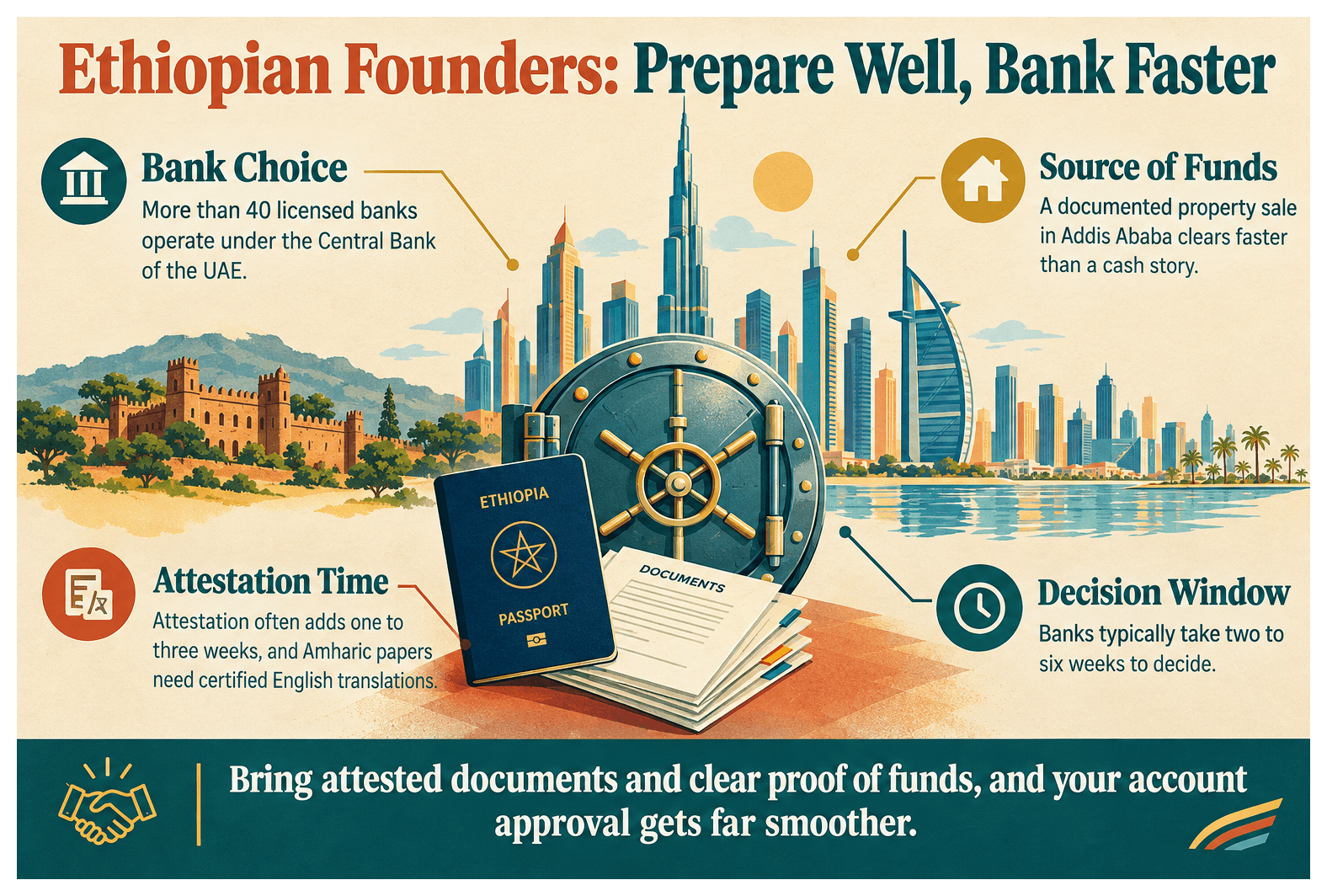
Ethiopian applicants typically need a valid passport, UAE residency, trade license, incorporation documents, proof of address, and a source-of-funds file. Ethiopian-issued documents are usually authenticated by Ethiopia's Ministry of Foreign Affairs, then legalised by the UAE Embassy in Addis Ababa.
Core Company and Personal Documents
Passport, Emirates ID or visa, and photos.
License, share certificate, memorandum, and lease.
Six months of personal statements.
A business plan with monthly volumes, such as AED 80,000 turnover and three named clients.
Attestation and Residency
Attestation often adds one to three weeks, and Amharic papers need certified English translations. Confirm current rules with the embassy and the bank. Residency runs through GDRFA Dubai and ICP channels, and a finished Emirates ID speeds onboarding. See our UAE investor visa for Ethiopian nationals guide.
How UAE Banks Assess Ethiopian Founders and Manage Compliance
UAE banks assess founders through KYC, anti-money-laundering screening, and a review of business substance, ownership, and source of funds, under Central Bank of the UAE rules.
What Compliance Teams Look For
Real clients, contracts, and invoices.
Clear beneficial ownership.
Realistic volumes and counterparties.
Common Reasons for Delay or Decline
Vague activity descriptions sink files. So do inconsistencies: one application stalled because the license said general trading while the invoices showed consulting. Unclear counterparties and missing funds evidence do the rest.
Step-by-Step Guide to Opening a UAE Corporate Bank Account as a Ethiopian Entrepreneur
Register your free zone company, secure residency, attest documents, prepare your funds file, choose a bank, apply, interview, and fund. Each stage builds trust.
Follow These Four Steps
License and residency:set up your company in Dubai South, then get your visa and Emirates ID.
Documentation: attest papers, translate them, and add quotes or purchase orders.
Bank choice: match fees, minimum balance, and currencies to your volumes.
Interview and funding: bring a one-page flow chart, deposit, and activate online banking.
Tax Registration and Treaty Considerations for Ethiopian-Owned UAE Companies
Most licensed companies must register for corporate tax with the Federal Tax Authority. Qualifying income is taxed at 0%, and taxable income above AED 375,000 at 9% (FTA, 2023).
VAT registration applies above AED 375,000 in taxable supplies.
Banks may ask for tax numbers as you grow.
Check the Ministry of Finance treaty list for Ethiopia. Don't assume treaty benefits without confirmation.
Funding Your Account and Moving Money Between Ethiopia and the UAE
Document capital origin and follow National Bank of Ethiopia foreign-exchange directives, which change, so verify them first. Use authorised banks and keep receipts.
How Do I Keep My Account Clean After Opening?
Match every receipt to an invoice or contract, avoid large unexplained cash deposits, and answer bank document requests quickly. Banks review accounts periodically and can ask for updated KYC, so a shared invoice folder saves real time.
Practical Tips to Improve Your Approval Chances
Present a clear model, evidence your funds, and apply with realistic volumes. Describe your activity exactly as the license does.
Show signed contracts, such as two clients supporting AED 60,000 monthly income.
Compare lessons from Kenyan founders in this Kenyan guide and Nigerian founders in this Nigerian guide.
Read how Egyptian founders structure their evidence.
Your Next Move
Follow the steps above, keep records consistent, and opening a UAE corporate bank account as a Ethiopian entrepreneur becomes manageable. Contact Dubai South Business Hub for a free consultation on company formation, trade licensing, residency visa packages, and getting your banking application ready.
References
Frequently Asked Questions