
Topic Summary
What Is Opening a UAE Corporate Bank Account as an Egyptian Entrepreneur and Why It Matters
Opening a UAE corporate bank account as an Egyptian entrepreneur means registering your licensed company's finances with a bank supervised by the Central Bank of the UAE. You can receive client payments, pay suppliers and staff, and keep business and personal money separate.
Requirements and Documents Egyptian Founders Need Before Applying
Requirements and Documents Egyptian Founders Need Before Applying
Process for Opening a UAE Corporate Bank Account as an Egyptian Entrepreneur
Secure your license, shortlist banks, prepare KYC documents, submit, attend any compliance interview, fund the account and activate online banking. Most applications take several weeks. Check the UAE corporate bank account opening timeline before you plan launch dates.
Residency, Emirates ID and Their Role in Bank Onboarding
A residence visa isn't always required at application, since many banks accept a valid free zone license. It can still speed onboarding. Residency and Emirates ID are issued through the Federal Authority for Identity, Citizenship, Customs and Port Security (ICP) .
Compliance Rules That Keep Your Corporate Account Active
Keep minimum balances, update KYC when licenses or passports renew, register for corporate tax, and keep transactions consistent with your declared activity. Banks follow Central Bank anti-money-laundering rules and may freeze unexplained activity.
Final Recommendations for Opening a UAE Corporate Bank Account as an Egyptian Entrepreneur
Align license activity with your application, prepare full source-of-funds evidence, pick banks that suit your transaction profile and answer queries quickly. A licensed free zone gives you a bank-ready foundation.
In 2026, more than 40 licensed banks compete for corporate clients (Central Bank of the UAE, 2025). Yet roughly 40% of first-time founders still see a delay or decline once. This guide to opening a UAE corporate bank account as an Egyptian entrepreneur shows you the documents, steps and compliance rules, so you can move from a Dubai South Business Hub trade license to an active account with fewer surprises.
What Is Opening a UAE Corporate Bank Account as an Egyptian Entrepreneur and Why It Matters
Opening a UAE corporate bank account as an Egyptian entrepreneur means registering your licensed company's finances with a bank supervised by the Central Bank of the UAE. You can receive client payments, pay suppliers and staff, and keep business and personal money separate.
How Corporate Accounts Work for Free Zone Companies
The account is opened in the company's name once your trade license is issued. Many banks accept a free zone license as the primary qualifying document. Picture an Egyptian consultant licensed at Dubai South Business Hub who invoices clients in dirhams and dollars from one account. The corporate bank account for a free zone company is the natural next step after licensing.
Why Egyptian Founders Face Extra Scrutiny
Banks run enhanced KYC (know your customer) and source-of-funds checks, especially for non-resident owners. They want proof of real business activity and Egypt-UAE trade links. A founder who submits contracts with Egyptian clients upfront usually clears questions faster. Here's why UAE banks reject corporate account applications.
Documents Required for an Egyptian Founder's Corporate Account Application
Document | Purpose |
|---|---|
Trade license | Proves the company is legally licensed and shows its approved activities |
Incorporation documents | Confirm ownership chain, share capital and signing authority |
Passport copies of shareholders and directors | Verify the identity of every owner and decision-maker |
Proof of address | Confirms residence in Egypt or the UAE for KYC records |
Source-of-funds evidence | Shows where your capital comes from, as anti-money-laundering rules require |
Requirements and Documents Egyptian Founders Need Before Applying
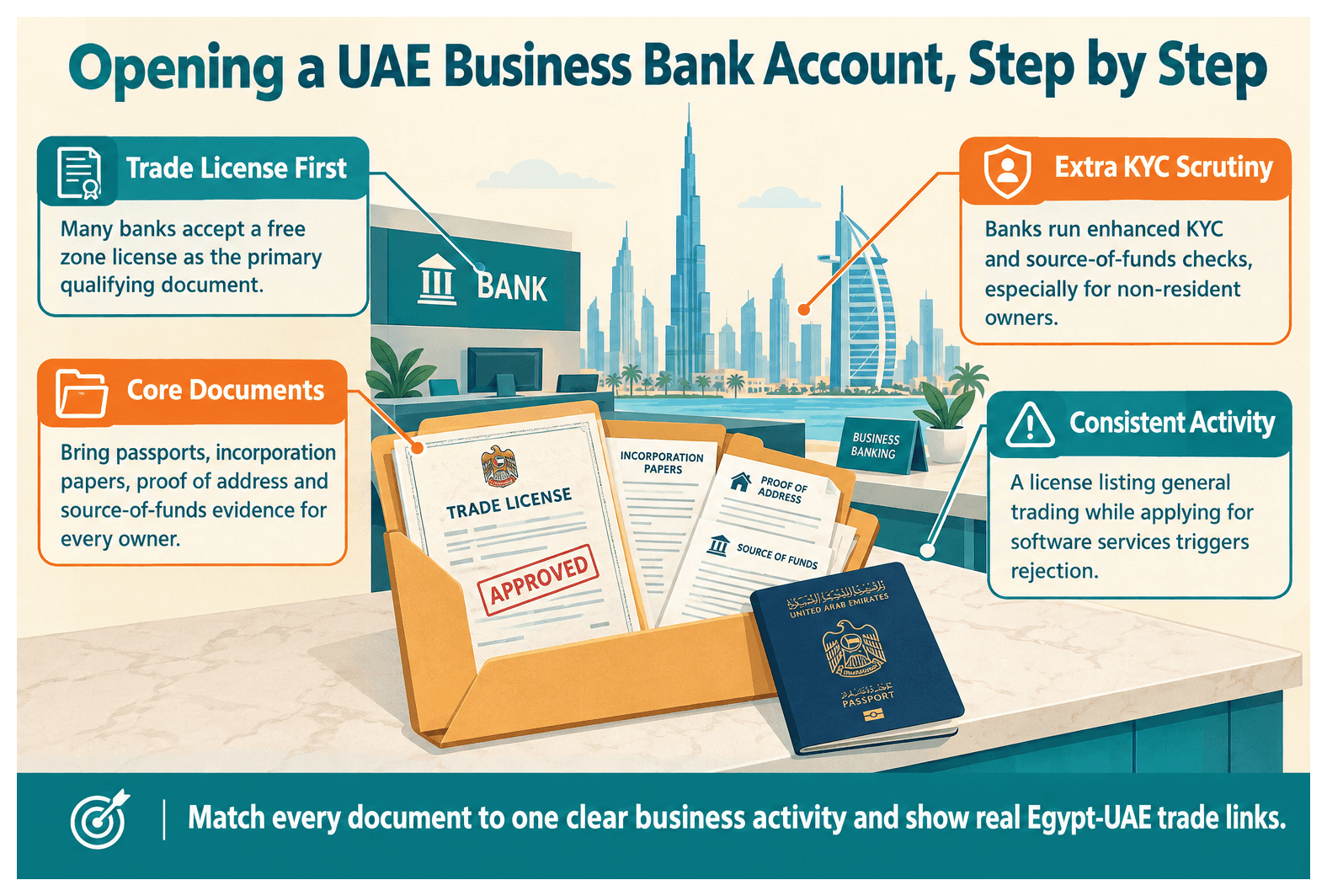
Egyptian founders typically need a valid trade license, incorporation documents, passports for every shareholder and director, proof of address, a business plan and source-of-funds evidence. Some banks also ask for Egyptian commercial registers. Lists vary, so confirm first. See documents UAE banks require from a new company.
Core Company and Shareholder Documents
Trade license and share certificate.
Memorandum or articles of association.
Passports, plus Emirates ID where held.
Matching names and addresses across all files.
Source of Funds and Business Substance Evidence
Bank statements and dividend or salary proof.
Client contracts, invoices or letters of intent.
One activity description everywhere.
Mistakes That Trigger Rejection
The classic one: a license listing general trading while the application describes software services. Vague business plans and unverified funds come next. Banks read inconsistency as risk.
Process for Opening a UAE Corporate Bank Account as an Egyptian Entrepreneur
Secure your license, shortlist banks, prepare KYC documents, submit, attend any compliance interview, fund the account and activate online banking. Most applications take several weeks. Check the UAE corporate bank account opening timeline before you plan launch dates.
Step 1: Secure Your License and Shortlist Banks
Obtain your Dubai South Business Hub trade license.
Compare minimum balances, fees and onboarding rules.
Match the bank to your profile, such as trade finance for an Egypt-UAE importer.
Step 2: Submit the Application and Complete KYC
Submit every document together.
Prepare answers on expected turnover and counterparties.
Reply to follow-ups the same day.
Step 3: Fund, Activate, and Test Payments
Deposit the minimum balance.
Set up online banking and signatories.
Test a small inbound and outbound transfer.
Residency, Emirates ID and Their Role in Bank Onboarding
A residence visa isn't always required at application, since many banks accept a valid free zone license. It can still speed onboarding. Residency and Emirates ID are issued through the Federal Authority for Identity, Citizenship, Customs and Port Security (ICP).
Applying Before Versus After Your Visa
Non-resident applications are possible but face more checks. Many Egyptian founders apply pre-visa, then upgrade their profile once the Emirates ID arrives. Read about opening a corporate bank account before your residence visa.
Currency and Cross-Border Account Features
Dirham, USD and EUR accounts reduce conversion losses. An exporter holding USD can pay suppliers without double conversion. Plan Egypt-UAE payment flows early with multiple currency corporate bank accounts.
Compliance Rules That Keep Your Corporate Account Active
Keep minimum balances, update KYC when licenses or passports renew, register for corporate tax, and keep transactions consistent with your declared activity. Banks follow Central Bank anti-money-laundering rules and may freeze unexplained activity.
Tax Registration and Reporting Obligations
Register for corporate tax with the Federal Tax Authority under Federal Decree-Law No. 47 of 2022.
Register for VAT once taxable supplies pass AED 375,000.
Follow Ministry of Finance guidance on reporting.
Ongoing KYC and Transaction Monitoring
Answer document refresh requests promptly. Avoid large unexplained deposits. One founder avoided a freeze simply by supplying invoices for a flagged transfer within a day.
Final Recommendations for Opening a UAE Corporate Bank Account as an Egyptian Entrepreneur
Align license activity with your application, prepare full source-of-funds evidence, pick banks that suit your transaction profile and answer queries quickly. A licensed free zone gives you a bank-ready foundation.
Practical Checklist Before You Apply
Documents and activity description match.
Funding story and counterparties are clear.
Timeline expectations are realistic.
Next Steps With Dubai South Business Hub
Opening a UAE corporate bank account as an Egyptian entrepreneur is manageable with consistent paperwork and ongoing compliance. Speak with Dubai South Business Hub about your free zone license and residency visa package, and confirm your activity codes before you approach any bank. For more, see corporate bank accounts for non-residents.
References
Frequently Asked Questions