
Topic Summary
Know the 60-Day Statutory Payment Default
Under Federal Decree-Law No. 48 of 2023, UAE commercial contracts automatically default to a 60-day payment period if no due date is specified in writing. Founders should always write explicit payment terms into contracts rather than relying on this statutory fallback.
Issue Tax Invoices Within 14 Days of Supply
UAE VAT law requires a compliant tax invoice to be issued within 14 days of the date of supply. Missing this window creates a compliance gap and can invalidate a client's VAT input tax claim, exposing your firm to FTA penalties.
Include All Mandatory Fields on Every Invoice
A valid UAE tax invoice must display the supplier's TRN, a sequential invoice number, supply date, net amount, VAT rate, and VAT amount in AED. Omitting any of these fields makes the invoice non-compliant and unenforceable for VAT purposes.
Separate Credit Control From Accounts Receivable
Accounts receivable is a passive financial record of what you are owed, while credit control is the active process of preventing invoices from ageing in the first place. Effective credit control starts at client onboarding, including setting credit limits before any purchase order is raised.
Plan for VAT Remittance Regardless of Client Payment
VAT must be remitted to the Federal Tax Authority within the quarterly cycle even if your client has not yet paid you. This cash flow gap is a common trap for UAE SMEs whose days sales outstanding already averages above 60 days.
Budget for Slow Bank Account Opening Timelines
Opening a bank account for a new UAE free zone company typically takes two to six weeks, a delay that can prevent founders from enforcing payment terms or receiving funds at all during the critical early trading period. Factor this into your pre-launch cash flow plan.
Avoid the AED 10,000 Late VAT Registration Penalty
Failing to register for VAT on time carries a flat AED 10,000 penalty from the FTA. Founders should confirm their registration obligation early, especially when revenue is approaching the mandatory registration threshold.
In 2026, more than 40% of B2B invoices in the UAE are paid late, according to regional trade finance surveys, and the average days sales outstanding for UAE SMEs sits above 60 days, nearly double the net-30 terms most founders intend to enforce. The 60-day statutory default period under Federal Decree-Law No. 48 of 2023 applies automatically if your contract is silent on payment date. VAT must be remitted to the Federal Tax Authority (FTA) within the quarterly cycle, regardless of whether your client has paid. A late VAT registration carries a flat AED 10,000 penalty. And bank account opening for a new free zone company typically takes 2–6 weeks, a timeline that catches many founders off-guard before they can even enforce payment terms credit UAE rules.
This guide explains what payment terms credit UAE rules require, how to write enforceable payment policies, how VAT invoicing obligations interact with your credit terms, and how to collect overdue balances without damaging client relationships, all framed for first-time founders setting up a business in Dubai.
What Are Payment Terms and Credit Control for UAE Firms
Payment terms credit UAE refers to the contractual conditions, due dates, credit periods, penalties, and collection procedures, that govern when and how a UAE business receives payment for goods or services. Credit control is the internal system a firm uses to assess client risk, issue compliant invoices, and recover overdue balances within UAE commercial law.
The Legal Framework: UAE Commercial Transactions Law
UAE Federal Decree-Law No. 48 of 2023 on Commercial Transactions governs B2B payment obligations and replaces the previous Commercial Transactions Law. The key rules every founder needs to know:
The default statutory payment period is 60 days for commercial contracts unless parties agree otherwise in writing.
Parties can contractually extend beyond 60 days, but UAE courts may scrutinise terms that are grossly unfair to the creditor.
Free zone companies are subject to the same federal commercial law for cross-border and mainland contracts.
Verbal agreements are recognised in principle, but written contracts are far easier to enforce.
Here's a practical illustration: a Dubai South free zone consultancy invoicing a mainland client defaults to 60-day statutory terms if the service contract says nothing about payment date. That's not ideal for cash flow. Write your terms in, don't let the statute write them for you (Ministry of Economy UAE, 2023).
Credit Control vs. Accounts Receivable: Key Distinctions
Accounts receivable is a financial record, it shows what you're owed. Credit control is the active management process that stops receivables from ageing in the first place. The distinction matters because credit control starts before the invoice, at client onboarding and credit limit approval.
For UAE free zone firms, credit control also intersects with VAT compliance. A tax invoice must be issued within 14 days of supply under FTA rules. Miss that window and you've already created a compliance gap. A marketing agency at a Dubai free zone that sets an AED 50,000 credit ceiling per client before issuing a purchase order is practising credit control, not debt collection. That's the proactive mindset you need.
VAT Compliance and Invoice Requirements Under UAE Payment Terms
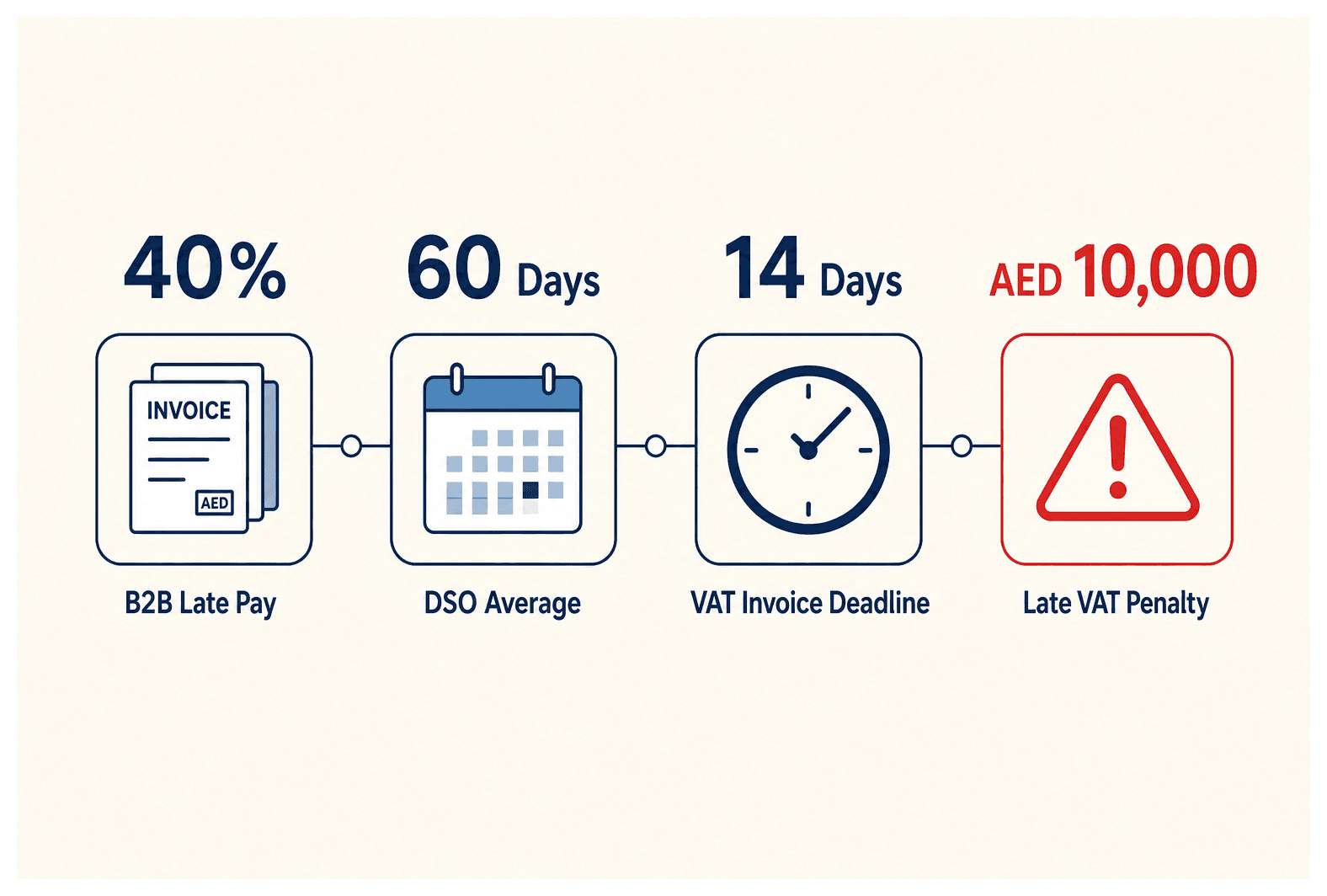
UAE VAT law requires a tax invoice to be issued within 14 days of the date of supply. The invoice must show the supplier's TRN, a sequential invoice number, supply date, net amount, VAT rate, and VAT amount in AED. Non-compliant invoices cannot support a VAT input tax claim and expose the issuer to FTA penalties.
Mandatory Fields on a UAE Tax Invoice
A software firm at Dubai South issuing a tax invoice for AED 25,000 must use a full tax invoice with all mandatory fields, a simplified version is non-compliant at that value. Here's the complete checklist (Federal Tax Authority, 2026):
Supplier's TRN, mandatory for all VAT-registered businesses.
Sequential invoice number unique to your records.
Date of supply and date of invoice, both required; they can differ.
Description of goods or services, unit price, quantity, net amount.
VAT rate (5% standard or 0% zero-rated) and VAT amount in AED.
Full tax invoice required for supplies over AED 10,000; simplified invoices are acceptable for B2C transactions below that threshold.
How Payment Terms Interact With VAT Timing
VAT becomes due at the earlier of: date of supply, date of invoice, or date of payment, whichever comes first. So if you offer 90-day payment terms, VAT is still due on your quarterly return based on the invoice date, not when the client pays.
This creates a real cash-flow risk. You may remit VAT to the FTA before you collect from the client. Consider a consultancy that invoices AED 100,000 on 1 March with 90-day terms, VAT of AED 5,000 falls due in the Q1 return filed by 28 April, regardless of whether the client has paid. Factor this into your pricing and bank account opening in UAE planning from day one.
How to Set a Credit Policy That Protects Your UAE Business
A UAE credit policy should define maximum credit limits per client, acceptable payment terms (net 30, net 60, or milestone-based), required documentation before extending credit, and escalation steps for overdue accounts. Written policies aligned with UAE commercial law reduce disputes and give you a clear basis for legal recovery if a client defaults.
Setting Credit Limits and Client Risk Assessment
Before extending credit, request a trade license copy, bank reference, and two supplier references, standard practice for UAE B2B onboarding. Set credit limits as a percentage of your own monthly turnover; the common ceiling is 15–20% of your monthly revenue per single client. For new clients, consider a pro-forma (advance payment) policy for the first two or three orders before granting open-account terms.
Worth flagging: government and semi-government entities in the UAE often pay on 90-day or longer cycles. Price this into contracts with these clients from the outset. A newly licensed trading company at Dubai South, for instance, might cap individual client credit at AED 30,000 for the first 90 days, then review the limit after three on-time payments, a sensible, low-risk approach while you build your receivables track record.
Structuring Payment Terms in Your Service Contracts
State payment terms explicitly in every contract and on every invoice. Don't rely on verbal agreements under UAE commercial law. Common structures include 50% upfront / 50% on delivery, milestone payments for long projects, and net 30 for repeat clients with a solid payment history.
Always include a late payment interest clause. UAE law permits parties to agree a contractual interest rate; without one, the court applies the statutory rate. Specify the currency (AED is standard; USD is widely accepted in free zone B2B contracts), dispute resolution jurisdiction, and governing law. A project-based IT services firm, for example, structures a AED 200,000 contract as 30% on signing, 40% at mid-project milestone, and 30% on go-live acceptance, significantly reducing exposure to end-of-project non-payment. Explore the full range of business activities available at Dubai South to understand which contract structures suit your license type.
UAE Payment Terms: Statutory Rules vs. Recommended Practice
Feature | Statutory Minimum (UAE Law) | Recommended Best Practice |
|---|---|---|
Payment period | 60-day default if contract is silent | Net 30 for new clients; net 60 for established accounts with good history |
Invoice issuance | Within 14 days of supply (FTA rule) | Same day as delivery or project milestone to start the payment clock immediately |
Late payment interest | Statutory court rate applies if no clause agreed | 2–5% above Central Bank base rate, written explicitly into the contract |
Overdue escalation | No statutory escalation timeline | Day 1 call, Day 30 formal written notice, Day 60 legal demand |
Credit limit | No statutory cap per client | Cap at 15–20% of your monthly revenue per single client |
Contract form | Verbal contracts recognised under UAE law | Always written, signed, with authorised signatories named for court enforceability |
Step-by-Step Credit Control Process for UAE Firms
An effective payment terms credit UAE process runs in six steps: onboard the client with a signed contract, issue a compliant VAT invoice within 14 days, send a payment reminder three days before the due date, follow up on day one of overdue, escalate at day 30, and initiate formal recovery at day 60 if unpaid.
Step 1: Client Onboarding and Contract Execution
Collect the client's trade license, Emirates ID or passport copy, and signed terms-of-business before any work begins.
Issue a formal quotation or pro-forma invoice referencing your payment terms, this document becomes part of the contract record.
For contracts above AED 100,000, consider notarisation or at minimum a witnessed signature for enforceability in UAE courts.
Record the client's authorised signatory name, UAE court filings require the correct legal entity name and authorised representative.
Getting this right from the start means you have a clean paper trail if you ever need to use the UAE courts. Don't skip the signatory check, an invoice addressed to the wrong entity name can invalidate a claim.
Step 2: Invoice Issuance, Reminders, and Escalation
Issue the tax invoice on or before the 14-day FTA deadline; date it from the day of supply, not the day you remember to send it.
Automate a payment reminder email three days before the due date, UAE accounting platforms like Zoho Books and QuickBooks MENA both support this natively.
On day one of overdue: a polite phone call or WhatsApp message (widely used in UAE B2B) referencing the invoice number and amount.
At day 30 overdue: a formal written notice on company letterhead citing the contract clause and stating that interest is accruing.
At day 60 overdue: refer to a UAE-licensed debt recovery firm or issue a formal legal demand through a registered advocate.
A Dubai media consultancy that adopted this three-stage escalation, automated email at day minus 3, account manager call at day 1 overdue, director-level letter at day 30, recovered 78% of overdue balances without litigation (illustrative scenario based on practitioner experience). Structure is the difference. Get business support UAE services to help set up your accounting and escalation workflows early.
Step 3: Formal Recovery Options Under UAE Law
UAE courts accept documentary evidence: signed contracts, tax invoices, delivery confirmations, and written communications. The Execution Court can issue a payment order (amr ada') for uncontested debts, a significantly faster route than full civil litigation. Post-dated cheques remain a useful security instrument for high-value contracts because bounced cheques carry criminal liability under the UAE Penal Code.
Free zone companies can file through the DIFC Courts if a DIFC jurisdiction clause is included in the contract, or through the mainland courts depending on the governing law specified. Choose your jurisdiction clause carefully at the contract drafting stage (Central Bank of UAE, 2026).
Managing Overdue Accounts and Late Payment Penalties in the UAE
UAE firms can charge contractual late payment interest if this is specified in the written agreement. Without a clause, the UAE commercial statutory interest rate applies. Persistent late payers should be moved to pro-forma terms or have credit suspended. Formal legal recovery through UAE courts requires documentary evidence of the debt and a prior demand notice.
Contractual vs. Statutory Interest on Late Payments
UAE commercial law allows parties to agree a late payment interest rate in the contract, typically 2–5% per annum above the Central Bank base rate for B2B transactions. If no rate is agreed, the court applies the statutory commercial interest rate, which has historically ranged from 9–12% per annum (verify the current rate with a UAE legal adviser before relying on this figure).
Interest clauses must be explicitly written. A general "late fees apply" statement without a defined rate may not be enforceable. Also worth noting: VAT may apply to interest or penalty amounts considered as consideration for a supply, take FTA guidance on how your specific penalty structure is treated before finalising your contract template (Federal Tax Authority, 2026).
When to Suspend Credit and Protect Your Cash Flow
Define a clear suspension trigger in your credit policy. A common market practice: any invoice more than 45 days overdue automatically places the account on hold. Communicate the suspension in writing, citing the contract clause, this protects you if the client claims you breached the service agreement by stopping work.
A UAE services firm with three clients on 45-plus-day overdue status temporarily suspended new project briefs for those accounts and recovered AED 180,000 within 30 days by making credit reinstatement the incentive. Review your aged debtors report monthly, accounts receivable ageing is a key metric for free zone firms managing VAT cash flow timing.
Payment Terms Credit UAE: Free Zone Considerations for New Founders
Free zone companies in the UAE can contract with mainland and international clients under standard UAE commercial payment terms. Goods sold from a free zone to the UAE mainland are duty-suspended, not duty-exempt, duty becomes payable on entry to the mainland. Payment terms in free zone contracts should specify the point at which title and risk transfer to clarify which party bears the duty cost.
Free Zone vs. Mainland Payment Dynamics
A Dubai South free zone company invoicing a UAE mainland client for services issues a standard VAT tax invoice at 5%, the free zone location does not change the VAT treatment for services. For goods, movement from free zone to mainland triggers customs duty assessment. Free zone goods are duty-suspended while within the zone; duty is not permanently waived, and Dubai South Business Hub (DSBH) is not a designated zone, so no designated-zone customs or VAT benefit applies.
A trading company licensed at Dubai South selling components to a Dubai mainland manufacturer, for example, specifies "DDP mainland warehouse" terms so the seller accounts for duty costs before invoicing the net amount to the buyer. That clarity prevents disputes at delivery. DSBH licenses are issued in one business day, with a first-year all-in cost for a sole founder with one visa from AED 18,350, giving new founders a fast, affordable base from which to build their payment infrastructure. Use the business setup cost in Dubai calculator to model your first-year budget before you commit.
Opening a UAE Bank Account to Receive Payments Efficiently
A UAE corporate bank account is essential for enforcing payment terms credit UAE rules. Clients paying by telegraphic transfer (TT) or UAEFTS need a valid IBAN. Most UAE banks process same-day transfers through UAEFTS, the domestic interbank payment system operated by the Central Bank of UAE. Choose a bank that supports multi-currency accounts if you invoice in USD or EUR, this avoids forced conversion at unfavourable rates.
Bank account opening for a new free zone company typically takes 2–6 weeks.
Factor this into your timeline before offering credit terms to clients.
Confirm the bank accepts your free zone license type before applying.
Ensure UAEFTS same-day settlement is available for your account tier.
Is a free zone license enough to open a UAE corporate bank account?
Yes. A valid free zone trade license, along with your trade license copy, passport, and company documents, is sufficient to apply for a UAE corporate bank account. Most major UAE banks accept free zone company applications. The account opening process typically takes 2–6 weeks depending on the bank's due diligence requirements.
Common Mistakes UAE Founders Make With Payment Terms
The most common payment terms credit UAE mistakes are: issuing invoices without a TRN, failing to state payment terms in writing, offering open-account credit before signing a contract, ignoring the VAT timing mismatch between invoice date and collection date, and not including a late payment interest clause, each of which costs founders time
References
Frequently Asked Questions