Topic Summary
Choose the Right Free Zone From the Start
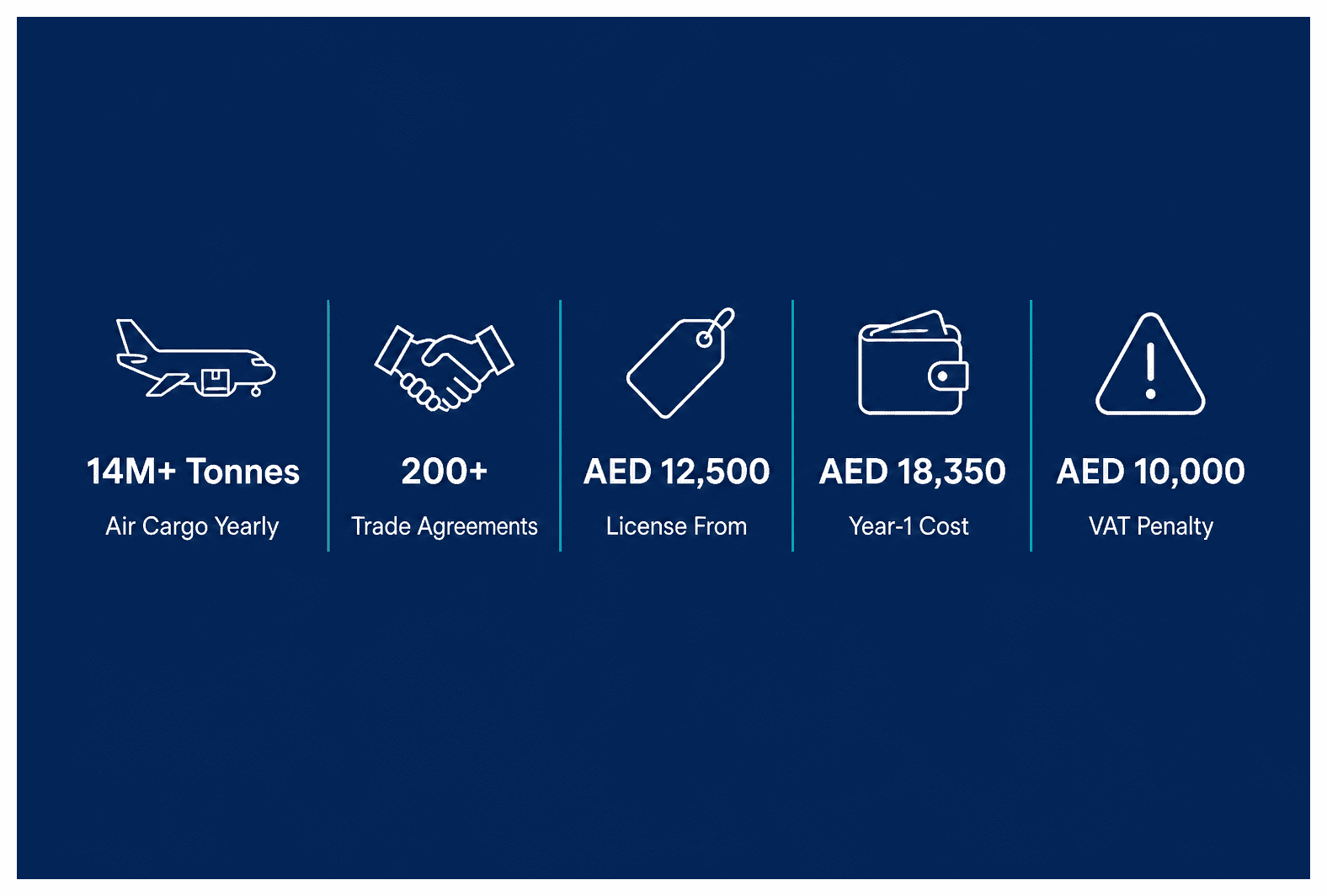
Dubai South Business Hub Free Zone offers trading licenses from AED 12,500, with first-year costs for a sole founder starting at AED 18,350. Selecting the correct zone early prevents costly restructuring later, since your license must align with the physical operations you actually run.
Match Your License to ISIC Activity Codes
Distribution hubs that buy and resell without physical transformation fall under ISIC Rev.4 Division 46, covering wholesale and commission trade. If you add repacking or light assembly, you may need a secondary manufacturing sub-class alongside your trading license to stay compliant.
Register for VAT Before You Start Trading
The Federal Tax Authority imposes a one-time AED 10,000 penalty for late VAT registration, making early compliance a straightforward cost-saving step. Factor VAT registration into your pre-launch checklist alongside your trade license application.
Leverage Dubai's Geographic and Cargo Advantages
Dubai sits within an eight-hour flight of two-thirds of the world's population and handles over 14 million tonnes of air cargo annually. This combination gives distribution hubs genuine same-day reach across the Middle East, Africa, and South Asia.
Use the UAE's Trade Agreements to Cut Costs
The UAE holds over 200 bilateral trade and investment agreements, and its double-taxation treaties significantly reduce cross-border friction for re-export businesses. A USD-pegged currency and no foreign-exchange controls further simplify dollar-denominated supply contracts and profit repatriation.
Secure Sector-Specific Approvals for Regulated Goods
Distributing pharmaceuticals, food, or other regulated categories requires additional approvals from named authorities beyond a standard trade license. Identifying these requirements before applying prevents delays that commonly stall founders for months.
Model Your True First-Year Cost Before Committing
Many founders underestimate setup costs by focusing only on the license fee and missing regulatory touchpoints, visa costs, and warehouse arrangements. Building a complete first-year cost model upfront, including the AED 18,350 baseline for a sole founder, keeps your launch on schedule and budget.
In 2026, Dubai handles over 14 million tonnes of air cargo annually through its logistics corridor, making it the busiest re-export gateway between Asia, Africa, and Europe (Dubai Airports, 2024). The UAE holds 200+ bilateral trade and investment agreements (UAE Ministry of Economy, 2024). A trading license at Dubai South Business Hub Free Zone starts from AED 12,500. The first-year cost for a sole founder with one visa starts from AED 18,350. Late VAT registration carries a one-time AED 10,000 penalty (Federal Tax Authority, 2026). Yet a significant share of founders planning a regional distribution hub in Dubai still spend months on setup because they underestimate the licensing sequence, the regulatory touchpoints, and the true first-year cost.
This guide covers the requirements, the cost, and the exact steps to launch a compliant regional distribution hub in Dubai, so you can move product, not paperwork.
What Is a Regional Distribution Hub in Dubai and Why It Matters
A regional distribution hub in Dubai is a licensed trading operation that receives goods from suppliers, holds inventory, and redistributes product across the Middle East, Africa, and South Asia. It combines a UAE trade license, physical or third-party warehouse space, and import-export permissions into a single, compliant commercial structure.
The Commercial Case for Dubai as a Distribution Base
Dubai sits within an eight-hour flight of two-thirds of the world's population, giving distributors same-day reach to markets across three continents. That geographic reality, combined with over 14 million tonnes of annual air cargo capacity at Dubai airports, makes the emirate a genuine transshipment centre rather than simply a regional office location.
Founders consistently cite four operational advantages that competing jurisdictions can't easily match:
The UAE's 200+ double-taxation treaties reduce cross-border friction for re-export businesses significantly
A USD-pegged currency removes foreign-exchange risk on dollar-denominated supply contracts
No foreign-exchange controls mean you can repatriate profits freely
Predictable, codified regulation gives founders a stable planning horizon
Consider a practical example: a European medical-device brand routes finished goods from its German factory through a Dubai distribution entity to serve hospital procurement departments in Saudi Arabia, Kenya, and Pakistan, cutting lead times from six weeks to ten days. The licensing structure makes that model compliant; the geography makes it fast.
How Distribution Activities Are Classified Under ISIC
Understanding how your activities are classified matters before you apply for any license. ISIC Rev.4 places wholesale trade and commission trade (except motor vehicles) under Division 46, Section G, Wholesale and Retail Trade (UN Statistics Division, 2008, still accurate as of 2026). A distribution hub that buys and resells without physical transformation falls squarely in this division.
Things get more nuanced if you perform light assembly or repacking. A founder importing electronics components and repackaging them for retail sale under a private label would need to confirm whether the repacking step triggers a secondary manufacturing sub-class alongside the wholesale trading activity. Dubai South Business Hub Free Zone aligns its business activities in Dubai to ISIC-derived categories, so the activities listed on your license must match the physical operations you actually intend to run. Misclassification, licensing a trading activity but performing a regulated logistics activity, is a compliance risk that can surface during customs audits or license renewals.
Regional Distribution Dubai Requirements: Licensing and Structure
To operate a regional distribution hub in Dubai you need a valid UAE trade license covering your distribution activities, a registered office address, and, for regulated goods such as pharmaceuticals or food, sector-specific approval from the named regulator. The license category, activity list, and legal structure must be confirmed before you apply.
Choosing the Right License Type and Legal Structure
A free zone license through Dubai South Business Hub Free Zone (launched September 2025) suits founders who want 100% foreign ownership, a fast digital setup, and the ability to trade internationally. Here's what you need to know about the fee structure before submitting:
B2B trading license Dubai: from AED 12,500
B2C trading license: from AED 12,500
Zero paid-up share capital required, no frozen bank deposit at incorporation
Each activity beyond the first five costs AED 2,000, confirm your full list before submitting
100% foreign ownership is available here and on the UAE mainland; it is not exclusive to free zones
A sole founder distributing industrial spare parts internationally would select a free zone trading license, list wholesale of machinery parts as the primary activity, and add re-export as a secondary activity within the same application.
Activity Selection for a Distribution Business
Your license activity list defines what you can legally buy, hold, and sell. Overly narrow activity descriptions create operational gaps that only surface when you're mid-shipment. Common activities for a regional distribution hub include general trading, wholesale of specific product categories, import and export, and re-export. Review the full business activities in Dubai list at Dubai South Business Hub before finalising your application.
For regulated goods, food, pharma, medical devices, chemicals, the structure is always two-part. Dubai South Business Hub Free Zone issues the commercial license, and the named regulator grants separate product or activity approval. For medical devices, that's the Dubai Health Authority (DHA). A founder distributing nutritional supplements needs a trading license from Dubai South Business Hub Free Zone AND a product registration from the relevant health authority before the first shipment clears customs. Both approvals are required; one does not substitute for the other.
Office Address and Warehouse Arrangements
A free zone license requires a registered address within the zone. Dubai South Business Hub provides a flexi-desk or office address as part of the license package, which satisfies this requirement for most distribution models.
Physical warehousing is arranged separately with a third-party logistics provider or a bonded warehouse operator. Dubai South Business Hub does not provide bonded warehousing or customs integration. A fashion accessories distributor, for example, uses a flexi-desk address at Dubai South Business Hub for its license and contracts a third-party logistics operator near Al Maktoum International Airport for ambient storage and outbound shipping. Worth flagging: goods stored in a UAE free zone are duty-suspended, not duty-exempt, while they remain in the zone. Duty becomes payable on entry into the UAE mainland customs territory. Founders distributing exclusively to overseas markets can operate with a minimal local footprint under this model.
Regional Distribution Dubai Requirements: Compliance and Tax Obligations
A regional distribution hub in Dubai must register for UAE VAT once taxable supplies exceed AED 375,000 annually. Corporate tax applies at 9% on taxable income above AED 375,000. Late VAT registration and late corporate tax registration each carry a one-time AED 10,000 penalty. Customs documentation and import permits are managed separately from the trade license.
VAT Registration and Ongoing Obligations
The mandatory VAT registration threshold is AED 375,000 in taxable turnover over any 12-month period. A distributor shipping AED 500,000 of goods in its first year must register for VAT before crossing the threshold, not after, to avoid the AED 10,000 one-time flat penalty (Federal Tax Authority, 2026).
Distribution businesses trading across borders also need to understand zero-rating rules for exports and place-of-supply rules for imported services. Maintaining accurate import and export documentation is essential for reclaiming input tax paid at the border, poor record-keeping is one of the most common causes of rejected VAT refund claims in distribution businesses.
Corporate Tax Considerations for Distribution Entities
UAE corporate tax at 9% applies to taxable income above AED 375,000 for financial years starting on or after 1 June 2023. A late corporate tax registration carries a one-time AED 10,000 flat penalty, not a monthly charge. The UAE tax environment is not tax-free; the 0% rate applies only to income at or below the AED 375,000 threshold.
Qualifying Free Zone Person (QFZP) status allows a 0% rate on qualifying income, but four conditions must be met simultaneously: deriving qualifying income, maintaining adequate substance in the free zone, not electing to be subject to the standard rate, and meeting the de minimis threshold for non-qualifying revenue. A free zone distribution company earning AED 2 million annually from overseas buyers may qualify for the 0% rate on that income if all four QFZP conditions are satisfied, but income from UAE mainland sales is taxed at 9%. QFZP status is not automatic; it requires assessment by a qualified accountant.
Does a free zone distribution company pay corporate tax in the UAE?
Yes. UAE corporate tax at 9% applies to taxable income above AED 375,000 for all entities, including free zone companies. A Qualifying Free Zone Person may apply a 0% rate to qualifying income only if all four QFZP conditions are met simultaneously. Income from UAE mainland sales is always taxed at 9%.
Employment and Visa Compliance
Every employee hired under a free zone license requires a UAE residence visa. Visas are always an additional cost and are never included in the base license fee. A sole founder with one visa can expect a first-year total cost from AED 18,350 at Dubai South Business Hub, this covers the license and one visa package.
Free zone employees fall under free zone authority rules, but federal labour law principles apply. MoHRE governs employment contracts, end-of-service entitlements, and Emiratisation obligations for mainland entities. A founder hiring two sales staff in the first year adds two visa packages on top of the AED 18,350 base; each visa is priced separately and should be budgeted before committing to headcount.
Step-by-Step Guide to Setting Up Your Regional Distribution Hub in Dubai
Setting up a regional distribution hub in Dubai takes as little as one day for license issuance at Dubai South Business Hub Free Zone. The process runs in sequence: reserve a trade name, select activities, submit incorporation documents, receive the license, then apply for visas and open a corporate bank account.
Regional Distribution Hub in Dubai: Key Cost and Timeline Figures
Item | Detail |
|---|---|
B2B trade license fee | From AED 12,500 |
B2C trade license fee | From AED 12,500 |
First-year cost (sole founder, one visa) | From AED 18,350, visa always an additional cost, never bundled |
Additional activity (beyond first five) | AED 2,000 per activity, confirm full list before submitting |
Paid-up share capital required | AED 0, no bank deposit certificate needed at incorporation |
License issuance time | 1 business day once documents are complete |
VAT registration threshold | AED 375,000 in taxable turnover over any 12-month period |
Step 1: Reserve Your Trade Name and Confirm Activities
Check your trade name availability through Dubai South Business Hub's online portal before committing to any branding or domain registration.
Trade names must not conflict with existing registered names, must not include offensive or religious terms, and must reflect the business activity.
Confirm your complete activity list at this stage, adding activities post-incorporation costs AED 2,000 per activity beyond the first five.
If your goods fall into a regulated category, identify the named regulator at this step so you can plan the parallel approval timeline alongside the license application.
Step 2: Submit Incorporation Documents and Pay License Fee
Standard documents: passport copy of each shareholder, proof of residential address (utility bill or bank statement), and completed application form.
No notarised Memorandum of Association is required for most free zone structures at Dubai South Business Hub.
Zero paid-up share capital means no bank deposit certificate is needed at the incorporation stage.
License fee from AED 12,500; the license can be issued in one business day once documents are complete.
The license is issued digitally, a founder based in Germany can submit a scanned passport copy and a recent bank statement via the online portal on a Monday morning and receive the digital license the same day.
Step 3: Apply for Visas, Open a Bank Account, and Arrange Logistics
Residence visa applications follow license issuance. The visa is always a separate, additional cost and is never bundled into the license fee, apply through residency services at Dubai South Business Hub.
A UAE investor visa requires an entry permit, medical fitness test, Emirates ID registration (ICP, 2026).
Corporate bank account opening requires the trade license, shareholder documents, and a clear description of business activities and expected transaction volumes; allow four to six weeks for bank due diligence, open a bank account in UAE with support from the Dubai South Business Hub team.
Arrange third-party warehousing and a freight forwarder before your first shipment. Dubai South Business Hub does not provide bonded warehousing or customs integration.
Register for VAT with the Federal Tax Authority before your taxable supplies approach the AED 375,000 threshold (tax.gov.ae).
Cost Breakdown for a Regional Distribution Hub in Dubai
A sole founder setting up a regional distribution hub in Dubai through Dubai South Business Hub Free Zone can expect a first-year cost from AED 18,350, covering the license and one visa. The license starts from AED 12,500. Activities beyond the first five cost AED 2,000 each. Visas, warehousing, and bank charges are additional.
License and Government Fees
B2B trading license: from AED 12,500
B2C trading license: from AED 12,500
Each activity beyond the first five: AED 2,000 per activity
Zero paid-up share capital required, no capital deposit fee
A founder listing seven distribution activities pays the base license fee plus AED 4,000 for the two additional activities (activities six and seven at AED 2,000 each). Use the business setup cost in Dubai calculator to model your specific activity count and visa requirements before committing.
Visa and Operational Costs
The AED 18,350 first-year figure covers a sole founder with exactly one visa. Additional visas add to this total and should be budgeted per person before committing to headcount. Operational costs to plan separately include third-party warehousing and logistics, freight forwarding fees, corporate bank account charges, and any regulated-goods approvals from the named regulator.
VAT registration and ongoing compliance, quarterly returns, bookkeeping, are recurring costs. Corporate tax registration and any QFZP assessment by a qualified accountant are additional professional fees. A realistic first-year budget for a two-person distribution startup includes the AED 18,350 base, a second visa package, an accountant retainer for VAT returns, and a monthly third-party logistics fee. Founders should model AED 35,000 to AED 50,000 total depending on activity scope and product category.
Key Benefits of a Regional Distribution Hub in Dubai for Founders
A regional distribution hub in Dubai gives founders 100% foreign ownership, access to a re-export corridor spanning 150+ countries, a USD-pegged currency, and a licensing process that can complete in one day. The UAE's treaty network and logistics infrastructure make it one of the most operationally efficient distribution bases globally.
Ownership, Speed, and Operational Flexibility
100% foreign ownership is available at Dubai South Business Hub Free Zone and on the UAE mainland, it is not a free-zone-exclusive benefit.
License issuance in one day removes the weeks-long waiting period common in other jurisdictions.
Zero paid-up share capital means founders can allocate startup funds to inventory and logistics rather than a frozen bank deposit.
The free zone structure allows founders to invoice international clients in any currency without foreign-exchange restrictions.
A South Asian founder building a regional distribution business for consumer electronics can start a business fully online, receive a digital license the same day, and begin contracting with suppliers before physically relocating to Dubai.
Strategic Location and Trade Infrastructure
Dubai sits at the intersection of major east-west and north-south shipping lanes, with Al Maktoum International Airport positioned as a dedicated cargo hub. The UAE's 200+ bilateral trade and investment agreements reduce tariff friction for re-export to GCC, African, and South Asian markets (UAE Ministry of Economy, 2024).
Goods held in a UAE free zone are duty-suspended, not duty-exempt, while destined for re-export, improving working-capital efficiency for distribution businesses. DP World operates major port infrastructure adjacent to the Dubai South ecosystem, supporting sea-freight distribution alongside air-freight options. A European industrial-components brand routes product through a Dubai distribution entity to serve procurement teams in Saudi Arabia, Egypt, and India, consolidating three regional supply chains into one licensed UAE hub (Dubai Trade, 2024).
Is a regional distribution hub in Dubai worth it for a first-time founder?
Yes, for founders targeting GCC, African, or South Asian markets. The combination of one-day license issuance, zero paid-up share capital, duty-suspended re-export, and 200+ bilateral trade agreements creates a cost and speed advantage that few alternative jurisdictions can match at this price point.
References
Frequently Asked Questions