
Topic Summary
Choose the Right Business Activity Codes
SaaS falls under ISIC Section J and maps to codes like 'Software as a Service,' 'Computer Programming,' and 'Cloud Computing Services.' Selecting the wrong codes at incorporation can block payment gateway approvals and trigger costly amendments of AED 2,000 per activity.
Free Zone Beats Mainland for Most SaaS Founders
Both structures now allow 100% foreign ownership, but free zones offer faster setup, lower costs, and no heavy office rental obligations. Founders targeting international or online markets will rarely need a mainland license.
Get Licensed in a Single Business Day
Dubai South Business Hub Free Zone, launched in September 2025, processes the entire application through one touchpoint and can issue a license within one business day. The base B2B ICT license starts at AED 12,500.
Zero Paid-Up Share Capital Required
Free zone SaaS entities at Dubai South Business Hub carry no minimum share capital requirement, lowering the financial barrier for early-stage founders. A sole founder with one investor visa can expect a first-year all-in cost from AED 18,350.
A Flexi-Desk Satisfies Your Office Requirement
A registered flexi-desk address qualifies as the required office space for a free zone SaaS license, keeping overhead low. This makes the setup model practical for remote-first or bootstrapped software businesses.
Keep Your Document List Short and Ready
The core requirements are a valid passport, proof of address, a trade name, at least one ICT business activity, a registered office address, and a corporate bank account. Having these prepared in advance prevents delays in what is already a fast process.
Plan Your Activity Scope Before You Apply
Each business activity beyond the first five costs AED 2,000 to add later, so mapping your full revenue model upfront saves money. For example, pairing 'Software as a Service' with 'IT Consultancy' covers both subscription and implementation fees under one license.
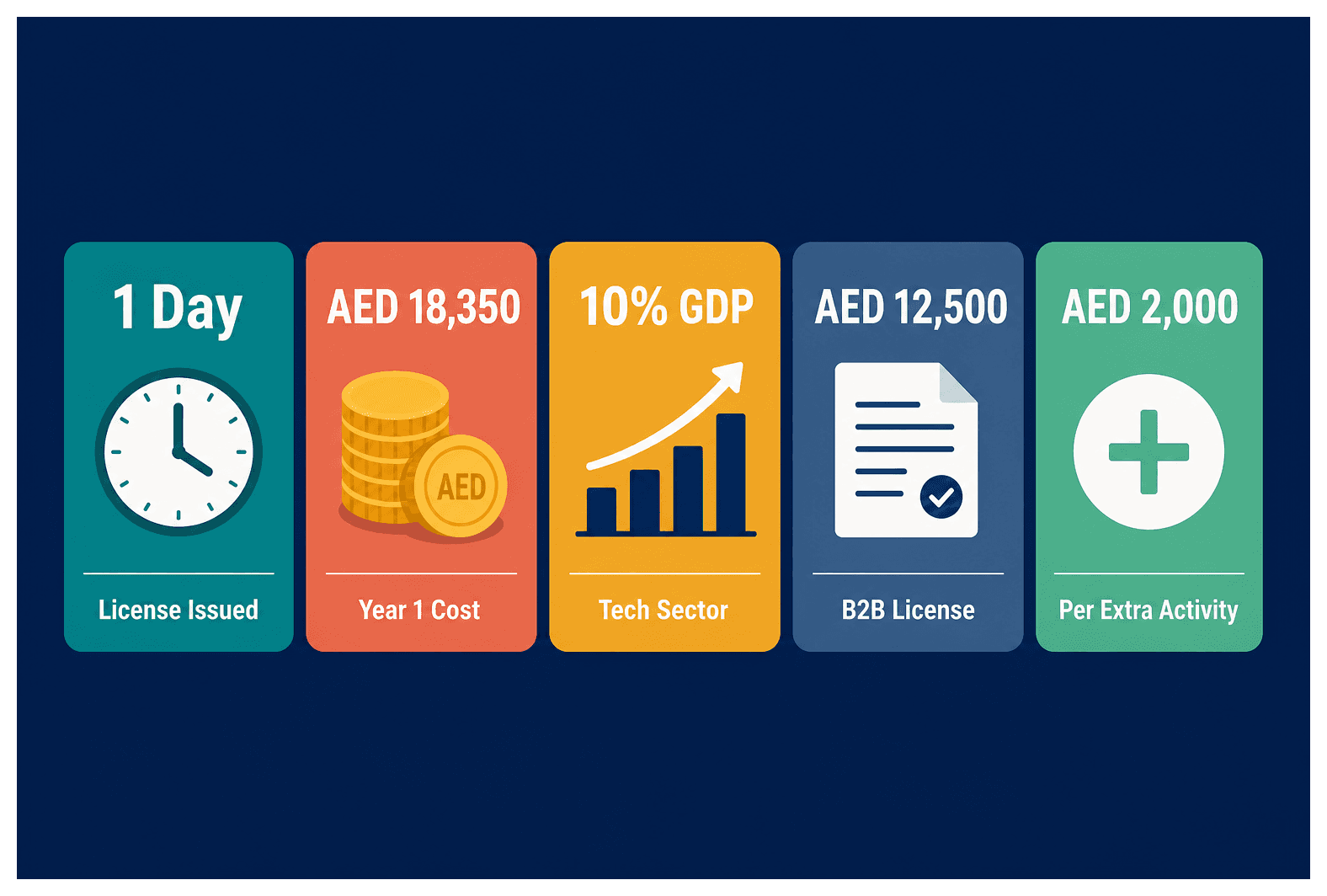
In 2026, Dubai's technology sector accounts for more than 10% of the emirate's GDP, with cloud software adoption growing at double digits year-on-year across the GCC (u.ae, 2026). A SaaS company setup in Dubai can be completed with a license issued in a single day [1], zero paid-up share capital [2], and a first-year all-in cost from AED 18,350 for a sole founder with one investor visa [3]. The base B2B license starts at AED 12,500 [4] five costs AED 2,000 [6]. Dubai South Business Hub Free Zone, launched September 2025, processes the entire sequence through one touchpoint [7].
This guide covers the exact requirements, realistic costs, and a clear process for getting your SaaS business licensed, officed, and banked in Dubai so you can start selling to clients without delay.
What Is SaaS Company Setup in Dubai and Why It Matters
A SaaS company setup in Dubai is the process of obtaining a free zone or mainlandtrade license that authorizes cloud-based software distribution and subscription services in the UAE and internationally. It covers legal structure, office space, and a corporate bank account, and can be completed in as little as one business day.
How the UAE Classifies SaaS as a Business Activity
SaaS falls under ISIC Section J (Information and Communication), the internationally recognized classification for all ICT-related economic activities. In practice, the Department of Economy and Tourism (DET) and free zone authorities map SaaS to activity codes including "Software as a Service," "Computer Programming," and "Cloud Computing Services."
Getting these codes right at incorporation matters more than most founders realize. A misclassified activity can block payment gateway approvals and force a costly amendment later. At Dubai South Business Hub, each activity amendment beyond the first five costs AED 2,000 per activity, so planning your full scope upfront is worth the extra hour of thought.
A founder selling a project-management SaaS to SMEs across the GCC, for example, would select "Software as a Service (SaaS)" as the primary activity and "IT Consultancy" as a secondary activity, covering both subscription revenue and onboarding or implementation fees under the same license. You can browse the full list of business activities in Dubai before you apply.
Free Zone vs. Mainland: Which Structure Suits a SaaS Founder
Both free zone and mainland structures now offer 100% foreign ownership under UAE Commercial Companies Law reforms, so ownership alone shouldn't drive your decision. The real differentiators are cost, speed, and your target market.
Mainland setup requires DET approval and typically carries higher office rental obligations. Free zone setup is faster, lower cost, and well-suited to a founder whose primary market is outside the UAE or who operates entirely online. A European founder building a B2B analytics SaaS targeting Saudi and Egyptian enterprises, for instance, has no practical need for a mainland presence and will save significantly on setup costs by choosing a free zone.
Free zone entities can sell SaaS digitally to UAE clients in many service categories without a local distributor, since the product is delivered over the internet rather than physically imported. An ICT license in Dubai from Dubai South Business Hub starts at AED 12,500 for B2B and is issued in one business day.
SaaS Company Dubai Requirements: License, Office and Eligibility
To meet SaaS company Dubai requirements you need a valid passport, proof of address, a chosen trade name, at least one ICT-related business activity, a registered office address (flexi-desk qualifies), and a bank account opened in the company's name. No minimum share capital is required for a free zone SaaS entity at Dubai South Business Hub.
Document Checklist for a SaaS License Application
The document list is short. Here's what you'll need:
Passport copy (all pages) for each shareholder and director
Recent utility bill or bank statement as proof of residential address, dated within three months
Proposed trade name, check your trade name availability before submitting to avoid rejection delays
Business plan summary (not mandatory at Dubai South Business Hub, but strongly recommended for bank account opening)
No notarized documents required at application stage for most SaaS structures
Zero paid-up share capital required
A sole founder from Germany, for example, can submit a scanned passport and a German bank statement dated within 90 days and receive a license within one business day. The process is genuinely that straightforward at this stage.
Office Requirements: What a SaaS Company Actually Needs
You don't need a dedicated office room. A flexi-desk or smart-desk arrangement satisfies the registered office requirement for a free zone SaaS license. Dubai South Business Hub includes a registered address as part of the license package, so there's no separate lease to negotiate at launch.
Physical office space becomes relevant only if you plan to sponsor a larger number of employee visas or run regulated operations that require an on-site inspection. For most SaaS founders, the flexi-desk arrangement is perfectly adequate.
Registered address appears on your license and trade certificate
Used for all official correspondence, including bank account opening
Physical office needed only for higher visa quotas or regulated inspections
A two-person SaaS startup can operate remotely from anywhere in the world while maintaining a valid flexi-desk address at Dubai South Business Hub for licensing and banking purposes. That's a genuinely useful setup for distributed founding teams.
Step-by-Step Guide to SaaS Company Setup in Dubai
Setting up a SaaS company in Dubai takes five key steps: choose your business activities and legal structure, reserve your trade name, submit your license application with documents, receive your license and establishment card, then open a corporate bank account. The full process from name reservation to a live bank account typically takes one to three weeks.
SaaS Company Setup Dubai: Cost and Timeline at a Glance
Item | Detail |
|---|---|
B2B License Fee | From AED 12,500, covers up to 5 activities, registered address, and establishment card |
B2C License Fee | From AED 12,500, same inclusions as B2B tier |
First-Year Total (sole founder, one visa) | From AED 18,350, visa is always an additional cost, never included in the license fee |
Extra Activity Beyond First Five | AED 2,000 per activity, plan your full activity list before submitting to avoid amendment fees |
Paid-Up Share Capital | AED 0 required, no capital deposit needed to incorporate |
License Issuance Timeline | 1 business day from a complete and approved application |
Step 1: Choose Your Activities and Structure
Select your primary activity (e.g., Software as a Service) and up to four secondary activities, all five are included in the base license fee.
Each activity beyond the first five costs AED 2,000. Map your full revenue model before submitting so you don't pay amendment fees six months later.
Choose between a sole establishment (one shareholder) or a free zone company (FZC) with multiple shareholders. Both carry zero paid-up share capital at Dubai South Business Hub.
A founder building a SaaS HR platform, for example, might select: Software as a Service, IT Consultancy, Data Processing, E-commerce, and Digital Marketing, all within the first five activities and all covered by the base license fee.
Step 2: Reserve Your Trade Name and Submit Your Application
Search name availability before paying any fees. Names that conflict with existing registrations are rejected without a refund, and resubmitting with a revised name adds two to three days of delay.
Submit your passport copy, proof of address, selected activities, and preferred legal structure to Dubai South Business Hub.
A complete and approved application produces a license within one business day. Dubai South Business Hub launched in September 2025 and has built its process specifically around this speed.
Step 3: Arrange Your Visa and Open Your Bank Account
Visas are always an additional cost on top of the license fee. A sole founder with one investor visa brings the first-year total to AED 18,350. Apply for your UAE residency visa through Dubai South Business Hub's residency services after receiving your license and establishment card.
Bank account opening requires your trade license, establishment card, passport, Emirates ID (once issued), and a business plan summary. Most UAE banks take two to four weeks to complete due diligence on technology businesses.
Consider a digital-first UAE bank for faster interim access while your primary corporate account is being reviewed.
A sole founder who receives their license on Day 1 can submit their visa application on Day 2 and typically holds an Emirates ID within two to three weeks, which gives them full bank account access.
SaaS Company Setup Dubai: Cost Breakdown for 2026
A SaaS company setup in Dubai costs from AED 12,500 for a B2B license at Dubai South Business Hub. A sole founder adding one investor visa reaches a first-year total from AED 18,350. Each business activity beyond the first five adds AED 2,000. Zero paid-up share capital is required.
License Fees and What They Cover
The B2B SaaS license starts at AED 12,500 at Dubai South Business Hub. Both include up to five business activities, a registered address, and the establishment card. There are no hidden renewal surcharges on these published rates.
A founder launching a B2B project-management SaaS with five activities pays AED 12,500 for the license. Adding a sixth activity such as mobile app development adds AED 2,000, bringing the license cost to AED 14,500. The lesson: map your full activity scope before you submit. You can use the business setup cost calculator to model different activity combinations before committing.
Visa and Total First-Year Cost
Visas are always an additional cost and are never included in the license fee. A sole founder with one investor visa brings the total first-year cost to AED 18,350. Each additional employee or dependent visa adds to this figure, so budget separately for each visa holder from the start.
Sole founder, one investor visa: from AED 18,350 in year one
Co-founder partnership with two investor visas: higher total, use the calculator to confirm
Zero paid-up share capital required at any tier
A solo SaaS founder relocating to Dubai with no staff pays AED 18,350 in year one. That's a genuinely accessible entry point for a globally distributed software business.
Corporate Tax and VAT Obligations for a SaaS Company in Dubai
A SaaS company in Dubai is subject to UAE corporate tax at 9% on taxable income above AED 375,000. Free zone entities may qualify for a 0% rate under the Qualifying Free Zone Person (QFZP) rules, but four specific conditions must all be met. VAT registration is mandatory once taxable turnover exceeds AED 375,000.
Qualifying Free Zone Person: The Four Conditions
The 0% corporate tax rate is not automatic for free zone entities. To qualify as a QFZP, your company must satisfy all four of the following conditions (Federal Tax Authority, 2023):
Maintain adequate substance in the UAE (staff, premises, decision-making)
Derive income only from qualifying activities as defined under the Corporate Tax Law
Not elect to be subject to the standard 9% corporate tax rate
Meet the de minimis threshold for non-qualifying revenue
SaaS subscription revenue from overseas clients is generally treated as a qualifying activity. Revenue from UAE-resident clients requires careful review with a qualified tax adviser. A free zone SaaS company earning 95% of revenue from clients in Europe and Asia, with a staffed UAE office and no mainland sales, is likely to satisfy all four conditions, but always get written confirmation from a registered tax agent before filing.
Worth flagging: late registration for corporate tax carries a one-time flat penalty of AED 10,000. It is not a monthly charge, but it's entirely avoidable if you register on time.
VAT Registration and SaaS Revenue
UAE VAT is 5% and applies to taxable supplies made in the UAE. SaaS services supplied to overseas clients are typically zero-rated, which significantly reduces your effective VAT burden in the early stages of a globally focused business.
VAT registration is mandatory once your taxable turnover exceeds AED 375,000 in any 12-month period. A SaaS startup billing AED 30,000 per month to UAE clients reaches that threshold in approximately 13 months and must register before that point. Late VAT registration carries a penalty of AED 10,000, register proactively once you approach the threshold, not after you've crossed it.
Is a free zone SaaS company automatically exempt from UAE VAT?
No. Dubai South Business Hub is not a designated zone and carries no designated-zone VAT benefit. Free zone goods are duty-suspended, not duty-exempt. For a pure SaaS business with no physical goods, these distinctions rarely affect day-to-day operations, but you must still register for VAT once you exceed the AED 375,000 threshold.
Banking for a SaaS Company in Dubai: What Founders Need to Know
Opening a corporate bank account for a SaaS company in Dubai requires your trade license, establishment card, Emirates ID, passport, and a business plan. UAE banks conduct thorough due diligence on technology businesses; the process typically takes two to four weeks. Digital-first banks can provide faster interim access while your primary account is reviewed.
Documents Banks Require from a SaaS Entity
Trade license and establishment card (issued by Dubai South Business Hub)
Passport and Emirates ID for all shareholders and signatories
A business plan or pitch deck describing your SaaS product, target market, and projected revenue
Sample client contracts or a description of your subscription model, this helps compliance teams classify your revenue accurately
Six-month personal bank statement from your home country (some banks require this as a source-of-funds reference)
A UK-based founder setting up a SaaS payroll platform for GCC SMEs prepared a two-page business plan with ARR projections and a sample SaaS subscription agreement. The bank approved the corporate account within 12 business days. Preparation is the variable you can control.
Choosing the Right Banking Setup for a SaaS Business
Traditional UAE banks offer multi-currency accounts, letters of credit, and established payment gateway integrations, useful once your SaaS reaches meaningful monthly recurring revenue. Digital-first UAE business accounts open faster and handle international transfers at lower fees, making them a practical bridge while your primary account is processed.
Link your banking to a UAE payment gateway early in the process. Gateway providers require a UAE trade license and corporate bank account before activation. A SaaS founder integrated Stripe UAE within three weeks of receiving their license, enabling subscription billing from Day 1 of commercial launch. All UAE banks operate under the supervision of the Central Bank of the UAE, confirm your chosen bank is licensed before depositing company funds.
Dubai South Business Hub's Beyond Hub service includes banking and taxation advisory to guide founders through bank selection and documentation preparation, which reduces rejection rates on first submission.
Regulated Activities Within a SaaS Company Setup in Dubai
Some SaaS products require regulatory approval beyond the trade license. Fintech SaaS needs Central Bank of UAE authorization; health-tech SaaS requires Dubai Health Authority or MOH approval; edtech platforms may require KHDA registration. Dubai South Business Hub licenses the activity, but the named regulator must approve it separately before you can operate commercially.
Fintech, Healthtech and Edtech SaaS: Dual Approval Explained
Fintech SaaS (payment processing, lending platforms, investment tools): Dubai South Business Hub licenses the activity. The Central Bank of UAE or DFSA must grant a separate financial services authorization before you accept customer funds or provide regulated financial services.
Healthtech SaaS (telemedicine, EHR systems, diagnostic tools): Dubai South Business Hub licenses the activity. The Dubai Health Authority (DHA) or Ministry of Health and Prevention (MOHAP) must approve the platform separately.
Edtech SaaS (online learning platforms, credentialing tools):
References
Frequently Asked Questions