
Topic Summary
Wrong License Costs You Weeks to Fix
A significant share of first-time Dubai founders choose the wrong license type in their first month, triggering weeks of corrections. Picking between a service and trading license upfront is a legal and operational decision, not an administrative formality.
Service License Covers Skills, Not Goods
A service license permits you to invoice clients for expertise, outcomes, or deliverables such as consulting, IT support, or marketing — with no physical goods changing hands. Activities fall under ISIC Sections M and N, giving founders a reliable cross-reference when matching their work to the correct license type.
Trading License Governs Physical Product Resale
A trading license authorises importing, exporting, distributing, and reselling physical goods, whether under a general or specific commodity category. Even a general trading license requires named product categories to be listed as approved activities.
Both License Types Start at AED 12,500
At Dubai South Business Hub Free Zone, service and trading licenses both start from AED 12,500, with zero paid-up share capital required and licensing in one working day for eligible activities in one business day. A sole founder with one visa can expect a first-year all-in cost from AED 18,350 for either license type.
Free Zone Trading Has Hidden Customs Costs
Goods in Dubai free zones move under duty suspension, not duty exemption, meaning VAT and customs duty apply the moment products enter the UAE mainland. Founders who need bonded warehousing or customs integration should budget for third-party logistics costs from day one.
Regulated Activities Require Additional Approvals
Certain service activities demand a separate approval from the named sector regulator, beyond the standard license issued by DET for mainland entities or the free zone authority. Founders should identify any sector-specific requirements before submitting their application to avoid delays.
Match Your License to What You Invoice
The clearest decision rule is straightforward: if your invoices are for outcomes and expertise, choose a service license; if your invoices are for physical products, choose a trading license. Getting this right from the start determines what you can legally bill for and how your supply chain must be structured.
In 2026, more than 40,000 new business licenses are expected to be issued across Dubai's free zones and mainland jurisdiction, yet a significant share of first-time founders pick the wrong license type in their first month and spend weeks correcting it. The service license vs Dubai trading license decision is not a formatting choice. It determines what you can legally invoice for, how your supply chain is structured, and how your first-year costs stack up from day one. At Dubai South Business Hub Free Zone (DSBH), both license types start from AED 12,500, require zero paid-up share capital, and are issued in one business day. The first-year all-in cost for a sole founder with one visa starts from AED 18,350. This article gives you a direct, scenario-by-scenario recommendation, built around a single comparison table, so you leave with a decision, not just a summary.
What Is a Service License vs Trading License in Dubai and Why It Matters
A service license in Dubai permits a company to sell skills, expertise, or deliverables to clients without physically handling goods. A trading license authorises the import, export, and resale of physical products. Choosing the wrong type restricts your legal activities and can trigger regulatory penalties before you invoice your first customer.
Defining a Service License in Dubai
A service license in Dubai covers professional, consultancy, technical, creative, and operational activities where the deliverable is a skill or outcome, not a physical product. Think management consulting, IT support, marketing, logistics coordination, and facility management. The license is issued by the relevant authority, DET for mainland entities, the free zone authority for free zone entities, and regulated activities require a separate approval from the named sector regulator.
Service activities fall under ISIC Section M (Professional, Scientific and Technical) and Section N (Administrative and Support Services) in the UN classification framework, which gives you a useful cross-reference when matching your activity to the correct license type.
A practical example: a Dubai-based digital marketing agency that invoices clients for campaign strategy and media buying has no goods changing hands, so a service license is the correct instrument. The agency bills for outcomes, not inventory.
Defining a Trading License in Dubai
A trading license in Dubai authorises the buying and reselling of physical goods, either as a general trading license covering a broad range of products, or as a specific trading license limited to named commodity categories. Activities covered include import, export, re-export, distribution, and local wholesale or retail sale of goods. Trading activities align with ISIC Section G (Wholesale and Retail Trade) under UN Rev.4 classification.
Two points worth flagging for founders considering a free zone trading setup:
Free zone goods move under duty suspension, not duty exemption, VAT and customs duty apply when goods enter the UAE mainland.
DSBH does not provide bonded warehousing or customs integration; founders needing those facilities should factor in third-party logistics costs from the outset.
A founder importing consumer electronics from Asia and reselling to UAE retailers needs a trading license with the specific product categories listed as approved activities, a general trading license still requires those categories to be named.
Service License vs Trading License in Dubai: Side-by-Side Comparison
Feature | Service License | Trading License |
|---|---|---|
License cost at DSBH | From AED 12,500 | From AED 12,500 |
First-year all-in cost (sole founder, one visa) | From AED 18,350 (visa always additional) | From AED 18,350 (visa always additional) |
Activity scope | Approved service activities only; skills, outcomes, deliverables | Import, export, re-export, distribution, wholesale/retail of listed goods |
Goods handling | No physical goods involved | Physical goods bought, stored, and resold |
Warehousing required | None required | Third-party logistics arranged independently; DSBH does not provide bonded warehousing |
Visa eligibility | UAE residency visa sponsorship available; visa cost always additional | UAE residency visa sponsorship available; visa cost always additional |
Paid-up share capital | Zero required | Zero required |
Service License vs Trading License in Dubai: Head-to-Head Comparison
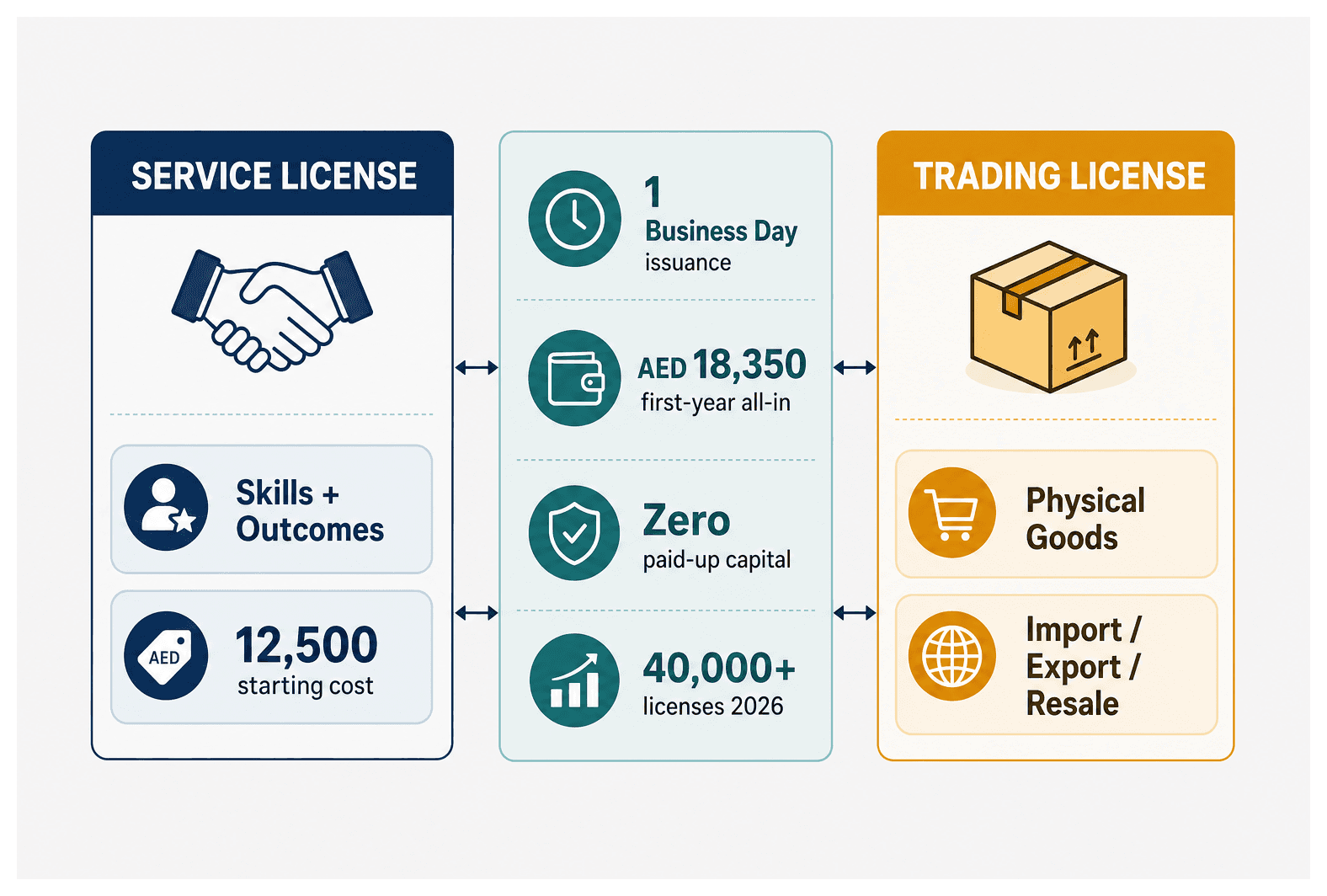
Compared side by side, a service license suits founders selling skills or outcomes with lower setup cost and no inventory risk, while a trading license suits founders handling physical goods with import-export scope. Cost, activity scope, visa impact, and storage requirements differ significantly between the two instruments.
Activity Scope: What Each License Lets You Invoice For
A service license restricts the holder to the specific service activities listed on the license. Adding activities beyond the first five costs AED 2,000 each, regardless of license type. A trading license restricts the holder to the specific goods categories listed, general trading licenses cover a wider range but must still name approved product types.
Neither license permits activities outside its approved scope. Operating outside scope risks license suspension and a DET or free zone authority penalty. Check the full list of business activities at DSBH before you apply.
The mixed-revenue scenario trips up a lot of founders. A founder offering IT consulting and also reselling physical server hardware should verify whether a service license with an equipment supply activity covers both, or whether a separate trading license is needed for the hardware component. Two founders at DSBH pay the same AED 18,350 first-year cost, one runs a management consultancy under a service license, the other runs a consumer goods import business under a trading license. The difference is in what each can legally invoice for, not what they pay.
Corporate Tax and VAT Obligations for Each License Type
Both service and trading license holders in Dubai are subject to UAE corporate tax at 9% on taxable income above AED 375,000. VAT registration is mandatory once taxable supplies exceed AED 375,000 annually. Late registration carries a one-time AED 10,000 penalty for corporate tax and a separate AED 10,000 penalty for VAT (UAE Federal Tax Authority, 2024).
Corporate Tax: What Both License Types Owe
UAE corporate tax applies at 9% on taxable income above AED 375,000 for both service and trading license holders, the license type makes no difference to this calculation. A service license holder generating AED 500,000 net profit pays 9% on AED 125,000 (the amount above the threshold). The same maths applies to a trading license holder at the same profit level.
Worth flagging: free zone entities can potentially qualify for a 0% rate on qualifying income, but only if all four Qualifying Free Zone Person (QFZP) conditions are met. The entity must be a free zone person, derive qualifying income, maintain adequate substance in the UAE, and comply with transfer pricing rules. None of those conditions is automatic. Never assume a free zone license alone delivers a 0% rate.
Late corporate tax registration carries a one-time flat penalty of AED 10,000. It does not accrue monthly, so it is a fixed exposure, but one you want to avoid. Check your obligations via banking and taxation guidance before you start trading.
VAT and Import Duty: Where Trading Licenses Carry Extra Exposure
Both license types must register for VAT once taxable supplies exceed AED 375,000 per year. Late VAT registration also carries an AED 10,000 penalty (UAE Federal Tax Authority, 2024).
Trading license holders face an additional layer that service license holders generally avoid:
Import duty applies when goods move from the free zone into the UAE mainland. Free zone storage suspends duty, it does not eliminate it.
DSBH is not a designated zone, so no designated-zone VAT benefit or customs duty suspension applies at the entity level.
Service license holders have no import duty exposure unless they are also supplying physical goods.
A trading license holder importing furniture into DSBH's free zone and then selling to a Dubai mainland retailer must account for import duty at the point of mainland entry. That cost must be built into the product margin from day one, not discovered at the customs gate.
Five Steps to Choosing the Right License Type Before You Register
Choose the right Dubai license type in five steps: identify your revenue model, list your approved activities, check sector regulator requirements, calculate all-in first-year cost including visas, then confirm your storage and logistics needs. Completing all five before registration prevents costly amendments and delayed operations.
Steps 1 to 3: Revenue Model, Activity List, and Regulator Check
Define your revenue model. Are you invoicing for skills, outcomes, and deliverables (service) or for physical goods (trading)? If both, identify the primary revenue driver first, that determines your license type.
List every activity you plan to invoice for in year one. At DSBH, the first five activities are included in the license; each additional activity costs AED 2,000. Match each activity to the correct license type using the business activities list.
Check whether any activity on your list is regulated. DSBH licenses the activity; the named regulator approves it separately. Both approvals are required before you operate. A founder planning to offer health and wellness coaching must obtain the DSBH service license AND a separate DHA approval, the free zone license alone does not authorise regulated health activity.
Steps 4 and 5: First-Year Cost Calculation and Storage Needs
Calculate your all-in first-year cost. At DSBH, a sole founder with one visa starts from AED 18,350. Visas are always an additional cost, never described as included. Use the DSBH cost calculator to model your specific setup before you commit.
Assess your storage and logistics needs. Service license holders typically need no warehousing. Trading license holders must arrange third-party logistics independently, DSBH does not provide bonded warehousing or customs integration.
A solo IT consultant at DSBH models AED 18,350 all-in for year one, license plus one visa, with no warehousing cost. A trading founder working to the same budget must add third-party storage fees on top of that AED 18,350 base. Once all five steps are complete, you have enough information to confirm your license type and submit your application (UAE Government Portal, 2024).
Regulated Activities: What Both License Types Require Beyond the Free Zone
For regulated activities in Dubai, the free zone issues the commercial license and the named sector regulator issues the operational approval separately. Both are mandatory. Healthcare requires DHA approval, education requires KHDA, financial services require CBUAE or SCA oversight. Operating without both instruments is a regulatory violation.
Service License Holders: Regulated Sectors to Check
If your service activities fall into any of the sectors below, you need two approvals, not one:
Healthcare and wellness: DSBH licenses the activity; DHA approves it separately before any patient-facing operation begins. See the healthcare license in Dubai guide for the full approval chain.
Education and training: DSBH licenses the activity; KHDA approves it separately. A founder offering corporate financial training holds the free zone service license and a separate KHDA approval, both must be current before the first session runs.
Financial advisory or investment services: DSBH licenses the activity; CBUAE or SCA approval is required separately, depending on the specific financial activity.
ICT and technology services: Generally unregulated at the activity level, but UAE data protection requirements may apply. Review the ICT license in Dubai page for sector-specific notes.
Trading License Holders: Restricted and Controlled Goods
Certain goods categories require additional approvals regardless of the trading license. Pharmaceuticals, food products, chemicals, and weapons are all controlled categories. DSBH licenses the trading activity; the relevant product authority approves the specific goods category separately.
A founder planning to trade in nutritional supplements must obtain both the DSBH trading license and a separate MOHAP product registration. The license without the product approval does not authorise sale. For food products, Dubai Municipality is the relevant authority. Never assume a trading license alone clears controlled goods for sale, verify the specific approval chain before listing the activity.
Which License Suits Your Business at Dubai South Business Hub Free Zone
At Dubai South Business Hub Free Zone, a service license suits consultants, agencies, tech founders, and coaches billing for skills. A trading license suits importers, distributors, and product resellers handling physical goods. Both start from AED 12,500 with zero paid-up share capital and a one-business-day issuance timeline.
Scenario A: Choose a Service License If This Describes You
You invoice clients for consulting, advice, creative output, software development, marketing, or any other skill-based deliverable.
You have no plans to import, store, or physically distribute goods in year one.
You want the lowest possible first-year overhead-year all-in cost from AED 18,350 for a sole founder with one visa.
You plan to keep your approved activities to five or fewer, staying within five avoids the AED 2,000-per-activity add-on.
A UK-based management consultant relocating to Dubai, billing three corporate clients for strategic advisory retainers, is a textbook service license candidate. No goods, no warehousing, skills-only revenue. You can apply for a UAE residency visa tied to the company license as an additional cost once the license is issued.
Scenario B: Choose a Trading License If This Describes You
You import physical goods from overseas suppliers and resell to UAE or regional buyers.
Your revenue is driven by product margin, not billable hours or service retainers.
You have arranged or are budgeting for third-party warehousing and logistics, DSBH does not provide bonded warehousing or customs integration.
You understand that goods entering the UAE mainland from the free zone attract import duty at the point of entry, and you have factored this into your pricing model.
Trading licenses at DSBH start from AED 12,500 with the same first-year all-in cost from AED 18,350 for a sole founder with one visa.
An Indian entrepreneur importing eco-friendly packaging materials for resale to Dubai F&B businesses needs a trading license with the specific packaging goods categories listed, and a third-party logistics provider arranged before the first shipment arrives. Both license types support 100% foreign ownership, which is standard across UAE free zones and also available on the mainland.
Is a service license cheaper than a trading license in Dubai?
At DSBH, the base license cost is the same for both types, from AED 12,500. The B2C service license starts from AED 12,500. First-year all-in cost for a sole founder with one visa starts from AED 18,350 for either type. The real cost difference for trading license holders comes from third-party warehousing and import duty, not the license fee itself.
Visa Eligibility and Staffing Implications for Each License Type
Both service and trading licenses in Dubai qualify the license holder to sponsor UAE residency visas for themselves and employees. Visa costs are always additional and are never included in the license price. The number of visas available depends on office space and the free zone's visa allocation policy, not on the license type.
Visa Costs Are Always Additional: What to Budget
Visas are always an additional cost at DSBH, never described as included in either a service or trading license. The first-year all-in figure of AED 18,350 covers a sole founder with one visa. Any additional visas for employees add to this base. Residency visa eligibility is identical for both license types, the license type does not restrict or expand the visa quota available to you. See the full breakdown on the residency services page.
A service license holder sponsoring two staff members and a trading license holder sponsoring two staff members face identical visa cost structures. The license type creates
References
Frequently Asked Questions