Topic Summary
No Relocation Required to Enter UAE Market
Singapore founders can incorporate a UAE free zone entity without leaving Singapore, dissolving their existing company, or blocking capital in a UAE bank account. The UAE entity operates as a fully independent legal person capable of trading, invoicing, and holding its own bank account.
Zero Tax Environment Attracts Singapore Founders
The UAE charges no personal income tax on salaries or dividends drawn from a UAE entity, making it a compelling second base for founder compensation. There is also no withholding tax on dividends flowing between the UAE and Singapore structures.
Four-Hour Time Gap Enables Dual-Region Coverage
With Singapore only four hours ahead of the UAE, a lean team can realistically manage client calls across both APAC and Gulf markets within a single working day. This overlap is a practical operational advantage, not just a geographic convenience.
Free Zone vs. Mainland: Know the Key Difference
A free zone entity can invoice UAE clients and trade internationally, but selling directly to UAE mainland customers at scale typically requires a local distributor or special approvals. A mainland entity licensed by DET faces no such restriction and can trade anywhere in the UAE without intermediaries.
Duty-Suspended Does Not Mean Duty-Exempt
Goods stored in a UAE free zone warehouse are duty-suspended, meaning customs duty only applies once those goods are released into the UAE mainland market. Singapore trading founders holding stock in free zone warehouses should plan for this cost before committing to a distribution model.
Singapore Banking Reputation Eases UAE Account Opening
UAE banks tend to view applicants with Singapore-headquartered parent or holding companies more favorably, given Singapore's strong global regulatory standing. This makes the bank account opening process — often a bottleneck for foreign founders — more straightforward in a dual-entity structure.
One UAE License Opens the Entire GCC Market
A single UAE trade license provides a legal base to service clients across the Gulf Cooperation Council region, which represents a substantial combined consumer and enterprise market. For Singapore SaaS or services founders targeting Gulf enterprise clients, this can justify the setup cost on its own.
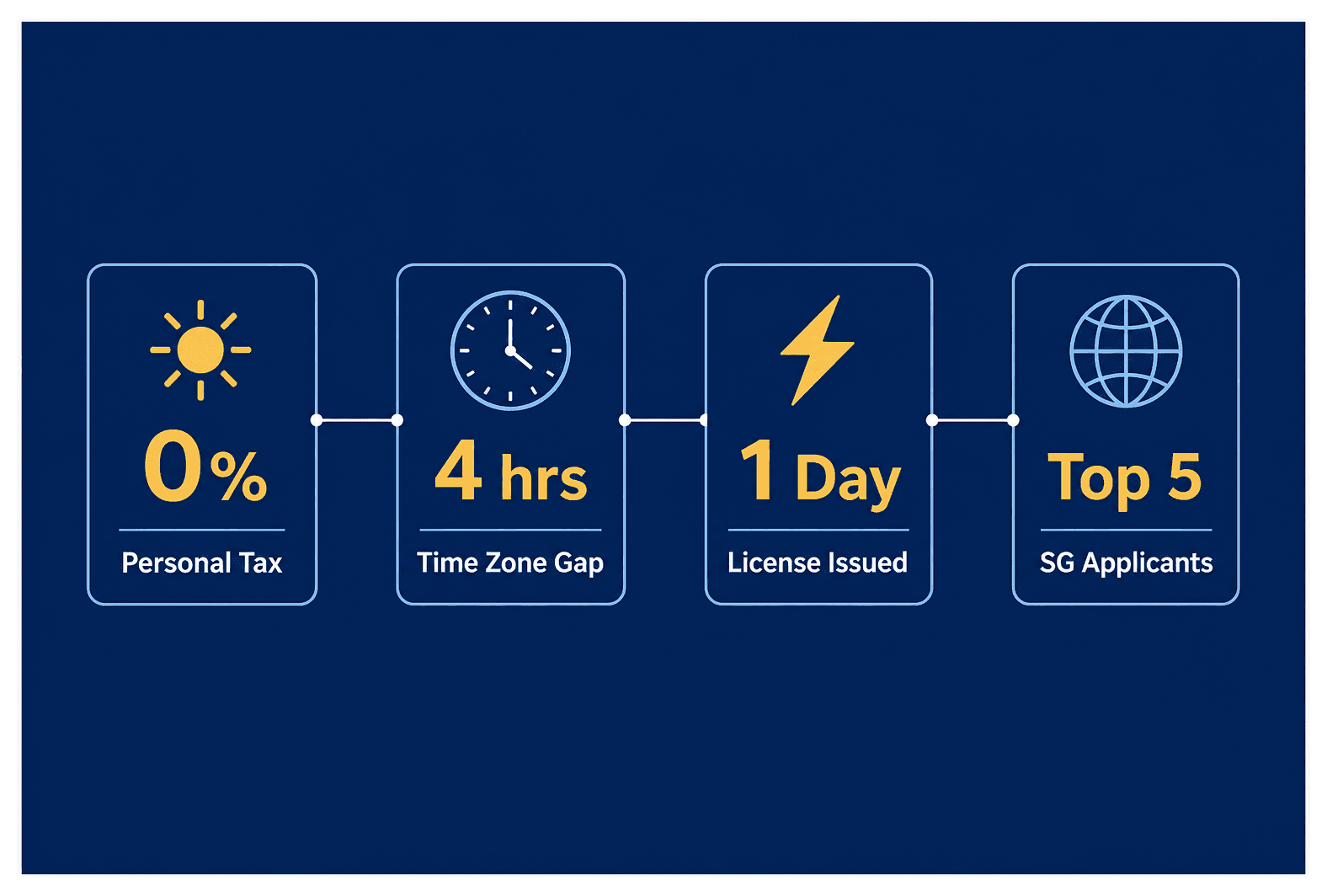
Setting company Singapore UAE means incorporating a legal UAE entity, typically a free zone establishment or company, while remaining based in Singapore. You don't need to relocate, dissolve your Singapore company, or block capital in a UAE bank. In 2026, Singapore ranks among the top five countries of origin for new UAE free zone license applicants [1], drawn by the UAE's zero personal income tax [2], zero withholding tax on dividends [3], a trade license issued in one day at Dubai South Business Hub Free Zone [4], and a time-zone gap of just four hours that lets a Singapore team service both APAC and Gulf clients within a single working day [5].
This guide covers what setting company Singapore UAE actually means in practice, then walks you through the legal requirements, realistic costs using verified Dubai South Business Hub Free Zone figures, and the step-by-step process, so you can make your first hire or land your first UAE invoice without surprises.
What Setting Company Singapore UAE Actually Means for Founders
Setting company Singapore UAE means a Singapore-resident founder incorporates a legal entity in the UAE, typically a free zone LLC or establishment, without relocating. The UAE entity can trade, invoice, and hold a UAE bank account independently of the Singapore structure, with no requirement to dissolve or modify the existing Singapore company.
Why Singapore Founders Choose the UAE as a Second Base
The case for a dual Singapore-UAE structure is practical, not just tax-driven. Here's what makes it work:
Zero personal income tax in the UAE, founders drawing a salary or dividend from the UAE entity pay no personal income tax on that income in the UAE (u.ae, 2026).
Dividends flow freely, Singapore and the UAE have no double-taxation agreement that restricts profit repatriation, so dividends move between the two entities without treaty-imposed withholding.
GCC market access from one license, a single UAE trade license gives you a legal base to service the Gulf Cooperation Council region's substantial consumer and enterprise market.
Singapore's banking reputation helps, UAE banks are generally more receptive to applicant groups with Singapore-headquartered parent or holding companies, given Singapore's strong regulatory standing.
Time-zone alignment, at four hours behind Singapore, UAE business hours overlap enough for a lean team to manage client calls across both regions in one day.
A Singapore-based SaaS founder, for example, might set up a UAE free zone entity specifically to invoice Gulf enterprise clients in AED, while keeping the Singapore entity for all APAC revenue. Two separate legal persons, one coordinated treasury, and no flight required to set it up.
Free Zone Entity vs. Mainland Entity: The Core Distinction
Before you commit to a structure, you need to understand what a free zone entity actually is, and what it isn't.
A free zone entity operates within a designated geographic or sector zone. It can trade internationally and invoice UAE clients, but selling directly to UAE mainland customers at scale typically requires a local distributor arrangement or specific approvals. A mainland entity licensed by DET can trade directly anywhere in the UAE without a distributor requirement. Worth flagging: 100% foreign ownership is available on the UAE mainland and has nothing to do with free zone or designated-zone status.
One distinction that catches Singapore trading founders off-guard: free zone goods entering the UAE mainland are duty-suspended, not duty-exempt. Customs duty applies at the point goods are released into the mainland market. A Singapore electronics importer holding stock in a third-party UAE warehouse pays no duty while goods sit in the free zone, but the duty clock starts the moment goods clear into the mainland.
Dubai South Business Hub (DSBH) is a UAE free zone. It is not a designated zone, so it carries no designated-zone customs or VAT benefit. Don't conflate the two, they're different classifications with different legal consequences.
UAE Free Zone vs. Mainland: Key Differences for Singapore Founders
Feature | Free Zone Entity (DSBH) | UAE Mainland Entity |
|---|---|---|
Foreign ownership (100% available) | 100% foreign ownership, no local partner required | 100% foreign ownership also available; not exclusive to free zones |
Trade with UAE mainland customers | Via local distributor or approved channel; direct retail requires specific conditions | Direct trade anywhere in the UAE; no distributor requirement |
Customs duty on mainland entry | Duty suspended while goods remain in free zone; duty applies on mainland clearance | Standard customs duty applies at point of import into the UAE |
Designated-zone VAT benefit | DSBH is not a designated zone; no designated-zone VAT treatment applies | Not applicable; designated-zone status is separate from mainland licensing |
Paid-up share capital requirement | Zero paid-up share capital required at DSBH | Varies by activity and legal form; some activities require minimum capital |
License issuance speed | License issued in 1 day at DSBH once documents are complete | Typically several business days; timeline varies by DET workload and activity |
Legal Requirements for Setting Company Singapore UAE
To set up a UAE company from Singapore you need a valid passport with at least six months' validity, a No Objection Certificate if you hold UAE residency under another sponsor, proof of address, and a chosen trade name. Regulated activities require separate approval from the relevant UAE authority in addition to the free zone license.
Core Document Checklist for Singapore-Based Applicants
Passport valid for at least six months, this is the single most common cause of application delays. A Singapore fintech founder who submitted a passport expiring in four months received an immediate rejection; resubmitting with a renewed passport cleared the application the same day.
Proof of Singapore residential address, a utility bill or bank statement dated within three months of submission.
Trade name reservation, check your preferred company name before paying any fees; DSBH issues licenses within one day once all documents are in order.
Memorandum of Association or equivalent, required if the applicant is a corporate shareholder (such as a Singapore Pte Ltd) rather than an individual.
Zero paid-up share capital, DSBH requires no capital deposit or blocked funds to form the entity.
Regulated Activities: Dual-Approval Requirement
If your planned activity is regulated, financial services, healthcare, education, or ICT involving data handling, the process has two tracks running in parallel. DSBH issues the underlying trade license; the named UAE regulator grants the activity-specific permission separately. Both approvals are required before you operate.
For financial services, the Central Bank of the UAE grants the regulated permission. For healthcare, the Dubai Health Authority (DHA) approves clinical operations, a Singapore-based telemedicine group, for instance, can license its entity at DSBH on day one, then apply to DHA for clinical approval as a parallel process that typically takes several additional weeks. For education, KHDA approval is required before instruction begins. An ICT license in Dubai involving data processing may also trigger a separate regulatory review.
Budget time and fees for both tracks. The free zone license cost and the regulator's approval fee are separate line items, and regulatory timelines vary significantly by activity type.
Step-by-Step Process for Setting Company Singapore UAE at Dubai South
Setting a UAE company from Singapore at Dubai South Business Hub Free Zone takes six steps: choose your activities, reserve your trade name, submit documents, receive your license (issued in one day), open a UAE bank account, then apply for residency visas if needed. The entire process can be completed remotely without visiting Dubai.
Step 1: Choose Your Business Activities and Legal Structure
Review the full activity list, DSBH covers trading, services, professional, ICT, and other sectors. Browse the business activities available at Dubai South before committing to a structure.
Count your activities carefully, the first five are included in the base license fee. Each activity beyond five costs AED 2,000. A focused activity list keeps your first-year cost lower.
Choose your legal form, a Free Zone Establishment has a single shareholder; a Free Zone Company has multiple shareholders. Singapore corporate shareholders can hold 100% of the UAE entity in either form.
Step 2: Reserve Your Trade Name and Submit Documents
Name compliance, UAE naming rules prohibit offensive terms, names of ruling families, and anything implying government affiliation. Check availability before paying any fees.
Remote submission, DSBH accepts passport copies, proof of address, and completed application forms remotely. You don't need to be in Dubai.
Corporate shareholders, if a Singapore Pte Ltd is the applicant, you'll need attested constitutional documents (Memorandum and Articles of Association or equivalent).
Watch the passport date, under six months' remaining validity is the most common delay trigger at this stage.
Step 3: Receive License, Open Bank Account, and Apply for Visas
License in one day, DSBH issues the trade license within one business day of receiving a complete, compliant application.
Open your UAE bank account, the issued license is the primary document UAE banks require. A Singapore logistics founder, for example, received her DSBH license on day one, applied to three UAE banks simultaneously on day two, and had a live corporate account within two weeks.
Residency visas are always additional, visa costs are never included in the license fee. Each visa requires a separate application through the UAE immigration authority (ICP, 2026). Founders wanting UAE residency apply for an investor visa linked to the trade license.
Emirates ID follows the visa, the Emirates ID is issued after the residency visa is stamped. It's mandatory for all UAE residents, including the founder.
Need to open a bank account in the UAE or manage your taxation setup? DSBH's beyond-hub services cover both.
Cost of Setting Up a UAE Company From Singapore at Dubai South
At Dubai South Business Hub Free Zone, a trade license starts from AED 12,500. A sole founder with one residency visa should budget from AED 18,350 for the first year all-in. Zero paid-up share capital is required. Visas are always priced separately from the license.
License and First-Year Cost Breakdown
Trade license from AED 12,500 for standard activities
First-year all-in from AED 18,350 for a sole founder with one residency visa package
AED 2,000 per additional activity beyond the first five included in the base fee
Zero paid-up share capital, no funds need to be deposited or blocked in a UAE bank to form the entity
DSBH launched September 2025, it's one of the UAE's newer free zone options
A Singapore consultant adding three activities to a professional services license pays the base AED 12,500, all three fall within the first-five-activity allowance, so no additional activity fees apply. Use the Dubai South company setup cost calculator to build your personalised first-year budget before submitting.
Ongoing Costs to Factor Into Your Business Plan
Annual license renewal, a recurring cost; confirm renewal pricing directly with DSBH as fees can vary by activity type
Corporate tax registration, mandatory once your entity is active; late registration carries a one-time flat penalty of AED 10,000 (Federal Tax Authority, 2026)
VAT registration, required once taxable supplies exceed AED 375,000 annually; late VAT registration also carries a one-time flat penalty of AED 10,000
Additional residency visas, each hire beyond the first visa is an additional cost; get a clear per-visa quote before finalising headcount plans
Warehousing and customs, DSBH does not provide bonded warehousing or customs integration; founders needing those services must contract them separately
Tax and Compliance Requirements for Singapore Founders
UAE corporate tax applies at 9% on taxable income above AED 375,000. A Qualifying Free Zone Person may access a 0% rate only if it meets all four QFZP conditions: adequate substance, qualifying income, no mainland election, and compliant transfer pricing. Registration with the Federal Tax Authority is mandatory for all active UAE entities.
Corporate Tax: What the 0% Rate Actually Requires
The standard UAE corporate tax rate is 9% on taxable income above AED 375,000. A free zone entity does not automatically qualify for the 0% rate. To be treated as a Qualifying Free Zone Person (QFZP), your UAE company must satisfy all four conditions simultaneously:
Adequate economic substance in the UAE
Income qualifies as "qualifying income" under the corporate tax rules
The entity has not elected to be treated as a standard taxable person
Transfer pricing rules are complied with for all related-party transactions
A Singapore holding company that sets up a DSBH subsidiary and assumes QFZP status applies automatically is making a costly assumption, it does not. The subsidiary must demonstrate UAE substance and confirm its income qualifies before filing at 0%. Register with the Federal Tax Authority promptly after license issuance; the late registration penalty is AED 10,000 as a one-time flat charge, not a monthly accumulation.
Can a Singapore founder become a UAE tax resident?
Yes, and it's a material change to your personal tax position. If you take UAE residency alongside your company license, you may meet the UAE's tax residency criteria. Singapore and the UAE do not currently have a comprehensive double-taxation agreement in force, verify the current treaty status with a qualified tax adviser before making any residency decision. UAE economic substance regulations also require free zone entities in certain sectors (holding companies, intellectual property, finance, and others) to demonstrate real activity, employees, and expenditure in the UAE. Transfer pricing rules apply to all transactions between your UAE entity and the Singapore parent or any related parties.
Hiring Staff After Setting Company Singapore UAE
Once your UAE trade license is active, you can sponsor employee residency visas through your entity. Each hire requires a work permit from MoHRE, a residency visa from the UAE immigration authority, and an Emirates ID. Visa quotas are linked to your license type and office space allocation.
Work Permits, Visas, and Emirates ID for UAE Employees
Two separate approvals per hire, a work permit from MoHRE and a residency visa from the UAE immigration authority are distinct processes
Investor visa vs. employee visa, the founder's investor visa is processed through the free zone; employee visas go through MoHRE and the General Directorate of Residency and Foreigners Affairs (GDRFA Dubai)
Emirates ID is mandatory, for all residents, including every employee you sponsor; the application is part of the residency process
Visa costs are always additional, budget per-head before committing to headcount; get a per-visa quote from DSBH's residency services team
Labour Law Obligations for Free Zone Employers
UAE Labour Law under Federal Decree-Law No. 33 of 2021 applies to employees working in free zones unless the free zone operates its own separate employment regulations. Written employment contracts are mandatory, each contract must specify salary, role title, and notice period. Gratuity (end-of-service benefit) accrues from day one for employees on unlimited-term contracts, so factor this liability into your payroll planning from the moment you make your first hire.
If you're hiring from Singapore into a UAE-based role, confirm which jurisdiction's labour law governs the employment relationship. A UAE-based employee is covered by UAE federal law; a Singapore-based employee working remotely for your UAE entity sits in a different legal position entirely. That distinction matters when it comes to termination, gratuity, and dispute resolution.
Setting company Singapore UAE gives you access to the UAE's talent pool and the ability to sponsor visas, but the compliance obligations
References
Frequently Asked Questions