
Topic Summary
Know the Two Laws Behind FTA Authority
Federal Decree-Law No. 8 of 2017 governs VAT audits, while Federal Decree-Law No. 47 of 2022 covers corporate tax audits. Both grant the FTA broad power to examine any registered business at any time, including remotely via the EmaraTax portal.
Understand the Four Types of FTA Audits
The FTA can conduct desk audits, field audits, follow-up audits, and random risk-scored audits. Desk audits require document submission within just 5 business days, so having organised records is essential.
Register for VAT Before Hitting AED 375,000
Mandatory VAT registration kicks in once taxable supplies or imports reach AED 375,000 per year, with voluntary registration available from AED 187,500. Missing the mandatory deadline triggers an immediate AED 10,000 flat penalty.
File Corporate Tax Returns Within Nine Months
Corporate tax returns must be submitted within 9 months of the end of the relevant tax period, and the 9% rate applies to taxable income above AED 375,000 for financial years starting on or after 1 June 2023. Missing this deadline results in an immediate AED 10,000 penalty, not a recurring monthly charge.
Always Verify an Auditor's Official Authorisation
FTA auditors are legally required to present an official authorisation card before accessing your premises or records. Businesses have every right to check this identity before granting any access.
Build an Audit-Ready Compliance Calendar Early
With over 40,000 UAE businesses already audited since VAT launched in 2018, audit exposure is a real and growing risk. Maintaining organised VAT returns, purchase invoices, and bank statements from day one is far cheaper than addressing compliance gaps after an FTA notification arrives.
Since VAT launched in January 2018, the Federal Tax Authority has audited more than 40,000 businesses across the UAE (Federal Tax Authority, 2026). Corporate tax audit UAE activity is accelerating: the 9% rate now applies to financial years starting on or after 1 June 2023. The mandatory VAT registration threshold sits at AED 375,000 (Federal Tax Authority, 2024). Late registration carries an AED 10,000 flat penalty. Corporate tax returns must be filed within 9 months of the tax period end. Miss that window and another AED 10,000 penalty lands, immediately, not monthly. This guide walks you through exactly what a tax audit UAE involves, which thresholds and deadlines apply, what penalties you face if you miss them, and how to build a compliance calendar that keeps your books audit-ready from day one.
What Is a Tax Audit in the UAE and Why It Matters
A tax audit in the UAE is a formal examination by the Federal Tax Authority of a registered business's financial records, tax returns, and supporting documents to verify that VAT and corporate tax obligations have been calculated and paid correctly. Audits can be scheduled or unannounced and cover any open tax period.
If you're planning to start your business in Dubai, understanding audit exposure from day one is far cheaper than fixing compliance gaps after the FTA comes knocking.
The Legal Basis for FTA Audits
Two laws give the FTA its audit authority. Federal Decree-Law No. 8 of 2017 covers VAT; Federal Decree-Law No. 47 of 2022 covers corporate tax. Both grant the FTA broad power to audit any registered taxable person, at any time, for any open tax period (Federal Tax Authority, 2024).
The FTA can audit at your business premises, at its own offices, or remotely through the EmaraTax portal. One practical point worth flagging: auditors must present an official authorisation card before you grant access. You have every right to verify their identity first. A Dubai-based trading company, for instance, might receive a formal audit notification via EmaraTax and then host an FTA team at its warehouse, the auditors request 24 months of VAT returns, purchase invoices, and bank statements in that same visit.
Types of Tax Audits You May Face
Desk audit: The FTA requests documents electronically through EmaraTax. No site visit. Response window is typically 5 business days.
Field audit: Auditors visit your registered business address or operational premises.
Follow-up audit: Triggered when a previous audit found discrepancies and the FTA wants confirmation of corrective action.
Random audit: No specific trigger. The FTA uses risk-scoring algorithms to select businesses regardless of filing history.
A professional services firm holding a consultancy license in Dubai might receive a desk audit request asking it to upload 12 months of tax invoices and signed contracts, all within that 5-business-day window.
Corporate Tax and VAT Thresholds That Trigger a Tax Audit UAE Filing Review
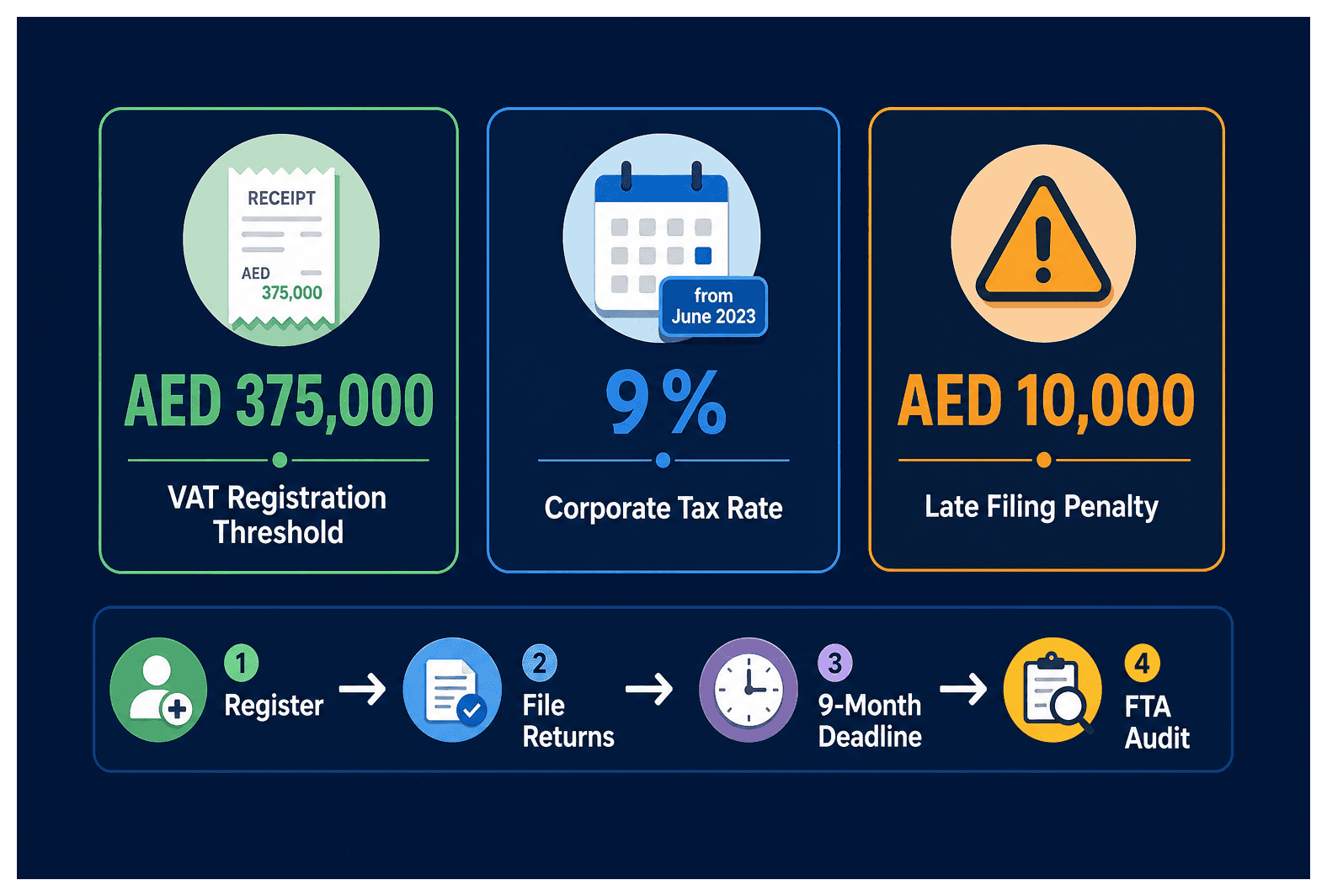
VAT registration is mandatory when taxable supplies exceed AED 375,000 per year; voluntary registration opens at AED 187,500. Corporate tax at 9% applies to taxable income above AED 375,000 for financial years starting on or after 1 June 2023. Missing either registration deadline carries an AED 10,000 flat penalty.
UAE Tax Thresholds, Deadlines, and Penalties at a Glance
Tax Obligation | Key Figure |
|---|---|
VAT mandatory registration threshold | AED 375,000 in taxable supplies or imports per year |
VAT voluntary registration threshold | AED 187,500 |
Late VAT registration penalty | AED 10,000 one-time flat penalty |
Corporate tax rate on income above AED 375,000 | 9% (0% on income up to AED 375,000) |
Late corporate tax registration penalty | AED 10,000 one-time flat penalty (not a monthly charge) |
Corporate tax return filing deadline | Within 9 months of the end of the relevant tax period |
VAT Registration Thresholds and Deadlines
Mandatory threshold: AED 375,000 in taxable supplies or imports in the preceding 12 months, or expected in the next 30 days.
Voluntary threshold: AED 187,500, useful if you want to reclaim input VAT early.
Late registration penalty: AED 10,000, applied immediately as a one-time flat charge.
Late VAT filing: AED 1,000 for the first offense; AED 2,000 for each subsequent offense within 24 months.
A startup that crosses AED 375,000 in revenue in month 10 of trading must register within 30 days or face that AED 10,000 penalty on the spot. There's no grace period once the threshold is breached.
Corporate Tax Registration Thresholds and Deadlines
9% corporate tax applies to taxable income above AED 375,000; income up to that level is taxed at 0%.
Every UAE-incorporated entity must register for corporate tax, even if it generates no taxable income.
Late registration penalty: AED 10,000 flat, one-time, not a recurring monthly charge.
Corporate tax returns must be filed within 9 months of the tax period end.
Qualifying Free Zone Persons (QFZP) may access 0% on qualifying income, but only when all four conditions are met simultaneously: adequate substance in the free zone, income from qualifying sources, no election out of the regime, and annual audited financial statements.
A free zone company with a financial year ending 31 December 2024 must file its first corporate tax return by 30 September 2025. You can explore the full range of business activities in Dubai and their tax implications before you commit to a structure.
Step-by-Step Guide to Surviving a Tax Audit UAE Process
To survive a tax audit in the UAE, acknowledge the FTA notification within the stated deadline, appoint a tax agent if needed, gather all requested records, respond to queries in writing via EmaraTax, attend any scheduled meetings, and implement corrective measures before the audit closes to minimise penalty exposure.
Step 1: Acknowledge the Notification and Appoint Representation
Log in to EmaraTax immediately on the day you receive the notification and acknowledge receipt.
Check the audit type: field audits require at least 5 business days' notice from the FTA (unannounced visits are only permitted in suspected fraud cases).
Decide whether to engage a registered tax agent. For first-time audits or complex corporate structures, this is strongly advisable.
Notify your accountant and legal counsel the same day, not after the weekend.
Here's a real scenario: a sole founder who set up a company through a free zone receives an EmaraTax notification on Monday. By Wednesday, they've appointed a registered tax agent and confirmed the audit date with the FTA. That two-day turnaround is realistic and it matters.
UAE Tax Compliance Calendar: Key Deadlines and Penalties
Obligation | Deadline / Penalty |
|---|---|
VAT return (monthly filer) | 28th of the month following the tax period |
VAT return (quarterly filer) | 28th of the month after quarter-end |
Late VAT registration | AED 10,000 one-time flat penalty |
Corporate tax return | Within 9 months of tax period end |
Late corporate tax registration | AED 10,000 one-time flat penalty |
VAT record retention | Minimum 5 years (15 years for real estate transactions) |
Corporate tax record retention | Minimum 7 years |
Step 2: Gather and Organise Your Records
Compile VAT returns, tax invoices (sales and purchases), credit notes, import and export declarations, and bank statements covering the full audit period.
Reconcile your accounting software figures against submitted VAT returns. Any gap is the first thing auditors flag.
For corporate tax, include audited financial statements, transfer pricing documentation for related-party transactions, and evidence of qualifying income if you're claiming QFZP status.
Organise everything in a single folder, physical or digital, labelled clearly by tax period.
An ICT company preparing for a VAT desk audit might create a shared drive with four sub-folders per quarter: invoices issued, invoices received, import certificates, and bank reconciliations. That structure takes an afternoon to build and saves days during the audit itself. If you need to understand how banking and taxation services connect for UAE businesses, it's worth reviewing before your first filing.
Step 3: Respond, Cooperate, and Follow Up
Submit all requested documents within the FTA's stated deadline. Extensions can be requested but aren't guaranteed.
Respond to every query in writing via EmaraTax, this creates a traceable record you can reference if there's a dispute.
If the audit uncovers an underpayment, file a voluntary disclosure before the audit closes. That single step can reduce the administrative penalty by 50%.
Once the audit report is issued, you have 20 business days to file a formal objection if you disagree with the findings.
A retail business that discovers an AED 18,000 VAT underpayment during an audit can cut its administrative penalty in half simply by filing a voluntary disclosure before the audit closes. That's a meaningful saving for any small business.
Building an Audit-Ready Compliance Calendar for Your UAE Business
An audit-ready compliance calendar maps every VAT filing deadline, corporate tax payment date, and record-retention milestone across the year. UAE businesses must retain tax records for a minimum of 5 years (15 years for real estate transactions). A calendar prevents missed deadlines and the AED 10,000 penalties that follow.
Monthly and Quarterly VAT Filing Milestones
Monthly filers: VAT return and payment due by the 28th of the month following the tax period.
Quarterly filers: VAT return and payment due by the 28th of the month following the quarter-end.
Reconcile your EmaraTax dashboard against your accounting records at least two weeks before each deadline. That buffer gives you time to correct errors without rushing.
Flag zero-rated and exempt supplies separately in your records. Misclassification is one of the most common triggers for a tax audit UAE desk review.
A quarterly filer whose period ends 31 March must submit and pay by 28 April. Setting a calendar reminder for 14 April gives a two-week window to catch and fix discrepancies, enough time to avoid a late-filing penalty of AED 1,000 on the first offense (Federal Tax Authority, 2024).
Corporate Tax Payment and Reporting Deadlines
The 9-month filing window is fixed: a company with a 31 December year-end files by 30 September of the following year. A free zone company set up in September 2025 with a 31 December financial year-end must file its first corporate tax return by 30 September 2026.
Retention rules for corporate tax are stricter than VAT:
Audited financial statements, board resolutions, and transfer pricing files: minimum 7 years.
QFZP claimants: document all four qualifying conditions every year before filing, the FTA can request this evidence during any audit.
Advance corporate tax payments are not currently required under UAE law, but monitor Ministry of Finance UAE announcements, as this may change.
You can use the business setup cost calculator to factor compliance costs into your first-year budget before you commit to a structure.
Common Audit Triggers and How to Avoid Them
The most common tax audit UAE triggers include inconsistent VAT return figures, large input tax recovery claims, frequent amendments to filed returns, significant related-party transactions, and gaps between declared revenue and bank deposits. Maintaining clean, reconciled books month-to-month is the single most effective risk-reduction measure.
Financial Red Flags the FTA Risk-Scores
Large or recurring input tax credit claims that significantly exceed output tax, especially in the first year of trading.
VAT returns that are consistently amended after submission, repeated amendments signal unreliable record-keeping.
Revenue declared to the FTA that doesn't match figures reported to the Ministry of Economy or in audited financial statements.
High-value transactions with related parties or connected persons without transfer pricing documentation.
A newly licensed consulting business that claims AED 80,000 in input VAT on office fit-out costs in its first quarter is a textbook example. The FTA's algorithm flags the claim as disproportionate to declared output tax, triggering a desk audit, even if the claim is entirely legitimate.
What happens if I miss a VAT filing deadline?
Missing a VAT filing deadline in the UAE triggers an AED 1,000 administrative penalty for the first offense and AED 2,000 for each subsequent offense within any rolling 24-month period. The FTA may also flag your account for closer scrutiny, increasing the likelihood of a tax audit UAE review in subsequent quarters.
Operational Habits That Reduce Audit Risk
Reconcile your accounting software against EmaraTax every month. Never leave it until filing day.
Issue tax-compliant invoices for every supply: Tax Registration Number (TRN), date, description, and VAT amount must all appear on each invoice.
Keep a separate record of exempt and zero-rated supplies so they can be defended quickly if queried.
Use a registered tax agent to review each return before submission. The cost is modest compared to an AED 10,000 penalty.
A trading business that sets a recurring monthly task, reconcile EmaraTax draft return against QuickBooks on the 15th of each month, builds a two-week buffer before the 28th deadline. That one habit eliminates most of the common triggers for a tax audit UAE flag.
How Setting Up in a Free Zone Affects Your Tax Audit UAE Exposure
Free zone companies in the UAE are subject to the same VAT and corporate tax audit rules as mainland businesses. The key difference is that a free zone company claiming Qualifying Free Zone Person status must maintain audited financial statements and documented evidence of qualifying income every year or risk losing the 0% rate.
References
Frequently Asked Questions