
Topic Summary
Know Which Sectors Trigger External Approvals
Over 40 regulated business activity categories in Dubai require sign-off from at least one external government body before a trade license is granted. Identifying whether your activity falls into a regulated sector before you apply can save weeks of unexpected delays.
Understand the Two-Layer Approval System
License authorities like the DET or free zone bodies register your company and issue the trade license, while sector regulators like the DHA or DFSA separately approve the specific activity. Both approvals must be in place — a trade license alone does not authorize practice in regulated fields.
Free Zones Don't Exempt You From Regulatory Approvals
Choosing a free zone over the mainland does not remove the obligation to obtain third-party regulatory clearances for sensitive sectors. Free zones issue their own licenses but still require the same external approvals for regulated activities.
Plan for Timelines Ranging From Days to Months
Approval timelines vary dramatically, from as little as 3 business days to over 6 months depending on the sector and regulator involved. Multi-approval scenarios, common in healthcare or hospitality, can push total setup timelines to 3–6 months if approvals are managed sequentially rather than in parallel.
Map the Right Regulatory Body to Your Activity
Dubai has more than 20 specialist regulatory bodies covering different economic sectors, including the DHA for healthcare, KHDA for education, and DFSA for financial services in DIFC. Identifying the correct regulator early ensures you submit the right documentation to the right authority from the start.
Budget for Regulator-Specific Requirements
Many regulators require physical inspections, facility drawings, equipment specifications, or professional credential verification as part of their approval process. These requirements carry their own costs and cannot be fast-tracked, so they must be factored into both your timeline and your setup budget.
Apply to Regulators Early to Avoid Mid-Process Delays
A common and costly mistake is submitting to the DET or a free zone first, then discovering mid-process that an external regulator must approve before the license can be issued. Initiating regulatory applications in parallel with your license application, rather than after, is the most effective way to protect your launch timeline.
By Editorial Team, Business setup specialists with direct experience supporting UAE free zone and mainland license applications across regulated sectors. Full bio →
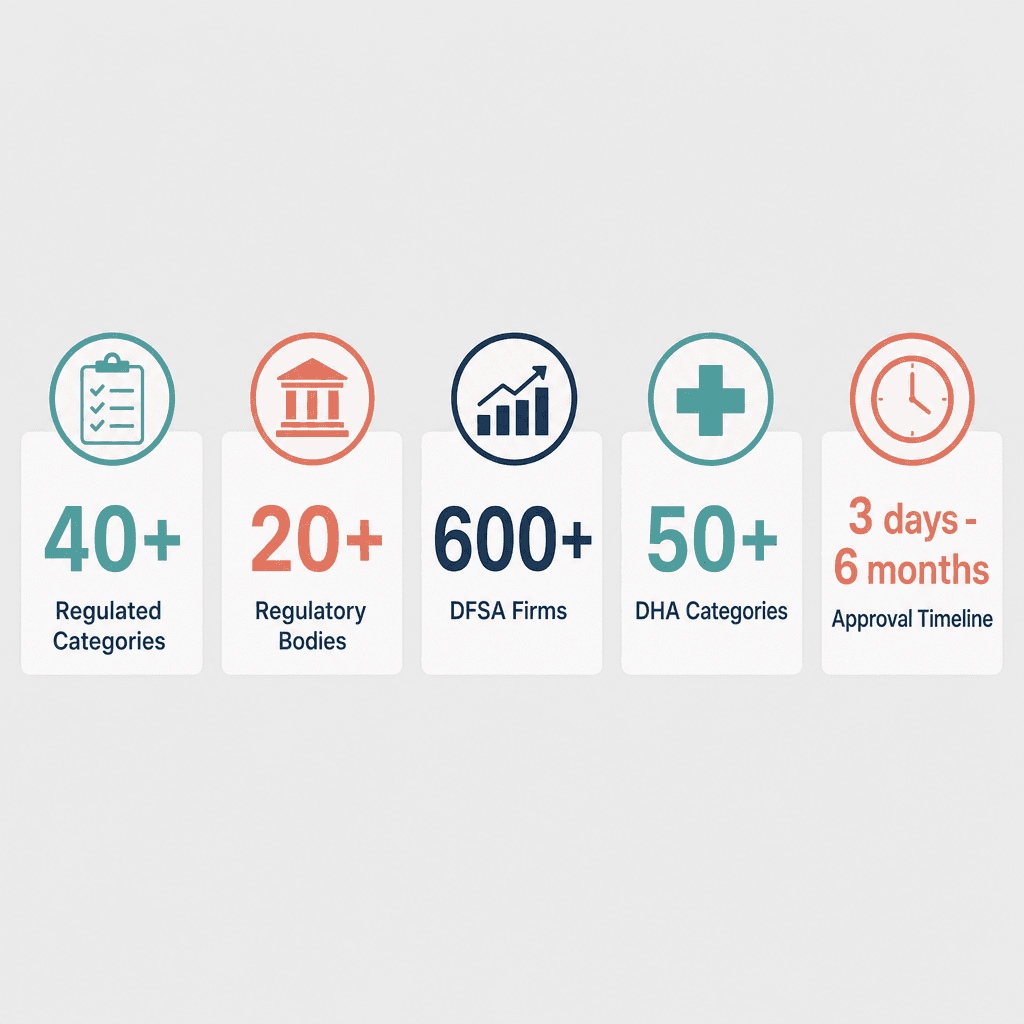
Not all business licenses in Dubai can be issued by a free zone authority or the Department of Economic Development (DET) alone. In 2026, over 40 regulated business activity categories require sign-off from at least one external government body before your trade license can be granted, a requirement that catches many first-time founders completely off guard. Approval timelines range from 3 business days to 6+ months depending on the sector. Dubai has more than 20 specialist regulatory bodies covering different economic sectors (UAE Government Portal, 2024). DHA practitioner licensing alone covers more than 50 healthcare professional categories (Dubai Health Authority, 2024). DFSA-regulated entities in DIFC exceeded 600 firms as of 2024 (DFSA Annual Report, 2024). Multi-approval scenarios in healthcare or hospitality can push total setup timelines to 3–6 months if managed sequentially.
This guide explains what third party approvals Dubai business founders must plan for, which regulatory bodies are involved, how to identify whether your activity triggers an approval requirement, and what timelines and costs to build into your setup plan. For more detail, see our guide on approvals needed for a construction company in Dubai. For more detail, see our guide on approvals needed for non-standard business activities in Dubai.
What Are Third-Party Approvals for Dubai Business and Why They Exist
Third-party approvals for Dubai business are mandatory clearances issued by specialist government regulators, separate from the DET or free zone authority, before a trade license can be granted. They exist to ensure that sensitive sectors like healthcare, finance, and education meet safety, professional, and consumer-protection standards set by dedicated oversight bodies. For more detail, see our guide on municipality and third-party approvals in Dubai. For more detail, see our guide on NOC and third-party approvals for Dubai businesses.
The Difference Between a License Authority and a Regulatory Body
DET and free zone authorities issue the commercial license, but they are not sector regulators. Their job is to confirm your company structure, trade name, and activity classification, not to verify that your clinic is medically safe or that your financial firm has a compliant risk framework.
Sector regulators do that second layer of work. They set professional standards, inspect premises, verify credentials, and can revoke permission independently of the license authority. Both approvals must align. A license without the regulatory approval is invalid for the regulated activity.
License authority (DET / free zone): Registers the company, assigns the activity code, issues the trade license.
Sector regulator (DHA, KHDA, DFSA, etc.): Approves the specific activity, inspects facilities, licenses practitioners, and enforces ongoing compliance.
A clinic licensed by DET but without Dubai Health Authority (DHA) approval cannot legally treat patients. The trade license alone does not authorise medical practice. This dual-layer system protects consumers and maintains Dubai's reputation as a compliant, well-regulated jurisdiction.
Worth flagging: free zones issue their own licenses but still require the same external regulatory approvals for regulated activities. Choosing a free zone over the mainland does not remove the obligation.
Why Discovering This Late Adds Weeks to Your Timeline
Many founders submit their application to DET or a free zone, then learn mid-process that an external body must approve first. The problem is that approval processes run on the regulator's timeline, not the license authority's. Some require physical inspections, credential verification, or committee review, none of which can be rushed.
Real scenario: A fitness studio operator who selected "health club" as their activity faced a three-week delay after discovering Dubai Sports Council approval was needed, an approval that requires a separate application with facility drawings and equipment specifications. For more detail, see our guide on RERA approval for real estate businesses in Dubai.
If you're planning a business setup in Dubai for first-time founders, understanding the regulatory layer before you apply is one of the most time-saving steps you can take.
Which Regulatory Bodies Issue Third-Party Approvals for Dubai Business
The main regulatory bodies that issue external approvals for Dubai business licenses include the Dubai Health Authority, Knowledge and Human Development Authority, Dubai Tourism and Commerce Marketing, Roads and Transport Authority, Dubai Financial Services Authority, UAE Media Council, and Dubai Civil Defence, each governing a distinct sector with its own application process. For more detail, see our guide on civil defence and third-party approvals in Dubai.
Healthcare, Education, and Tourism Regulators
Dubai Health Authority (DHA): Governs all health-related activities, clinics, pharmacies, optical centres, physiotherapy, and wellness businesses. Requires facility registration, professional licensing for practitioners via the DataFlow credential verification system, and premises inspection. DHA professional licensing covers more than 50 healthcare professional categories (Dubai Health Authority, 2024).
Knowledge and Human Development Authority (KHDA): Oversees private education, training institutes, tutoring centres, and e-learning platforms targeting students in Dubai. Reviews curriculum, instructor qualifications, and facility standards. KHDA regulates over 200 private schools and hundreds of training providers in Dubai (KHDA Annual Report, 2023).
Dubai Tourism and Commerce Marketing (DTCM): Issues approvals for hotels, hotel apartments, tour operators, travel agencies, desert safari operators, and event management companies. Includes star-rating classification and periodic re-inspection. DTCM approval is required before DET or a free zone will process a hospitality or tourism license.
A private tutoring company operating in Dubai must obtain KHDA approval even if it delivers sessions online to students physically located in the emirate. The regulator's jurisdiction is tied to the student base, not just the premises.
Transport, Financial Services, Media, and Safety Regulators
Roads and Transport Authority (RTA): Required for passenger transport, vehicle rental, logistics companies using public roads, and driving schools. A logistics startup planning to run a last-mile delivery fleet must secure RTA approval and vehicle permits before its DET license for transport activities can be issued.
Dubai Financial Services Authority (DFSA): Governs financial services conducted in or from the Dubai International Financial Centre (DIFC). Applies to fund managers, brokers, insurance intermediaries, and fintech firms. This is DIFC-specific, mainland financial services fall under the UAE Securities and Commodities Authority (SCA).
UAE Media Council (NMC): Approval required for media production, publishing, advertising agencies, printing, public relations firms, and digital content creation businesses. NMC approval timelines typically run 5–10 business days for straightforward media activity classifications.
Dubai Civil Defence (DCD): Required for businesses dealing in fire safety equipment, food production facilities, warehouses storing hazardous materials, and any premises that must meet fire safety codes. DCD clearance is also a prerequisite for many commercial leases.
For guidance on matching your business description to the correct activity code before any of these approvals are triggered, see our guide on choosing the right business activity in Dubai.
Dubai Business Activity: Regulatory Body, Approval Required, and Typical Timeline
Business Activity | Regulatory Body | Approval Required | Typical Timeline |
|---|---|---|---|
Medical clinic / pharmacy / physiotherapy | Dubai Health Authority (DHA) | Facility registration + practitioner licensing | 6–12 weeks |
Private school / training institute / tutoring centre | Knowledge and Human Development Authority (KHDA) | Academic institution approval | 8–16 weeks |
Hotel / travel agency / tour operator | Dubai Tourism and Commerce Marketing (DTCM) | Tourism/hospitality classification | 4–8 weeks |
Passenger transport / vehicle rental / logistics fleet | Roads and Transport Authority (RTA) | Transport activity permit | 5–10 business days |
Fund manager / broker / fintech (DIFC) | Dubai Financial Services Authority (DFSA) | Financial services authorisation | 3–6 months |
Media production / advertising / publishing | UAE Media Council (NMC) | Media activity approval | 5–7 business days |
Food manufacturing / fire safety equipment / warehouse | Dubai Civil Defence (DCD) | Safety compliance clearance | 3–7 business days |
Activity-to-Approval Reference Table: Third-Party Approvals for Dubai Business
This reference maps common Dubai business activities to the regulatory body responsible, the specific approval required, and the typical processing timeline, giving founders a single-view reference before they submit their license application. The nature of the activity determines the regulator, not the business name. That's a point worth emphasising.
How to Read This Table and Apply It to Your Activity
Activities are matched to their ISIC Rev.4-equivalent classifications where relevant. Under ISIC Rev.4 (approved by the UN Statistical Commission in 2006), the classification is determined by what a business actually does, not what it calls itself. The same logic applies in Dubai: your DET activity code maps to the underlying economic activity, and that code is what triggers an approval flag.
Some activities appear under multiple regulators because they require approvals from more than one body. A food manufacturing business, for example, requires both Dubai Civil Defence clearance for its production facility and a Dubai Municipality food safety permit, two separate applications with two separate timelines running in parallel. Always confirm with your chosen free zone directly, as some publish their own internal lists of activities requiring external approvals.
Activities That Commonly Trigger Multiple Simultaneous Approvals
Some business types don't just need one external approval, they need several. Plan for this before you submit anything:
Healthcare facilities: DHA (clinical) + DCD (fire safety) + Dubai Municipality (food if catering on-site)
Educational institutions: KHDA (academic) + DCD (building safety) + possibly Municipality
Hotels and serviced apartments: DTCM (hospitality rating) + DCD + Municipality (food and beverage)
Financial advisory firms in DIFC: DFSA authorisation + DIFC authority registration
A private hospital project in Dubai typically requires sign-off from at least three separate bodies, DHA, Dubai Civil Defence, and Dubai Municipality, before DET will issue the commercial license. Multi-approval scenarios can extend total setup timelines to 3–6 months for complex healthcare or hospitality projects. Map all applicable approvals before submitting the first application; staggered submissions are the single biggest source of avoidable delays.
6 stepsh2> to Identify Whether Your Business Needs a Regulatory Approval Before Applying
To identify whether your Dubai business needs a third-party approval before applying for a license: confirm your exact business activity code, check the DET or free zone regulated activity list, identify the relevant sector regulator, review that regulator's pre-approval requirements, prepare documentation in parallel, and submit the regulatory application before or alongside your license application.
Step 1: Pin Down Your Exact Activity Code Before Anything Else
DET and free zones assign licenses based on specific activity codes, the code determines whether an external approval is flagged. A vague activity description may not trigger a flag even if the underlying work is regulated. Be precise.
DET maintains a list of over 2,000 licensed activity types, a significant share of which carry mandatory external approval flags (DET Dubai, 2024). Selecting "management consultancy" instead of "healthcare management consultancy" may bypass a DHA flag, but if your actual work involves advising clinical operations, operating without the correct code exposes you to regulatory risk later.
ISIC Rev.4's four-level hierarchy (Section, Division, Group, Class) is the underlying framework that DET activity codes map to. The classification is determined by what you actually do, not what you call your company. See our full guide on choosing the right business activity in Dubai for detailed activity selection guidance.
Steps 2–6: Verify, Prepare, and Submit in the Right Order
A travel agency founder submitted their DET license application first, then learned DTCM required a separate application with a tenancy contract and a qualified tourism manager on payroll. Restarting the process cost four weeks. Free zone authorities typically flag regulated activities during initial activity selection, but this flagging is not always exhaustive. Always verify directly with the relevant emirate-level regulator regardless of jurisdiction.
Which activities most commonly surprise founders with an approval requirement?
Health clubs, tutoring centres, e-commerce food businesses, and any activity involving vehicle operation on public roads are among the most frequently overlooked. Founders assume the license authority handles everything, but for these activities, the sector regulator's clearance is a legal prerequisite that the license authority cannot waive or shortcut.
Typical Timelines and Costs for the Most Common Third-Party Approvals in Dubai
Third-party approval timelines in Dubai range from 3 business days for straightforward media or transport approvals to 8–12 weeks for healthcare facility registrations requiring physical inspection. Costs vary from a few hundred AED for basic clearances to AED 10,000 or more for regulated professional licensing in healthcare and financial services.
Fast-Track Approvals: What You Can Realistically Resolve in Days
Several approvals can be completed quickly, especially if your application is complete on first submission. Incomplete submissions are the leading cause of approval delays across all regulatory bodies in Dubai.
NMC (media production / advertising): 5–7 business days; fees typically AED 1,000–3,000 depending on activity type.
RTA (vehicle rental / basic logistics): 5–10 business days once documentation is complete; fees vary by fleet size and permit category.
DCD (low-risk commercial premises): 3–7 business days for a no-objection certificate; fees typically AED 500–2,000.
A boutique advertising agency secured its NMC approval in six business days by submitting a complete application with activity descriptions and shareholder documents in one go, no back-and-forth revisions required. These faster approvals can often run in parallel with the license application to minimise total setup time.
Long-Lead Approvals: Healthcare, Finance, and Education Planning Horizons
DHA (clinic or medical centre): 6–12 weeks minimum, including facility inspection and practitioner credentialing via DataFlow verification, fees range from AED 5,000 to AED 15,000+ depending on facility type (DHA, 2024).
KHDA (training centre or school): 8–16 weeks for full approvals requiring curriculum review; initial pre-approval may be faster for smaller training providers.
DFSA (financial services, DIFC): 3–6 months for full authorisation, requiring a detailed regulatory business plan, financial projections, compliance manuals, and fit-and-proper assessments for key personnel.
DTCM (hotel or serviced apartment): 4–8 weeks after physical inspection; fees tied to property category and star rating.
A DIFC-based investment advisory firm planning to launch in Q1 submitted its DFSA application in the prior year's Q3, recognising that the 4–5 month authorisation process would otherwise delay revenue-generating activity by an entire quarter. For healthcare, finance, and education founders: treat regulatory approval as phase one of setup, not a parallel task. Choosing a free zone does not reduce the time required, these timelines are set by the sector regulator, not the free zone authority.
Ready to map your approvals before you apply? The Dubai South Business Hub Free Zone business support services team can identify every external approval your activity requires and prepare your documentation before submission. For more detail, see our guide on Trakhees approvals for a Dubai South business.
How Dubai South Business Hub Free Zone Helps You Manage Third-Party Approvals for Dubai Business Setup
Dubai South Business Hub provides end-to
Citations
Dubai Health Authority.. dha.gov.ae. DHA UAE, 2024.
Dubai Economy and Tourism.. dubaidet.gov.ae. DET Dubai, 2024.
Knowledge and Human Development Authority.. khda.gov.ae. KHDA Dubai, 2024.
UAE Media Council.. uaemc.gov.ae. UAE Media Council, 2024.
Dubai International Financial Centre.. difc.ae. DIFC, 2024.
Frequently Asked Questions