
Topic Summary
What Are Trade Finance Options for Dubai Free Zone Import Companies and Why They Matter
Trade finance options for Dubai free zone import companies are bank and non-bank instruments that fund or secure imported goods. They include letters of credit, bank guarantees, invoice discounting, supply chain finance and trade credit insurance. They bridge the gap between paying suppliers and collecting from buyers.
Core Trade Finance Options for Dubai Free Zone Import Companies
Core Trade Finance Options for Dubai Free Zone Import Companies
Choosing Between Financing Structures for Imported Goods
Match the instrument to your risk. Use letters of credit when supplier trust is low, discounting when customers pay slowly, and supply chain finance with stable suppliers and strong buyers. A foodstuff importer with weekly shipments usually prefers a revolving facility over one-off LCs. Perishables need shorter tenors than durable goods.
How to Qualify for Import Financing as a Free Zone Company
Hold a valid trade license with import activities, a corporate bank account, customs registration and evidence of real trade. Banks supervised by the Central Bank of the UAE also review shareholders, financials and cash flow. Check which license you need to import goods into Dubai first.
Step-by-Step Guide to Securing Import Finance
Confirm licensed activities, register with customs, open a corporate account, size your cash gap, shortlist instruments, submit a full file, then negotiate and monitor. This order cuts rejections for trade finance options for Dubai free zone import companies.
Managing Risk While Financing Imports
Insure receivables, verify suppliers, keep documents compliant and budget for VAT and logistics. Currency, delays and customer default are the main threats.
Common Mistakes to Avoid With Trade Finance as a New Importer
Common mistakes include mismatched license activities, mixed personal and company funds, undersized facilities, weak document compliance and reliance on one financier.
Dubai's non-oil foreign trade passed AED 2.2 trillion in 2024 (Dubai Chamber, 2024), and its ports handle over 14 million TEUs a year (DP World, 2025). Yet new importers still stall when cash sits between supplier payment and customer receipt. This guide covers trade finance options for Dubai free zone import companies, so Dubai South license holders can compare instruments and build a bank-ready file.
What Are Trade Finance Options for Dubai Free Zone Import Companies and Why They Matter
Trade finance options for Dubai free zone import companies are bank and non-bank instruments that fund or secure imported goods. They include letters of credit, bank guarantees, invoice discounting, supply chain finance and trade credit insurance. They bridge the gap between paying suppliers and collecting from buyers.
How Trade Finance Bridges the Cash Gap
Importers often pay suppliers 30 to 90 days before goods sell. Picture an electronics importer paying a Shenzhen supplier on shipment, then selling to retailers on 60-day terms. Invoice discounting releases that cash early, so you don't inject personal funds into the company.
Why Free Zone Status Shapes Your Financing Profile
Banks assess license activity, shareholders and trade history. A trading importing exporting business in Dubai setup at Dubai South starts from AED 12,500. Present the licensed activity and signed supplier contracts at onboarding, and keep company and personal money separate.
Core Trade Finance Options for Dubai Free Zone Import Companies
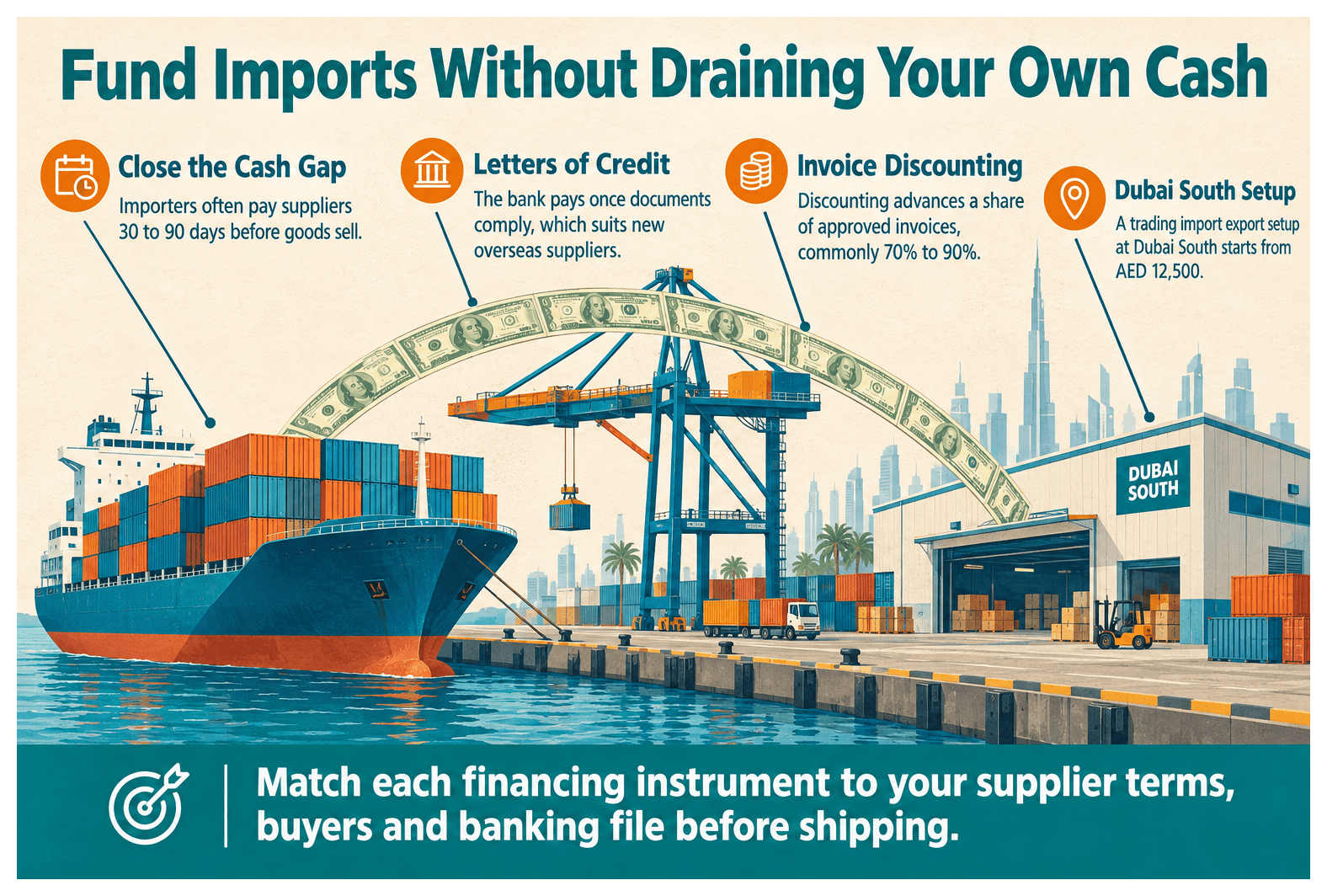
The main options are letters of credit, bank guarantees, invoice discounting, supply chain finance and trade credit insurance. Letters of credit secure supplier payment, discounting releases cash from unpaid invoices, and supply chain finance extends your payment terms. Availability depends on your license activity and banking relationship, as well as location. For a wider view, see trade finance options for Dubai traders.
Letters of Credit and Bank Guarantees
The bank pays once documents comply.
It suits new overseas suppliers.
Guarantees back customs or supplier duties.
New companies should expect margin or collateral.
A food importer might open a sight LC for an Indian exporter, paying against the bill of lading and invoice.
Invoice Discounting and Supply Chain Finance
Discounting advances a share of approved invoices, commonly 70% to 90% depending on the provider. A building materials importer can discount a large contractor's invoices to fund the next container. Supply chain finance pays your supplier early while you pay later. Both work best with creditworthy buyers.
Comparison of Trade Finance Options for Importers
Feature | Letter of Credit | Invoice Discounting |
|---|---|---|
Main purpose | Guarantees payment to your supplier | Releases cash from unpaid customer invoices |
Best suited for | New suppliers and one-off shipments | Importers selling on credit terms |
Typical collateral | Cash margin or security deposit | The receivables themselves |
Speed to set up | Slower, due to limit approval and drafting | Faster once buyers are approved |
Key risk | Document discrepancies delay payment | Buyer concentration and late payment |
Trade Credit Insurance and Forfaiting
Insurance covers buyer default or political risk. An importer reselling to regional distributors can insure receivables to qualify for higher limits. Forfaiting is usually exporter-side, but it shapes how your suppliers get paid, so read up on forfaiting services in Dubai.
Choosing Between Financing Structures for Imported Goods
Match the instrument to your risk. Use letters of credit when supplier trust is low, discounting when customers pay slowly, and supply chain finance with stable suppliers and strong buyers. A foodstuff importer with weekly shipments usually prefers a revolving facility over one-off LCs. Perishables need shorter tenors than durable goods.
Compare cost, speed and collateral. LCs take longer to arrange than invoice finance. A startup might compare a cash-margin LC with receivables-backed finance after six months of trading.
How to Qualify for Import Financing as a Free Zone Company
Hold a valid trade license with import activities, a corporate bank account, customs registration and evidence of real trade. Banks supervised by the Central Bank of the UAE also review shareholders, financials and cash flow. Check which license you need to import goods into Dubai first.
Trade license and shareholder IDs.
Bank statements and management accounts.
Proforma invoices and purchase orders.
A three-month cash flow forecast.
Build a record early. Run receipts through the corporate account, start with small facilities and repay on time. Six clean months before applying for a revolving line is a sensible benchmark.
Step-by-Step Guide to Securing Import Finance
Confirm licensed activities, register with customs, open a corporate account, size your cash gap, shortlist instruments, submit a full file, then negotiate and monitor. This order cuts rejections for trade finance options for Dubai free zone import companies.
Confirm license and customs readiness. Check import activities and finish Dubai Trade Portal registration. Over 98% of declarations run digitally (Dubai Trade, 2025).
Map your cash cycle. A 75-day cycle with 30-day supplier terms leaves a 45-day gap.
Shortlist providers. Request indicative terms from two banks and one platform.
Submit, negotiate, monitor. Negotiate margins and limits, then set calendar alerts for due dates.
Managing Risk While Financing Imports
Insure receivables, verify suppliers, keep documents compliant and budget for VAT and logistics. Currency, delays and customer default are the main threats.
The AED is pegged to the USD, but euro payments carry exchange risk.
Hedge with a bank forward contract.
Delays raise storage and financing costs.
Vet suppliers and buyers first.
Import VAT is 5% (Federal Tax Authority). Include it, plus freight, insurance and demurrage, in your facility request. Then plan to reclaim import VAT through registration.
Common Mistakes to Avoid With Trade Finance as a New Importer
Common mistakes include mismatched license activities, mixed personal and company funds, undersized facilities, weak document compliance and reliance on one financier.
Goods descriptions differ across invoice, LC and license.
Source-of-funds papers are incomplete.
Only one facility exists.
One shipment gets held because the invoice wording differs from the LC. Another importer survives a bank limit cut only because a secondary line was in place. Keep a buffer for renewals.
Next Steps for Your Import Financing
Trade finance options for Dubai free zone import companies range from LCs to discounting, supply chain finance and insurance. Pick the one that fits your cash cycle and keep license, customs and banking records aligned. Set up your trading license with Dubai South Business Hub Free Zone, then approach banks with a complete, activity-matched file.
References
Frequently Asked Questions