
Topic Summary
AED 3,000,000 Threshold Triggers Full Documentation
Any UAE taxable person whose related-party transactions exceed AED 3,000,000 in a single tax period must prepare both a Master File and a Local File. This threshold applies equally to mainland, free zone, and offshore entities.
Master File Required for Large MNE Groups
MNE groups with consolidated revenues above AED 3,150,000,000 must maintain a Master File covering group-wide pricing policies. This requirement is mandated under Ministerial Decision No. 97 of 2023 and carries the full force of UAE law.
Benchmarking Studies Must Be Refreshed Regularly
Transfer pricing benchmarking studies cannot be prepared once and forgotten — UAE rules require them to be updated every three years. Outdated studies are a common cause of FTA documentation rejection during audits.
Free Zone Entities Face Especially High Stakes
Qualifying Free Zone Persons who fail transfer pricing documentation requirements risk losing their 0% tax rate entirely, with the FTA able to apply a 9% corporate tax rate across all income, not just non-compliant transactions. Full compliance with documentation rules is one of the four conditions required to maintain QFZP status.
Late Filing Penalties Start at AED 10,000
The Federal Tax Authority began issuing corporate tax assessments in 2026 to businesses with inadequate transfer pricing documentation, with penalties starting at AED 10,000 per missed obligation. These are not warnings — they are enforceable financial consequences already being applied.
Five OECD Methods Determine Arm's Length Pricing
The UAE adopts the OECD Transfer Pricing Guidelines, which provide five approved methods for establishing arm's length prices: comparable uncontrolled price, resale price, cost plus, transactional net margin, and profit split. Businesses must select the method that best matches the transaction's nature and available comparable data.
Three-Tier Framework Covers Group and Entity Levels
The UAE's documentation framework — Master File, Local File, and Country-by-Country Report — follows OECD BEPS Action 13 and allows the FTA to review both group-wide policies and individual transaction details simultaneously. This structure reduces ad hoc audit requests but requires proactive, layered record-keeping from businesses.
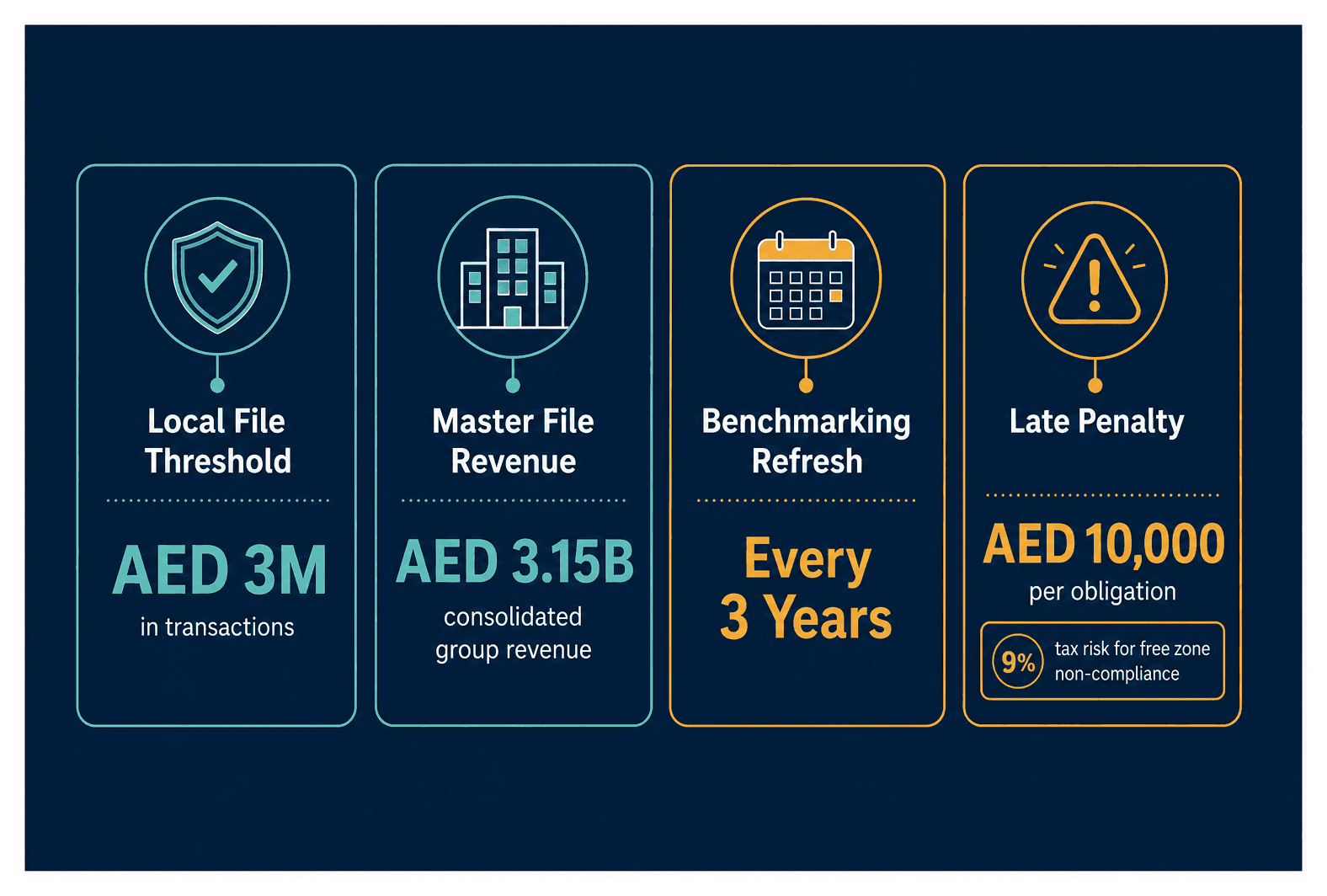
In 2026, the UAE Federal Tax Authority has issued corporate tax assessments to businesses that failed to maintain adequate transfer pricing documentation, with late registration penalties starting at AED 10,000 per obligation missed (Federal Tax Authority, 2025). The Local File threshold sits at AED 3,000,000 in related-party transactions per tax period. The Master File is mandatory for MNE groups with consolidated revenues above AED 3,150,000,000. Benchmarking studies must be refreshed every three years. And for free zone entities, documentation failure can trigger a 9% corporate tax rate on all income, not just the non-compliant transactions.
This guide walks free zone company owners and finance managers through every stage of UAE transfer pricing documentation: what it is, exactly who must prepare it, which documents to file and when, how to avoid the most common rejection causes, and where free zone entities licensed at Dubai South Business Hub Free Zone sit within these rules.
What Is Transfer Pricing Documentation in the UAE and Why It Matters
Transfer pricing documentation in the UAE is the formal record-keeping framework that proves related-party transactions were priced at arm's length. Under Federal Decree-Law No. 47 of 2022, UAE businesses must maintain a Master File, Local File, and Disclosure Form to satisfy the Federal Tax Authority and avoid penalties.
The Arm's Length Principle Explained
Every transaction between related parties must be priced as if it were conducted between two independent, unconnected businesses. That's the arm's length principle, and it's the foundation of all transfer pricing documentation in the UAE.
The OECD Transfer Pricing Guidelines, adopted by the UAE under Federal Decree-Law No. 47 of 2022, set five approved methods for establishing an arm's length price: comparable uncontrolled price, resale price, cost plus, transactional net margin, and profit split. You pick the method that best fits the transaction's nature and the available comparable data.
Here's the practical risk. A UAE free zone holding company charges its wholly owned subsidiary a management fee of AED 500,000 per year. If no benchmarking study shows that comparable independent parties pay a similar fee for equivalent services, the FTA can disallow part or all of that deduction and adjust taxable income upward. That creates an unexpected corporate tax liability with no offsetting cash benefit.
Why the UAE Adopted a Three-Tier Documentation Framework
The UAE aligned with the OECD Base Erosion and Profit Shifting (BEPS) Action 13 framework, which prescribes a Master File, Local File, and Country-by-Country Report (CbCR). This three-tier structure lets the FTA assess both group-wide pricing policies and entity-specific transaction details without issuing ad hoc information requests mid-audit.
Ministerial Decision No. 97 of 2023 sets the specific UAE thresholds and formats for the Master File and Local File. Cabinet Decision No. 44 of 2020 governs CbCR obligations. These are not aspirational guidelines; they carry the force of law and are enforceable by the Ministry of Finance UAE.
Worth flagging: free zone entities that are Qualifying Free Zone Persons (QFZPs) still fall within UAE corporate tax and therefore within transfer pricing documentation rules. The 0% rate on qualifying income applies only when all four QFZP conditions are met, one of which is full compliance with transfer pricing rules including documentation. Failure on documentation alone can cost you that status.
Who Must Prepare Transfer Pricing Documentation in the UAE
Any UAE taxable person that enters into transactions with related parties or connected persons must maintain transfer pricing documentation. Mandatory Master File and Local File preparation is triggered when total related-party transactions exceed AED 3,000,000 in a tax period, regardless of whether the entity is mainland, free zone, or offshore.
Thresholds That Trigger Full Documentation
Disclosure Form: Required for every taxable person with any related-party or connected-person transactions, regardless of value. No minimum threshold.
Local File: Mandatory when total related-party transactions in the tax period exceed AED 3,000,000.
Master File: Mandatory when the taxable person is part of an MNE group with consolidated revenues of AED 3,150,000,000 (approximately EUR 750 million) or more.
Country-by-Country Report (CbCR): Filed at group level when consolidated revenues exceed AED 3,150,000,000.
A Dubai free zone trading company with AED 4,200,000 in annual intercompany loans and management fees from its parent must prepare and retain a Local File, even if its parent group revenues are well below the MNE threshold. The Local File trigger is entity-level, not group-level.
UAE Transfer Pricing Documentation Requirements by Entity Type and Threshold
Document | Trigger Condition | Submission Requirement |
|---|---|---|
Disclosure Form | Any related-party or connected-person transactions, regardless of value | Filed with the corporate tax return; nine months after tax period end |
Local File | Total related-party transactions exceed AED 3,000,000 in the tax period | Prepared by filing deadline; produced within 30 days of FTA request |
Master File | MNE group consolidated revenues above AED 3,150,000,000 | Prepared by filing deadline; produced within 30 days of FTA request |
Country-by-Country Report | MNE group consolidated revenues above AED 3,150,000,000 | Filed within 12 months of group fiscal year end |
Benchmarking Study | Required to support Local File; triggered by AED 3,000,000 threshold | Updated annually for financial data; fully refreshed every 3 years |
Related Parties and Connected Persons: Who Counts
Related parties include entities where one holds 50% or more ownership or control over the other, or where a third party holds 50% or more in both. This is defined under Federal Decree-Law No. 47 of 2022, Article 35.
Connected persons extend the net to natural persons: partners, shareholders owning 50% or more, directors, and their relatives. Transactions with these individuals carry the same arm's length requirement as transactions with corporate related parties. Transactions between a UAE permanent establishment and its head office are also in scope.
Free zone companies, including those with a financial services business license in Dubai, are taxable persons under UAE corporate tax law. If they transact with related parties above the AED 3,000,000 threshold, the Local File obligation applies regardless of whether their income qualifies for the 0% QFZP rate.
The Transfer Pricing UAE Documents Checklist by Stage
UAE transfer pricing documents fall into three stages: pre-filing preparation (benchmarking study, intercompany agreements, functional analysis), filing stage (Disclosure Form submitted with the corporate tax return), and retention stage (Master File and Local File held for seven years and produced within 30 days of an FTA request).
Stage 1: Pre-Filing Preparation Documents
Functional analysis: Maps functions performed, assets used, and risks assumed by each related party. This is the foundation of your documentation; without it, no transfer pricing method can be properly defended.
Benchmarking study: Uses databases such as Bureau van Dijk Orbis to identify comparable independent transactions and establish an arm's length range. The five OECD-approved methods each require a different comparable set.
Intercompany agreements: Signed contracts for each transaction type (loans, services, IP licenses, goods supply) with terms consistent with the benchmarking outcome. Generic group policies do not satisfy this requirement.
Transfer pricing policy document: A group-level narrative explaining the chosen method and rationale for each transaction category. Particularly important when the Master File is required.
Stage 2: Filing-Stage Documents
Disclosure Form: A schedule within the corporate tax return declaring all related-party transactions by type and value. Submitted to the FTA by the corporate tax return deadline (nine months after the end of the tax period).
Master File: Prepared and ready by the filing deadline if the MNE revenue threshold is met. Not submitted automatically, but produced on FTA request.
Local File: Prepared and ready by the filing deadline if the AED 3,000,000 transaction threshold is met. Also produced on request, not filed proactively.
Attestation note: The Master File and Local File do not require notarisation or external attestation under current FTA guidance, but must be signed off by a responsible officer of the entity before the filing deadline, not at the time of an audit.
Stage 3: Retention and Validity
All transfer pricing documents must be retained for seven years from the end of the relevant tax period.
On an FTA audit or information request, documents must be produced within 30 days (extendable on request).
Benchmarking studies should be updated annually for financial data and fully refreshed every three years when economic or market conditions change materially.
Intercompany agreements must be signed and in force before the transaction occurs. Backdated agreements are a leading cause of FTA rejection and cannot be remedied retrospectively.
Need help organising these obligations? The business support services at Dubai South Business Hub Free Zone can connect you with qualified tax advisers familiar with FTA documentation standards.
Filing Deadlines and Validity Periods for UAE Transfer Pricing Documents
The Disclosure Form is due with the corporate tax return, nine months after the tax period ends. The Master File and Local File must be ready by the same date and retained for seven years. Benchmarking studies remain valid for three years if conditions are unchanged but require annual financial updates.
Key Dates for a Standard 12-Month Tax Period
31 December: Tax period end for calendar-year entities.
30 September (following year): Corporate tax return and Disclosure Form due. Nine months after period end.
30 September (following year): Master File and Local File must be finalised and signed. Not at the time of an FTA request; by the filing deadline.
Within the tax period: CbCR notification filed. CbCR report filed within 12 months of group fiscal year end.
A Dubai South Business Hub Free Zone company with a 31 December 2024 year-end must have its Local File signed and its Disclosure Form submitted by 30 September 2025. That deadline does not extend because the documents were not requested by the FTA.
What Are the Penalties for Missing UAE Transfer Pricing Deadlines?
Failure to register for corporate tax carries a one-time flat penalty of AED 10,000. Late filing of the corporate tax return (including the Disclosure Form) triggers separate administrative penalties under the Tax Procedures Law. The FTA can also deny deductions and adjust taxable income where documentation does not support the arm's length nature of a transaction, creating a substantive tax cost that goes well beyond any administrative penalty. Repeat non-compliance or fraudulent documentation can escalate to criminal liability under Federal Law No. 7 of 2017 on Tax Procedures.
5 Common Rejection Causes and How to Prevent Them
The five most common reasons UAE transfer pricing documentation is rejected or challenged are: backdated intercompany agreements, benchmarking studies with poor comparables, mismatched contract terms and actual conduct, missing functional analysis, and Disclosure Form omissions. Each can be avoided with preparation that starts before the transaction, not after.
Rejection Cause 1: Backdated or Missing Intercompany Agreements
Agreements must be signed and in force before the transaction starts. Creating them retrospectively to satisfy an audit is one of the most common and most damaging mistakes in UAE transfer pricing documentation. The FTA treats backdated agreements as absent.
Each transaction category needs its own specific agreement. A loan agreement, a service fee agreement, a royalty license, and a goods supply contract are four separate documents. A generic group policy covering all of them is not sufficient.
Rejection Cause 2: Weak or Unrepresentative Benchmarking
Comparables must come from genuinely independent parties in comparable industries, functions, and markets. Cherry-picking high-margin comparables artificially inflates the arm's length range and is a pattern the FTA recognises quickly.
Benchmarking for UAE-based transactions should account for regional market conditions. Relying solely on European or US datasets without adjustment for Gulf market characteristics weakens the study's credibility. The OECD identifies five comparability factors that must be addressed: characteristics of the property or services, functions performed, contractual terms, economic circumstances, and business strategies. Document your search strategy, rejection criteria, and final comparable set so the FTA can follow the reasoning without requesting further information.
Rejection Causes 3, 4, and 5: Conduct, Omissions, and Missing Analysis
Conduct versus contract mismatch: If the intercompany agreement states a service fee of AED 200,000 but invoices show AED 350,000, the FTA will disregard the contract and treat the actual payment as the transaction price, then assess whether it meets arm's length.
Disclosure Form omissions: All related-party transactions must be declared, including those below the AED 3,000,000 Local File threshold. Selective disclosure is treated as non-compliance, not an oversight.
Missing functional analysis: Skipping the functions-assets-risks mapping leaves the documentation without a foundation. Without it, the chosen transfer pricing method cannot be defended, because the method selection depends on which party performs which functions and bears which risks.
How Free Zone Companies Fit Into UAE Transfer Pricing Rules
Free zone companies are taxable persons under UAE corporate tax law and are fully subject to transfer pricing documentation requirements. A Qualifying Free Zone Person earning a 0% rate on qualifying income must still comply with all transfer pricing rules; non-compliance can cause loss of QFZP status and exposure to the standard 9% corporate tax rate.
QFZP Status and the Transfer Pricing Condition
The four conditions for QFZP status are: deriving qualifying income, maintaining adequate economic substance, not electing standard taxation, and complying with UAE corporate tax rules including transfer pricing documentation. All four must be satisfied in the same tax period.
Transfer pricing non-compliance, including failure to maintain a Local File where required, can cause the FTA to disqualify the entity from QFZP status for that entire tax period. Disqualification means all income, not just the non-compliant transactions, becomes subject to 9% corporate tax for that period. That's a significant exposure for a free zone entity that assumed its qualifying income was protected.
Consider a free zone company licensed at Dubai South Business Hub Free Zone that provides management consulting services to its parent group. If those intercompany fees are not supported by a Local File and a benchmarking study, QFZP status for the entire tax period is at risk, even if every other condition is met.
Transactions Between Free Zone and Mainland Related Parties
Transactions between a free zone entity and a related mainland UAE entity are related-party transactions fully in scope of transfer pricing rules. The fact that one entity benefits from a free zone license does not create any exemption.
Free zone goods are duty-suspended, not duty-exempt. That customs treatment has no effect on transfer pricing obligations. Finance managers should map all intragroup flows (goods, services, IP, financing) at the start of each tax year and assess whether the AED 3,000,000 Local File threshold will be crossed, ideally before transactions begin rather than at year-end.
Dubai South Business Hub Free Zone issues trade licenses from AED 12,500, with licenses issued in one business day and zero paid-up share capital required. First-year costs for a sole founder with one visa start from AED 18,350, with visas an additional cost. DSBH is not a designated zone, so no designated-zone VAT or customs benefit applies. You can calculate your business setup cost using the DSBH cost calculator before committing.
Transfer Pricing Documentation in the UAE: Your Action Checklist
Start your transfer pricing documentation checklist with a related-party transaction map, then assess thresholds, commission a benchmarking study, draft intercompany agreements, prepare the functional analysis, compile the Local File and Master File, complete the Disclosure Form with the corporate tax return, and retain all records for seven years.
Before the Tax Year Starts
Map all related-party and connected-person transactions planned for the year by type, counterparty, and estimated value.
Identify whether total related-party transaction value will cross AED 3,000,000 (the Local File trigger).
Confirm whether your group meets the AED 3,150,000,000 MNE consolidated revenue threshold for Master File and CbCR obligations.
Ensure intercompany agreements are signed, current, and consistent with planned pricing before transactions begin.
During the Tax Year
Commission or update the benchmarking study using current-year comparable data from sources such as Bureau van Dijk Orbis.
References
Frequently Asked Questions