
Topic Summary
Know the Difference Between Ban Types
The UAE has five distinct ban types: travel bans, labour bans, GCC-wide bans, immigration blacklists, and overstay bans. Each is issued by a different authority and requires its own separate resolution process.
Check Your Status in Under 60 Seconds
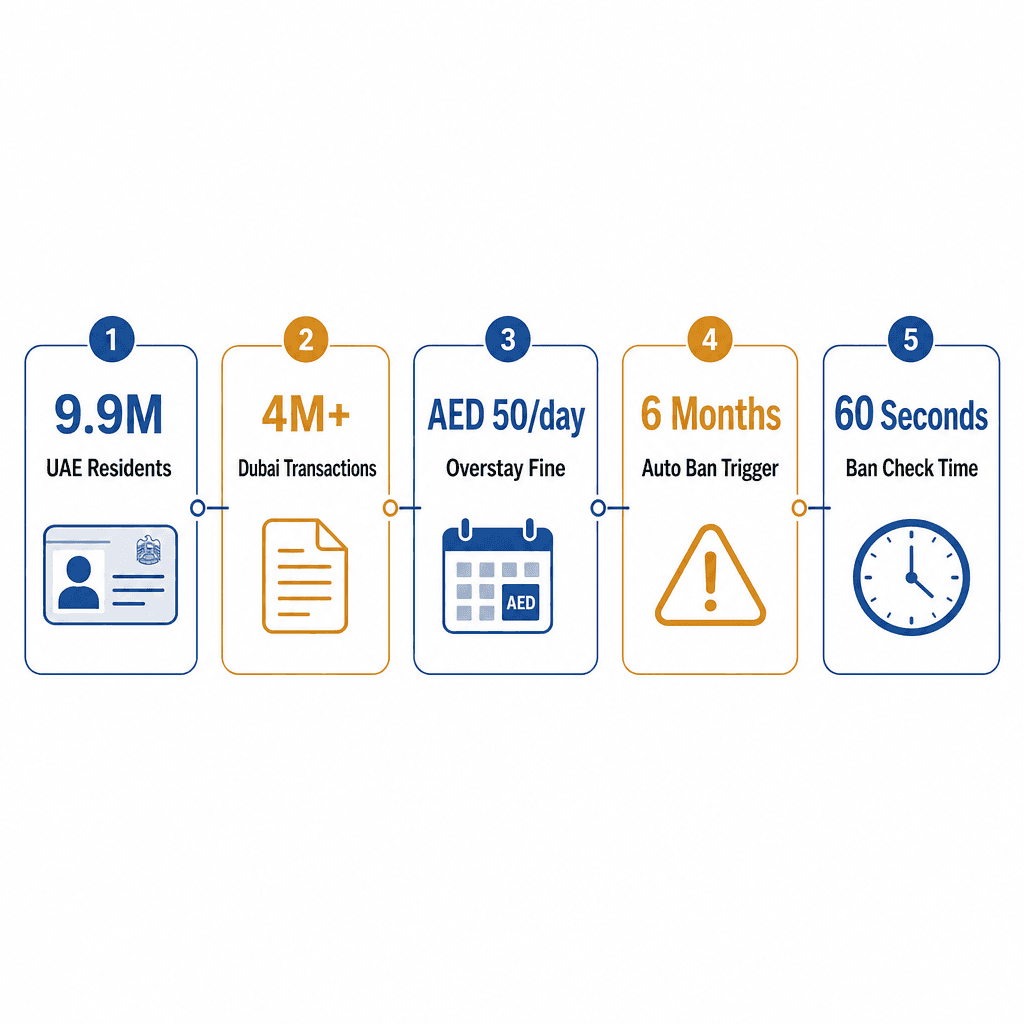
The ICP portal at icp.gov.ae allows UAE residents to check for an active travel ban in less than a minute. Many people only discover a ban exists when they reach the airport departure gate.
Overstaying Triggers Automatic Bans
Overstaying a UAE visa by 6 months or more automatically triggers a 1-year travel ban, while overstaying by a full year results in a 3-year ban. Overstay fines also start accumulating at AED 50 per day.
Bans Can Be Placed Without Notifying You
A court-ordered travel ban can appear on your record without any direct notification, such as when a lender files against an unpaid loan. The restriction only becomes visible when you attempt to leave the country.
A Travel Ban Stops Departure, Not Entry
A UAE travel ban is a departure restriction, meaning it prevents you from leaving the UAE rather than entering it. A resident can continue living and working normally while an active ban sits undetected on their record.
Labour Bans Don't Restrict Travel
A labour ban issued by MOHRE limits your ability to take up new employment in the UAE but does not prevent you from traveling. It requires a separate check through the MOHRE portal and its own resolution process.
The System Operates at Massive Scale
The ICP manages immigration records for over 9.9 million UAE residents, while GDRFA Dubai alone processes more than 4 million residency transactions annually. Enforcement at ports of exit is largely automated.
In 2026, the Federal Authority for Identity, Citizenship, Customs and Port Security (ICP) manages residency and immigration records for over 9.9 million UAE residents through icp.gov.ae. The General Directorate of Residency and Foreigners Affairs (GDRFA) processes more than 4 million residency transactions annually in Dubai alone. Overstay fines start at AED 50 per day, and overstaying by 6 months or more triggers an automatic 1-year travel ban (UAE Government, 2026). Knowing how to check if you have a ban in UAE takes under 60 seconds using the ICP portal, yet many residents discover a ban only at the airport departure gate.
This guide covers every method to check your ban status across all UAE and GCC portals, how to run a labour ban check on MOHRE, how to get a UAE police clearance certificate, how long bans last, and the fastest route to getting a travel ban removed. If you're worried about overstay fines specifically, the UAE overstay fine check guide covers that process in full. For more detail, see our guide on UAE overstay fine check. For more detail, see our guide on UAE labour ban duration and removal guide.
What Is a UAE Travel Ban
A UAE travel ban is an official immigration restriction that prevents a person from leaving the United Arab Emirates. It is issued by a UAE court, the Federal Authority for Identity, Citizenship, Customs and Port Security (ICP), or the General Directorate of Residency and Foreigners Affairs (GDRFA), and remains active until the underlying cause is resolved. Checking your UAE travel ban status before starting a business ensures there are no legal obstacles to obtaining your investor visa or trade license.
Definition and Legal Basis of a UAE Travel Ban
A travel ban is a departure restriction, not an entry ban. It stops you from leaving the UAE, not from entering it. That distinction matters: you could be living and working normally in the UAE while a travel ban sits on your record without your knowledge. For more detail, see our guide on UAE entry exit report and travel history.
The legal basis depends on the cause. Debt-related travel bans are issued under UAE Federal Law No. 11 of 1992 (Civil Procedures Law), which allows courts to restrict departure for individuals with outstanding civil judgments against them. Criminal travel bans fall under the UAE Penal Code. Both the ICP and GDRFA enforce these restrictions at all UAE airports and land borders.
Here's the part most people don't realise: a travel ban can be placed on your record without any direct notification to you. A UAE resident with an unpaid personal loan of AED 50,000, for example, may have a court-ordered travel ban placed by the lender without receiving a single official letter, the restriction only surfaces when they attempt to travel. ICP manages records for 9.9 million UAE residents, and the GDRFA Dubai processes over 4 million residency transactions annually, so the system operates at scale with automated enforcement at ports of exit.
Types of Bans You Can Have in UAE
Not all UAE bans are the same. There are five distinct types, each issued by a different authority and requiring a separate resolution process:
Travel ban: Restricts departure from the UAE. Issued by courts or ICP/GDRFA for civil, criminal, or immigration violations.
Labour ban: Restricts the ability to take up new employment. Issued by the Ministry of Human Resources and Emiratisation (MOHRE) for labour law violations, does not prevent travel.
GCC-wide ban: A restriction extending across all six Gulf Cooperation Council member states. Usually triggered by deportation or serious criminal offences.
Immigration blacklist: A permanent or long-term record flagging serious immigration violations. Different from a temporary travel ban, harder to remove.
Overstay ban: Automatically applied when a resident or visitor overstays their UAE visa by 6 months or more. Overstaying 6 months triggers a 1-year ban; overstaying 1 year triggers a 3-year ban (UAE Government, 2026).
An employee who abandons their job without proper resignation may receive both a labour ban from MOHRE and a travel ban if the employer files a court case, two separate restrictions requiring two separate resolutions. Knowing which type applies to you determines which portal you check and which authority you contact.
What Causes a Travel Ban in UAE
The most common causes of a UAE travel ban are unpaid debts subject to a court order, active criminal cases, labour law violations, immigration violations such as visa overstay of 6 months or more, and bounced cheques. Courts and immigration authorities can issue a ban without prior notice to the individual.
Financial and Legal Causes
Financial disputes are the leading trigger for UAE travel bans. Here's what puts you at risk:
Unpaid bank loans or credit card debt where a creditor has obtained a court judgment against you.
Bounced cheques, still a criminal offence under Federal Decree-Law No. 14 of 2020 on Commercial Transactions. A business owner who issues a cheque that bounces due to insufficient funds can face both a criminal case and an immediate travel ban, even for amounts as low as AED 1,000.
Unpaid rent where a landlord has filed a civil case in the rental disputes court.
Active civil or criminal court cases at any stage of proceedings, including cases you may not know have been filed against you.
Court-ordered travel bans are enforced at all UAE airports and land border crossings by ICP. There's no grace period between the court issuing the order and it appearing in the system.
Immigration and Labour Causes
Visa overstay of 6 months or more triggers an automatic ban, no court order required. Overstay fines start at AED 50 per day (UAE Government, 2026).
Absconding report filed by an employer with MOHRE, marks the employee as having abandoned their job without notice.
Working without a valid work permit or for an employer other than your visa sponsor.
Entry on a visit visa and failing to depart within the permitted period.
Previous deportation from the UAE, deported individuals are automatically added to the immigration blacklist.
The overstay thresholds are fixed: 6 months of overstay equals a 1-year automatic ban; 1 year of overstay equals a 3-year automatic ban from the date of departure (UAE Government, 2026). These are not discretionary, the system applies them automatically.
UAE Travel Ban Check Methods - Portal, Cost, and Processing Time (2026)
Method | Portal / Location | Fee | Result Time | Coverage |
|---|---|---|---|---|
ICP Online Portal | icp.gov.ae | Free | Instant | All Emirates |
GDRFA Dubai App | gdrfad.gov.ae / App Store | Free | Instant | Dubai |
Amer Centre (in person) | Multiple Dubai locations | Free | Immediate | Dubai |
TAMM Service Centre | tamm.abudhabi | Free | Immediate | Abu Dhabi |
ICP Branch (in person) | ICP offices nationwide | Free | Immediate | All Emirates |
How to Check If You Have a Travel Ban in UAE - Step by Step
To check if you have a travel ban in UAE, go to icp.gov.ae, select Inquiries, then Travel Ban Inquiry, and enter your passport number or UAE ID number. Dubai residents can also check via the GDRFA Dubai app at gdrfad.gov.ae. In-person checks are available at any Amer Centre in Dubai, where staff confirm ban status immediately using the GDRFA system.
How to Check Travel Ban via ICP Portal (icp.gov.ae)
The ICP portal at icp.gov.ae is the primary federal portal for travel ban inquiries, covering all seven emirates. Results display in real time with no processing delay. A Sharjah-based expat can check their ban status at 11pm from home in under 60 seconds, no appointment needed.
How to Check Travel Ban via GDRFA Dubai App
The GDRFA Dubai app at gdrfad.gov.ae covers Dubai-issued residency visas and Dubai court travel bans specifically. GDRFA Dubai processes over 4 million residency transactions annually, so the data is current and updated in real time.
How to Check Travel Ban in Person at Amer Centres
If you'd rather speak to someone directly, Amer Centres across Dubai are authorised GDRFA service points. Staff can check your ban status immediately using the live GDRFA system, the same data you'd see in the app.
Locations include Deira, Bur Dubai, Al Barsha, and other districts across Dubai.
Bring your original passport and Emirates ID, both are required for verification.
Amer Centres are operated by the Dubai Government and provide the same real-time data as the GDRFA app.
For Abu Dhabi residents: visit a TAMM service centre at tamm.abudhabi or an ICP branch for an equivalent in-person check.
Want to understand how recent visa rule changes might affect your status? The UAE visa rule changes and updates guide covers the 2024-2026 amendments in detail.
GCC Ban Check - How to Check Across All Gulf Countries
A GCC-wide ban check requires contacting the immigration authority of each Gulf Cooperation Council member state separately, there is no single unified GCC ban portal in 2026. The six GCC countries are UAE, Saudi Arabia, Kuwait, Bahrain, Oman, and Qatar. A UAE deportation or blacklisting often triggers automatic restrictions across multiple GCC countries through bilateral data-sharing agreements.
What Is a GCC-Wide Ban and Who Gets One
A GCC-wide ban extends beyond the UAE to some or all six member states. It's not a separate document, it's the result of data shared between GCC immigration authorities under bilateral and multilateral agreements. There's no single GCC immigration portal; each country maintains its own records.
Deportation from the UAE for criminal offences or serious immigration violations is the most common trigger. A worker deported for document fraud, for example, may find they're also refused entry into Saudi Arabia and Kuwait, even though no separate ban was formally issued by those countries. The UAE blacklist entry flags their name across the region automatically.
How to Check Your Ban Status in Each GCC Country
Each GCC country maintains its own immigration database, no unified cross-GCC portal exists in 2026. You'll need to check each one separately if you have reason to believe a GCC-wide restriction may apply to you.
How to Check Labour Ban in UAE
To check a labour ban in UAE, go to mohre.gov.ae, select "Services", then "Labour Ban Inquiry", and enter your passport number or labour card number. The Ministry of Human Resources and Emiratisation (MOHRE) issues and tracks labour bans separately from travel bans, a labour ban restricts employment, not departure from the UAE.
What Is a Labour Ban and How It Differs from a Travel Ban
A labour ban is issued by MOHRE and prevents a worker from taking up new employment in the UAE for a fixed period. It's entirely separate from a travel ban: you can leave the UAE freely with a labour ban active, but you can't join a new UAE employer until the ban expires or is lifted.
Labour bans are issued under UAE Labour Law Federal Decree-Law No. 33 of 2021. Common triggers include absconding (leaving a job without notice), working for an employer other than your visa sponsor, or violating a limited-term contract. An employee on a 2-year limited contract who resigns after 3 months without employer consent may receive a 1-year labour ban, blocking them from joining any new UAE employer until it expires.
Worth flagging: the 2021 labour law reforms significantly reduced labour bans for workers switching jobs in many circumstances (UAE Government, 2026). MOHRE manages over 5.8 million active work permits across the UAE, so the portal is comprehensive and up to date.
Is a labour ban the same as a travel ban in UAE?
No. A labour ban issued by MOHRE restricts your ability to work for a new UAE employer, it does not prevent you from leaving the country. A travel ban is a departure restriction enforced by ICP and GDRFA at UAE ports of exit. You can have one, both, or neither. Always check both portals separately if you have an unresolved employer dispute.
UAE Police Clearance Certificate - How to Get One
A UAE police clearance certificate is an official document confirming whether an individual has a criminal record in the UAE. It costs AED 200 in Dubai and AED 100 in Abu Dhabi, and is processed within 3 to 5 working days. Dubai residents apply via the Dubai Police app at dubaipolice.gov.ae; Abu Dhabi residents apply via adpolice.gov.ae.
Who Needs a UAE Police Clearance Certificate
A police clearance certificate is separate from a travel ban check, it confirms criminal record status, not immigration restrictions. You'll need one in these situations:
Applying for a visa to a third country, most embassies require a UAE police clearance if you've lived in the UAE for 6 months or more.
Job applications for government positions, healthcare roles, education, and security clearance-required jobs.
Applying for permanent residency or citizenship in another country.
A UAE-based professional applying for Canada PR, for instance, must submit a UAE police clearance certificate covering their full years of UAE residency, and it must be apostilled for use in Canada. The certificate is valid for 3 months from the date of issue in most jurisdictions.
Travel Ban Duration by Cause Type
Debt-related travel ban: No fixed expiry. Active until the full debt is paid and the court formally cancels the order.
Overstay ban (6 months to 1 year of overstay): Automatic 1-year ban from the date of departure (UAE Government, 2026).
Overstay ban (over 1 year of overstay): Automatic 3-year ban from the date of departure (UAE Government, 2026).
Criminal case ban: Duration set by the court. Active
Useful Resources
Citations
General Directorate of Residency and Foreigners Affairs Dubai.. gdrfad.gov.ae. GDRFA Dubai, 2024.
Ministry of Human Resources and Emiratisation.. mohre.gov.ae. MOHRE UAE, 2024.
Federal Authority for Identity, Citizenship, Customs and Port Security.. icp.gov.ae. ICP UAE, 2024.
UAE Cabinet.. uaecabinet.ae. UAE Cabinet, 2023.
Dubai Health Authority.. dha.gov.ae. DHA UAE, 2024.
Frequently Asked Questions