Topic Summary
Preparation Gaps Cause Most Setup Delays
The UAE's business registration system is genuinely efficient, but founders who skip preparation steps face sequential delays that compound quickly. Errors at any stage can stall the entire process, since each step depends on the one before it.
Free Zone vs Mainland: Know the Trade-offs
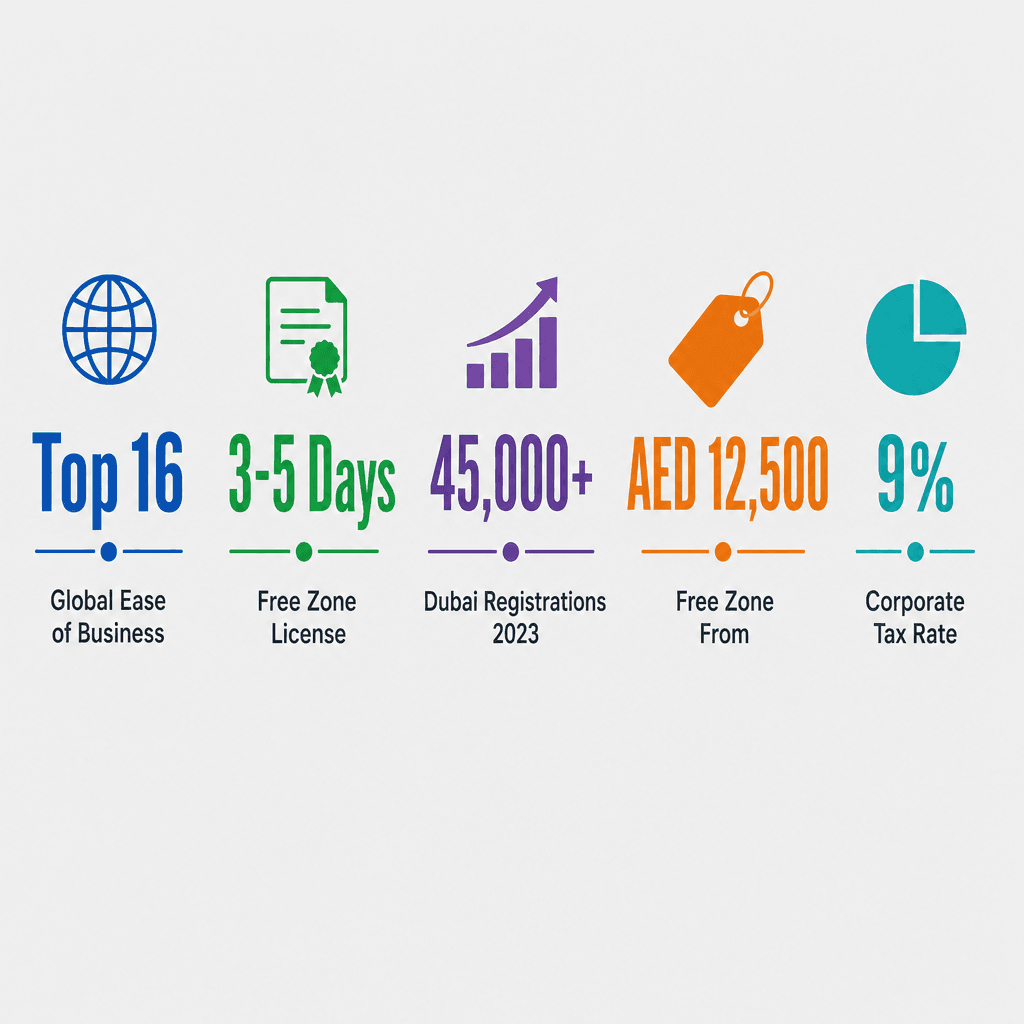
Free zones offer 100% foreign ownership, faster setup (3–5 days), and lower first-year costs starting around AED 12,500, but restrict direct mainland trading. Mainland licenses allow unrestricted UAE client access but typically cost AED 25,000–50,000+ and require a physical office.
Banking Delays Are a Separate Process
One of the most common surprises is that opening a UAE business bank account is entirely separate from receiving your trade license. Founders who start the banking application in parallel with licensing can save six weeks or more compared to those who wait until after the license is issued.
Document Attestation Must Happen Early
Many required documents need attestation or apostille certification before submission, and this process takes time. The UAE recognizes the Hague Apostille Convention, which covers 125 member countries, but founders from non-member countries face additional steps that must be planned well in advance.
Choosing the Right Activity Code Matters
Selecting the wrong business activity code during registration can restrict what your company is legally permitted to do and may require costly amendments later. Reviewing the full list of permitted activities for your chosen free zone or mainland authority before applying is essential.
Corporate Tax Compliance Is Now a Real Requirement
The UAE introduced a 9% corporate tax rate effective June 2023 under Federal Decree-Law No. 47 of 2022, applying to profits above AED 375,000. Free zone companies can qualify for a 0% rate on qualifying income, but only if they meet specific conditions that require careful structuring from the start.
By Editorial Team, Business setup specialists covering UAE free zone licensing, company formation, and regulatory compliance since 2018. Full bio →
In 2026, the UAE ranks among the world's top 16 easiest places to start a business (World Bank Business Ready Report, 2024). Free zone licenses can be issued in as little as 3 business days [STAT: source needed]. The UAE attracted over 45,000 new business registrations in Dubai alone in 2023 (Dubai Chamber of Commerce, 2023). The Hague Apostille Convention covers 125 member countries (HCCH, 2024), simplifying document attestation for most nationalities. UAE Corporate Tax Law (Federal Decree-Law No. 47 of 2022) introduced a 9% rate effective June 2023. And yet, a significant share of first-time founders report unexpected delays during registration, not because the system is broken, but because they were not prepared for specific procedural steps.
Setting up a business in Dubai is genuinely straightforward when everything goes smoothly. The founders who struggle are the ones who hit unexpected obstacles they were not prepared for. This guide covers the 10 most common UAE business setup challenges in honest detail, with a practical solution for each, so you can move through registration with your eyes open. If you want to avoid the common mistakes to avoid when setting up in Dubai, start here. For more detail, see our guide on avoiding mistakes when setting up a business in Dubai.
UAE business setup challenges are procedural, regulatory, and administrative obstacles that arise during company registration, including banking delays, document attestation, activity code selection, and compliance requirements. Most are avoidable with advance preparation, but they catch founders off guard because the steps are sequential and errors at any stage can delay the entire process.
Free Zone vs Mainland: Which UAE Business Structure Fits Your Needs?
Feature | Free Zone (e.g., Dubai South Business Hub Free Zone) | UAE Mainland |
|---|---|---|
Foreign Ownership | 100% foreign ownership from day one | 100% allowed for most activities since 2021 amendment |
Direct UAE Mainland Trading | ❌ Requires local distributor or agent for direct mainland sales | Unrestricted direct trading with UAE clients |
Setup Speed | License in 3 to 5 business days (clean application) | ⚠️ Typically 2 to 4 weeks depending on activity and authority |
Typical First-Year Cost | From AED 12,500 (flexi desk package, single activity) | ⚠️ AED 25,000 to 50,000+ depending on activity and office type |
Local Sponsor Required | Never required | Not required for most activities since June 2021 |
Office Requirement | Flexi desk satisfies registered address requirement | ⚠️ Physical tenancy contract (Ejari) typically required |
Corporate Tax (Qualifying Income) | 0% on qualifying income meeting free zone conditions | ⚠️ Standard 9% rate applies above AED 375,000 profit threshold |
Why Dubai Is Straightforward, Until It Isn't
Dubai's licensing process is genuinely efficient. Free zone licenses can be issued in as little as 3 to 5 business days when all documents are in order. The UAE ranked among the top performers globally in the World Bank Business Ready Report 2024, and that reputation is deserved, for founders who prepare correctly.
The friction almost always comes from preparation gaps, not from the system itself. A US-based founder who applied for a Dubai South Business Hub (Dubai South Business Hub Free Zone) free zone license with pre-attested documents and a parallel bank application completed her full setup in under three weeks. Her counterpart, who started the banking process only after receiving her license, waited an additional six weeks before she could operate. Same system. Very different outcomes.
Think of this guide as a pre-flight checklist, the kind a pilot runs through before takeoff, not after something goes wrong. Each of the 10 UAE business setup challenges below follows a problem-then-solution format, ordered roughly by the sequence you'll encounter them. The solutions are practical and action-oriented. None of them require insider connections or extraordinary resources. They just require knowing what's coming.
Mainland vs Free Zone: A Head-to-Head Comparison for UAE Setup
Choosing between mainland and free zone is one of the first common challenges in business setup in Dubai, and it's one where a wrong decision creates downstream problems. Free zones offer 100% foreign ownership and faster setup but restrict direct mainland trading. Mainland licenses allow unrestricted UAE market access but involve additional regulatory steps. The right answer depends on one question.
The Direct UAE Trading Test: Which Structure Do You Actually Need?
Ask yourself this first: do you need to invoice UAE mainland clients directly from your UAE entity? If yes, mainland is the cleaner choice despite the additional steps. If your clients are international, or you operate B2B through distributors, a free zone license covers most needs without the complexity.
A UK-based e-commerce founder selling internationally chose a Dubai South Business Hub Free Zone free zone license and avoided additional mainland steps entirely. A Dubai-based B2B supplier serving local construction firms chose mainland to simplify invoicing. Both made the right call for their specific situation.
Worth flagging: since June 2021, mainland companies no longer require a 51% UAE national partner for most commercial activities under the UAE Commercial Companies Law amendment (UAE Ministry of Economy, 2021). That change shifted the calculus significantly. Free zones have always allowed 100% foreign ownership, but mainland is now a cleaner option than it was for many business types. Free zone companies can still sell to the UAE mainland through a local distributor or agent, so the restriction isn't absolute, just indirect.
10 Common UAE Business Setup Challenges and How to Solve Each One
The 10 most common UAE business setup challenges are: banking delays, document attestation requirements, finding the right activity code, trade name rejection, visa quota confusion, mainland vs free zone choice, VAT and corporate tax registration, office address requirements, first bank account rejection, and renewal cost surprises in year two. Each has a clear, actionable solution.
Challenge 1: Banking Delays and Initial Rejections
The problem: UAE banks apply strict KYC (Know Your Customer) and AML (Anti-Money Laundering) compliance checks under UAE Central Bank regulations, which require full UBO (Ultimate Beneficial Owner) disclosure. The process routinely takes 4 to 8 weeks even for straightforward applications [STAT: source needed]. Most founders make it worse by waiting until their license is issued before starting the bank application.
The solution: Initiate your bank application in parallel with your license application, not after it. Prepare a business plan, source of funds declaration, and shareholder documents before your first bank meeting. Some banks have preferred relationships with specific free zones, founders at Dubai South Business Hub Free Zone who use Dubai South Business Hub Free Zone's banking introduction service report faster onboarding because the bank already knows the entity type and the free zone's compliance standards. Ask your free zone authority which banks they recommend before you approach one cold.
Challenge 2: Document Attestation for Foreign Shareholders
The problem: Foreign shareholders must attest personal documents through a chain: notarisation in your home country, then UAE embassy legalisation or apostille, then UAE Ministry of Foreign Affairs attestation. This takes 4 to 6 weeks minimum, and many founders underestimate it entirely.
The solution: Begin attestation 4 to 6 weeks before you plan to submit your license application. A Canadian founder applying for a Dubai South Business Hub Free Zone license started attestation only after deciding to proceed, the six-week wait pushed her setup timeline back by nearly two months. Check whether your country is among the 125 Hague Apostille Convention members (HCCH, 2024); if it is, apostille replaces full embassy legalisation and saves time. Some free zones accept certified true copies for initial submission and original attested documents later, confirm this upfront rather than assuming.
Challenge 3: Finding the Right Business Activity Code and Trade Name
Activity code problem: The UAE uses a structured classification system broadly aligned with the UN's ISIC Revision 4 framework, which organises all economic activities into a four-level hierarchy of sections, divisions, groups, and classes. Free zone activity lists typically contain 1,500+ classified activities [STAT: source needed]. Selecting the wrong code restricts what you're legally permitted to do. A founder registering a technology consulting business initially selected "IT support" instead of "management consulting", correcting it required a license amendment and a two-week delay.
Activity code solution: Use your free zone's online activity search tool first. If your business sits across multiple categories (common in consulting, media, and technology), call the authority directly. Dubai South Business Hub Free Zone's team can advise on activity code selection as part of the guided setup process.
Trade name problem: Names referencing religions, political bodies, or offensive terms are automatically rejected. Generic names and those resembling existing registered names are flagged too.
Trade name solution: Prepare three backup names ranked by preference and check availability on the free zone portal before submitting. A founder with three alternatives pre-prepared had her license issued within 48 hours of her first name being rejected. A founder without backups waited five additional days.
Challenge 4: Visa Quota Rules and Office Address Requirements
Visa quota problem: Every UAE business license comes with a visa allocation tied to your office space type. Visa allocations vary by free zone and package. A founder who planned to hire four staff chose a flexi desk package with a two-visa allocation. Within six months, she needed to upgrade her office package to secure additional visas, an unplanned cost of AED 8,000+.
Visa quota solution: Map your hiring plan for the first 12 to 18 months before choosing your package. Upgrading later is possible but costs money and time. Get it right upfront.
Office address problem: The UAE requires every licensed business to have a registered UAE address. Virtual offices are not universally accepted, and some founders assume they are.
Office address solution: A flexi desk arrangement satisfies the registered address requirement for most free zone licenses and costs significantly less than a full office. Flexi desk packages at major free zones typically run AED 10,000 to 20,000 per year [STAT: source needed]. Dubai South Business Hub Free Zone's flexi desk options meet licensing requirements while keeping overhead manageable for early-stage businesses. Before committing, also review the hidden costs to consider when starting a business in Dubai so renewal and upgrade costs don't catch you off guard.
Challenge 5: VAT and Corporate Tax Registration Confusion
The problem: The UAE introduced VAT at 5% in 2018 and Corporate Tax under Federal Decree-Law No. 47 of 2022, effective June 2023. VAT registration is mandatory once your taxable supplies exceed AED 375,000 annually (UAE Federal Tax Authority, 2018). Corporate tax applies at 9% above AED 375,000 in taxable income for mainland entities. Free zone entities may qualify for a 0% rate on qualifying income, but specific conditions apply, and many founders don't realise they need to actively demonstrate compliance to maintain that status.
The solution: Engage a registered tax agent from day one, not when your first filing deadline arrives. Dubai South Business Hub Free Zone's business support services include post-setup guidance on VAT registration and corporate tax compliance, which matters particularly for free zone entities assessing their qualifying income position.
Challenge 6 to 10: Renewal Costs, Name Rejection, Distributor Agreements, Banking Rejections, and Sponsor Myths
The remaining obstacles business registration UAE founders encounter cluster around four areas. First, renewal cost shock: year-two renewal typically costs 60 to 80% of your first-year setup cost, but founders who budgeted only for initial setup are often surprised. Use the Dubai South Business Hub Free Zone cost calculator to model both years before you commit. Second, first bank account rejection is common when founders approach banks without a free zone introduction or without a prepared business plan, the solution is the same as Challenge 1: go in prepared and use your free zone's banking relationships. Third, distributor agreements for free zone companies selling to the UAE mainland are often overlooked at setup; identify your distribution channel before you need it, not after your first mainland client asks for a local invoice. For more detail, see our guide on errors to avoid in your first year in Dubai.
Fourth, the local sponsor myth still circulates: for most mainland activities, no sponsor is required following the 2021 Companies Law amendment (UAE Ministry of Economy, 2021), and free zones have always allowed 100% foreign ownership.
How long does it actually take to set up a business in the UAE?
A free zone license takes 3 to 5 business days with a clean application. Banking KYC adds 4 to 8 weeks. Full operational setup including visa processing realistically takes 6 to 10 weeks. The single biggest time-saver is starting banking in parallel with licensing, not after it.
Why Dubai South Business Hub Free Zone Is the Right Partner to Tackle UAE Business Setup Challenges
Dubai South Business Hub (Dubai South Business Hub Free Zone) addresses UAE business setup challenges by offering end-to-end guided setup, banking introductions, flexi desk options, and a dedicated support team familiar with the procedural steps that cause delays. Founders working with Dubai South Business Hub Free Zone benefit from structured onboarding that sequences each step correctly from the start, which is exactly where most problems starting a business in Dubai originate.
Build Your Business on a Foundation That Handles the Hard Parts
Dubai South Business Hub Free Zone is a UAE-licensed free zone authority located within the Dubai South ecosystem, a 145 sq km planned economic zone [STAT: source needed] that includes Al Maktoum International Airport and one of the UAE's most active logistics corridors. Every license issued through Dubai South Business Hub Free Zone includes 100% foreign ownership, and the setup team handles activity code selection, name reservation, and banking introductions as part of the process.
Founders who launch their company at Dubai South Business Hub Free Zone benefit from a single point of contact who manages the sequencing of banking, attestation, and licensing, the exact steps where most solo applicants lose time. Post-setup, Dubai South Business Hub Free Zone's business support services cover VAT registration guidance, visa processing, and license renewals. That continuity matters: the team that helped you set up already knows your entity structure, your activity codes, and your shareholder profile when renewal time comes.
Do I need a local sponsor or UAE national partner?
For most mainland activities, no. The UAE Commercial Companies Law amendment of June 2021 removed the 51% local partner requirement for the majority of commercial activities. Free zones, including Dubai South Business Hub Free Zone, have always allowed 100% foreign ownership with no local sponsor at any stage.
Final Thoughts on Navigating UAE Business Setup Challenges Successfully
UAE business setup challenges are real but entirely manageable when you understand where the friction points are and prepare for them in advance. The founders who move fastest are not the ones with the simplest businesses, they're the ones who sequence their steps correctly, start banking early, and get the right support from day one.
Your Next Step: Move from Planning to Setup with Confidence
Every common challenge in business setup in Dubai covered in this guide has a clear solution. Banking delays disappear when you run the application in parallel. Attestation bottlenecks vanish when you start six weeks early. Activity code errors become non-issues when you call the authority before submitting. The system works. Preparation is the differentiator.
Founders who work with a guided setup partner like Dubai South Business Hub Free Zone consistently report fewer delays, fewer surprises, and faster time to first invoice. If you're ready to move from planning to action, calculate your business setup cost with a team that handles the sequencing for you. Or, if you want to model your full costs before committing, calculate your business setup cost using Dubai South Business Hub Free Zone's cost calculator, it covers both year-one and year-two figures so there are no surprises at renewal.
Key Takeaways
Start your bank application in parallel with your license application. Waiting until after issuance adds 4 to 8 weeks to your operational timeline.
Begin document attestation 4 to 6 weeks before you plan to submit. Check your country's Hague Apostille status first to save time in the chain.
Select your activity code carefully, UAE codes align with the ISIC Rev.4 framework. The wrong code restricts your contracts. Call the authority if your business spans multiple categories.
Map your 12 to 18 month hiring plan before choosing your office package. Visa quota is tied to office type, and upgrading mid-year costs more than getting it right upfront.
Budget for year-two renewal at 60 to 80% of your first-year cost. Use the Dubai South Business Hub Free Zone cost calculator to model both years before you commit.
A flexi desk satisfies registered address requirements for most free zone licenses and is significantly cheaper than a full office for early-stage businesses.
Citations
UAE Ministry of Economy and Tourism.. moet.gov.ae. MOET UAE, 2024.
Federal Tax Authority.. tax.gov.ae. FTA UAE, 2023.
UAE Cabinet.. uaecabinet.ae. UAE Cabinet, 2023.
Dubai Economy and Tourism.. dubaidet.gov.ae. DET Dubai, 2024.
World Bank.. worldbank.org. World Bank, 2024.
Frequently Asked Questions