
Topic Summary
Know the AED 375,000 Mandatory Registration Threshold
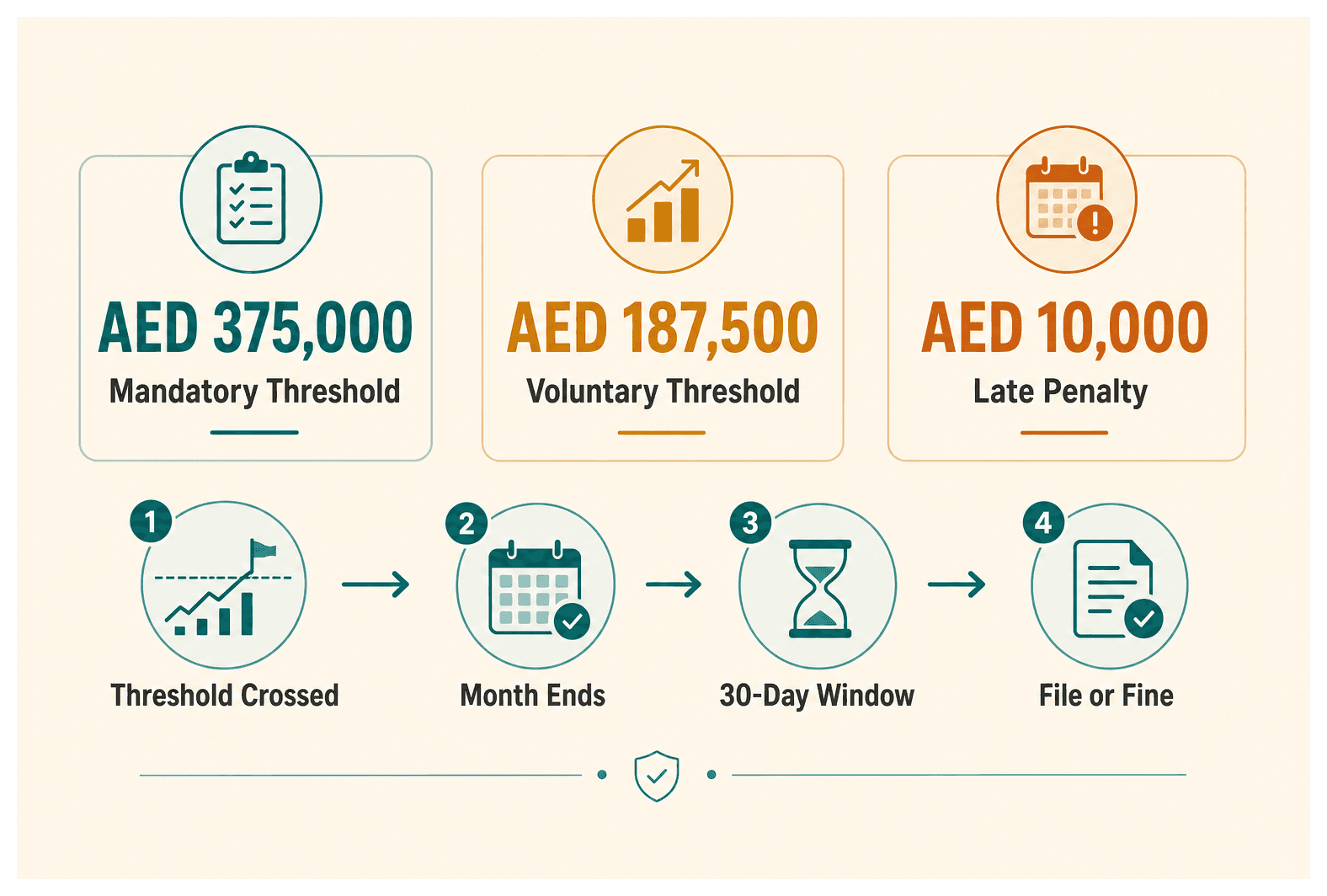
Once your taxable supplies or imports cross AED 375,000 in any trailing 12-month period, VAT registration becomes legally required. Both a backward-looking historic test and a forward-looking test apply, so signed contracts and confirmed purchase orders can trigger the obligation before you actually hit the number.
The 30-Day Clock Starts at Month-End
Most founders assume the deadline runs 30 days from the day the threshold is breached, but the FTA counts from the end of the calendar month in which the breach occurred. Filing even one day after that window closes triggers a flat AED 10,000 penalty with no grace period.
A AED 10,000 Penalty Waits for Late Filers
The Federal Tax Authority issues a flat AED 10,000 fine for missing the VAT registration deadline, and there is no appeal on the penalty itself. Corporate tax late registration carries its own separate AED 10,000 one-time penalty, so the two obligations must be tracked independently.
Voluntary Registration Starts at AED 187,500
Businesses can register voluntarily once taxable supplies reach AED 187,500, well before the mandatory threshold kicks in. This is especially valuable in the startup phase, when high capital expenditure on rent, fit-out, equipment, and software can generate significant recoverable input VAT.
Free Zone Status Does Not Delay Your Obligation
Dubai free zone companies face the same AED 375,000 threshold and 30-day filing window as any mainland UAE business. Duty-suspension treatment for goods in transit is a customs concept entirely separate from VAT registration, and the FTA applies registration rules uniformly regardless of where your license is issued.
Bank Account Delays Can Derail Your Timeline
Opening a bank account for a new free zone company typically takes four to eight weeks, which can easily overlap with your VAT registration window. Starting the banking process immediately after company formation reduces the risk of missing compliance deadlines due to account setup delays.
Build a Compliance Calendar From Day One
Tracking both your cumulative taxable supplies and the end-of-month deadline from the moment your license is issued keeps the AED 10,000 penalty off the table. Once registered, all obligations apply in full, including quarterly or monthly returns, compliant tax invoices, and five-year record retention.
In 2026, the Federal Tax Authority (FTA) issues a flat AED 10,000 penalty to businesses that miss their VAT registration deadline by even one day after crossing the mandatory AED 375,000 taxable supplies threshold (Federal Tax Authority, 2026). The 30-day filing window starts from month-end, not the breach date. The voluntary registration threshold sits at AED 187,500. Corporate tax late registration carries its own separate AED 10,000 one-time flat penalty. And bank account opening for new free zone companies typically takes 4 to 8 weeks, which is long enough to derail your entire timeline if you leave it late.
This guide covers the exact VAT registration timing rules that apply after Dubai company formation: the mandatory threshold, the voluntary threshold, the 30-day filing deadline, the AED 10,000 penalty for missing it, a compliance calendar, and what free zone owners specifically need to watch.
What Is VAT Registration Timing in Dubai and Why It Matters for Your Company
VAT registration timing in Dubai refers to the legal deadline by which a business must register for VAT with the Federal Tax Authority after its taxable turnover crosses AED 375,000 in any 12-month period. Companies have 30 days from the end of that month to file. Missing this window triggers an AED 10,000 penalty with no grace period and no appeal on the penalty itself (Federal Tax Authority, 2026).
The Mandatory Threshold and the 30-Day Rule
The mandatory registration threshold is AED 375,000 in taxable supplies or imports over any trailing 12-month period. Here's the detail most founders get wrong: the 30-day clock starts from the end of the calendar month in which the threshold was breached, not the day it was breached.
Both a historic test (backward-looking over the past 12 months) and a forward-looking test apply. If you expect to exceed AED 375,000 in the next 30 days based on signed contracts or confirmed purchase orders, you must register immediately, before the threshold is actually crossed.
Worked example: A trading company licensed in October 2025 crosses AED 375,000 in cumulative invoices on 20 March 2026. The 30-day window runs to 30 April 2026, not 20 April. Filing on 1 May triggers the AED 10,000 penalty.
The Voluntary Registration Option and When to Use It
Voluntary registration opens at AED 187,500 in taxable supplies or imports. It's worth considering from the moment your license is issued, particularly if you're incurring significant startup costs.
Registering voluntarily lets you reclaim input VAT on rent, office fit-out, equipment, and software before you hit the mandatory threshold. That's real cash back in your first year, when capital expenditure tends to run high relative to revenue. Once registered voluntarily, all VAT obligations apply in full: quarterly or monthly returns, compliant tax invoices, and five-year record retention.
A consulting firm that spent AED 60,000 on office fit-out and software in its first quarter can reclaim that input VAT immediately by registering voluntarily, rather than waiting until the mandatory threshold is reached. Free zone companies face the same thresholds as mainland entities. Being in a free zone does not delay or waive the obligation once taxable supplies exceed AED 375,000 (Federal Tax Authority, 2026).
How VAT Registration Timing Affects Dubai Free Zone Companies
Dubai free zone companies must register for VAT under the same AED 375,000 threshold as any UAE business. Free zone status does not delay or waive registration. Goods moving between free zones may receive duty-suspension treatment, but VAT registration timing rules from the Federal Tax Authority apply uniformly regardless of where your license is issued.
Duty-Suspended Goods vs. VAT Obligations: Clearing Up the Confusion
Free zone goods in transit are duty-suspended, not duty-exempt. Customs duty is deferred, not eliminated. VAT on imports into the UAE is a completely separate obligation governed by the Federal Tax Authority, not by customs authorities.
The key facts to keep in mind:
Duty suspension applies to goods in transit through a free zone, not to VAT on supplies made to UAE customers.
A free zone company making taxable supplies to the UAE mainland must account for VAT on those supplies.
100% foreign ownership is available on both the mainland and in free zones and has no bearing on VAT registration requirements.
A free zone trading company importing electronics for resale to UAE mainland retailers is making taxable supplies. Once invoiced supplies cross AED 50 million, the 30-day VAT registration window opens regardless of where goods cleared customs.
What Changes When Your Free Zone Company Starts Supplying the Mainland
Supplies from a free zone to a UAE mainland customer are treated as imports into the UAE for VAT purposes. Those revenues count toward your AED 375,000 taxable turnover total from the first invoice.
Services are generally taxable regardless of which zone you're licensed in. Inter-free-zone supplies of goods may fall outside the scope of VAT under certain conditions, but you should not assume this applies to your situation without specific advice. A software company licensed at a free zone providing SaaS subscriptions to Dubai mainland clients must include those subscription revenues in its taxable turnover calculation from day one.
Track mainland versus free zone revenue separately from the moment you issue your first invoice. Mixing the two makes it easy to misread your threshold position and miss the VAT registration timing deadline in Dubai. For help understanding which business activities carry different VAT treatments, review the FTA's published guidance before you finalise your license activity list.
Step-by-Step VAT Registration Filing Process in Dubai
To complete VAT registration in Dubai, log in to the Federal Tax Authority's EmaraTax portal, select 'Register for VAT,' upload your trade license, Emirates ID, financial records showing turnover, and bank details, then submit. The FTA reviews the application and issues a Tax Registration Number (TRN), typically within 20 business days (Federal Tax Authority, 2026).
Step 1: Confirm Your Threshold Position Before Filing
Pull 12 months of invoiced revenue (or a shorter period if the company is newer) and total all taxable supplies.
Apply the forward-looking test: if signed contracts or confirmed purchase orders will push you over AED 375,000 in the next 30 days, register now.
Assess whether you qualify for voluntary registration at AED 187,500 and whether early registration improves your input VAT recovery position.
A logistics consultancy with AED 160,000 in year-one revenue and a confirmed AED 250,000 retainer starting next month should register before the retainer begins, not after. Waiting until the invoice is issued means the clock has already started.
Step 2: Gather Required Documents and Access EmaraTax
Before logging into the EmaraTax portal at tax.gov.ae, prepare the following:
Trade license copy (current and valid)
Emirates ID and passport copy of the authorised signatory
UAE bank account IBAN (the FTA requires a local account)
Financial records: audited accounts or management accounts showing turnover
Description of business activities and expected monthly turnover
This is where bank account opening in the UAE becomes critical. Founders who delay banking until revenue starts flowing often find they cannot complete VAT registration on time because the FTA requires a local IBAN as part of the application.
VAT Registration Compliance Calendar for Dubai Companies
Milestone | Deadline / Action Required |
|---|---|
Taxable supplies reach AED 187,500 | Voluntary registration window opens. Assess input VAT recovery position and consider registering early to reclaim startup costs. |
Taxable supplies reach AED 375,000 | Mandatory 30-day clock starts from the end of the calendar month in which the threshold was breached. |
End of breach calendar month | Day zero of the 30-day filing window. Note this date precisely. The clock does not start on the breach date itself. |
Day 30 after month-end | VAT registration application must reach the FTA via EmaraTax. No extensions. Filing on Day 31 triggers the AED 10,000 flat penalty. |
TRN issued by FTA | Issue corrected tax invoices from the effective registration date. If backdated, amend all prior invoices and account for output VAT on historical supplies. |
End of first tax period | First VAT return and payment due to the FTA. Quarterly for most small businesses; monthly for larger registrants. |
Step 3: Submit and Track Your Application
Submit through EmaraTax at tax.gov.ae. No physical submission is required.
The FTA may issue a query requesting additional documents. Respond within the stated timeframe to avoid processing delays.
Once approved, the TRN must appear on all tax invoices from the effective registration date.
The effective date can be backdated to when the threshold was first met. If that happens, any VAT-applicable invoices issued from that date onward must be amended to show VAT, and output VAT on those invoices becomes payable immediately.
VAT Compliance Calendar: Key Dates After Company Formation
After Dubai company formation, track four VAT milestones: the date taxable supplies first cross AED 187,500 (voluntary option opens), the date they cross AED 375,000 (mandatory clock starts), the end of that calendar month (30-day window begins), and the filing deadline 30 days later. Missing the last date costs AED 10,000 (Federal Tax Authority, 2026).
Month-by-Month Compliance Milestones
Month 1 after your license is issued: open your UAE bank account and configure accounting software with a VAT-ready chart of accounts (5% standard rate, zero-rated, and exempt categories as separate tax codes). Every month after that, total your trailing 12-month taxable supplies and flag the moment you approach AED 187,500.
The month you breach AED 375,000, note the calendar month-end date. That is day zero of the 30-day window. Day 30 is your hard filing deadline with no extensions.
A company licensed in January 2026 crosses AED 375,000 on 15 August 2026. Month-end is 31 August. The registration deadline is 30 September 2026. A registration submitted on 1 October attracts the AED 10,000 penalty, regardless of how close it was.
Corporate Tax Registration: A Separate but Parallel Obligation
Corporate tax registration is a distinct obligation from VAT registration timing in Dubai. Missing the corporate tax registration deadline carries its own AED 10,000 one-time flat penalty, separate from any VAT penalty (UAE Ministry of Finance, 2023).
Corporate tax applies to financial years starting on or after 1 June 2023. Most free zone companies must register even if they believe they qualify for the 0% Qualifying Free Zone Person (QFZP) rate. That 0% rate has four strict conditions: adequate substance in the UAE, qualifying income only, transfer pricing compliance, and no election to be taxed at the standard 9% rate. All four must be met simultaneously.
A free zone IT company earning revenue from mainland UAE clients may not qualify for the QFZP rate on those mainland supplies. Those revenues could be taxed at 9%, not 0%. Never assume free zone status alone creates a tax advantage without reviewing each condition against your actual revenue mix.
Common VAT Registration Timing Mistakes Dubai Founders Make
The most common VAT registration timing mistakes in Dubai include miscounting the 30-day window from the breach date rather than month-end, omitting inter-company or related-party supplies from the threshold calculation, and delaying registration because a UAE bank account has not yet been opened. Each mistake risks the AED 10,000 late registration penalty.
Miscounting the Threshold: What Counts and What Does Not
This is where founders consistently trip up. Taxable supplies include both standard-rated (5%) and zero-rated supplies. Both count toward AED 375,000. Exempt supplies do not count.
Counts toward threshold: Standard-rated services and goods (5%), zero-rated exports, imports where you are the importer of record.
Does not count: Exempt supplies such as certain financial services and residential property rental.
Related-party transactions: May be included at fair market value even if invoiced below arm's-length rates.
A company with AED 300,000 in standard-rated services and AED 100,000 in zero-rated exports has AED 400,000 in taxable supplies. That's above the mandatory threshold, even though the exported revenue carries 0% VAT. The VAT registration timing clock in Dubai starts regardless.
Banking Delays That Block Timely Filing
The FTA requires a UAE bank account IBAN as part of the VAT registration application. You cannot submit without it. Bank account opening for new free zone companies typically takes 4 to 8 weeks, depending on the bank, the business activity, and the completeness of your KYC documents.
A trading company licensed in February that waits until April to open a bank account may find itself unable to file VAT registration by a May deadline if the bank account application is still pending. The FTA will not accept the application without a local IBAN, and the penalty clock does not stop for banking delays.
Open your UAE bank account in the same month your license is issued. Treat it as part of the formation process, not as something to handle once revenue starts. For guidance on open bank accounts in the UAE as a new free zone company, start the process the week your license is confirmed.
Is VAT registration timing in Dubai the same for services and goods companies?
Yes. The AED 375,000 mandatory threshold and the 30-day filing window from month-end apply to all taxable persons in the UAE, whether they supply goods or services. The nature of the supply affects the VAT rate applied, not the registration timing obligation.
How to Set Up Your Dubai Company to Stay VAT-Compliant From Day One
To stay VAT-compliant from day one after Dubai company formation, open a UAE bank account immediately, configure accounting software with UAE VAT settings, track taxable turnover monthly against the AED 375,000 threshold, and set a calendar alert for the end of the month in which you expect to cross it. Register before the 30-day window closes.
Accounting and Record-Keeping Requirements
UAE VAT law requires businesses to retain all VAT records for a minimum of five years from the date of issue.
Full tax invoices must include: TRN, supplier name and address, invoice date, description of goods or services, VAT amount, and total payable.
Simplified tax invoices are permitted only for supplies under AED 10,000.
Cloud accounting software with UAE VAT compliance (5% tax codes, zero-rated, and exempt categories) is the practical minimum from the day you issue your first invoice.
A professional services firm issuing monthly retainer invoices of AED 25,000 must issue full tax invoices, not simplified ones, and retain them for five years from the date of issue. Getting this wrong from invoice one creates a compliance gap that's expensive to correct retroactively.
Build a VAT-Ready Company Structure at Formation
Choose your business activities carefully at formation. Different activities carry different VAT treatments, and mixing taxable with exempt supplies in your license from day one means you'll need partial exemption calculations before you file your first return.
A company that includes both consulting (taxable at 5%) and investment holding (potentially exempt) activities in its license needs a partial exemption method agreed with its accountant before the first return is due, not after the FTA issues a query. Appoint a tax agent or qualified finance manager before you approach the AED 375,000 threshold, not after you've crossed it.
If you're looking to set up a company with a structure that keeps early-stage compliance costs manageable, Dubai South Business Hub Free Zone offers licenses from AED 12,500, issued in one day, with zero paid-up share capital required. That leaves more working capital available for accounting software, a tax agent, and the banking setup you need to meet VAT registration timing obligations in Dubai from the outset. Visas are always an additional cost; the first-year cost for a sole founder with one visa starts from AED 18,350. Each activity beyond the first five costs AED 2,000. Dubai South Business Hub Free Zone launched in September 2025 and is not a designated zone, so standard UAE VAT rules apply in full.
Do I need to register for VAT before I start trading in Dubai?
Not necessarily. You only need to register for VAT before your taxable supplies exceed AED 375,000 in any 12-month period, or immediately if you expect to cross that threshold in the next 30 days. Voluntary registration is available from AED 187,500 if early input VAT recovery is beneficial.
Final Checklist: VAT Registration Timing in Dubai
VAT registration timing in Dubai is governed by a hard 30-day deadline from the month-end in which taxable supplies cross AED 375,000. Missing it costs AED 10,000. Free zone status does not alter the rule. Open your UAE bank account at formation, track turnover monthly, and file before the window closes.
References
Frequently Asked Questions