
Topic Summary
Know Your VAT Registration Threshold
Businesses with taxable supplies or imports exceeding AED 375,000 annually must register for VAT. Voluntary registration is available once supplies exceed AED 187,500, which can help startups recover VAT on expenses and boost credibility.
Free Zone Companies Are Not Automatically Exempt
Operating in a UAE free zone does not automatically exempt a business from VAT obligations. VAT treatment depends on the nature of the supply, the place of supply, and the parties involved rather than business location.
Register Online Through the FTA Portal
VAT registration is completed entirely online via the Federal Tax Authority portal at tax.gov.ae. The process involves creating an account, entering business details, uploading documents, and tracking your application status.
Gather the Right Documents Before Applying
A valid trade license, passport copies, Emirates ID, and financial records are typically required for a successful application. Submitting incomplete or mismatched documents is one of the most common causes of delays or rejections.
Avoid Late Registration Penalties
Failing to register once the mandatory threshold is exceeded can result in administrative fines from the FTA. Late VAT return filing or payment can also trigger additional penalties and interest charges, even if registration was completed correctly.
VAT Registration Is Separate From Company Formation
Setting up a company in the UAE does not automatically complete VAT registration. Businesses must independently assess their VAT obligations and apply through the FTA once applicable thresholds are met.
VAT (Value Added Tax) was introduced in the UAE in 2018 at a standard rate of 5% and applies to businesses whose taxable supplies exceed AED 375,000 annually. It is administered by the Federal Tax Authority (FTA) and applies to most goods and services supplied in the UAE, including those provided by free zone companies.
As a business grows, understanding when VAT registration becomes mandatory and how to apply correctly is essential to remain compliant and avoid penalties. VAT registration is completed online through the FTA portal and becomes compulsory once the turnover threshold is exceeded. For more detail, see our guide on verifying a TRN in Dubai. For more detail, see our guide on VAT registration for service businesses in Dubai. For more detail, see our guide on UAE VAT registration threshold explained.
According to official guidance published by the Federal Tax Authority (https://www.tax.gov.ae), timely registration helps businesses avoid administrative fines and operational disruptions. Free zone companies are not automatically exempt from VAT, as VAT treatment depends on the nature of the transaction rather than the business location. For more detail, see our guide on difference between corporate tax and VAT.
This blog explains who needs to register for VAT in the UAE, how the registration process works, and what documents are required. For more detail, see our guide on invoicing for UAE content creators. For more detail, see our guide on UAE VAT registration for digital services.
Who Needs to Register for VAT?
A business must apply for VAT registration if its taxable supplies or imports exceed the mandatory threshold of AED 375,000.
The voluntary registration is permitted in case of taxable supplies over AED 187,500. Many startups prefer voluntary VAT registration to enhance business credibility and recover VAT on business expenses.
Corporations, which work in the free zones, are not relieved of the VAT automatically. VAT treatment depends on the nature of the supply, the place of supply, and the parties involved, rather than solely on whether a business is based in a free zone.
How to apply for VAT registration in the UAE?
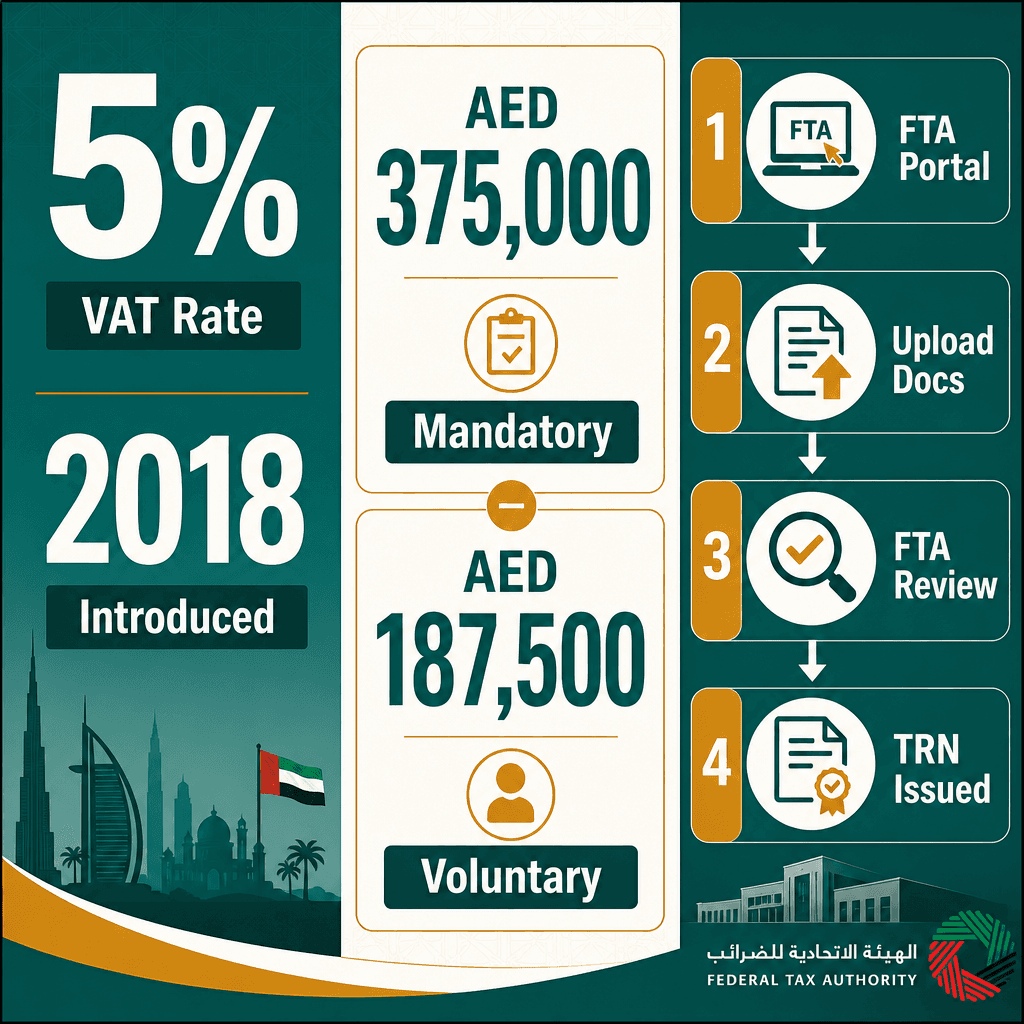
Registration of VAT is done online at Federal Tax Authority portal. It involves a creation of an account, an input of business information, and uploading of papers to be reviewed.
The portal will enable the businesses to monitor application status and deal with VAT returns after registration. Once the application is submitted, the Federal Tax Authority reviews the details and supporting documents. Processing timelines vary and may take several working days or longer, depending on the accuracy of information and whether additional clarification is required. For more detail, see our guide on VAT deregistration after closing a UAE business.
VAT registration is a separate compliance requirement and is not automatically completed during company formation. Businesses established in free zones must independently assess their VAT obligations, and apply for VAT registration through the Federal Tax Authority once the applicable thresholds are met.
Step by step guide for registering on the FTA Portal:
Documents needed to register VAT in the UAE:
1) Expired trade license
Mismatch between the trade license activity with the VAT classification may also cause the rejection of the application or audit flags.
2) Free Zone and mainland license
There is a misunderstanding among the companies that operate within the free zones when it comes to their VAT responsibilities. Not all free zone activities are subject to the same VAT and an incorrect issued license might lead to confusion in the registration.
3) Incomplete record keeping
Processing is deterred and the applicant may become obliged to start the application process again because of incomplete submissions.
4) Late VAT registration
Failing to register for VAT within the required timeframe after exceeding the threshold can result in administrative penalties.
Late VAT return filing or payment
Submitting VAT returns after the deadline or paying VAT late can lead to penalties and interest, even if registration was completed correctly.
Consequences of Non-Compliance
The FTA levies administrative fines for late registration, erroneous returns, or late payment. The Federal Tax Authority may impose administrative fines for late registration, incorrect returns, or late payment. Continued non-compliance can lead to increased scrutiny, audits, and further regulatory action. Being proactive and seeking advice from the appropriate professionals prevented that from happening.
Taking everything into consideration
Filing VAT in the UAE does not have to be a headache when companies know what they are reporting and have good financial records. Consistent and accurate VAT returns are necessary for the purpose of stating liability to the Federal Tax Authority and to reflect the liabilities properly. Timely filing of returns also enables the business to avoid administrative penalties, interest for late payment and scrutiny in the form of audit. By monitoring taxable supply, input tax and source invoices all the way through the tax period, businesses can finish their VAT return more effectively and consistently comply with local tax legislation. For more detail, see our guide on VAT refunds for UAE companies. For more detail, see our guide on UAE VAT guide for businesses.
FAQs:
VAT registration timelines vary depending on the completeness of documents and the nature of the business. Applications may be processed within several working days, but delays can occur if additional information is requested by the Federal Tax Authority.
Emirates ID is recommended but not mandatory. Passport and visa documents are accepted for non-resident shareholders.
Yes. Free zone companies must register if they meet VAT thresholds, depending on their business activities.
Registration is completed through the Federal Tax Authority portal by submitting business details and documents digitally.
Yes. Deregistration is possible if taxable turnover falls below the threshold or business operations cease.
Useful Resources
UAE corporate tax explained
Citations
Federal Tax Authority.. tax.gov.ae. FTA UAE, 2023.
Federal Authority for Identity, Citizenship, Customs and Port Security.. icp.gov.ae. ICP UAE, 2024.
Dubai Economy and Tourism.. dubaidet.gov.ae. DET Dubai, 2024.
Ministry of Human Resources and Emiratisation.. mohre.gov.ae. MOHRE UAE, 2024.
General Directorate of Residency and Foreigners Affairs Dubai.. gdrfad.gov.ae. GDRFA Dubai, 2024.
Frequently Asked Questions