Topic Summary
Free Zone Versus Mainland: Choosing the Right Structure for Egyptian Founders
Free Zone Versus Mainland: Choosing the Right Structure for Egyptian Founders
Residency Visa Rules and Timelines for Egyptian Nationals
Residency Visa Rules and Timelines for Egyptian Nationals
Step-by-Step Guide to What Egyptian Founders Need to Know Before Setting Up in Dubai
Choose an activity, select a package, submit documents, receive the license, then apply for residency, banking and tax. Most stages run digitally. Our guide to Dubai company setup for foreign entrepreneurs lists the documents.
Tax, VAT and Compliance Obligations Founders Often Overlook
UAE companies register with the Federal Tax Authority for corporate tax, set at 9% on taxable profits above AED 375,000 under Federal Decree-Law No. 47 of 2022 (FTA, 2026). Qualifying Free Zone Person status can bring a preferential rate.
Banking, Costs and Common Mistakes to Avoid
Budget for license, visa, medical, Emirates ID and banking costs. Banks review activity and source of funds closely. Present contracts and invoices from Egyptian clients to prove substance, and allow time for review.
Your Next Step
What Egyptian founders need to know before setting up in Dubai comes down to four early decisions: structure, an accurate activity, a visa plan and a tax and banking routine. Review your activity and visa needs, then speak with a Dubai South Business Hub consultant about a free zone package.
What Egyptian founders need to know before setting up in Dubai is the set of legal, visa, tax and banking rules that apply to a non-UAE national forming a company. Learn them first and you avoid rejected applications, wasted fees and delayed licenses.
Dubai issues over 30,000 new business licenses a year (Dubai Chamber, 2024), and the UAE sits among the top 20 economies for ease of doing business (World Bank, 2024). Egyptian applicants are a growing part of that pool.
Free Zone vs Mainland for Egyptian Founders
Feature | Free Zone (Dubai South Business Hub) | Mainland |
|---|---|---|
Foreign ownership | Full foreign ownership | Available for most activities, depending on the activity |
Licensing authority | Dubai Department of Economy and Tourism | |
Setup speed | Same-day digital registration | Longer, with more approvals |
Direct UAE market trade | Needs extra arrangements | Permitted directly |
Visa eligibility | Visa packages tied to the license | Quota tied to office space |
Why Preparation Changes Your Outcome
Most delays come from incomplete documents or a mismatched activity, not the regulator. Picture a Cairo software consultant who picks an activity that doesn't match her services. She must amend the license before she can even apply for a visa.
Who This Guide Is For
It suits Egyptian entrepreneurs forming a new company and owners relocating existing operations, such as an Alexandria trader serving Gulf customers. If you're deciding whether to travel, read how to set up a company in Dubai remotely.
Free Zone Versus Mainland: Choosing the Right Structure for Egyptian Founders
A free zone such as Dubai South Business Hub Free Zone allows full foreign ownership and quick digital licensing, but trading directly with the mainland needs extra arrangements. Your target customers should decide the structure. For a deeper comparison, see free zone vs mainland business setup.
Ownership and Licensing Differences
Free zone licenses cover trading, service, e-commerce and industrial activities. An Egyptian consultant serving overseas clients would pick a service license for speed and cost control.
Matching Structure to Your Customer Base
Export, regional and online models fit a free zone well.
Heavy UAE retail or government work may need mainland.
Activity wording governs what you may legally do.
Residency Visa Rules and Timelines for Egyptian Nationals
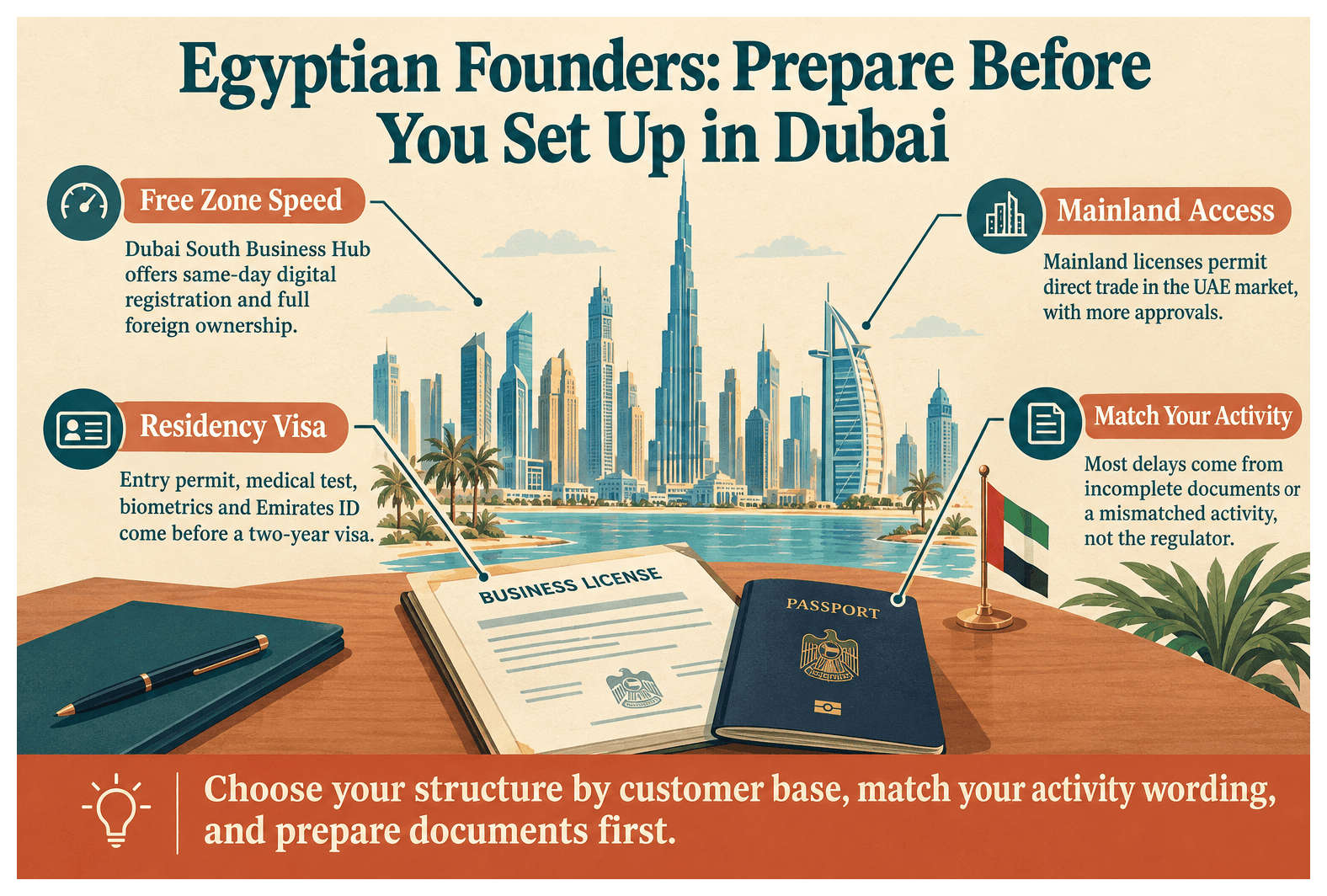
An Egyptian founder gains UAE residency through a visa linked to the company license. After the entry permit, medical test, biometrics and Emirates ID registration with the Federal Authority for Identity, Citizenship, Customs and Port Security (ICP, 2026), the residency visa is stamped, typically valid for two years.
How the Investor Residency Visa Works
The visa depends on an active license and your shareholder status. Quota follows your license and workspace package.
Hiring Staff and Labor Compliance
MOHRE regulates work permits and contracts (MOHRE, 2026).
Employee visas are separate from yours.
Register contracts for engineers you bring from Egypt.
Step-by-Step Guide to What Egyptian Founders Need to Know Before Setting Up in Dubai
Choose an activity, select a package, submit documents, receive the license, then apply for residency, banking and tax. Most stages run digitally. Our guide to Dubai company setup for foreign entrepreneurs lists the documents.
Step 1: Define Your Activity and Package
Match wording to real services.
Pick shareholders, capital and visa quota.
Registration can be same-day and digital.
Step 2: Submit Documents and Receive the License
Passport copies, photo and proof of address.
Sign and pay online from Cairo.
The license arrives by email.
Step 3: Complete Visa, Bank Account and Tax Registration
Entry permit, medical test, Emirates ID.
Prepare a business plan and proof of funds.
Book the bank appointment during the same trip.
Tax, VAT and Compliance Obligations Founders Often Overlook
UAE companies register with the Federal Tax Authority for corporate tax, set at 9% on taxable profits above AED 375,000 under Federal Decree-Law No. 47 of 2022 (FTA, 2026). Qualifying Free Zone Person status can bring a preferential rate.
Corporate Tax and Qualifying Free Zone Status
Qualifying income rules are strict. A service company should test its revenue mix before assuming the preferential rate applies.
VAT, Accounting and Egyptian Tax Residency
Register for VAT once turnover passes the mandatory threshold.
Keep books and annual accounts.
Confirm Egyptian tax residency with an adviser.
Banking, Costs and Common Mistakes to Avoid
Budget for license, visa, medical, Emirates ID and banking costs. Banks review activity and source of funds closely. Present contracts and invoices from Egyptian clients to prove substance, and allow time for review.
Five Costly Errors First-Time Founders Make
Choosing the wrong activity.
Ignoring visa quota limits.
Skipping tax registration.
Submitting unclear shareholding papers.
Delaying bank preparation.
One startup paid for an amendment because its activity missed its main revenue source. More in common mistakes for first-time founders.
Your Next Step
What Egyptian founders need to know before setting up in Dubai comes down to four early decisions: structure, an accurate activity, a visa plan and a tax and banking routine. Review your activity and visa needs, then speak with a Dubai South Business Hub consultant about a free zone package.
References
Frequently Asked Questions