Topic Summary
What Is Running a Dubai Company From Abroad
Running a Dubai company from abroad means keeping your free zone license active, your corporate tax and VAT filings current, and your company documents renewed while you're physically outside the UAE for extended periods, even if your residency visa lapses.
Company Owner Leaves UAE Rules That Apply to Your License
A UAE trade license continues as a legal obligation after the owner leaves the country. License renewal fees, establishment card renewals, and VAT or corporate tax filing deadlines all remain active. Operating the company through a power of attorney holder is permitted, but the license itself must stay current and in good standing regardless of where the owner is physically located.
Corporate Tax and VAT for a Non Resident Company Owner in Dubai
A non resident company owner in Dubai still owes 9% corporate tax on net profit above AED 375,000 and must file VAT returns if turnover crosses the mandatory threshold. Residency status doesn't exempt the company from Federal Tax Authority obligations.
Steps to Keep Running Dubai Company From Abroad Without Penalties
Keeping a Dubai company compliant from abroad follows five steps: appoint a signatory, renew the license on schedule, keep tax filings current, monitor visa status, and maintain a local correspondence address for government notices.
Documents, Cost and Timing for a Non Resident Company Owner in Dubai
Expect passport copies, power of attorney, and license renewal paperwork as core documents. Package pricing runs from AED 12,500 for a zero-visa setup to AED 18,200 for two visas, with renewal cycles typically completing within 4 to 6 weeks.
Common Mistakes Non Resident Founders Make Running a Dubai Company From Abroad
Founders running a Dubai company from abroad most often miss VAT registration thresholds, let their establishment card lapse, or assume ancillary support activities like bookkeeping don't need accurate record-keeping under DET rules.
Final Thoughts on Running Dubai Company From Abroad
Running a Dubai company from abroad is fully workable when the license, tax filings, and visa status are tracked on schedule. The rules don't change because the owner is overseas; the paperwork simply needs a reliable process behind it.
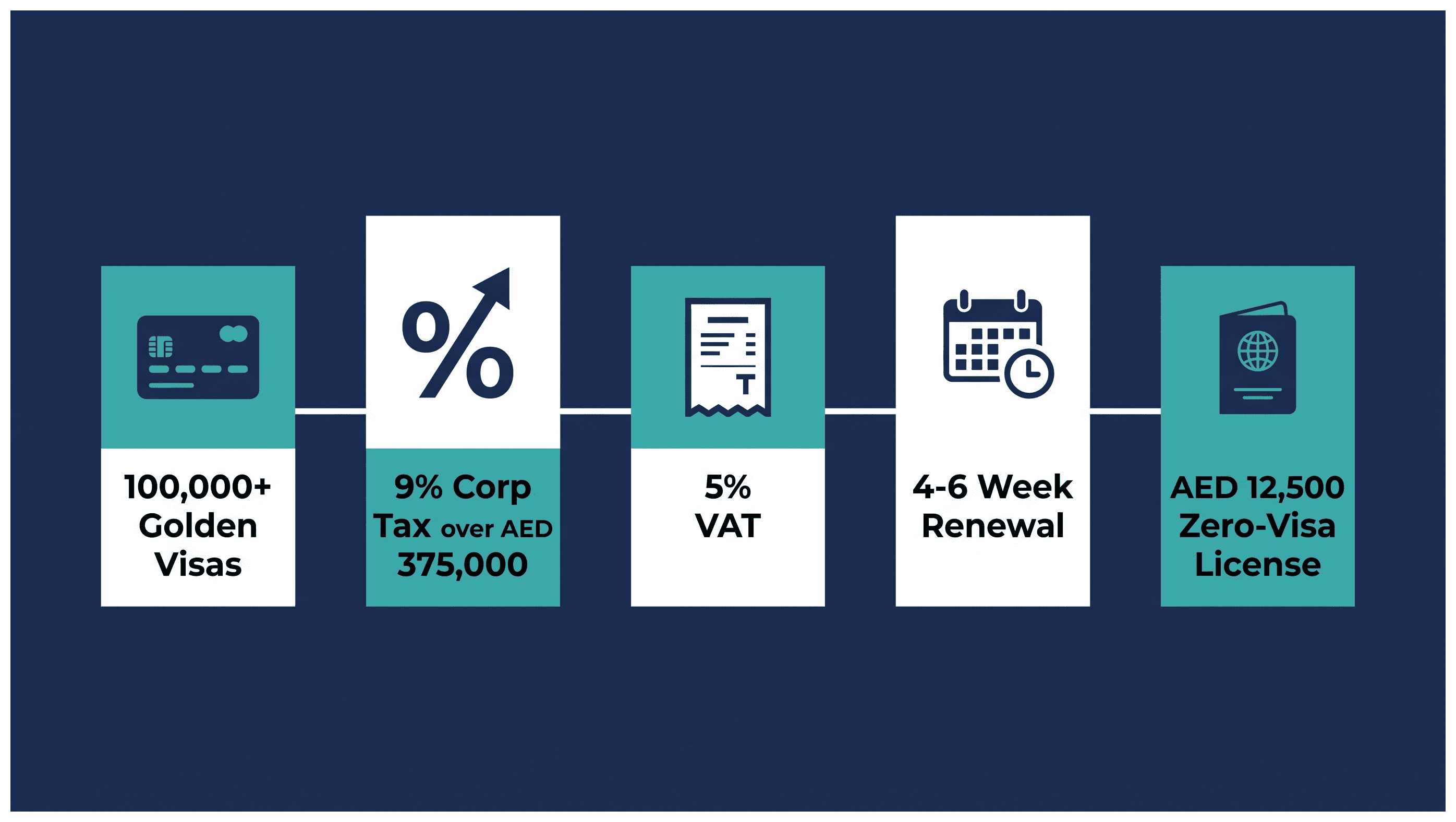
In 2026, over 100,000 Golden Visas have been issued across the UAE, and a growing share of holders now run their license from outside the country [1]. Running a Dubai company from abroad is more common than most founders expect. Roughly 9% corporate tax applies above AED 375,000 net profit regardless of residency [2]. VAT sits at 5% on most taxable supplies [3]. License renewal cycles typically run 4 to 6 weeks. Establishment cards need active tracking through ICP, even overseas. This guide sets the rule first, then who it applies to, the documents needed, the cost, and realistic timing for running a Dubai company from abroad.
What Is Running a Dubai Company From Abroad
Running a Dubai company from abroad means keeping your free zone license active, your corporate tax and VAT filings current, and your company documents renewed while you're physically outside the UAE for extended periods, even if your residency visa lapses.
License Ownership Does Not Require Physical Presence
A free zone license stays valid no matter where the owner lives. Shareholders can sign renewals remotely using a power of attorney. Physical presence only matters for specific appointments, like biometric capture for Emirates ID. A founder who set up a company at Dubai South Business Hub Free Zone and later relocated to London can renew that license online each year without ever flying back. The zero-visa package starts at AED 12,500, and it's built exactly for this kind of setup.
Who This Applies To
Sole shareholders relocating permanently for personal reasons.
Partners splitting time between two countries throughout the year.
Investors who never intended to reside in the UAE full time.
Founders managing a UAE license while employed elsewhere.
Company Owner Leaves UAE Rules That Apply to Your License
When a company owner leaves the UAE, the license itself remains active, but the owner's residency visa is affected if it was tied to that establishment card. ICP requires visa cancellation or renewal tracking, and Emirates ID status changes accordingly.
Visa Status Once You Depart
Residency visas linked to a license don't auto-cancel the moment you board a flight. But overstaying outside the UAE beyond set periods can trigger visa invalidation under GDRFA rules [4]. GDRFA tracks re-entry timelines for residency holders, and letting that window lapse creates real friction later. Worth flagging: this is separate from the license status, which keeps running independently.
Establishment Card and Sponsorship Obligations
The establishment card must stay current for any visa quota tied to the company. Sponsors abroad can still process renewals through an authorized signatory, so distance alone isn't a blocker. Failure to renew risks fines that stack up on the immigration file, sometimes silently, until you try to sponsor a new hire.
Checklist Before You Relocate
Confirm your license expiry date well in advance.
Set up power of attorney for remote signing.
Update Emirates ID and visa renewal reminders.
Register a UAE mailing address for correspondence.
What happens to my visa if I leave the UAE for six months?
Your residency visa may be flagged for review by GDRFA. Renewal windows vary by visa type. Check your specific re-entry period before departure to avoid invalidation.
Corporate Tax and VAT for a Non Resident Company Owner in Dubai
A non resident company owner in Dubai still owes 9% corporate tax on net profit above AED 375,000 and must file VAT returns if turnover crosses the mandatory threshold. Residency status doesn't exempt the company from Federal Tax Authority obligations.
Corporate Tax Registration Stays Mandatory
Nearly every licensed entity must register for corporate tax under Federal Decree-Law No. 47 of 2022 [2]. The 9% rate applies above AED 375,000 net profit annually, and filing deadlines run regardless of where the owner resides. Miss a deadline from London or Riyadh, and the Federal Tax Authority applies the same penalty schedule as it would locally.
VAT Filing From Overseas
The standard 5% VAT rate applies on most taxable supplies [3]. Here's something founders get wrong: Dubai South Business Hub Free Zone is not a designated zone for VAT purposes, so standard VAT rules apply to transactions within it. Goods held in the free zone are duty-suspended, not duty-exempt, and that distinction matters when calculating landed costs.
DSBH License Package Pricing for Owners Relocating Abroad
Feature | Package | Standard Price |
|---|---|---|
0 Visa Package | Best for owners who won't need UAE residency | AED 12,500 |
1 Visa Package | Covers the owner's own residency visa | AED 16,350 |
2 Visa Package | Suits partners or a spouse dependent visa | AED 18,200 |
Renewal cycle | Applies to all package tiers | 4 to 6 weeks |
Corporate tax | Applies once profit crosses the threshold | 9% above AED 375,000 net profit |
Steps to Keep Running Dubai Company From Abroad Without Penalties
Keeping a Dubai company compliant from abroad follows five steps: appoint a signatory, renew the license on schedule, keep tax filings current, monitor visa status, and maintain a local correspondence address for government notices.
Step 1: Appoint a Local Signatory
A power of attorney lets someone sign on your behalf.
Reduces delays on license renewals and bank matters.
Cuts down courier trips for wet-ink signatures.
Step 2: Renew the License on Time
Set calendar reminders 60 days before expiry.
Late renewal often triggers fines and immigration freezes.
Bundle renewal with your annual audit if applicable.
Step 3: File Tax Returns Remotely
Corporate tax and VAT portals work from anywhere.
Keep an accountant on retainer for deadlines.
Digital signatures speed up FTA submissions.
Step 4: Track Visa and Emirates ID Status
Confirm re-entry windows with GDRFA.
Renew Emirates ID before travel where possible.
Flag expiry dates months, not weeks, ahead.
Documents, Cost and Timing for a Non Resident Company Owner in Dubai
Expect passport copies, power of attorney, and license renewal paperwork as core documents. Package pricing runs from AED 12,500 for a zero-visa setup to AED 18,200 for two visas, with renewal cycles typically completing within 4 to 6 weeks.
Required Documents
Passport copy and attested power of attorney.
Updated shareholder resolution if ownership changes.
Proof of overseas address for correspondence.
Package Pricing Breakdown
Zero-visa package: AED 12,500.
One-visa package: AED 16,350.
Two-visa package: AED 18,200.
Typical Timing
License renewal cycles often take 4 to 6 weeks from submission to approval. Emirates ID biometric slots open within days of an active card. If you're planning a trip back for biometrics, book it early, since slots fill fast during peak renewal months. You can also calculate your business setup cost before committing to a package.
Common Mistakes Non Resident Founders Make Running a Dubai Company From Abroad
Founders running a Dubai company from abroad most often miss VAT registration thresholds, let their establishment card lapse, or assume ancillary support activities like bookkeeping don't need accurate record-keeping under DET rules.
Ignoring VAT Registration Thresholds
Turnover crossing the mandatory threshold triggers registration duty automatically. Missing this can mean backdated penalties from the Federal Tax Authority, calculated from the month you should have registered, not the month you noticed.
Letting the Establishment Card Lapse
An expired card blocks visa renewals and new hires entirely. A trading company owner who moved to Riyadh let the establishment card expire, delaying a new hire's visa by three months. Renewal should be filed well before expiry, ideally alongside your business activities review.
Final Thoughts on Running Dubai Company From Abroad
Running a Dubai company from abroad is fully workable when the license, tax filings, and visa status are tracked on schedule. The rules don't change because the owner is overseas; the paperwork simply needs a reliable process behind it.
Building a Remote Compliance Routine
Set recurring calendar checkpoints for tax and license dates. Keep a trusted local contact for urgent government matters, someone who can act on a power of attorney at short notice. This single habit prevents most of the penalties founders run into.
Important Considerations
Running a Dubai company from abroad requires proactive, not reactive, management.
Renew documents ahead of deadlines, not after reminders arrive.
Use a local business support service for PRO tasks.
Running a Dubai company from abroad comes down to discipline: renew on time, file taxes on schedule, and keep your visa status tracked, and the license keeps working exactly as it would if you'd never left. Ready to structure your company for life abroad? Start your business at Dubai South Business Hub Free Zone and build a setup that travels with you.
References
ICP - Federal Authority for Identity, Citizenship, Customs and Port Security, 2025
Federal Tax Authority, 2025
General Directorate of Residency and Foreigners Affairs Dubai, 2025
Dubai Department of Economy and Tourism, 2025
Ministry of Finance UAE, 2025
Frequently Asked Questions