Topic Summary
What Kenyan Founders Need to Know Before Setting Up in Dubai and Why It Matters
What Kenyan founders need to know before setting up in Dubai covers the licensing, ownership, visa, tax and banking rules that decide whether your launch runs smoothly. Learn them first and you avoid rejected files, wasted fees and weeks of delay.
Choosing the Right Free Zone License and Ownership Structure
Choosing the Right Free Zone License and Ownership Structure
Residency Visa Steps for Kenyan Shareholders
A Kenyan shareholder can apply for an investor or partner visa once the license issues. The process runs through GDRFA and ICP: entry permit, medical test, Emirates ID biometrics and visa stamping, usually within weeks.
Step-by-Step Guide to What Kenyan Founders Need to Know Before Setting Up in Dubai
The sequence is simple: define activity, pick the zone, choose the license, submit documents, receive the license, apply for visas, open the bank account. Following this order protects your timeline.
Tax, Compliance and Banking Rules to Plan For
UAE companies pay 9% corporate tax on profit above AED 375,000, and qualifying free zone income may be taxed at 0%. VAT is 5%. Kenyan founders register through the Federal Tax Authority .
Costs, Timelines and Common Mistakes to Avoid
What Kenyan founders need to know before setting up in Dubai includes budgeting for license, visa, medical, Emirates ID, office and renewals. Formation takes days to weeks, though banking runs longer.
Your Next Move
What Kenyan founders need to know before setting up in Dubai comes down to the right license, clear visa steps, tax planning and a realistic budget. Use the Dubai South Business Hub free cost calculator or speak with an advisor to map your license, visa and timeline.
More than 70% of new free zone applications at Dubai South Business Hub come from founders who never entered the UAE during formation (Dubai South Business Hub, 2026). This guide explains what Kenyan founders need to know before setting up in Dubai, so you can commit capital with confidence.
What Kenyan Founders Need to Know Before Setting Up in Dubai and Why It Matters
What Kenyan founders need to know before setting up in Dubai covers the licensing, ownership, visa, tax and banking rules that decide whether your launch runs smoothly. Learn them first and you avoid rejected files, wasted fees and weeks of delay.
Why Dubai Attracts Kenyan Entrepreneurs
Direct Nairobi-Dubai flights and established trade links make Dubai a practical Gulf base. The UAE hosts over 9 million expatriates (ICP), and free zones allow full foreign ownership without a local sponsor.
Mainland, Free Zone and Offshore at a Glance
Free zone: trade inside the zone and internationally.
Mainland: suits direct sales to UAE customers.
Offshore: no standard residency visa route.
Match structure to where your customers sit.
Choosing the Right Free Zone License and Ownership Structure
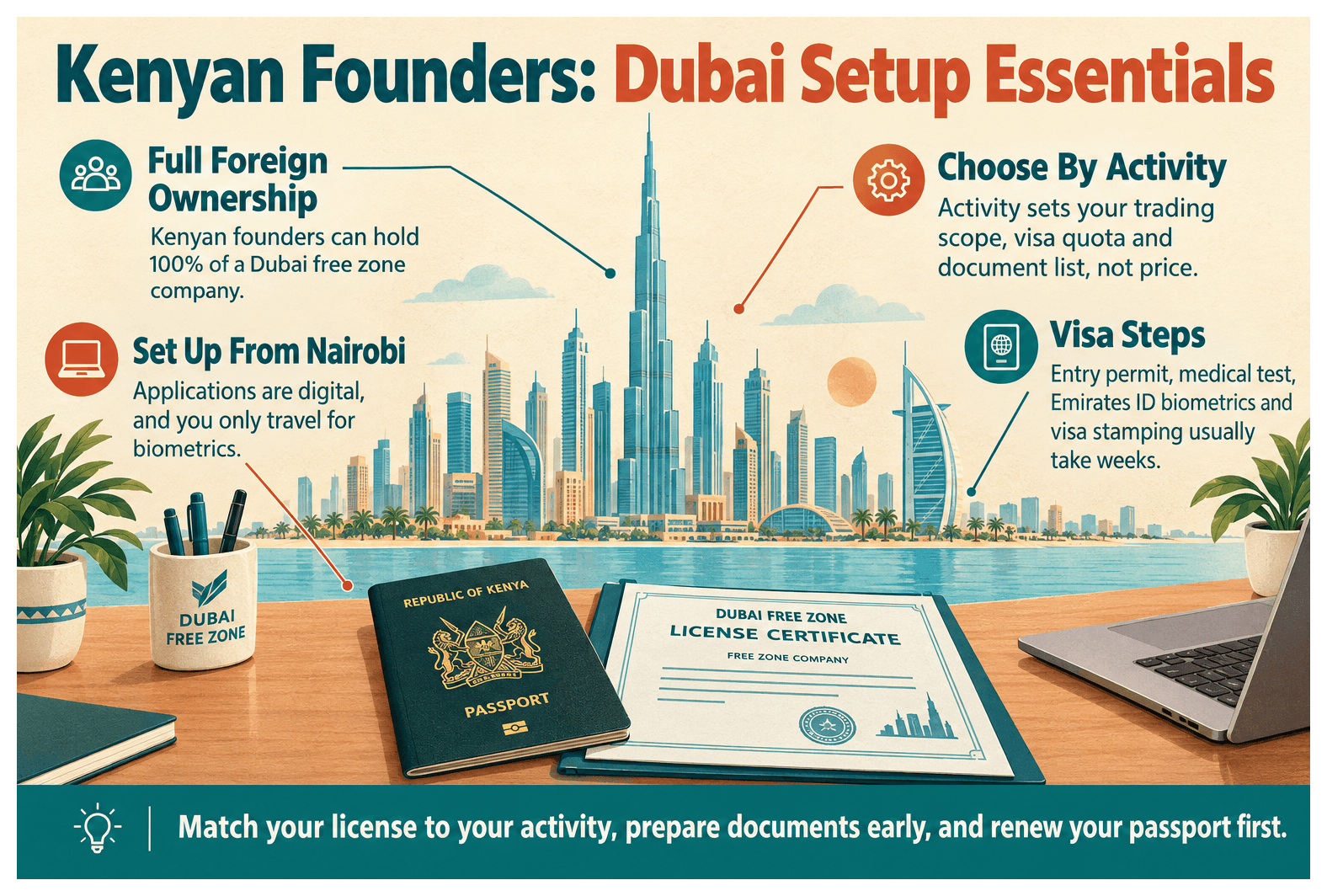
Kenyan founders can hold 100% of a Dubai free zone company under a trade, service or e-commerce license. Choose by activity, not price, because activity sets your trading scope, visa quota and document list.
Matching Your Business Activity to a License Type
A Kenyan tea exporter would pick a trading license covering import, export and re-export. Trading licenses at Dubai South Business Hub start from a base rate of AED 12,500. Check whether your activity needs external regulator approval, and read our guide on setting up a trading business.
Shareholding, Office Options and Visa Quotas
Foreign ownership is 100%.
A flexi-desk cuts early overheads.
Larger space raises your visa quota.
Two co-founders can start without a full office and upgrade when hiring begins.
Setting Up From Nairobi Without Flying In
Applications are digital. Kenyan documents may need notarisation and attestation. You only travel for biometrics. See setting up while living abroad.
Residency Visa Steps for Kenyan Shareholders
A Kenyan shareholder can apply for an investor or partner visa once the license issues. The process runs through GDRFA and ICP: entry permit, medical test, Emirates ID biometrics and visa stamping, usually within weeks.
How GDRFA and ICP Process Your Application
The free zone submits your file. ICP issues the Emirates ID. Visas typically last two years and renew. One founder received an entry permit by email, flew in, and finished medical and biometrics in a single trip.
Free Zone Setup Checklist for Kenyan Founders
Feature | Requirement | What to Prepare |
|---|---|---|
Business activity and license type | Activity code matching real trade | Activity list, any regulator approvals |
Valid Kenyan passport and photo | Sufficient passport validity | Passport copy, UAE-spec photo |
Residency visa and Emirates ID steps | Entry permit, medical, biometrics | Health insurance, one-trip booking |
Corporate tax and VAT registration | FTA registration | License, revenue forecast |
Corporate bank account documents | Due diligence file | Business plan, source of funds, contracts |
Documents Kenyan Applicants Should Prepare
Valid Kenyan passport.
Passport-size photo.
Proof of address.
Medical test and insurance.
Renew an expiring passport in Nairobi first.
Step-by-Step Guide to What Kenyan Founders Need to Know Before Setting Up in Dubai
The sequence is simple: define activity, pick the zone, choose the license, submit documents, receive the license, apply for visas, open the bank account. Following this order protects your timeline.
Step 1: Define Your Activity and Choose Your Structure
Confirm activity codes.
Name shareholders and managers.
Shortlist company names.
Step 2: Submit Documents and Receive Your License
Upload passports and forms, pay fees, and receive your digital license. Same-day registration is available at Dubai South Business Hub.
Step 3: Complete Visas, Emirates ID and Banking
Book medical and biometrics on one day. Bank onboarding commonly takes two to six weeks. Review business setup in a Dubai free zone before you start.
Tax, Compliance and Banking Rules to Plan For
UAE companies pay 9% corporate tax on profit above AED 375,000, and qualifying free zone income may be taxed at 0%. VAT is 5%. Kenyan founders register through the Federal Tax Authority.
Corporate Tax and VAT Basics
Register for corporate tax.
Test the 0% conditions and substance rules.
Register for VAT above AED 375,000.
Kenya-UAE Tax Residency and Reporting Considerations
Your Kenyan residency may interact with UAE income. Take advice on the double taxation arrangement and log days spent in each country.
Corporate Bank Account Expectations
Banks supervised by the Central Bank of the UAE ask for a business plan, source of funds and contracts. Submit invoices to evidence real trade.
Costs, Timelines and Common Mistakes to Avoid
What Kenyan founders need to know before setting up in Dubai includes budgeting for license, visa, medical, Emirates ID, office and renewals. Formation takes days to weeks, though banking runs longer.
Where Your Budget Actually Goes
License from AED 12,500 (base trading rate).
Visa, medical, insurance.
Desk and annual renewals.
Labour requirements if you hire.
Five Mistakes First-Time Founders Make
Wrong activity for actual trade.
Skipping record-keeping.
Assuming bank approval.
Missing renewal deadlines.
Ignoring document attestation.
More in common first-time founder mistakes.
Your Next Move
What Kenyan founders need to know before setting up in Dubai comes down to the right license, clear visa steps, tax planning and a realistic budget. Use the Dubai South Business Hub free cost calculator or speak with an advisor to map your license, visa and timeline.
References
Frequently Asked Questions