
Topic Summary
What Kuwaiti Founders Need to Know Before Setting Up in Dubai and Why It Matters
What Kuwaiti founders need to know before setting up in Dubai is the set of licensing, attestation, tax, visa and banking rules that apply when a Kuwaiti national forms a UAE company. Knowing them upfront prevents rejected documents, delayed accounts and unnecessary cost.
Regulatory Requirements Behind What Kuwaiti Founders Need to Know Before Setting Up in Dubai
Regulatory Requirements Behind What Kuwaiti Founders Need to Know Before Setting Up in Dubai
Tax Rules and Kuwait-UAE Agreements Founders Should Check
The UAE applies a 9% corporate tax and 5% VAT ( Federal Tax Authority, 2026). Kuwait and the UAE are both GCC members, so GCC common-market provisions and a bilateral double taxation agreement may apply. Confirm current treaty terms with the FTA and a tax adviser before structuring.
Step-by-Step Guide to Setting Up Your Dubai Company as a Kuwaiti National
Setting up takes six steps: pick your activity, choose the structure, submit documents, receive the license, apply for residency visas, and open a bank account. Remote formation is common, and sequence matters because visas and banking depend on the license.
Document Attestation From Kuwait to the UAE
Kuwaiti documents used in the UAE are typically attested by the relevant Kuwaiti authority, then the Kuwait Ministry of Foreign Affairs, then the UAE Embassy in Kuwait. Confirm which papers your license actually requires.
Residency Visa Rules for Kuwaiti Nationals
A Dubai South free zone license can support a residency visa package, processed through GDRFA ( General Directorate of Residency and Foreigners Affairs ) and ICP. Kuwaiti founders complete medical testing, Emirates ID biometrics. Quotas depend on office type.
Banking Considerations for Kuwaiti Founders
UAE banks run strict KYC and may review source of funds, business plan and shareholder profile. Kuwaiti founders should prepare a license, passport, proof of address, bank references and contracts. The Central Bank of the UAE regulates accounts, and approval can take several weeks.
Dubai issues more than 30,000 new business licenses a year (Dubai Chamber, 2024). Still, many Kuwait nationals lose weeks to attestation and banking errors. This guide covers what Kuwaiti founders need to know before setting up in Dubai, so you can plan your company and relocation in the right order.
What Kuwaiti Founders Need to Know Before Setting Up in Dubai and Why It Matters
What Kuwaiti founders need to know before setting up in Dubai is the set of licensing, attestation, tax, visa and banking rules that apply when a Kuwaiti national forms a UAE company. Knowing them upfront prevents rejected documents, delayed accounts and unnecessary cost.
Why Kuwaiti Founders Choose Dubai
Shared language, similar business culture and a short flight make Dubai an easy move. Picture a Kuwait City trading consultant opening a Dubai South entity to serve UAE and Saudi clients. A free zone allows full foreign ownership, so no local partner is needed.
Why a Free Zone Fits Most Kuwaiti Founders
Licenses start from AED 12,500 (Dubai South Business Hub, 2026).
A trade license comes with a residency visa package.
You can form the company before relocating.
Not sure where to begin? Start with our guide to set up a new business in Dubai.
Regulatory Requirements Behind What Kuwaiti Founders Need to Know Before Setting Up in Dubai
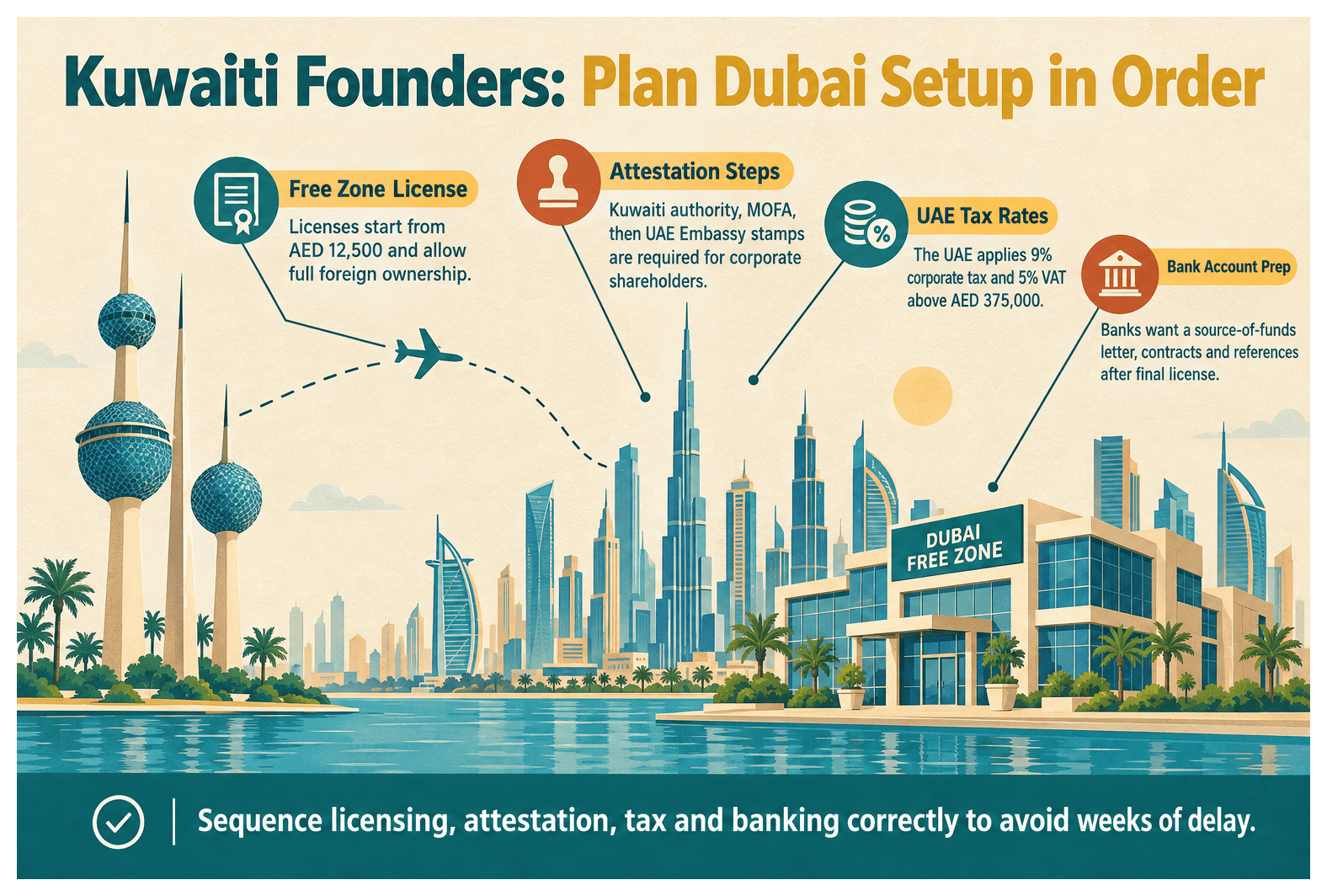
Kuwaiti founders must choose a licensed activity, a legal structure and a registered office, then hold a valid trade license from the free zone authority. The UAE Ministry of Economy sets the wider commercial framework, while the free zone issues the license and manages compliance.
Choosing Activity and Legal Structure
Match your activity to the license category first. A sole Kuwaiti owner running consulting would typically pick an FZE (Free Zone Establishment). Two or more shareholders form an FZ-LLC (Free Zone Limited Liability Company).
Office and Compliance Basics
A flexi-desk suits a remote-run trading firm.
Licenses renew every year.
Economic substance and UBO (ultimate beneficial owner) filings may apply.
A growing community of businesses operate in the Dubai South ecosystem (Dubai South Business Hub, 2026).
Founders from other markets face similar rules, as our guide for Egyptian founders shows.
Tax Rules and Kuwait-UAE Agreements Founders Should Check
The UAE applies a 9% corporate tax and 5% VAT (Federal Tax Authority, 2026). Kuwait and the UAE are both GCC members, so GCC common-market provisions and a bilateral double taxation agreement may apply. Confirm current treaty terms with the FTA and a tax adviser before structuring.
Corporate Tax and VAT Basics
The 9% rate applies to taxable income above AED 375,000.
Qualifying free zone persons can access a 0% rate on qualifying income only.
VAT registration becomes mandatory once turnover passes AED 375,000.
Setup Requirements for Kuwaiti Founders at a Glance
Feature | Requirement | What Kuwaiti Founders Need |
|---|---|---|
Trade license | Approved activity and legal structure | Passport copy, application, fees from AED 12,500 |
Document attestation | Required for corporate shareholders and family visas | Kuwaiti authority, MOFA, then UAE Embassy stamps |
Residency visa | Quota tied to office type | Medical test, biometrics, Emirates ID |
Corporate tax and VAT | 9% corporate tax, 5% VAT | FTA registration and records once thresholds apply |
Corporate bank account | Final license and KYC review | Source-of-funds letter, contracts, |
GCC Trade Provisions and Double Taxation Treaty
Say a Kuwaiti owner invoices Kuwait clients from Dubai. GCC trade rules and the double taxation agreement could affect where income is taxed. Verify treaty status with the FTA and Kuwaiti authorities, and check your own Kuwaiti tax residency and Zakat position. For a Gulf-selling comparison, see US founders selling into the Gulf from Dubai.
Step-by-Step Guide to Setting Up Your Dubai Company as a Kuwaiti National
Setting up takes six steps: pick your activity, choose the structure, submit documents, receive the license, apply for residency visas, and open a bank account. Remote formation is common, and sequence matters because visas and banking depend on the license.
Step 1: Select Activity and Structure
A Kuwaiti e-commerce founder would select a trading activity, then confirm it's permitted and pick the shareholder setup.
Step 2: Submit Documents and Receive the License
Passport copy and photo.
Civil ID where requested.
Online submission, no UAE visit needed.
Over 70% of applications come from founders who never visit during formation (Dubai South Business Hub, 2026). Pakistani founders follow the same route.
Step 3: Apply for Visas, Then Open the Bank Account
Your visa package follows the license. One trip covers biometrics. Timelines vary by activity, and the bank KYC pack comes last.
Document Attestation From Kuwait to the UAE
Kuwaiti documents used in the UAE are typically attested by the relevant Kuwaiti authority, then the Kuwait Ministry of Foreign Affairs, then the UAE Embassy in Kuwait. Confirm which papers your license actually requires.
Which Documents Need Attestation
Incorporation papers of a Kuwaiti holding company shareholder.
Powers of attorney.
Marriage and education certificates for family visas.
Individual-only founders often need fewer attested papers.
The Attestation Chain and Common Delays
Allow extra days for embassy processing. Arabic documents may need translation. One mismatched name spelling can force re-attestation, so check every stamp before submitting. Our Lebanese founders guide covers a similar chain.
Residency Visa Rules for Kuwaiti Nationals
A Dubai South free zone license can support a residency visa package, processed through GDRFA (General Directorate of Residency and Foreigners Affairs) and ICP. Kuwaiti founders complete medical testing, Emirates ID biometrics. Quotas depend on office type.
Founder and Family Visas
Founders hold an investor or partner visa.
Spouse and children follow by sponsorship after your Emirates ID arrives.
Medical, Biometrics and Emirates ID
Plan one relocation visit for the medical fitness test and biometrics. Visa stamping and ID delivery follow through ICP.
Banking Considerations for Kuwaiti Founders
UAE banks run strict KYC and may review source of funds, business plan and shareholder profile. Kuwaiti founders should prepare a license, passport, proof of address, bank references and contracts. The Central Bank of the UAE regulates accounts, and approval can take several weeks.
KYC and Source-of-Funds Preparation
Kuwaiti bank statements.
A source-of-wealth letter.
Client contracts supporting projected turnover.
Choice among 40+ licensed banks.
Personal Versus Corporate Accounts
Open the corporate account after the license is final. Residency helps with personal banking later. Paying Kuwait suppliers in KWD from your AED account works, but fees and minimum balances vary by bank.
Common Mistakes Kuwaiti Founders Can Avoid
Common mistakes include skipping attestation checks, picking the wrong license activity, opening a bank account before the license is final, and ignoring tax registration. Each costs weeks, so a pre-filing checklist saves time and fees.
Paperwork and Licensing Errors
Arabic-English name mismatches.
Activity not matching bank expectations.
Missing UBO details.
Next Move: Free Consultation
Ask for a pre-filing review before you submit. Dubai South Business Hub offers a free consultation with a tailored cost and timeline.
Final Steps for Kuwaiti Founders
What Kuwaiti founders need to know before setting up in Dubai comes down to the right license, correctly attested documents, clear tax registration, a sequenced visa process and a prepared banking file. Contact Dubai South Business Hub today for a free consultation to plan your company setup and relocation.
References
Frequently Asked Questions