
Topic Summary
What Is What Thai Founders Need to Know Before Setting Up in Dubai and Why It Matters
What Thai founders need to know before setting up in Dubai is the set of licensing, visa, attestation, tax and banking rules that apply to a Thai passport holder forming a UAE company. Knowing them upfront prevents rejected documents and delayed bank accounts.
Visa and Residency Rules Thai Nationals Must Plan For
Visa and Residency Rules Thai Nationals Must Plan For
Document Attestation From Bangkok to Dubai
Thai documents generally need certification by the Department of Consular Affairs, then legalization by the UAE Embassy in Bangkok. UAE Ministry of Foreign Affairs verification may follow. Confirm exact requirements with your advisor first.
Tax Obligations and the UAE-Thailand Double Tax Treaty
What Thai founders need to know before setting up in Dubai includes tax. The UAE applies 9% corporate tax above AED 375,000 and 5% VAT, and it has a tax treaty with Thailand. Qualifying free zone income may be taxed at 0%, but conditions apply.
Banking Considerations for Thai Founders in the UAE
UAE banks run strict due diligence. Thai founders should prepare a business plan, source of funds, trade license, residency documents and evidence of customers or suppliers. Reviews under Central Bank of the UAE rules can take several weeks.
Practical Steps to Set Up in Dubai as a Thai National
Thai nationals can set up in Dubai by defining the activity, attesting documents, applying for the license, then completing visa, bank and tax registration. Remote formation is common.
Common Mistakes Thai Founders Make and How to Avoid Them
Thai founders most often skip attestation checks, pick a license activity that doesn't match the plan, assume tax exemption, and underprepare for banks. Early planning saves weeks.
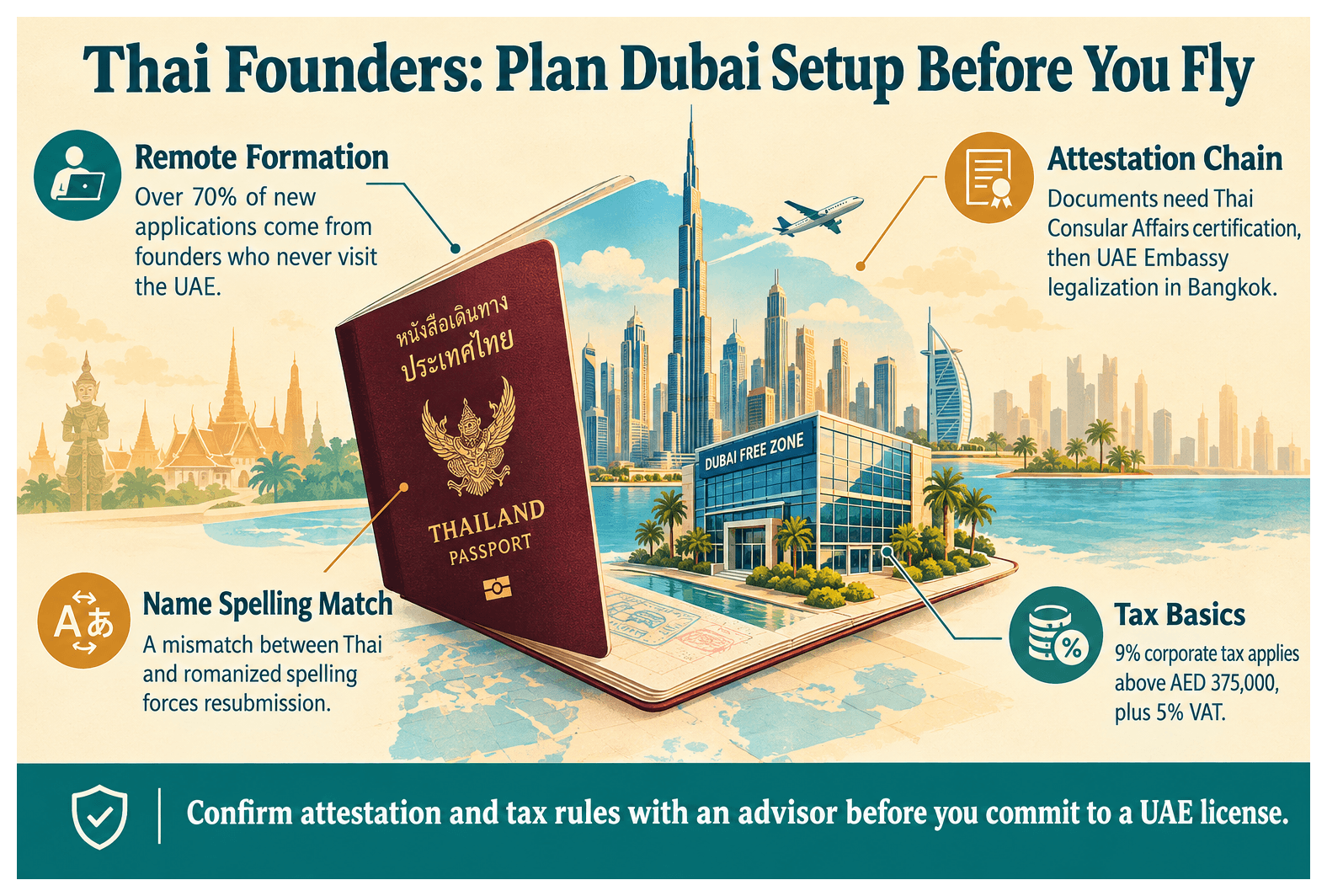
In 2026, over 70% of new applications at Dubai South Business Hub come from founders who never visit the UAE during formation [1]. A growing community of businesses operate through the free zone [1]. The UAE charges 9% corporate tax above AED 375,000 and 5% VAT [2]. This guide covers what Thai founders need to know before setting up in Dubai, so you can plan with confidence.
What Is What Thai Founders Need to Know Before Setting Up in Dubai and Why It Matters
What Thai founders need to know before setting up in Dubai is the set of licensing, visa, attestation, tax and banking rules that apply to a Thai passport holder forming a UAE company. Knowing them upfront prevents rejected documents and delayed bank accounts.
Why Thai Founders Are Choosing Dubai
Dubai connects trade and logistics across the Middle East, Africa and South Asia. Picture a Bangkok food exporter forming a free zone company to supply GCC retailers. Free zones allow full foreign ownership, so no local partner is needed.
What a Free Zone Company Gives You
Company formation and a trade license.
Residency visa packages tied to the license.
A base for GCC buyers.
Start with our guide to set up a new business in Dubai.
Visa and Residency Rules Thai Nationals Must Plan For
Thai nationals obtain UAE residency through a company license that includes a visa allocation. The process runs through the ICP (Federal Authority for Identity, Citizenship, Customs and Port Security) and GDRFA Dubai.
Entry Permit and Status Change
Confirm current entry rules on the ICP portal before you fly. A founder might land on a visit entry, then convert to investor residency inside the UAE. Check your passport validity too.
Medical Test, Biometrics and Emirates ID
Medical fitness test at an approved center.
Biometrics and Emirates ID issuance.
Visa stamping.
Once the license is active, this usually takes a few working days. Singaporean founders follow a similar sequence.
Document Attestation From Bangkok to Dubai
Thai documents generally need certification by the Department of Consular Affairs, then legalization by the UAE Embassy in Bangkok. UAE Ministry of Foreign Affairs verification may follow. Confirm exact requirements with your advisor first.
Which Documents Usually Need Attestation
Passport copies and photos.
Educational certificates for profession-linked licenses.
Thai Co., Ltd. certificate of incorporation and board resolution, if the company is your shareholder.
Certified English translations.
Avoiding Common Attestation Delays
Match name spellings to your passport exactly. A mismatch between Thai and romanized spelling forces resubmission. Book embassy appointments early and keep digital scans ready. Filipino founders face the same issue.
Tax Obligations and the UAE-Thailand Double Tax Treaty
What Thai founders need to know before setting up in Dubai includes tax. The UAE applies 9% corporate tax above AED 375,000 and 5% VAT, and it has a tax treaty with Thailand. Qualifying free zone income may be taxed at 0%, but conditions apply.
UAE Corporate Tax and VAT Basics
9% corporate tax above AED 375,000.
0% only for Qualifying Free Zone Person income.
VAT registration threshold: AED 375,000.
Registration through the Federal Tax Authority.
A Thai trading company with mixed income will pay 9% on the non-qualifying portion.
How the Double Tax Treaty Helps Thai Residents
The tax treaty aims to stop the same income being taxed twice in Thailand and the UAE. You may need a UAE tax residency certificate. If you split time between Chiang Mai and Dubai, review residency status in both countries. Check treaty text via the UAE Ministry of Finance and the Thai Revenue Department, and consult a tax adviser.
Banking Considerations for Thai Founders in the UAE
UAE banks run strict due diligence. Thai founders should prepare a business plan, source of funds, trade license, residency documents and evidence of customers or suppliers. Reviews under Central Bank of the UAE rules can take several weeks.
What UAE Banks Typically Ask For
License, passports, Emirates ID if available.
Expected transaction flows.
Thai bank statements and baht transfer records, within Bank of Thailand foreign exchange rules.
Thai Founder Setup Checklist: Requirement, Authority and Typical Action
Feature | Requirement | Authority and Action |
|---|---|---|
Trade license: Dubai South Business Hub | Defined activity, shareholder structure, visa count | Apply online, pay fees, receive license |
Residency visa: ICP and GDRFA | Valid passport, active license | Entry permit, medical, Emirates ID |
Document attestation: Thai Consular Affairs and UAE Embassy | Certified Thai documents with English translations | Certify in Bangkok, legalize at embassy |
Corporate tax and VAT: Federal Tax Authority | Registration after license issuance | Register and file on the FTA portal |
Bank account: UAE bank under Central Bank rules | Business plan, source of funds, license | Submit application, answer due diligence queries |
Keeping Your Bank Application Smooth
Align your license activity with your business plan, and keep figures consistent across documents. A Thai software founder's declined application was approved once client geography was clarified. Consider a personal account first. Korean applicants can see how to set up a company in Dubai South for comparison.
Practical Steps to Set Up in Dubai as a Thai National
Thai nationals can set up in Dubai by defining the activity, attesting documents, applying for the license, then completing visa, bank and tax registration. Remote formation is common.
Define your activity and license type. Match the activity to the trade license options and decide visa numbers. A Thai wellness brand might choose trading with two visas.
Prepare and attest documents. Gather passports, photos, proof of address and certified translations. Allow buffer for Bangkok embassy appointments.
Apply, pay and receive your license. Submit online, pay fees and arrange a flexi-desk or lease. You can complete this from Thailand.
Complete visa, bank and tax registration. Finish the entry permit, medical and Emirates ID, apply for the bank account, then register for corporate tax and VAT where required.
Compare with the Japanese founder guide.
Common Mistakes Thai Founders Make and How to Avoid Them
Thai founders most often skip attestation checks, pick a license activity that doesn't match the plan, assume tax exemption, and underprepare for banks. Early planning saves weeks.
Assuming Tax Exemption Applies Automatically
Free zone benefits are conditional. One founder's non-qualifying income triggered 9% corporate tax. Treaty relief needs proper residency evidence, and the structure is never simply tax free.
Mismatched Documents and Weak Banking Preparation
Name and date inconsistencies.
Vague business plans.
Thin source-of-funds evidence.
Your Next Move
What Thai founders need to know before setting up in Dubai comes down to four things: a fitting license and visa structure, correctly attested Thai documents, realistic tax planning, and a prepared bank application. Sequence them properly and formation is predictable. Contact Dubai South Business Hub for a free consultation to map your company formation, license and residency visa package.
References
Frequently Asked Questions