
Topic Summary
UBO Disclosure Is Non-Negotiable
Any individual holding 25% or more of company shares must personally sign the UBO declaration form. Having a company secretary or agent sign it instead can pause your application for weeks and reset your position in the compliance queue.
Free Zone and Mainland Companies Face Equal Scrutiny
UAE banks apply the same Central Bank KYC framework regardless of whether your startup is a free zone or mainland entity. Your legal structure does not reduce or simplify the documentation requirements.
Corporate Shareholders Require a Full Ownership Chain
If any shareholder is a corporate entity rather than an individual, banks will trace ownership through every layer until they identify the natural-person UBO. Every level of that chain must be documented with share certificates.
Your Trade License Must Match Your Invoicing Activity
Banks verify that the business activity listed on your trade license matches what you intend to invoice for. A mismatch between your license and your stated banking purpose is a common reason applications are returned.
Document Freshness Deadlines Can Catch You Off Guard
Passport notarisations, proof of address, and similar documents typically must be dated within 90 days of submission. Submitting an expired document forces a full restart of the compliance review process.
Tax Registration Penalties Add Up Fast
Late VAT registration and late corporate tax registration each carry a flat AED 10,000 penalty from the UAE Federal Tax Authority. Completing these registrations before or alongside your bank application avoids unnecessary costs.
A Complete First Submission Cuts Onboarding Time Significantly
Banks return incomplete files rather than follow up on individual missing items, and each return restarts your queue position. Submitting a fully prepared file from the outset can reduce account activation time from weeks to days.
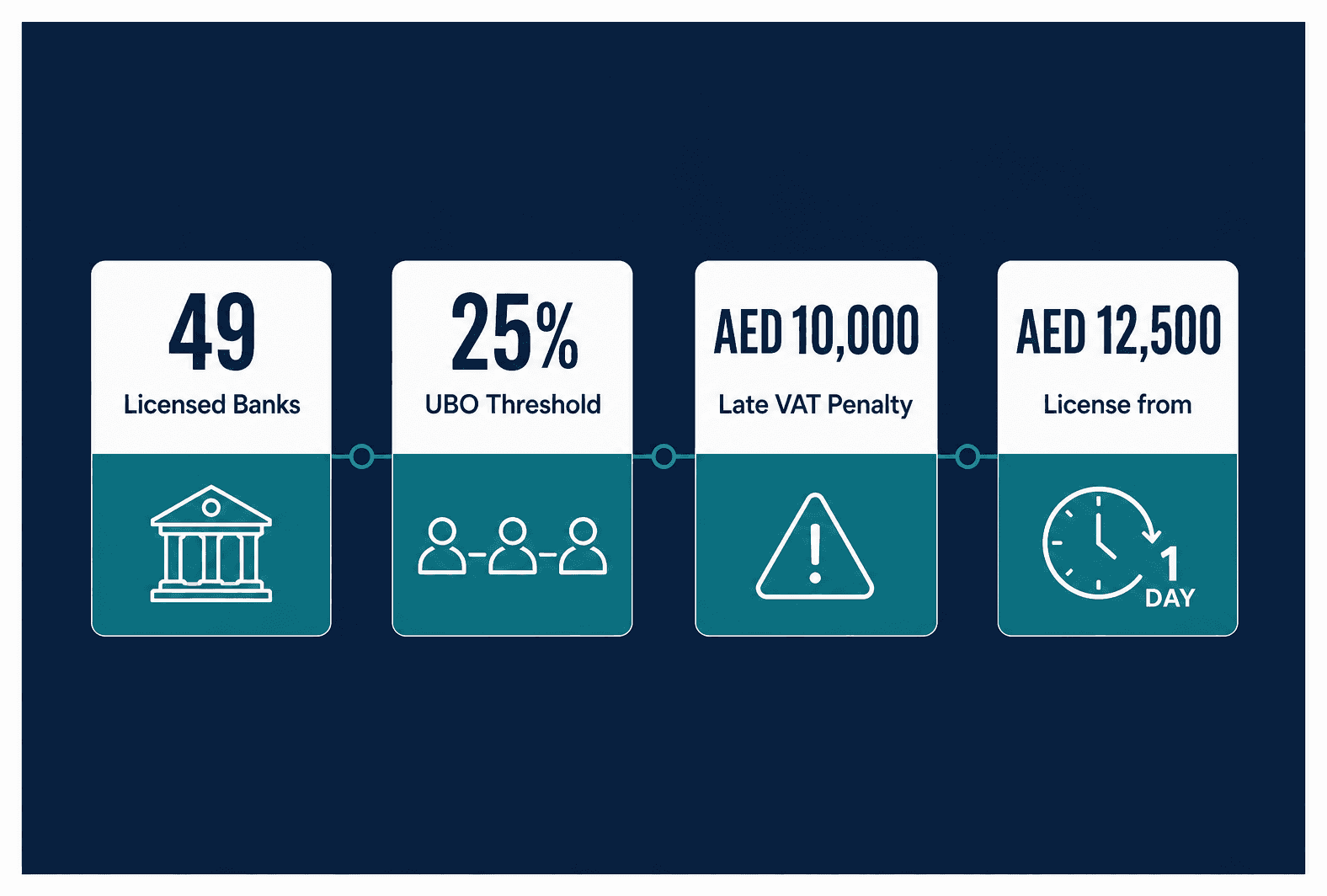
A significant share of new free zone company registrations in the UAE stall at the banking stage because founders submit incomplete or mismatched documentation to their chosen bank. The UAE has 49 nationally licensed banks serving commercial clients (Central Bank of the UAE, 2025). Every one of them applies the same Know Your Customer (KYC) framework mandated by the Central Bank of the UAE. The UBO (ultimate beneficial owner) disclosure threshold sits at 25% shareholding or more. A late VAT registration costs AED 10,000 in penalties. A late corporate tax registration also costs AED 10,000 as a one-time flat penalty (UAE Federal Tax Authority, 2024). And at Dubai South Business Hub Free Zone (DSBH), launched in September 2025, a trade license is issued in one day from AED 12,500.
This article walks you through exactly what UAE banks look for in a startup application, covering the requirements, the costs you should budget for, and the step-by-step process to open a business account after you set up a company in Dubai.
What UAE Banks Look for in a Startup Application and Why It Matters
UAE banks assess a startup application by verifying the legal structure, source of funds, business activity, and beneficial ownership of the company. They apply Central Bank of the UAE anti-money-laundering rules to every new account. A well-prepared file reduces onboarding time from weeks to days.
The Regulatory Framework Banks Must Follow
The Central Bank of the UAE issues binding AML/CFT (anti-money-laundering and counter-financing of terrorism) guidelines that every licensed bank must follow. There's no grey area here. Relationship managers cannot skip a documentation step even if they wanted to, non-compliance by the bank carries direct regulatory penalties.
Here's what that means in practice for your startup application:
Every bank must verify the UBO of a company before activating an account.
The UBO disclosure threshold is 25% shareholding or more.
Free zone companies and mainland companies face identical KYC scrutiny, your structure does not reduce the requirements.
If the company has a corporate shareholder, the bank traces the chain to the natural-person UBO at every level.
A sole-founder tech startup registered at a Dubai free zone in late 2025 had its account application paused for three weeks because the UBO declaration form was signed by the company secretary rather than the founder personally. That single error reset the compliance queue. The rule is clear: the UBO signs the UBO form.
UAE Startup Bank Application: Document Checklist at a Glance
Document Type | Notes |
|---|---|
Trade license (certified copy) | Must list the business activity you intend to invoice for. At DSBH, up to five activities are included in the license fee. |
Certificate of incorporation | Issued by the free zone authority (e.g., DSBH) or DET for mainland entities. Confirms legal existence of the company. |
Memorandum and articles of association | Must be signed and stamped. Banks use this to verify ownership structure and decision-making authority. |
Share certificates for all shareholders | Confirms ownership percentages. Required for every shareholder, including corporate shareholders (full chain to natural person). |
Passport copies (notarised) for all shareholders and directors | Most banks require notarised copies. UAE residents should also provide Emirates ID. Certification must typically be within 90 days. |
UBO declaration form | Required for every individual holding 25% or more of shares. Must be signed by the UBO personally, not by a company secretary or agent. |
Proof of residential address (within 90 days) | Utility bill or tenancy contract. UAE residents with Emirates ID linked to a DSBH license may satisfy this requirement with the Emirates ID address at most banks. |
Why Getting This Right Saves You Weeks
Banks return incomplete files rather than chase individual items. Each return restarts your position in the compliance queue. A complete first submission typically results in account activation within 5 to 15 business days, depending on the bank and account tier.
Delays cost you more than time. Your first invoice date slips. Staff salary processing is pushed back. Your VAT registration timeline moves, and a late registration carries a AED 10,000 penalty. The same penalty applies to late corporate tax registration.
DSBH issues licenses in one day, which means your banking file can be ready to submit on day two of operations. Founders who pre-assemble their corporate documents, business plan, and source-of-funds letter before the license is printed open accounts consistently faster than those who gather documents reactively. That's not a small advantage, it can mean the difference between invoicing in week two versus week six.
You can explore how bank account opening in UAE works through the DSBH Beyond Hub support network before you even receive your license.
Key Documents UAE Banks Require from Startups
UAE banks require a valid trade license, certificate of incorporation, memorandum of association, passport copies of all shareholders, a UBO declaration, proof of registered address, and a business plan with projected turnover. Some banks also request six months of personal bank statements from the primary shareholder.
Corporate Formation Documents
Trade license (original or certified copy) showing the business activity you intend to invoice for.
Certificate of incorporation issued by the free zone authority or DET.
Memorandum and articles of association, signed and stamped.
Share certificates confirming ownership percentages for every shareholder.
If a shareholder is a corporate entity, the bank requires the full corporate chain up to the natural-person UBO.
A DSBH license listing 'ICT Consultancy' as the primary activity must match the services described in the business plan you submit to the bank. Inconsistencies trigger a compliance review that can add weeks to the process. DSBH licenses can cover up to five business activities in Dubai; each additional activity beyond five costs AED 2,000.
Shareholder and Beneficial Owner Identification
Passport copies for all shareholders and directors, most banks require a notarised copy.
UAE Emirates ID if the shareholder is already a UAE resident.
UBO declaration form completed by every individual holding 25% or more of shares.
Proof of residential address, typically a utility bill or tenancy contract dated within 90 days.
Some banks request a reference letter from the applicant's existing bank, particularly for non-resident founders.
A founder holding a UAE residency visa tied to a DSBH license satisfies the address requirement with the Emirates ID address at most banks, no separate utility bill needed. The first-year cost for a sole founder with one visa starts from AED 18,350 at DSBH. Visas are always an additional cost, separate from the license fee.
Business Plan and Source of Funds
Your business plan should run two to four pages. Cover the nature of the business, target markets, anticipated revenue streams, and projected monthly turnover. Keep projections credible, a first-time founder projecting AED 2 million in monthly revenue from a single-person consultancy in month one is likely to face additional scrutiny. Align projections with realistic ramp-up timelines.
Your source-of-funds letter explains the origin of the initial capital being deposited. Salary history, prior business sale proceeds, and inheritance each require different supporting evidence. Banks pay close attention to plausibility relative to the company's registered activity and your professional background.
DSBH requires zero paid-up share capital, so there's no mandatory capital injection before banking. That said, banks may ask for a minimum opening deposit, confirm this directly with your chosen bank during your pre-application call.
Costs to Budget for When Opening a UAE Startup Bank Account
Opening a UAE business bank account typically involves a minimum average balance requirement ranging from AED 25,000 to AED 100,000 depending on the bank, plus account maintenance fees if the balance falls below the threshold. The trade license itself starts from AED 12,500 at Dubai South Business Hub Free Zone.
License and Setup Costs Before Banking
DSBH trade license from AED 12,500.
First-year total for a sole founder with one visa from AED 18,350, visas are always an additional cost.
Each business activity beyond the first five costs AED 2,000.
Zero paid-up share capital required, no capital lock-up before banking.
A solo founder setting up an ICT consultancy at DSBH in 2026 pays from AED 18,350 all-in for year one before approaching a bank. No additional capital injection is mandated by the free zone. You can use the business setup cost calculator to model your specific structure before committing.
Bank-Side Fees and Balance Requirements
Minimum average balance: typically AED 25,000 to AED 100,000 for business accounts, varying by bank and account tier. (UNVERIFIED: confirm before publishing.)
Monthly maintenance fees: apply when balance drops below threshold, these can range from AED 100 to AED 500 per month. (UNVERIFIED: confirm before publishing.)
One-time account opening fee: some banks charge this, confirm during your pre-application call.
International wire transfer fees and currency conversion margins are separate ongoing costs.
A startup with predictable monthly inflows can negotiate a lower average balance tier at some banks by demonstrating projected transaction volume during the application interview. Worth flagging: VAT registration becomes mandatory once your annual turnover crosses AED 375,000, and a late registration carries a AED 10,000 penalty (UAE Federal Tax Authority, 2024).
Step-by-Step Guide to Applying for a UAE Business Bank Account
To apply for a UAE business bank account as a startup, form your company and collect all corporate documents, prepare your KYC file, shortlist banks that serve your activity and transaction profile, submit a complete application, attend the compliance interview, and await account activation. Preparation before license issuance cuts weeks off the process.
Steps to Open Your Business Bank Account
Register your company and obtain your trade license. DSBH issues licenses in one day. Your banking file can be ready to submit on day two.
Compile your corporate document pack. Trade license, certificate of incorporation, MOA, and share certificates for all shareholders.
Prepare your KYC pack. Passport copies (notarised), Emirates ID if you're a UAE resident, UBO declarations signed by the UBO personally, and proof of residential address within 90 days.
Write a concise business plan. Two to four pages, with realistic turnover projections matched to your license activity.
Draft your source-of-funds letter. Include supporting evidence for your opening deposit, salary slips, prior sale proceeds, or equivalent documentation.
Shortlist banks and call relationship managers. Confirm the exact checklist before submitting. Different banks have different minimum balance tiers and account types.
Submit a complete application in one go. A trading company founder shortlisted two banks, called both relationship managers on day two after license issuance, confirmed the checklist, and submitted a complete file on day four, the account was active within ten business days.
Attend the compliance interview. In-person or video, with the primary signatory. Be ready to explain your business model clearly.
The Compliance Interview: What to Expect
Most UAE banks require an in-person or video interview with the primary signatory before activating a new business account. Expect questions about your business model, your customers' geographies, your suppliers, and how you plan to use the account day-to-day.
Your answers must be consistent with your business plan and the activity listed on your trade license. A founder whose license listed 'General Trading' but who described a software subscription model in the interview was asked to amend the license activity before the bank would proceed. That amendment cost time and an additional AED 2,000 for the activity addition, avoidable with upfront planning.
What does a bank ask in a startup compliance interview?
Banks typically ask about your revenue model, your primary customer geographies, your supplier relationships, and how you intend to use the account (payments to staff, suppliers, or international transfers). Answers must align precisely with the business activity on your trade license and the projections in your business plan.
Common Reasons UAE Banks Decline Startup Applications
UAE banks most commonly decline startup applications due to mismatched business activity and transaction descriptions, incomplete UBO disclosure, implausible revenue projections, unclear source of funds, or a business model that does not align with the bank's internal risk appetite for certain industries or geographies.
Documentation and Compliance Gaps
Missing or unsigned UBO declaration, the single most common technical rejection.
Expired certified document copies, most banks require certification within 90 days of submission. (UNVERIFIED: confirm before publishing.)
Address mismatch, registered address on the license differs from the address provided in KYC forms.
Incomplete corporate shareholder chain, not documented to the natural-person UBO level.
A two-shareholder startup was rejected because one shareholder's passport copy was certified 120 days prior, just outside the bank's 90-day window. Recertification and resubmission added 18 days to the process. Check certification dates before you submit, not after.
Business Model and Risk Profile Issues
Certain business activities attract enhanced due diligence or outright restrictions at some banks. These include financial intermediation, crypto-adjacent services, and cross-border payment facilitation. If your activity falls into a regulated category, you'll need both a DSBH license and approval from the named regulator before any bank will open an account.
A fintech startup offering payment aggregation services needed both a DSBH license and a Central Bank of the UAE approval for the relevant regulated activity before any bank would proceed. DSBH licenses the activity; the named regulator approves it separately. Both are required.
Operating in high-risk jurisdictions as your primary market also raises flags during the compliance interview. And a business plan with no clear customer acquisition strategy, or with margin assumptions that don't match the industry, signals a poorly prepared application to the compliance team.
How Your License Structure Affects What Banks Look for in a Startup
Your license type and free zone authority directly shape a bank's assessment. A free zone license from an authority like Dubai South Business Hub Free Zone is evaluated on its regulatory standing, the clarity of its activity list, and whether the founding structure matches the bank's onboarding criteria for free zone entities.
Free Zone vs. Mainland License: What the Bank Sees
Both free zone and mainland licenses are accepted by UAE banks. 100% foreign ownership is available on both structures, this is unrelated to designated-zone status. Banks assess the free zone authority's regulatory standing and whether the license is current and in good standing.
One distinction worth flagging: free zone goods operate under duty-suspension, not duty-exemption. DSBH is not a designated zone, so it carries no designated-zone customs or VAT benefits. A trading startup that accurately described its free zone goods as duty-suspended (not duty-free) avoided a compliance flag during the bank's sanctions and customs screening step. Be precise when describing your supply chain to the bank.
Matching Your Activity List to Your Banking Needs
Banks cross-reference your license activity against anticipated transaction types.
A mismatch triggers enhanced review, sometimes an outright pause.
Add any activity you plan to invoice for before submitting your banking application.
At DSBH, the first five activities are included in the license fee; each additional activity costs AED 2,000.
References
Frequently Asked Questions