
Topic Summary
What Is What Ugandan Founders Need to Know Before Setting Up in Dubai and Why It Matters
What Ugandan founders need to know before setting up in Dubai is the set of legal, visa, banking and tax requirements that decide whether a company launches smoothly. It covers license choice, document attestation, residency and compliance.
Choosing a Free Zone License as a Ugandan Founder
Choosing a Free Zone License as a Ugandan Founder
Step-by-Step Guide to What Ugandan Founders Need to Know Before Setting Up in Dubai
Setting up takes six stages: define your activity, select a package, submit documents, sign the agreement, receive the license, then apply for residency and banking.
Residency Visa Rules Every Ugandan Founder Should Understand
A Ugandan founder with a licensed company applies for a residency visa through GDRFA and ICP . Steps include entry permit, status change, medical test and Emirates ID.
Tax, Compliance and Banking Obligations After Incorporation
After incorporation, you must register for corporate tax with the Federal Tax Authority , register for VAT above the threshold, renew annually and keep books.
Common Mistakes Ugandan Founders Make and How to Avoid Them
Ugandan founders most often lose time through the wrong activity, incomplete documents, underestimated bank checks and ignored tax registration.
Your Next Step
What Ugandan Founders Need to Know Before Setting Up in Dubai comes down to a matched license, complete documents, clear visa and tax awareness, and a bank-ready story. Use the Dubai South Business Hub Free Zone cost calculator, then speak with a setup consultant.
In 2026, more than 70% of new free zone applications at Dubai South Business Hub Free Zone come from founders who never visit the UAE during formation. This guide covers What Ugandan Founders Need to Know Before Setting Up in Dubai, so you can prepare once and avoid costly resubmissions.
What Is What Ugandan Founders Need to Know Before Setting Up in Dubai and Why It Matters
What Ugandan founders need to know before setting up in Dubai is the set of legal, visa, banking and tax requirements that decide whether a company launches smoothly. It covers license choice, document attestation, residency and compliance.
Why Preparation Matters for Ugandan Applicants
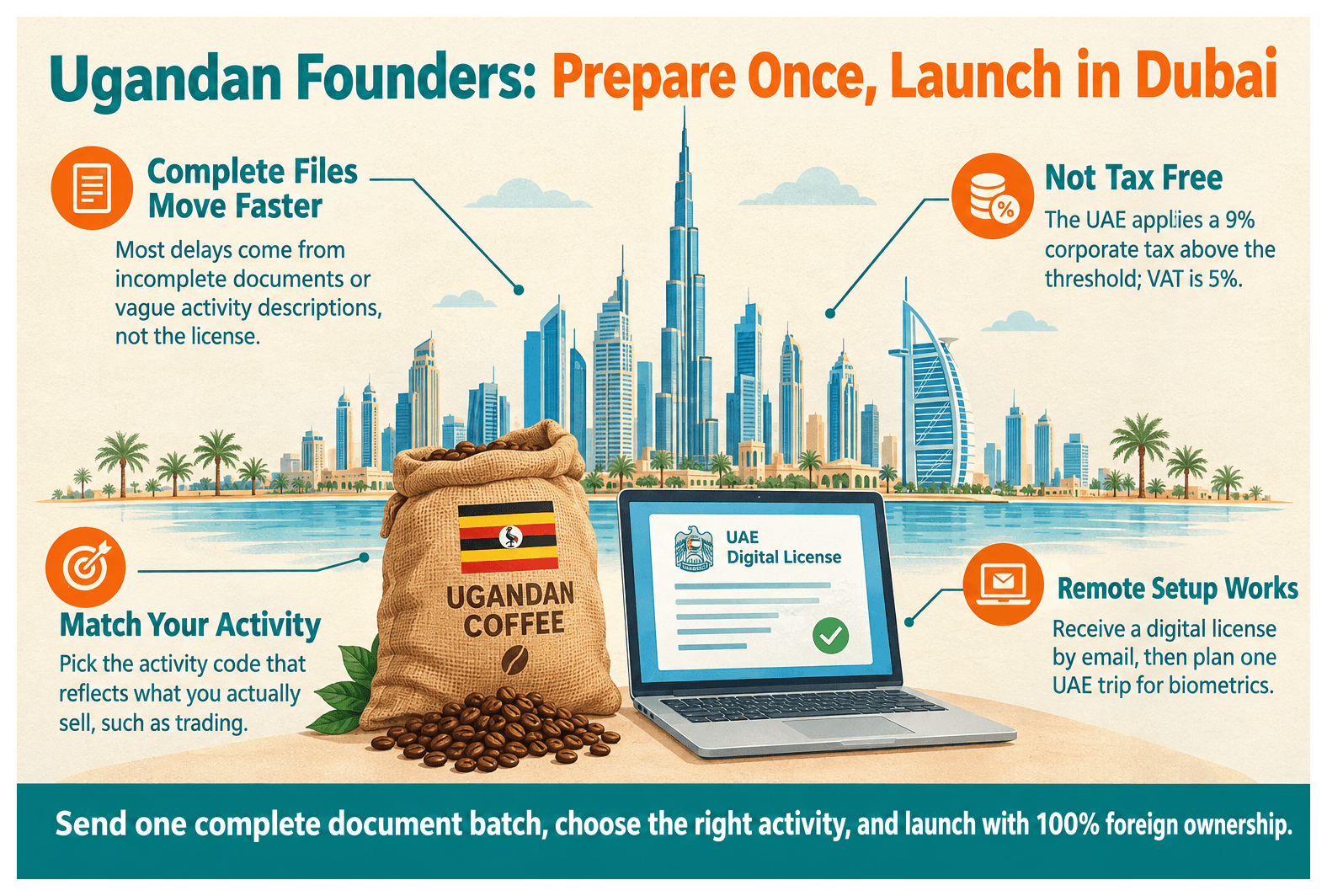
Compliance checks can be thorough, so complete files move faster. Most delays come from incomplete documents or vague activity descriptions, not the license itself. A Kampala consultant who sends passport, proof of address and a clear activity description in one batch is licensed faster than one who sends three rounds.
What a Free Zone Company Is and Is Not
A free zone company is a UAE legal entity licensed by its zone authority, with 100% foreign ownership. It isn't tax free. The UAE applies a 9% corporate tax above the threshold (Ministry of Finance, 2023). Mainland suits businesses trading directly with the local market; free zone suits streamlined setup. Read the Dubai free zone business setup guide for the basics.
Choosing a Free Zone License as a Ugandan Founder
A Ugandan founder should match business activity, visa needs and trading model to the zone's permitted activities. Dubai South Business Hub Free Zone offers trade licenses with 100% foreign ownership and visa packages tied to the license.
Matching Your Business Activity to the License
Pick the activity code that reflects what you actually sell.
Trading, consulting and e-commerce need different documents.
Regulated activities need extra approvals.
Picture a Ugandan coffee exporter choosing a trading license, not a consultancy one. That choice avoids banking and renewal problems later. See the trading, importing and exporting options.
Key Requirements for Ugandan Founders at a Glance
Feature | Requirement | Authority and Detail |
|---|---|---|
Trade license and activity approval | Passport, photo, proof of address, activity description | Free zone authority; extra approval for regulated activities |
Residency visa and Emirates ID | Entry permit, medical test, biometrics | GDRFA and ICP; investor visas typically two to three years |
Employee visa and labour rules | Visa allocation within the license package | MOHRE labour rules apply |
Corporate tax and VAT registration | Corporate tax registration; VAT above turnover threshold | Federal Tax Authority; 9% corporate tax, 5% VAT |
Corporate bank account opening | KYC pack, source of funds, contracts | Banks regulated by the Central Bank of the UAE |
Sole Shareholder or Multiple Partners
Decide ownership before applying, because later changes add amendment work. Two Ugandan co-founders splitting equity 60/40 must also decide who relocates, since visa allocation follows the package.
Setting Up Remotely From Uganda
An Entebbe founder can receive a digital license by email before landing in Dubai. Same-day digital registration is possible when documents are complete. Plan one UAE trip for biometrics. The guide on setting up while living abroad explains more.
Step-by-Step Guide to What Ugandan Founders Need to Know Before Setting Up in Dubai
Setting up takes six stages: define your activity, select a package, submit documents, sign the agreement, receive the license, then apply for residency and banking.
Define your activity. Write a one-paragraph description and choose the visa allocation.
Submit and sign. Upload documents from Kampala, review the agreement, e-sign and pay.
Residency and bank. Complete the entry permit, medical test and Emirates ID, then prepare your KYC pack.
Price your package with the official cost calculator. First-timers should read business setup in Dubai for first-time founders.
Residency Visa Rules Every Ugandan Founder Should Understand
A Ugandan founder with a licensed company applies for a residency visa through GDRFA and ICP. Steps include entry permit, status change, medical test and Emirates ID.
Investor Visa Versus Employee Visas
Shareholder visas are tied to the license allocation. Employee visas follow MOHRE labour rules. Take the investor visa first, then add a sales hire later.
Medical, Emirates ID and Attestation
Medical and biometrics happen in the UAE.
Some documents may need attestation.
Keep passport validity above six months.
Tax, Compliance and Banking Obligations After Incorporation
After incorporation, you must register for corporate tax with the Federal Tax Authority, register for VAT above the threshold, renew annually and keep books.
Corporate Tax and VAT Registration
The standard rate is 9% above the threshold, with VAT at 5%. Qualifying free zone income may be treated differently. Register within the deadline to avoid penalties.
Opening a UAE Corporate Bank Account
More than 40 licensed banks operate in the UAE (Central Bank of the UAE). Expect due diligence. Show a signed supply contract and Ugandan bank statements, and apply elsewhere if one bank declines.
Annual Renewal and Record-Keeping
Set a reminder 60 days before expiry. Missed renewals bring fines and can block visa services.
Common Mistakes Ugandan Founders Make and How to Avoid Them
Ugandan founders most often lose time through the wrong activity, incomplete documents, underestimated bank checks and ignored tax registration.
Vague activity descriptions.
Name spelling that differs between passport and utility bill.
Assuming the bank account opens with the license.
Mixing personal and business funds.
Budget six months of operating costs, since onboarding can take weeks. More in top challenges of opening a business.
Your Next Step
What Ugandan Founders Need to Know Before Setting Up in Dubai comes down to a matched license, complete documents, clear visa and tax awareness, and a bank-ready story. Use the Dubai South Business Hub Free Zone cost calculator, then speak with a setup consultant.
References
Frequently Asked Questions